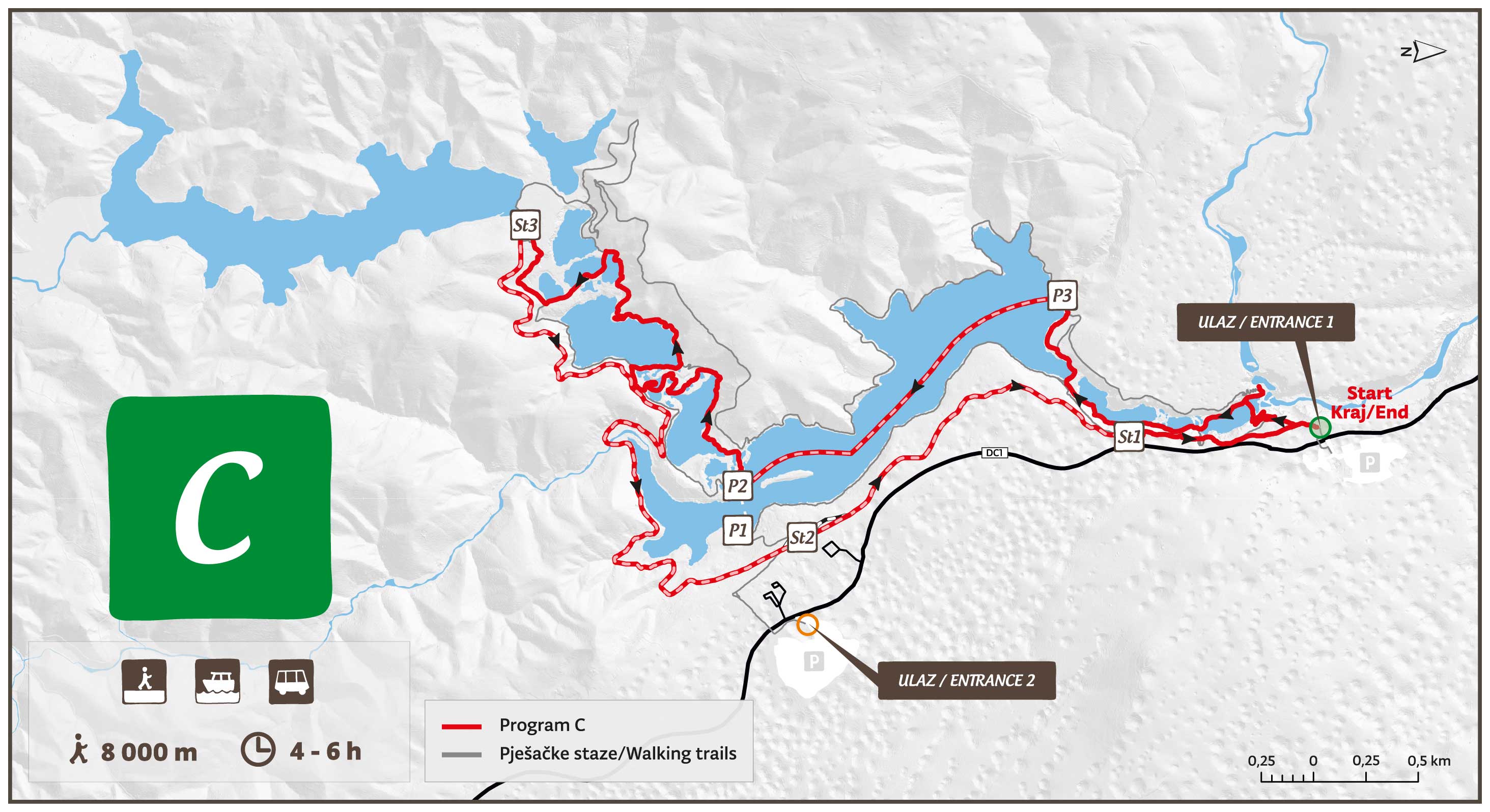
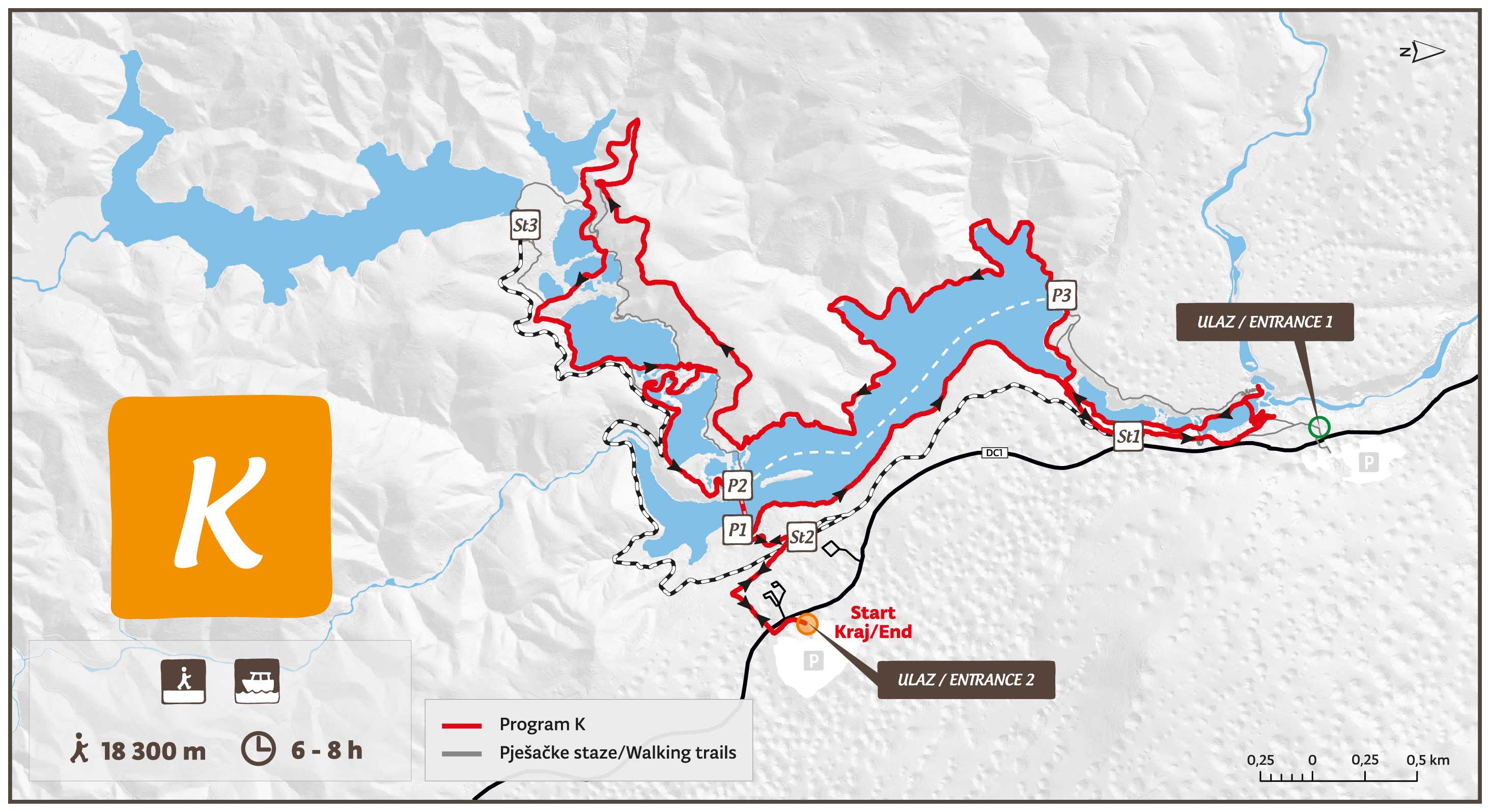
What we did- Program C or route C (5 miles or 8 Km) which is the most comprehensive route covering most the park, lower and upper lakes. Took us about 5 hours to finish
Where we stayed – Split. Did this as a day trip starting at 6 AM from Split and reaching the park around 9.30 AM. Went back to Split the same day which made for a long day.
Where we ate– Park food is expensive and not great. Decided to wait till we got out of the park to eat at restaurant Degenija which has amazing food. If you want to stay close to the park, the hotel might be a great option.
Plitvice lakes has been on my bucket list for few years and when we started planning our Balkan trip, this national park was the main focal point around which entire itinerary was built. Plitvice lakes is Croatia’s oldest and largest national park is renowned for its pristine natural beauty. We visited Plitvice as a day trip from Split but if I had to redo, I would stay close to Plitvice lakes overnight and do it as 2-day trip to be able to do lower lakes one day and upper lake next day and take my time photographing this amazing place.
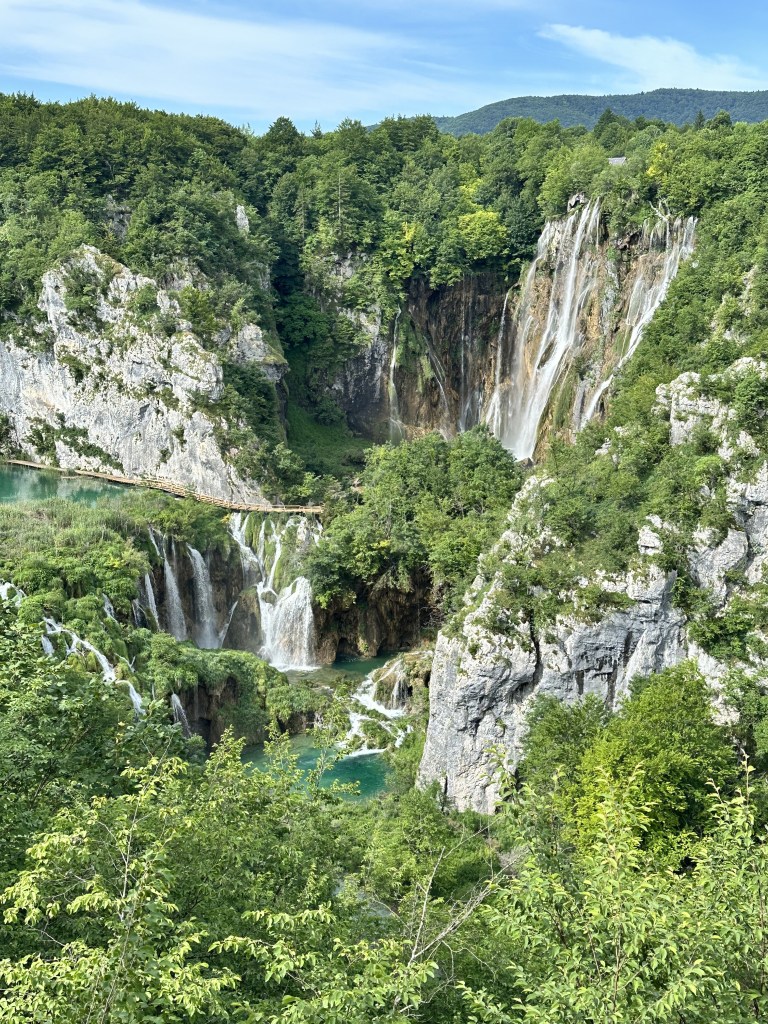
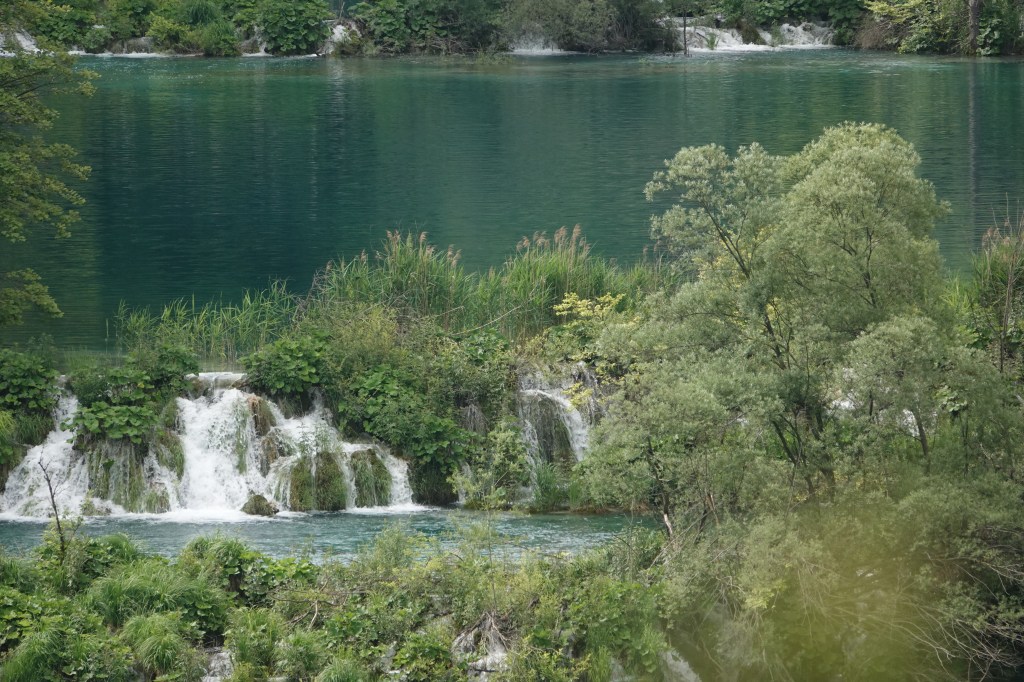
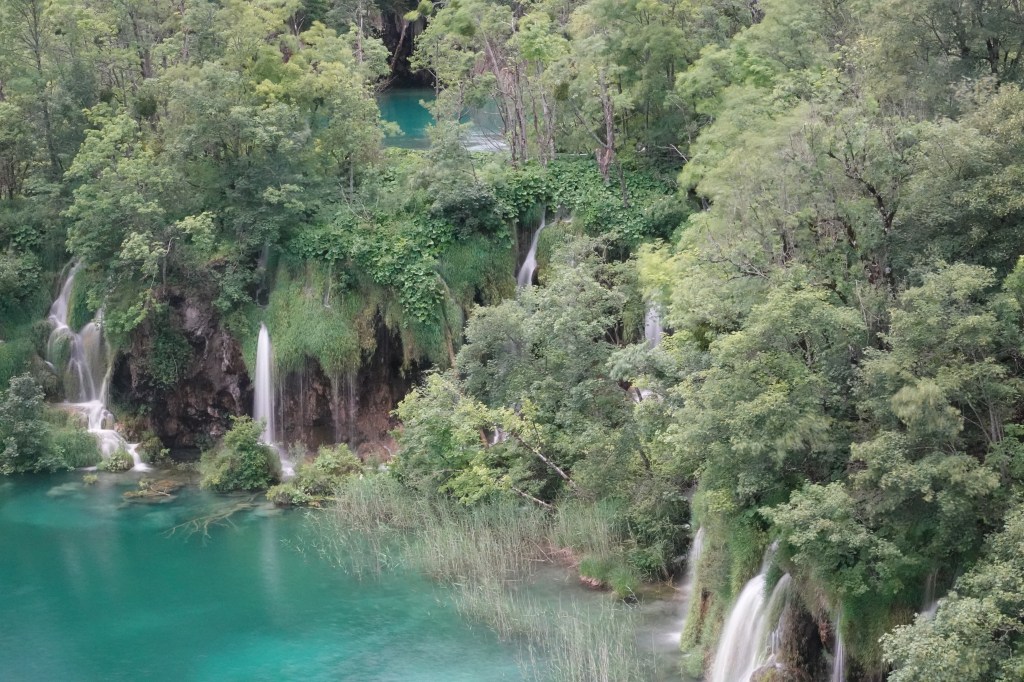
Plitvice Lakes National Park features 16 emerald, teal, and blue colored lakes that are connected by over 90 cascades and waterfalls, divided into the Upper Lakes and the Lower Lakes. The Upper Lakes consist of twelve lakes formed on dolomite rock, while the four Lower Lakes are situated in limestone, carved into a canyon with dramatic cliffs.
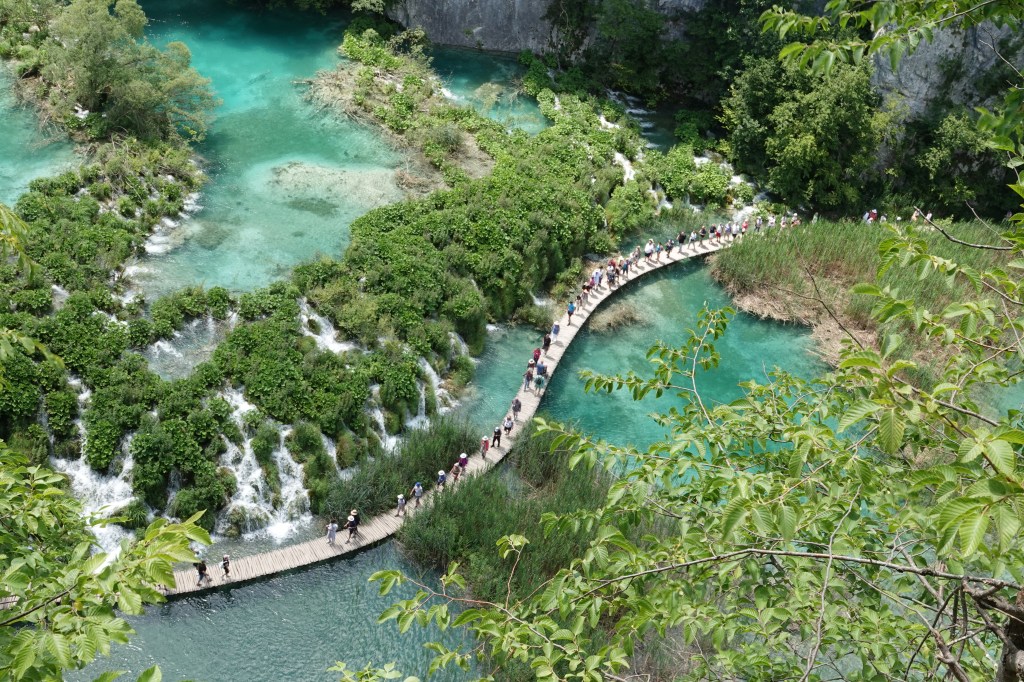
It is very easy to walk around the park with its wooden footbridges and pathways snaking over the lakes and around their shores providing trails for visitors to explore and take in the breathtaking views. You can also take electric boats across the lower lake and a “panoramic train”- a long bus to cover parts of the park. This is not a difficult hike, and we did the program C in about 5 hours with lots of stopping take photos.
Plitvice Lakes National Park is located in central Croatia, near the border with Bosnia and Herzegovina. It’s about 2 hours south of Zagreb and 1.5 hours north of Zadar.
How to Visit:
By Car: You can drive to the park from Zagreb, Zadar, or Split via the E65, E71, and D1 highways. The park has two main entrances: Entrance 1 (North) near the Lower Lakes and Entrance 2 (South) near the Upper Lakes.
Distance from Zadar Airport: 120 km. Travel time: About 1.5 hours
Distance from Zagreb Airport: 140 km. Travel time: About 2 hours
Distance from Split Airport: 230 km. Travel time: 3 to 3.5 hours
Parking facilities: There are 3 visitor parking areas. Parking area P1 is located near Entrance 1 while P2 and P3 are located near Entrance 2.
By Bus: There are intercity buses from Zagreb, Zadar, and Split that drop you off near the entrances. Booking tickets online in advance can help you skip the queue.
Travel Time:
Zagreb to Plitvice Lakes: Between 1 hr 50 minutes to 2 hrs 40 minutes.
Zadar to Plitvice Lakes: Between 1 hr 45 minutes to 2 hrs 40 minutes.
Split to Plitvice Lakes: Between 3 hrs 30 minutes to 5 hrs 50 minutes.
The journey times from these cities depend upon travel routes and any stops along the way.
Tickets and Timing
You can buy tickets from here and it is good to book tickets ahead of time especially during peak season.
The national park is open 365 days a year, though the hours the park is open to the public varies depending on the season. During winter, most hospitality facilities are closed to visitors, and accommodation is available only in Hotel Jezero. Check national park website for current information. During summer, the park is open from 7AM while winter hours vary.
Choosing the right path
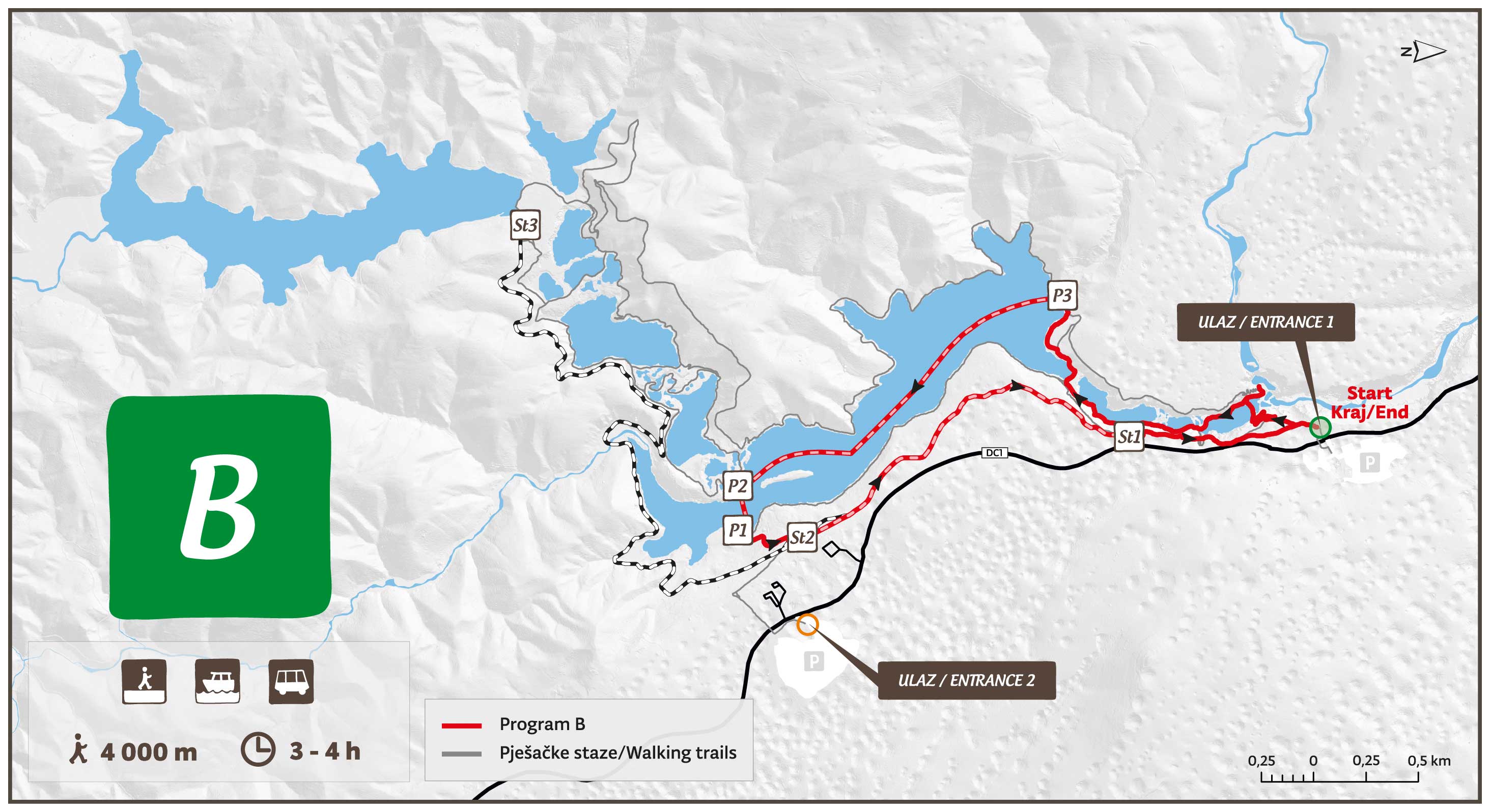
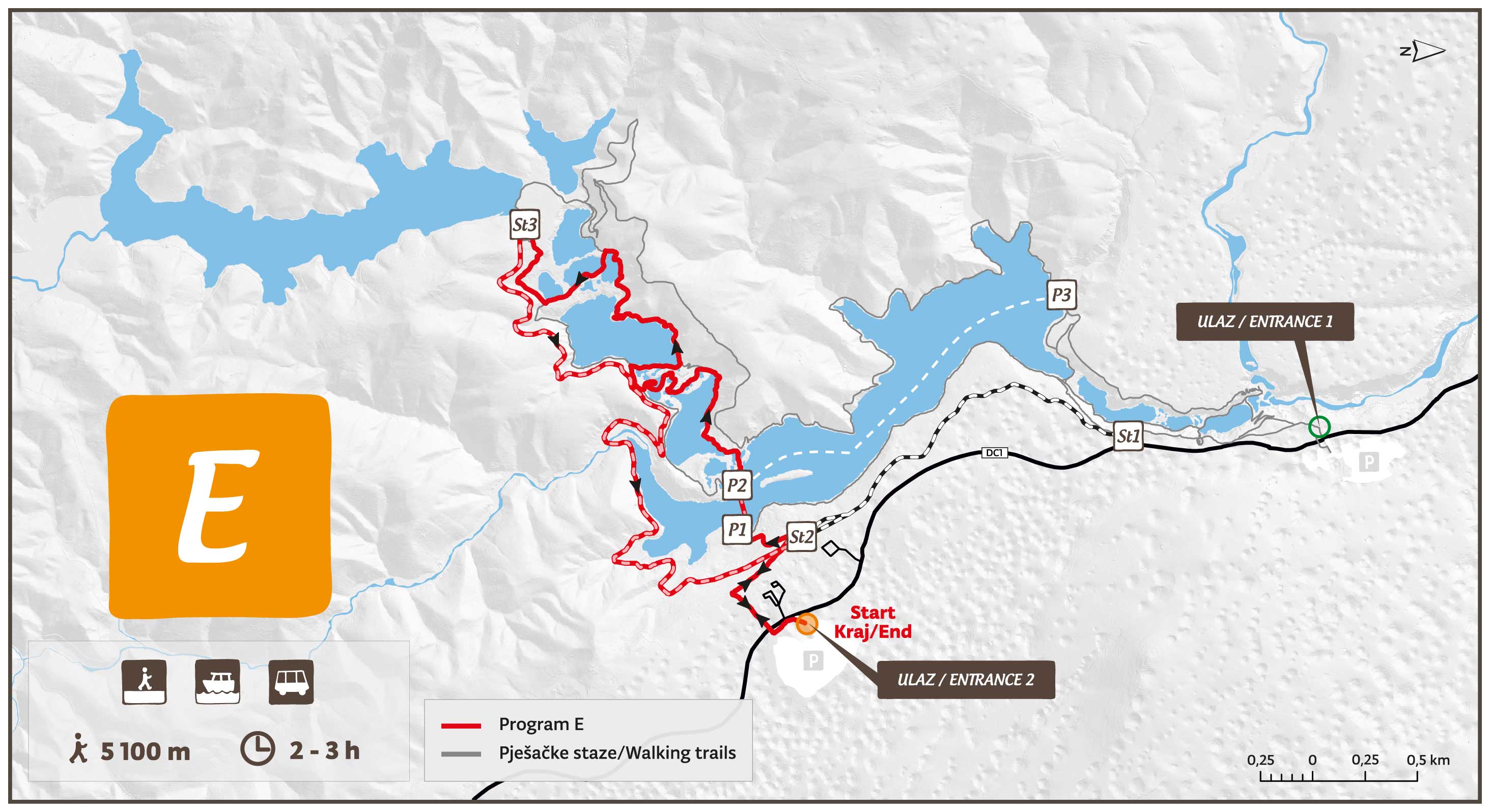
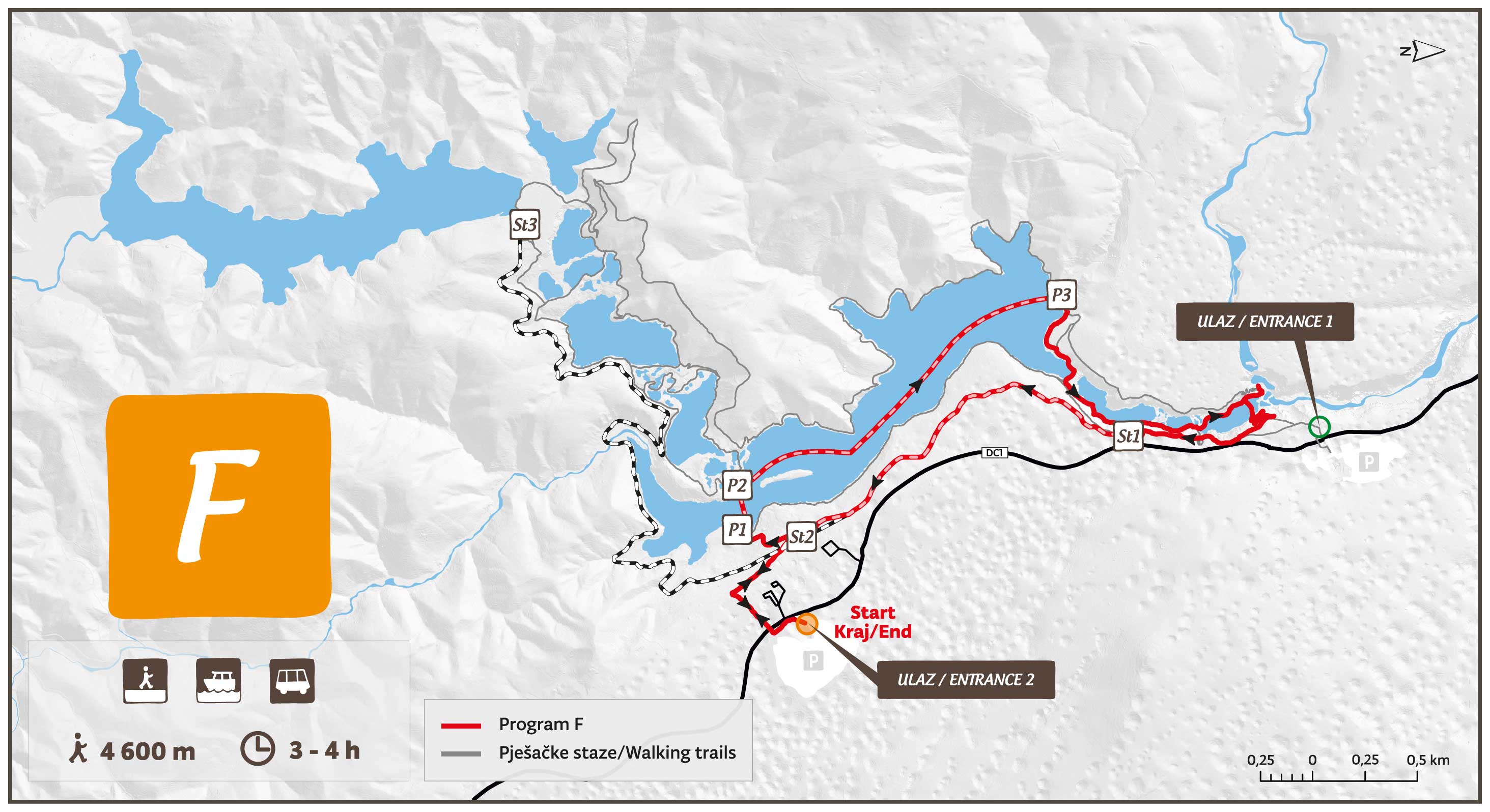
The national park has several routes you can take depending on how much time you want to spend and what you want to see. These routes are called programs and national park webpage has maps of each of these programs. There are 8 routes and each cover different part of the park. The most comprehensive routes are Program C and H which as exactly same routes but C start at entrance 1 and H start at entrance 2. We did Program C which is about 5 miles and includes boat ride across the Kozjak and return to the starting point in electric panoramic vehicle.
Below is the details on each of the program and these are taken from the national park webpage.
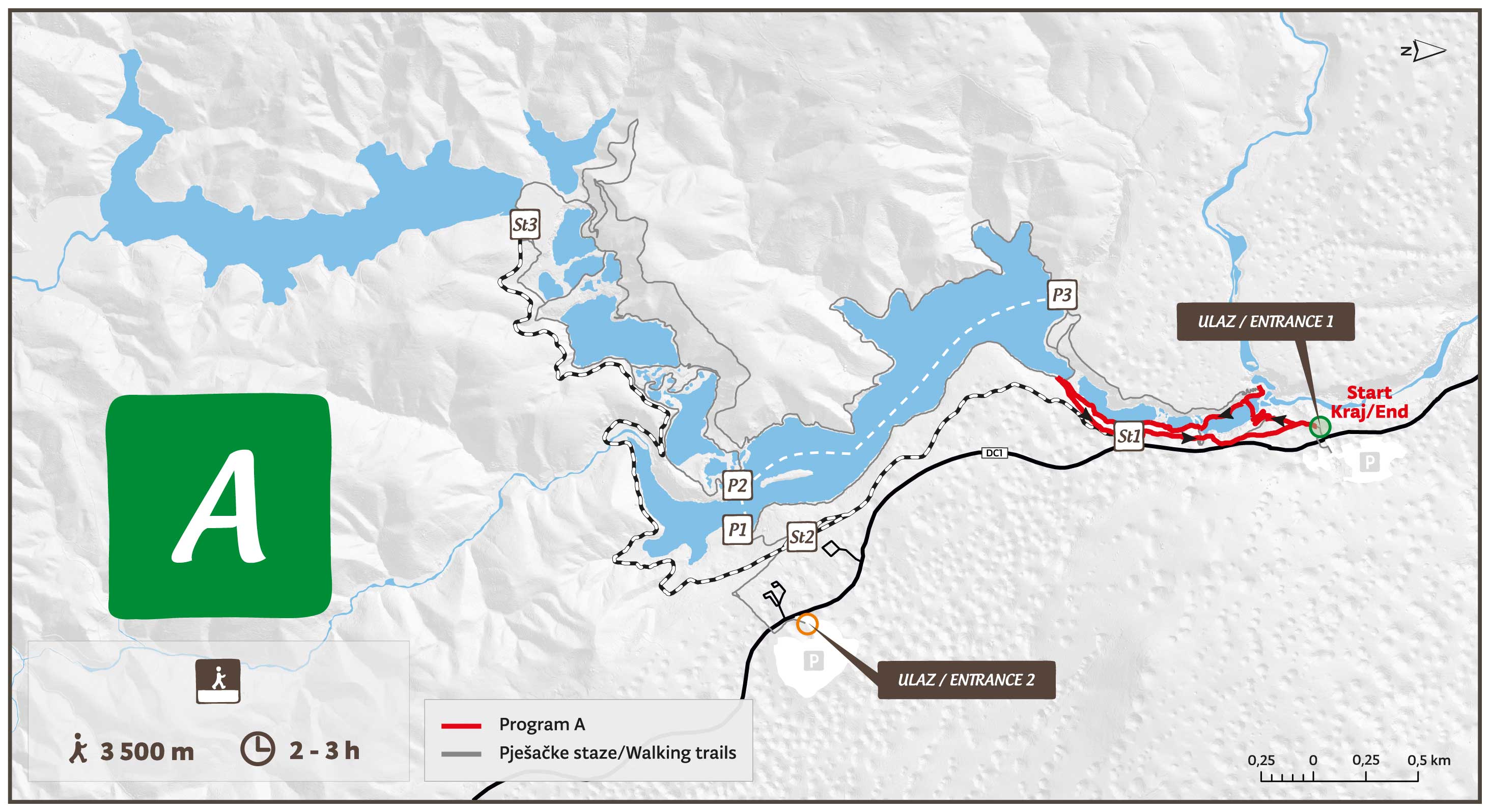
A Program
Duration – 2 to 3 hours
Trail length- 3.5 KM or 2 miles
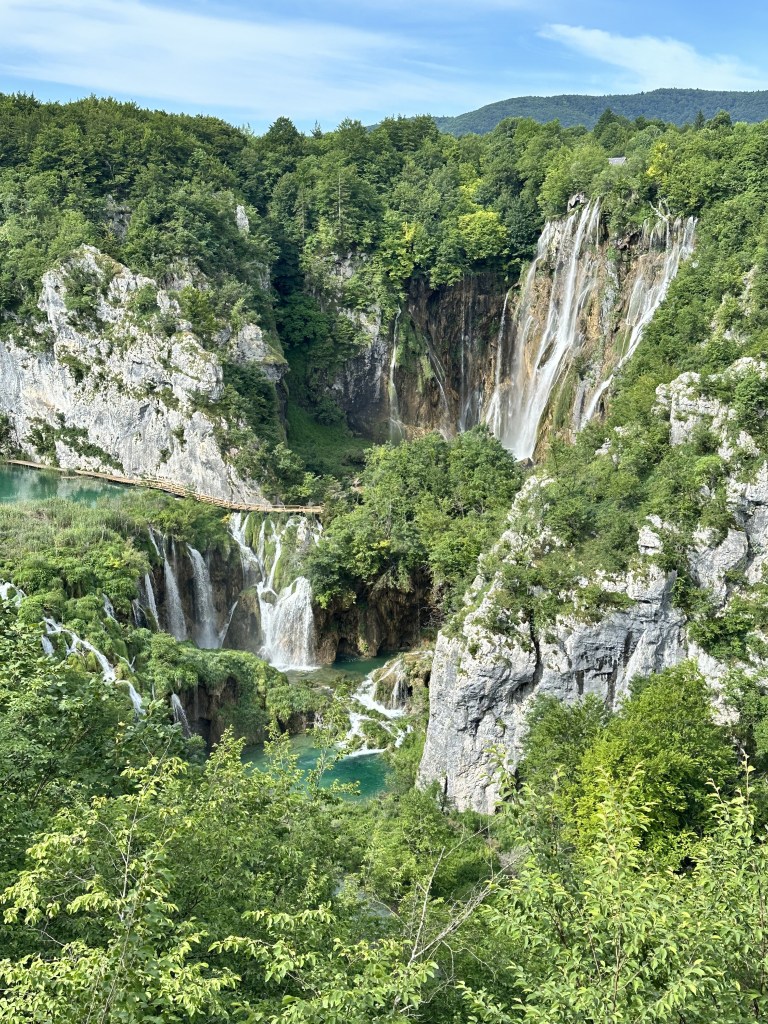
Starts at the entrance 1 and it is circular route with opportunity to admire ” Great Waterfall” or Veliki Slap- the largest waterfall in the park as well in Croatia. The path leads on upstream through lower lakes canyon to Kozjak Bridge. You can turn around this point to come back to the entrance
The great waterfall
B Program
Duration – 3 to 4 hours
Trail Length- 4 Km or 2.5 miles
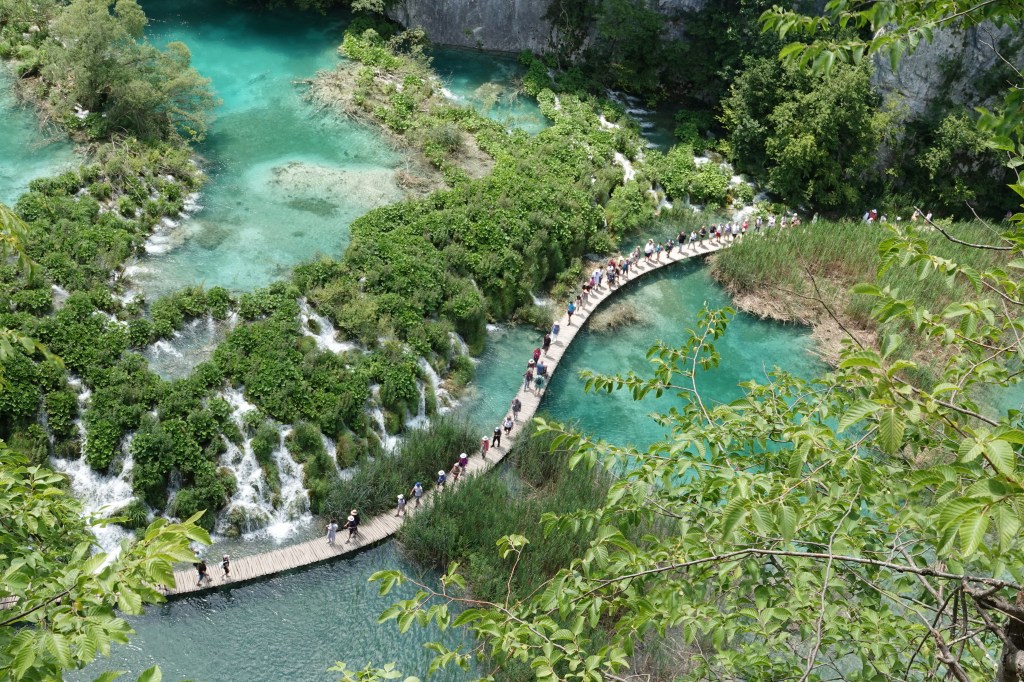
Start at entrance 1 and includes walking the lower lakes and a boat ride across the lake Kozjak followed by ride in Panoramic bus and walk along the top of the canyon to the entrance 1. You will see everything you see in Program A including Great waterfall or Veliki Slap. Walking along the top of the canyon gives you the most iconic view of the Plitivice lake with the wooden walkway and waterfall
Photo taken from the top of the canyon
C Program
Duration – 4 to 5 hours
Trail Length- 8KM or 5 Miles
This is route we took by starting at entrance 1 and this route includes lower and upper lakes, boat ride across Lake Kozjak as well as ride on the panoramic vehicle. We found this to be most comprehensive route that covers most of the park.
E Program
Duration – 2 to 3 hours
Trail Length- 5.1 KM or 3.1 Miles
Starts at entrance 2 and covers upper lakes and includes boat ride across Kozjak lake as well as train ride/Panoramic bus ride back to entrance 2. You will not see the Great waterfall or Veliki Slap on this route but will see Great and Small Prstavci falls as well other smaller falls
F Program
Duration – 3 to 4 hours
Trail length- 4.5 KM or 2.85 Miles
Starting point at the entrance 2 with a boat ride across Lake Kozjac and walk through lower falls to Great water fall or Veliki Slap. Walk back on the canyon top with the views of the iconic photo spots to Panoramic vehicle/bus station to take the bus back to entrance 2
H Program
Duration – 4 to 6 hours
Trail length – 8.9 Km or 5.5 miles
Another comprehensive route that covers most of waterfalls and lakes. This route is opposite of route c with starting point at entrance 2 and walk along upper lakes followed by boat ride on Lake Kozjak , and walk through the lower lakes to Great waterfall or Veliki Slap. Finish by walking on the canyon ridge back to Panoramic vehicle stop to ride back to entrance 2.
K1 Program
Duration – 6 to 8 hours
Trail Length- 16.5 KM or 10.25 Miles
The programme starts at the northern entrance (Entrance 1) and provides a walking tour of a large part of the lake zone in the Plitvice Lakes National Park. Walkers will see the Big Waterfall, pass through the Lower Lakes canyon and along the west coast of Kozjak lake, continue by the Prštavci waterfalls, the biggest and most beautiful waterfalls of the Upper Lakes, and visit the recently opened Tomićevo Pogledalo viewpoint. On the way back, walkers can enjoy the magnificent Upper Lakes and walk along the east coast of Kozjak lake, which is reached by a short electric boat ride. The programme continues with a walk above the east side of the Lower Lakes canyon, all the way back to the starting point at Entrance 1.
K2 Program
Duration – 6 to 8 hours
Trail length-17.5 KM or 11 miles
The programme starts at the south entrance (Entrance 2) and provides a walking tour of a large part of the lake zone in the Plitvice Lakes National Park. Walkers will see the Big Waterfall, pass through the Lower Lakes canyon and along the west coast of Kozjak lake, continue by the Prštavci waterfalls, the biggest and most beautiful waterfalls of the Upper Lakes, and visit the recently opened Tomićevo Pogledalo viewpoint. On the way back, walkers can enjoy the magnificent Upper Lakes and walk along the east coast of Kozjak lake, which is reached by a short electric boat ride. The programme continues with a walk above the east side of the Lower Lakes canyon, all the way back to the starting point at Entrance 2.
Where to stay
There are several lodges close to the national park that are run by the park system and have special deals on tickets as well as accommodations. Check here for more details. This is very convenient way to stay close to the park. There are several other hotels near the national park including this one. We had late lunch at this restaurant attached to this hotel and food was amazing and our guide said that the hotel was equally good.
Final thoughts
Plitvice lake is one of most beautiful national parks I have ever visited, and it is well maintained with crystal clear water and unbelievable beauty. It is hard to capture the beauty of this place in photos but totally worth visiting if you are in Croatia. If I had to redo this trip, I would definitely plan on staying a night close the park and be first one in the park when it opens at 7AM and take time walking through the park as well photograph without crowds.
Before we went to Split, I thought Diocletian’s palace was a walled city with Palace at the center but in reality, the old town of split and the palace are intertwined with each other and it is the living, breathing, vibrant heart of Split. In fact, 3000 people live in the hodgepodge of palace and old city of Split and the winding narrow streets are filled with restaurants, gift shops, homes, cloth lines, flowerpots, ATMs etc. People live, work, and eat in the UNESCO site and is the only inhabited roman ruin. It is fascinating to walk through these streets to realize that you are walking on the same path that Diocletian walked centuries ago but now regular people live here. It is very easy to get lost and I enjoyed getting lost on purpose in the winding streets and popping out of the old town at various locations and discovering fascinating views this palace has to offer (I did this at 7AM and not very many people around and highly recommend doing this).
Top 12 things to see at the old town/Diocletian Palace
There is no entrance fee to see most of the attractions of the Diocletian Palace. It is open to the public 24 hours a day, and if you want to photograph without thousands of people, go either early morning between 6:30 and 8:00 AM or late in the evening (I went at 7 AM and had the place to myself). Most of the main attractions can be done as a self-guided tour and are free, except the cathedral, bell tower, and Jupiter Temple, which have an entrance fee and have set open times.
PeristyleVestibuleBell Tower St. DomniusSphinxTemple of Jupiter Let me pass street Statue of Gregory of NinGolden GateSilver GateIron GateMosaicsCellars of the palace
Peristyle -Central Courtyard of the Palace
Vestibule -The entrance to Diocletian’s private quarters, acting as an anteroom for visitors.
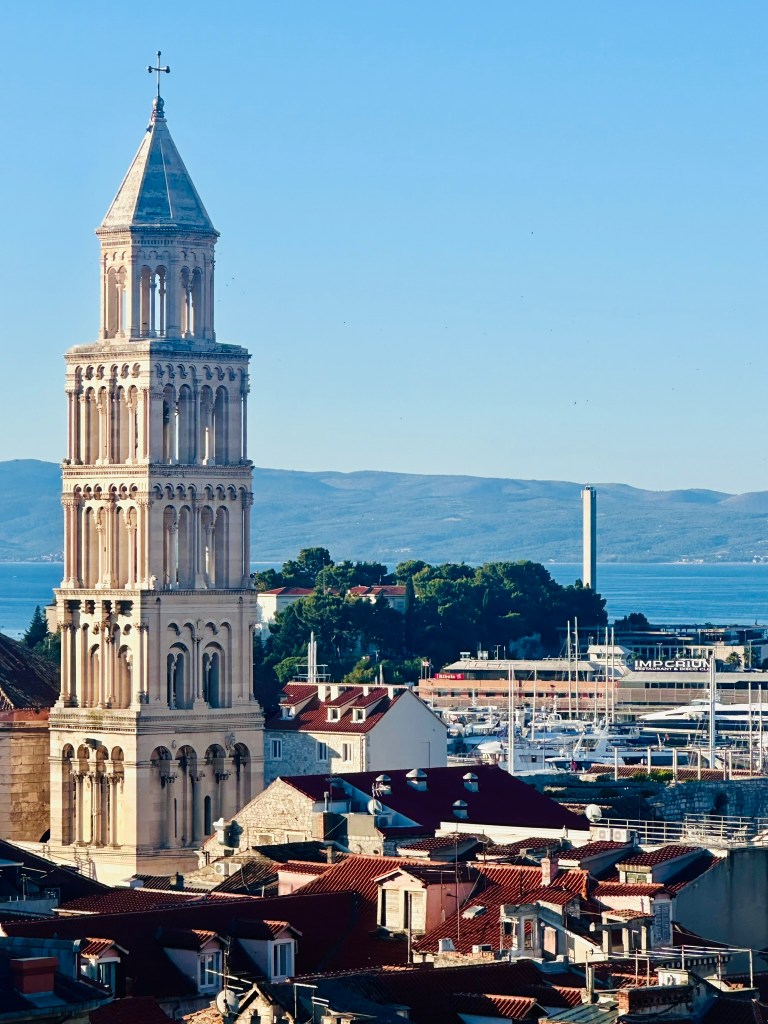
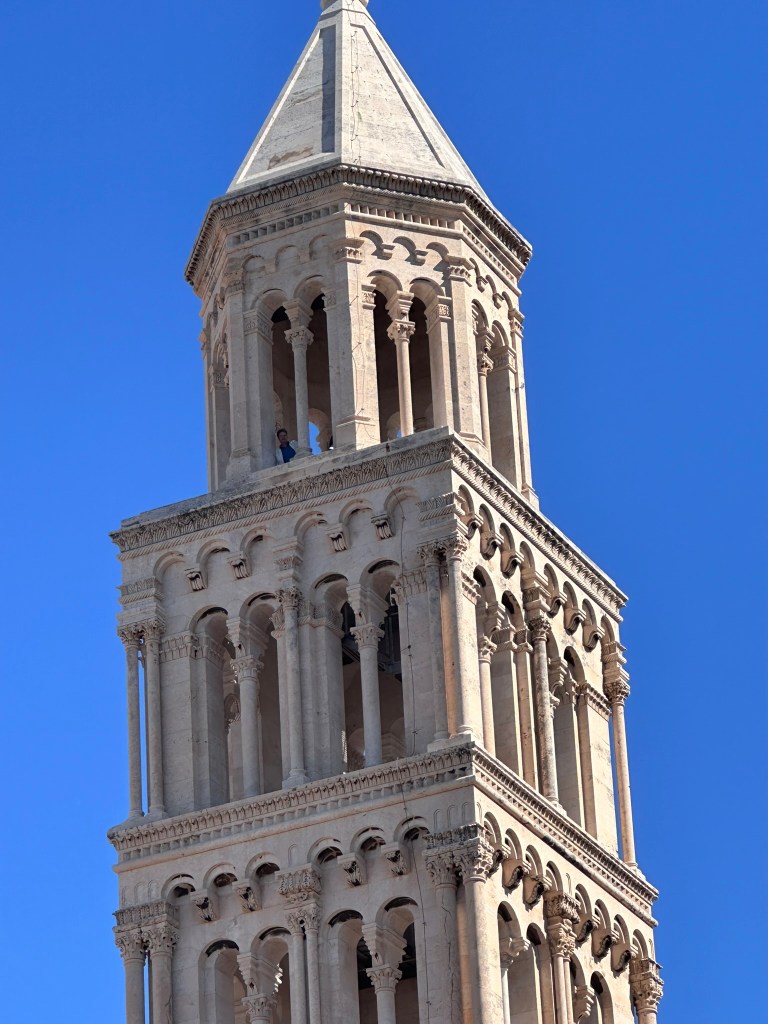
Cathedral and Bell Tower of St. Domnius-Situated in the Peristyle, stands the magnificent Cathedral of St. Domnius, and the bell tower that serves as the symbol of city of Split.
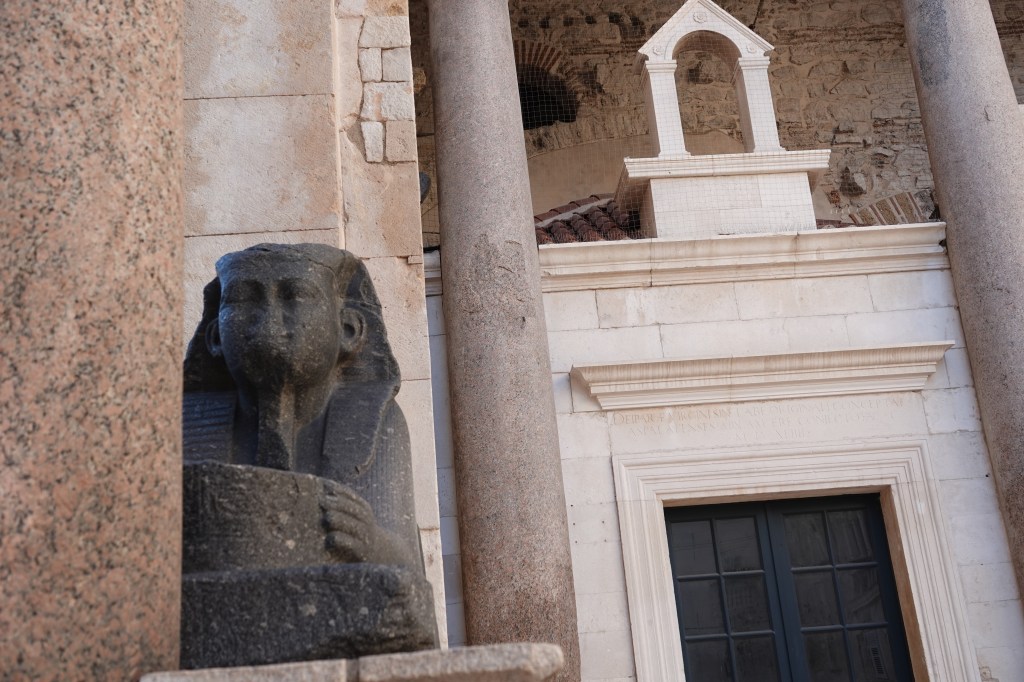
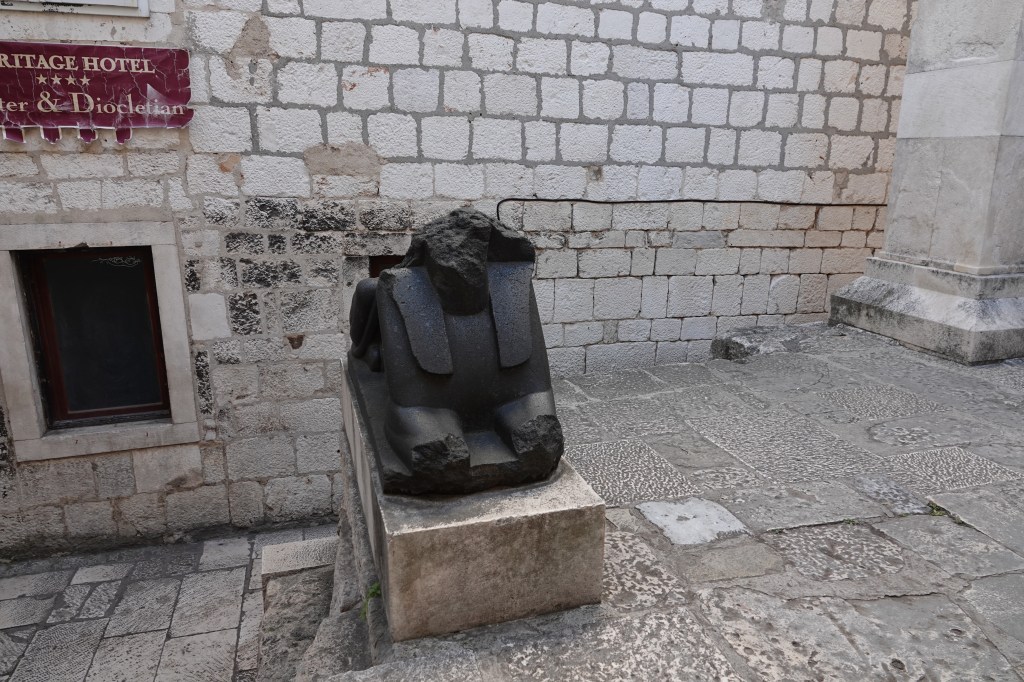
Egyptian Sphinxes-Out of twelve sphinxes Diocletian brought from Egypt, only one is intact and can be seen at the peristyle and the headless one that can be seen Infront of Jupiter temple
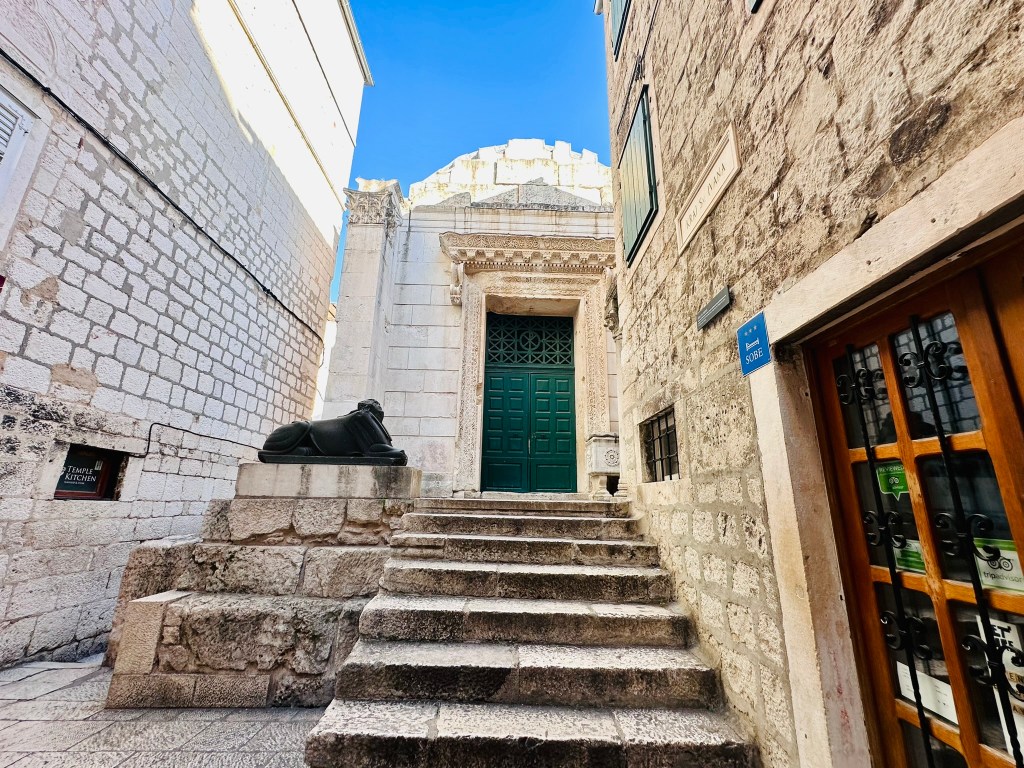
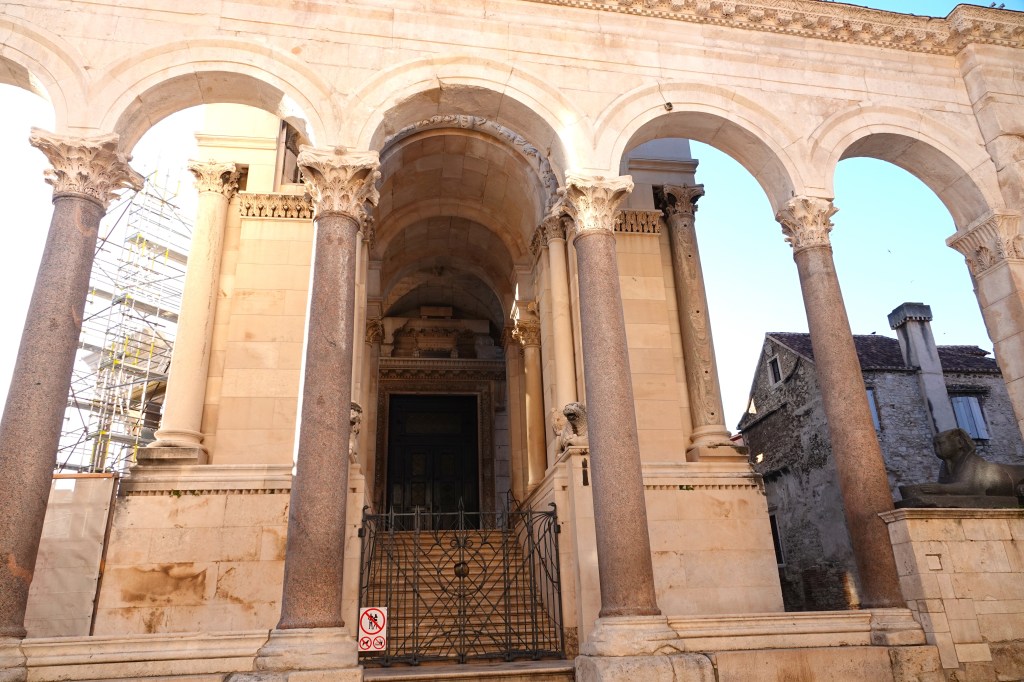
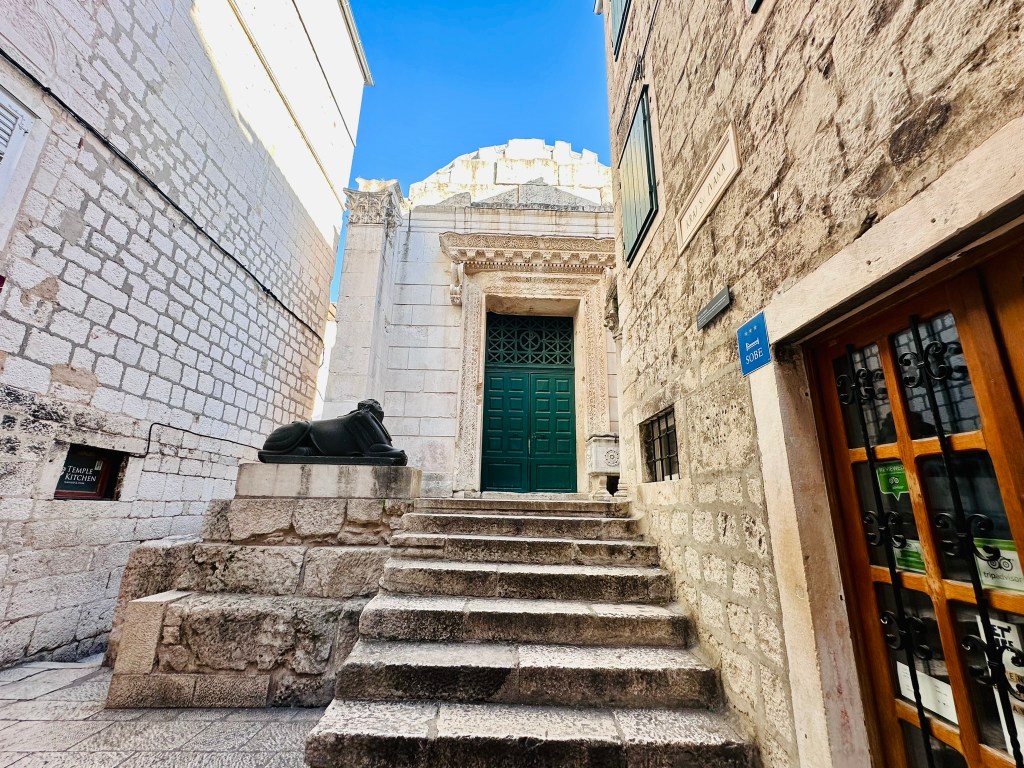
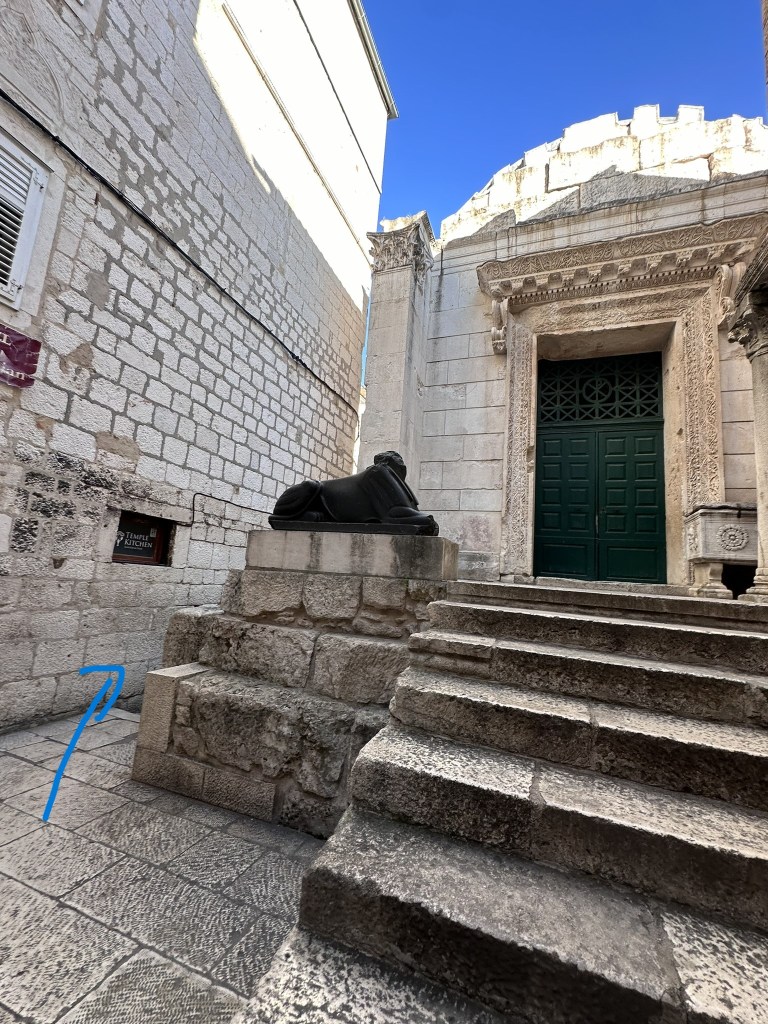
Temple of Jupiter– One of the original temples built between 295-305 AD and very close to the peristyle
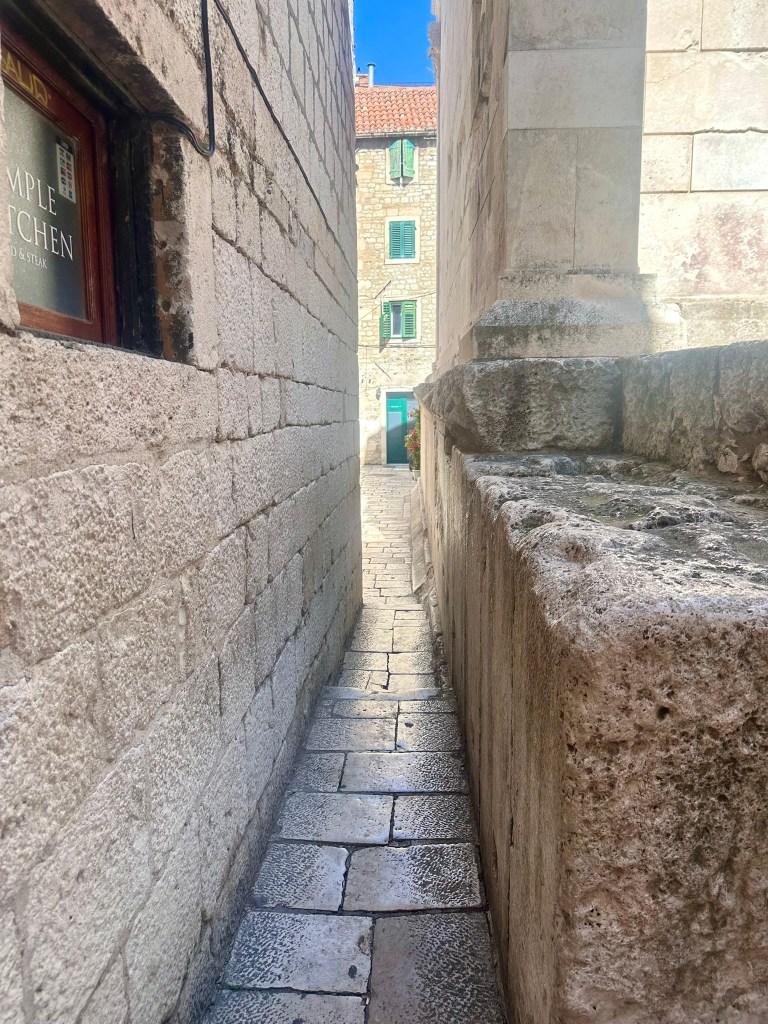
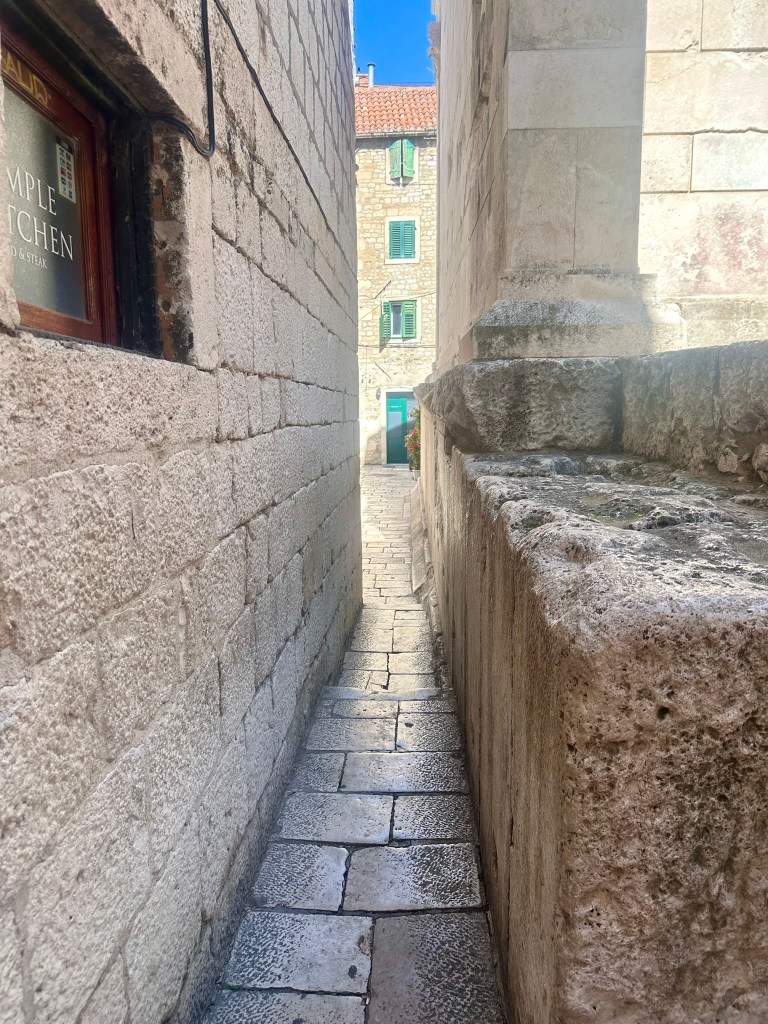
‘Let me pass’ street-The narrowest street in Split, right next to the temple of Jupiter.
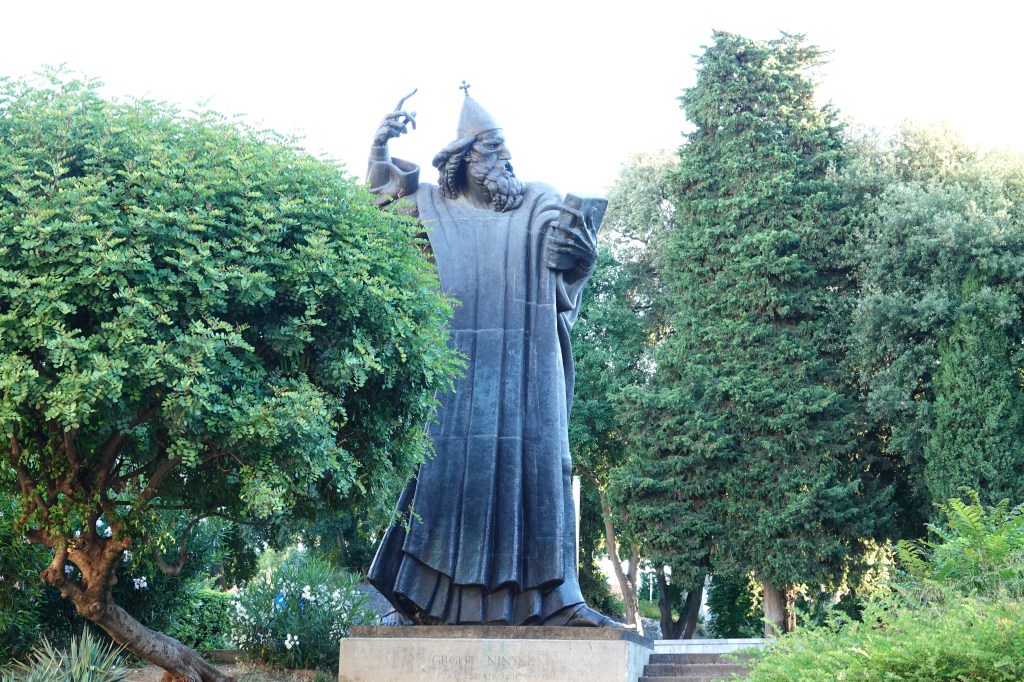
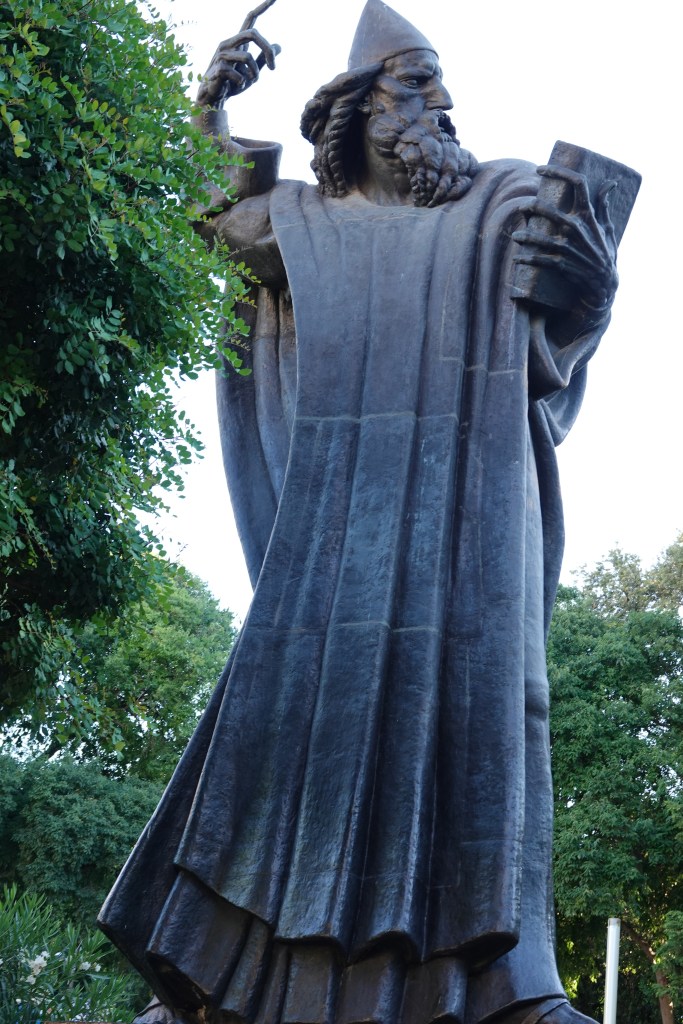
Statue of Grgur Ninski (Bishop Gregory of Nin) – created by renowned Croatian sculptor Ivan Meštrović in 1929 and located near the golden gate
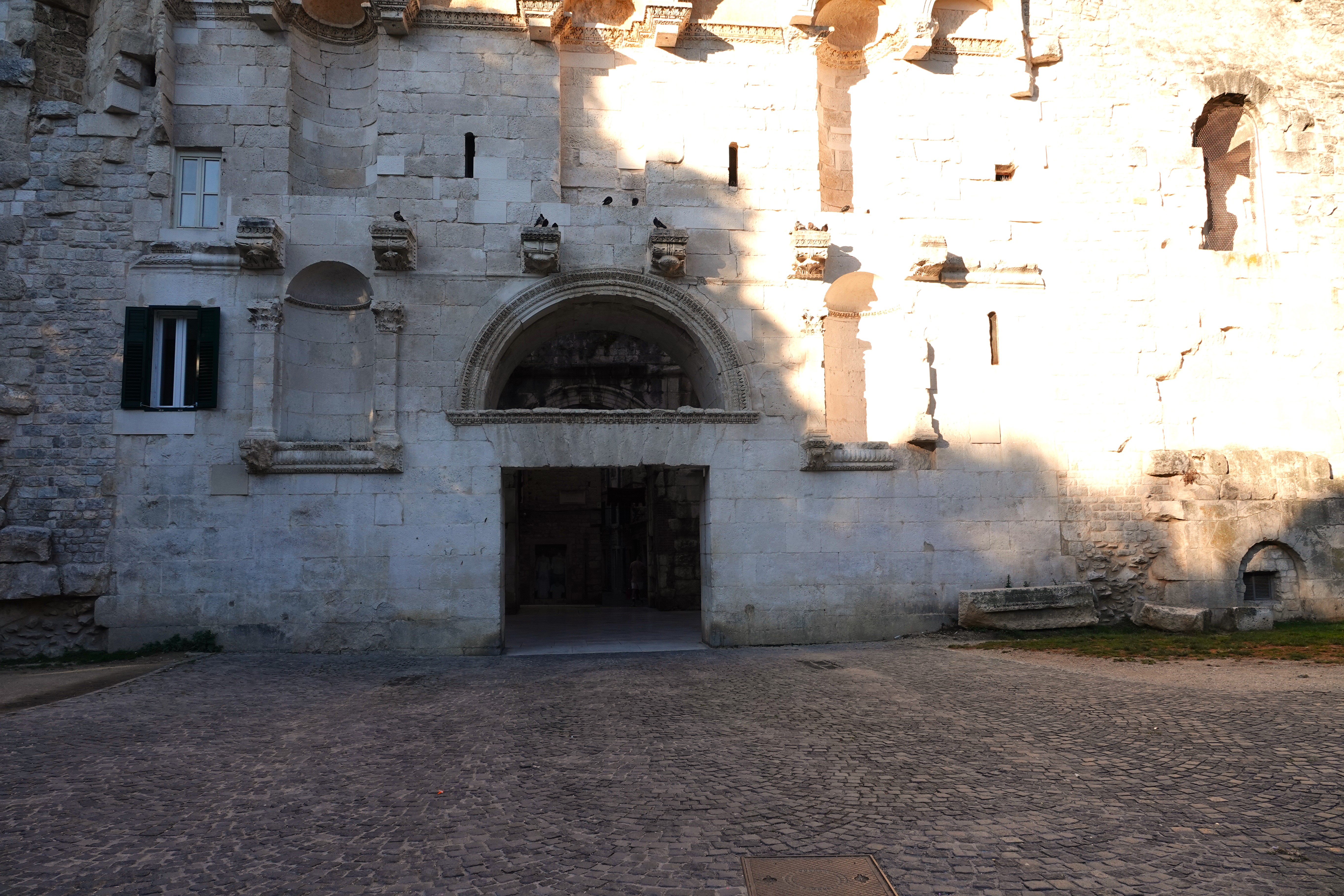
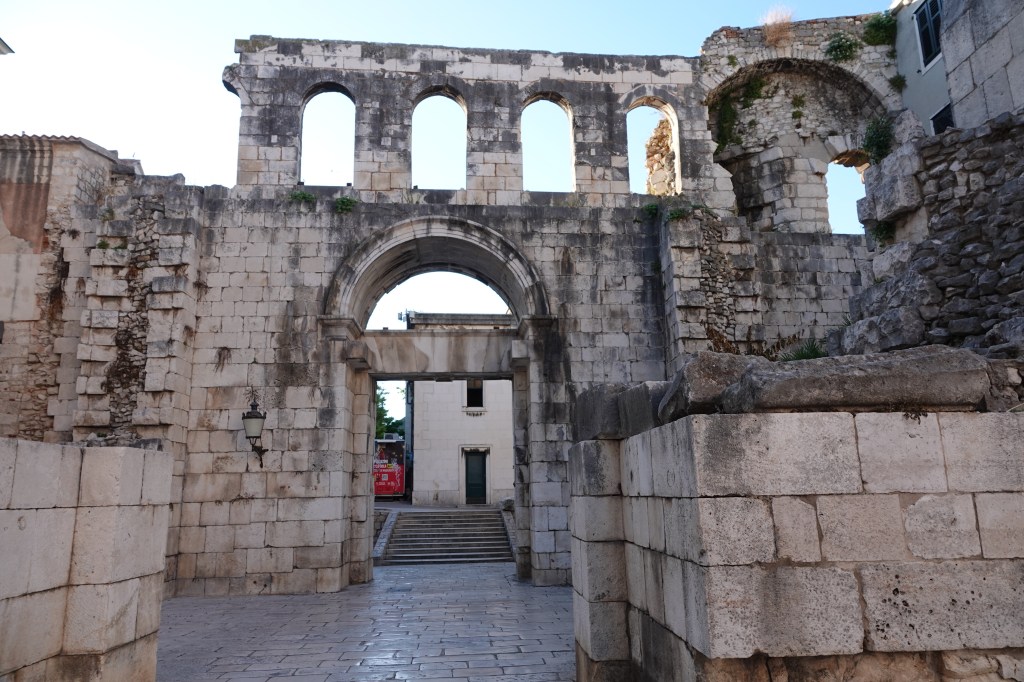
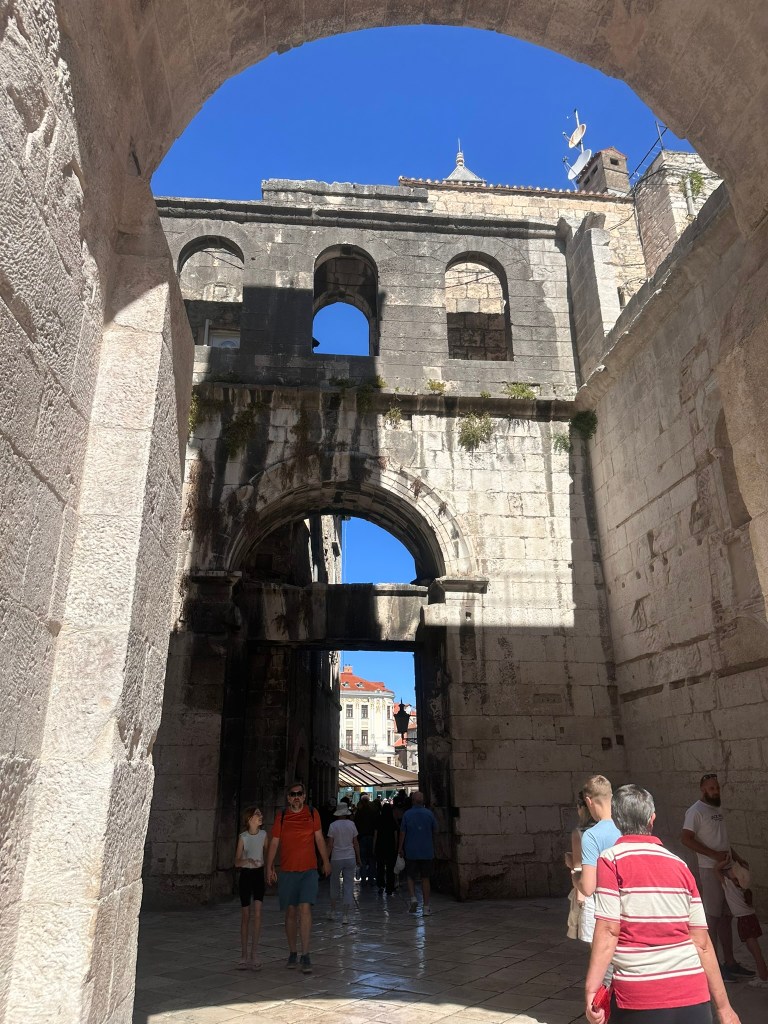
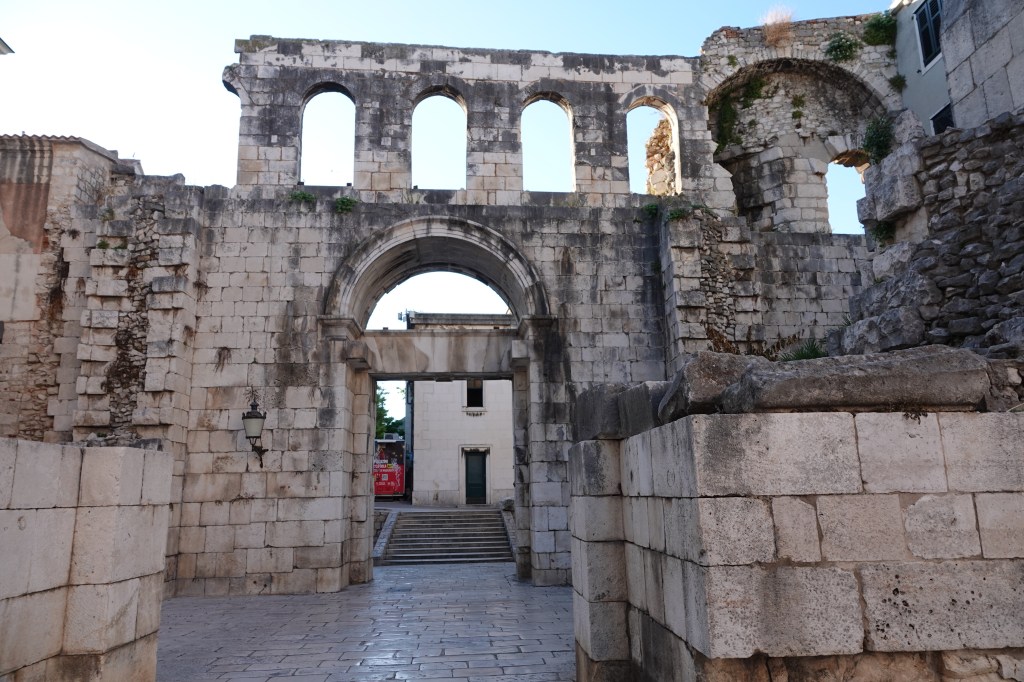
The 4 gates of the palace– Gold, Silver, Iron, and Bronze
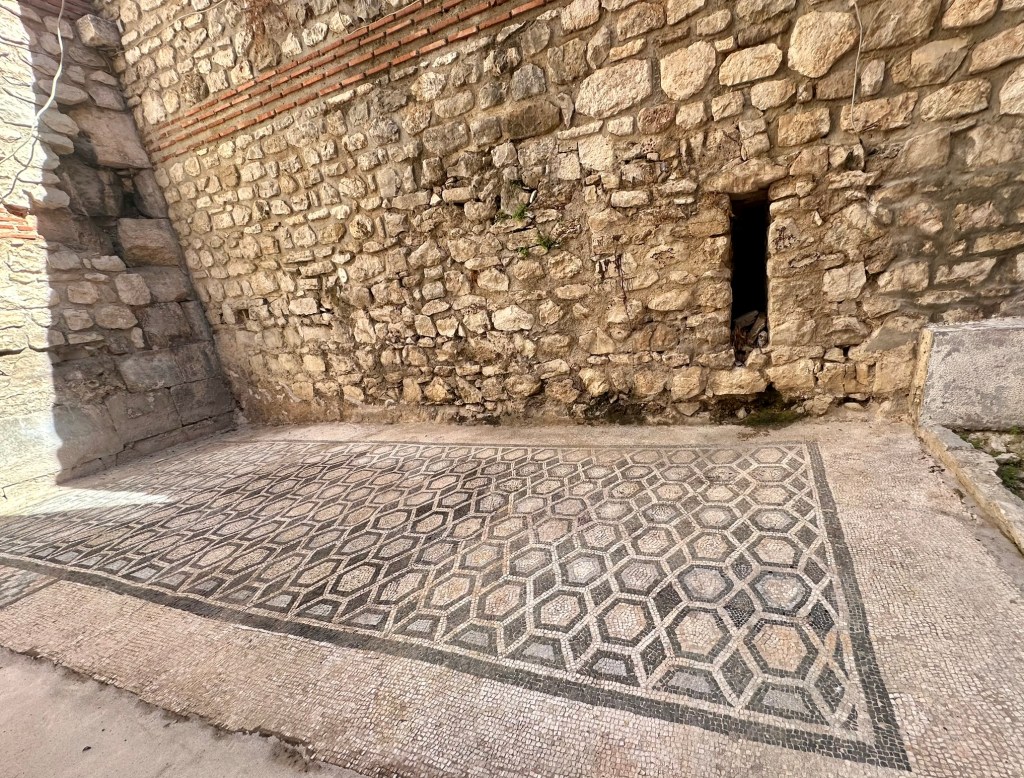
Mosaic – A geometric floor mosaic, made by the mosaic workshop from Salona in late 4th and early 5th century
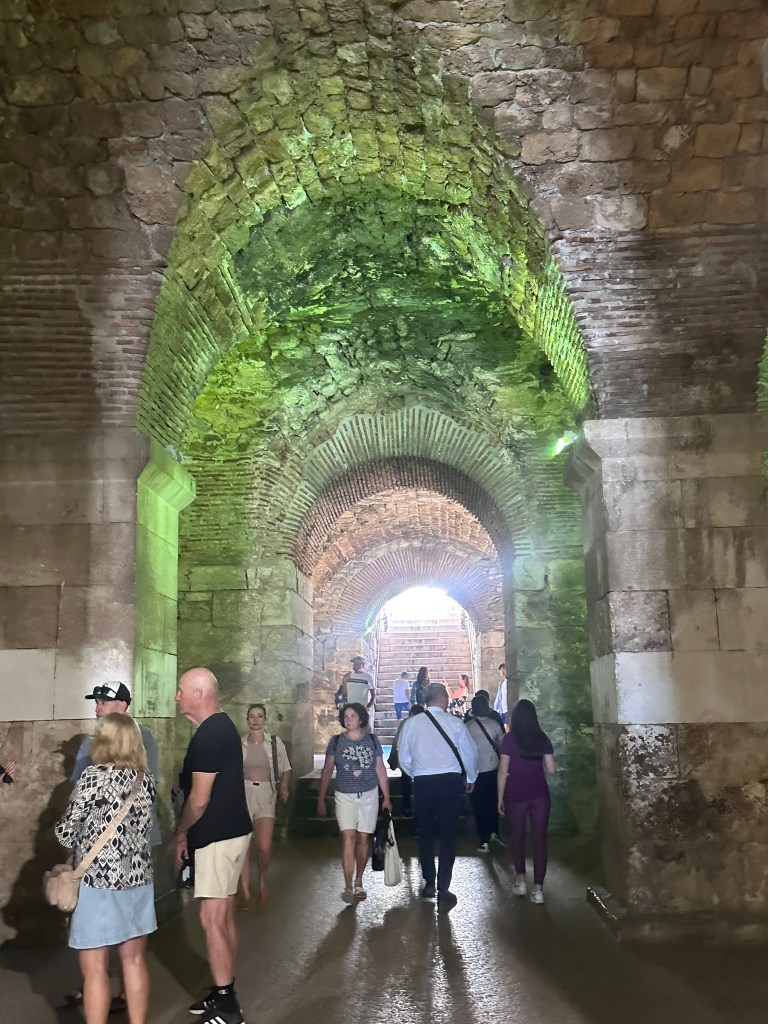
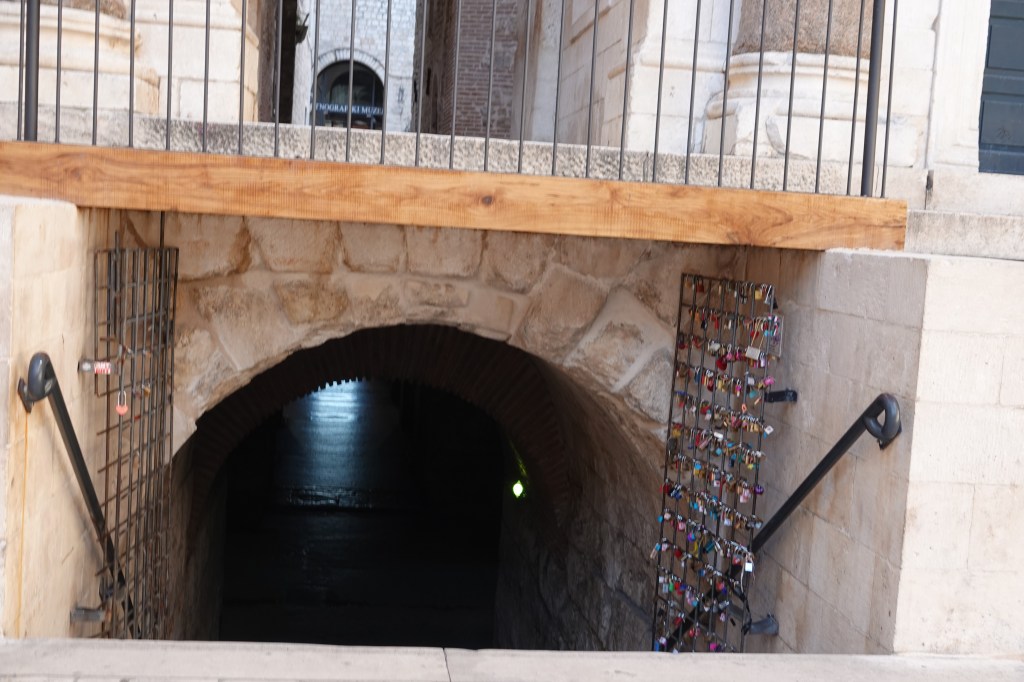
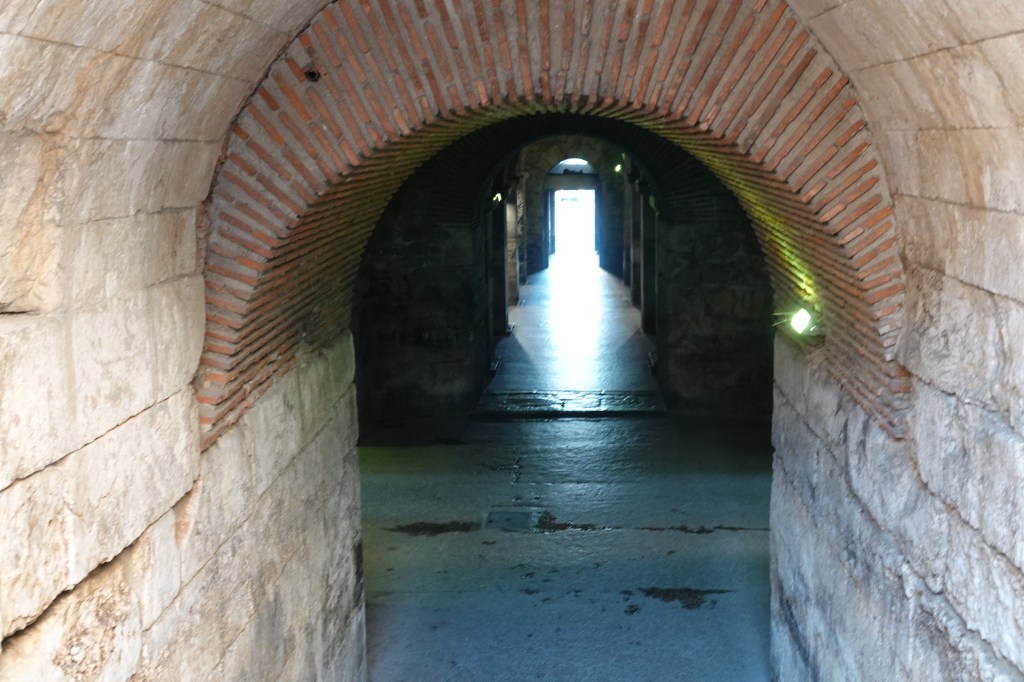
Palace Cellars -‘basements’ or the ‘substructions’, are the underground complex of halls and corridors located underneath the southern section of the Diocletian’s Palace
If you want to orient yourself with the main attractions, here is map that shows main attractions (highlighted in yellow) and bronze gate is located near Reva promenade, and you can use the bell tower as the guide.
A brief history of the palace and the Roman ruler who built it
Diocletian, who was born in Dalmatia in 244 AD, worked his way up in the Roman military and became emperor in 284 AD. His time as ruler included important changes in the Roman Empire as he addressed issues like political chaos, economic problems, and outside threats.
One of his key ideas was the Tetrarchy, which was a system where multiple emperors shared power. Instead of ruling by himself, Diocletian wanted four leaders to help share the load and create stability during tough times. He also reorganized the empire into smaller provinces to make administration easier and improve governance.
Diocletian is best known for the Diocletianic Persecution, a time when Christians faced severe oppression. He viewed Christianity as a threat to traditional Roman values and took major steps to eliminate it, leading to the destruction of churches and the taking of Christian writings. Despite these efforts, the persecution wasn’t completely effective, as Emperor Constantine later introduced religious tolerance for Christians in 324 AD, changing the religious landscape of the empire.
Besides his administrative reforms, Diocletian believed in divine kingship, seeing himself as a living god. This idea is reflected in his building projects. He ordered the construction of a grand palace in Split, which became his retirement home. Known as Diocletian’s Palace, this impressive structure combines Roman, Greek, and Egyptian architectural styles. Built between AD 295 and 305, it used high-quality white limestone from Brač Island and covers about 30,000 square meters (322,917 square feet). The palace was designed to show wealth and power, featuring four main gates, including the prominent “Porta Aurea” and “Porta Ferrea,” representing imperial authority. The complex was divided into different sections, with the south side designated for the emperor’s private living areas and the north side for military personnel and the general public. This thoughtful design highlighted the blend of residential and military functions in the imperial space.
Highlights of the Palace in detail
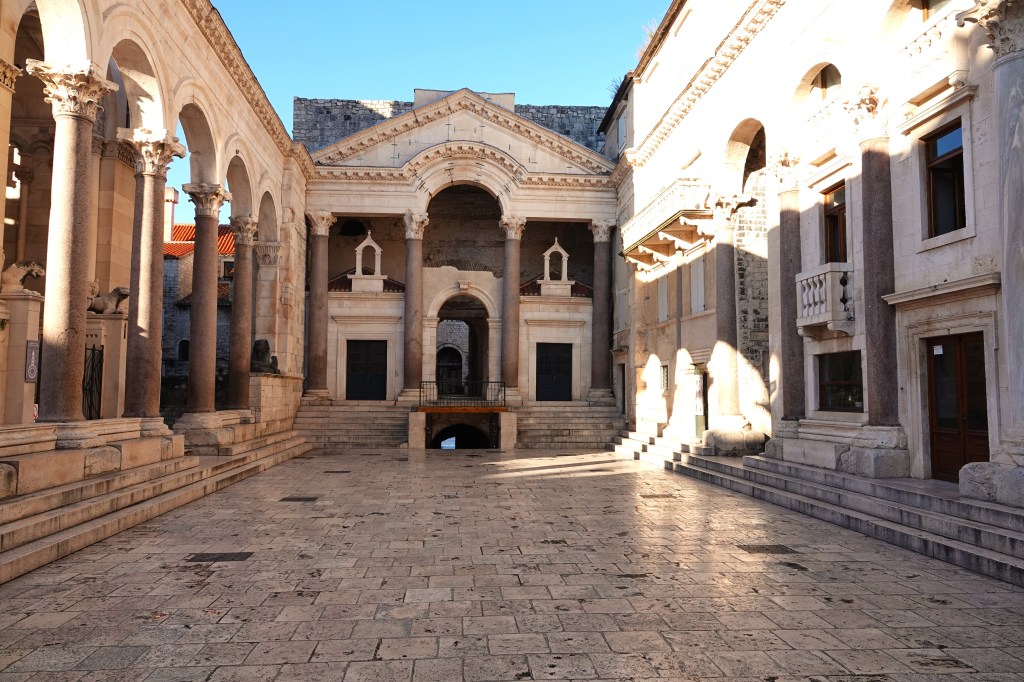
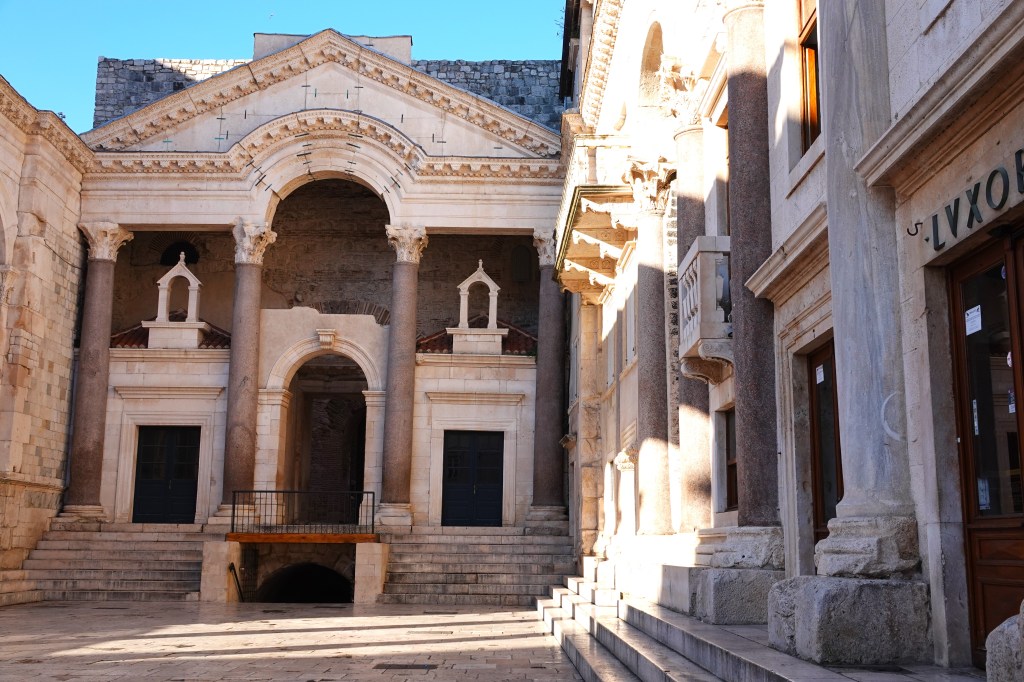
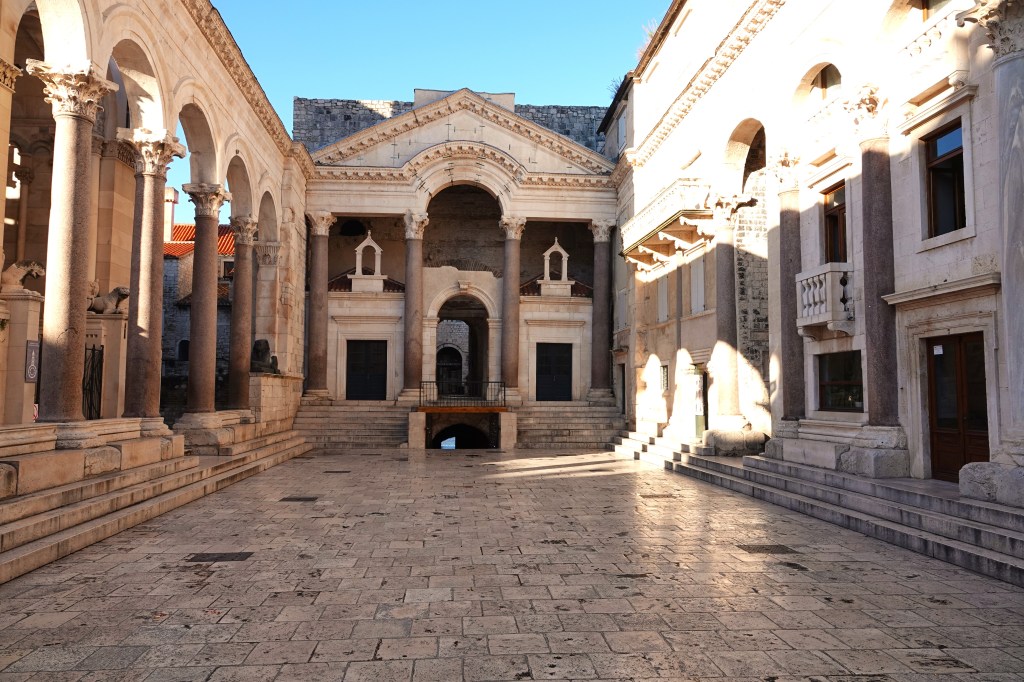
Peristyle–The Palace’s Central Square
Peristyle at 7AM
Flanked by two rows of Corinthian columns, the Peristyle is the central plaza of Emperor Diocletian’s palace complex, located at the southern entrance. Built in the fourth century, during a time when clothing changed from togas to tunics, it functioned like a Roman town hall, lacking formal speeches. In Split, it also served as the main access to the emperor’s private rooms, marking an important area. Historians call it the ‘buffer zone,’ which represents the space between the busy northern part of the palace—similar to an old industrial park or staff dormitory—and the luxurious southern section where the emperor lived. To the east, there is a mausoleum now used as the Cathedral of Split, and to the west, three smaller Roman temples remain, with only the Temple of Jupiter still standing.
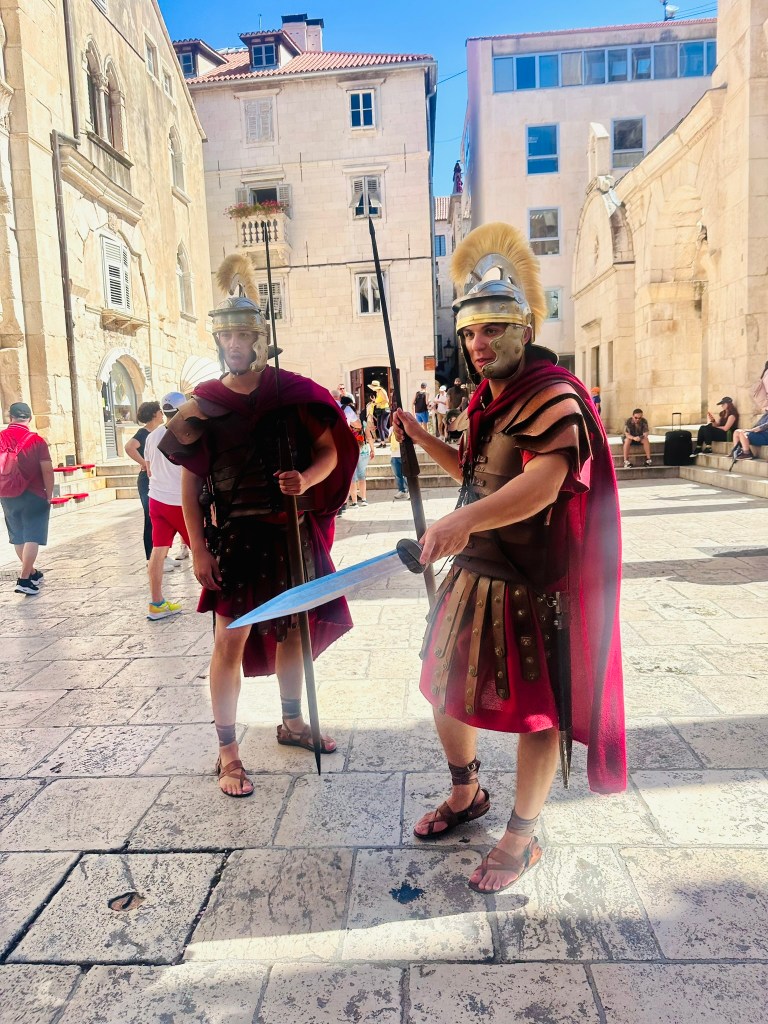
The Peristyle was lively with visitors when we saw it in the afternoon after our tour (I had taken photos at 7 AM, enjoying the lack of crowds). Every day at noon in summer, Croatian students dressed as Roman centurions perform a reenactment of the Roman changing of the guard. Diocletian and his wife Priska, dressed in beautiful gowns and accompanied by their visible Praetorian Guard, stand in the center to greet everyone. Diocletian then gives a welcoming speech in both Latin and English, inviting, “Please come and explore my palace!” At night, the Peristyle becomes a bright and lively place, drawing a mix of locals and tourists who come to enjoy live music or street performances.
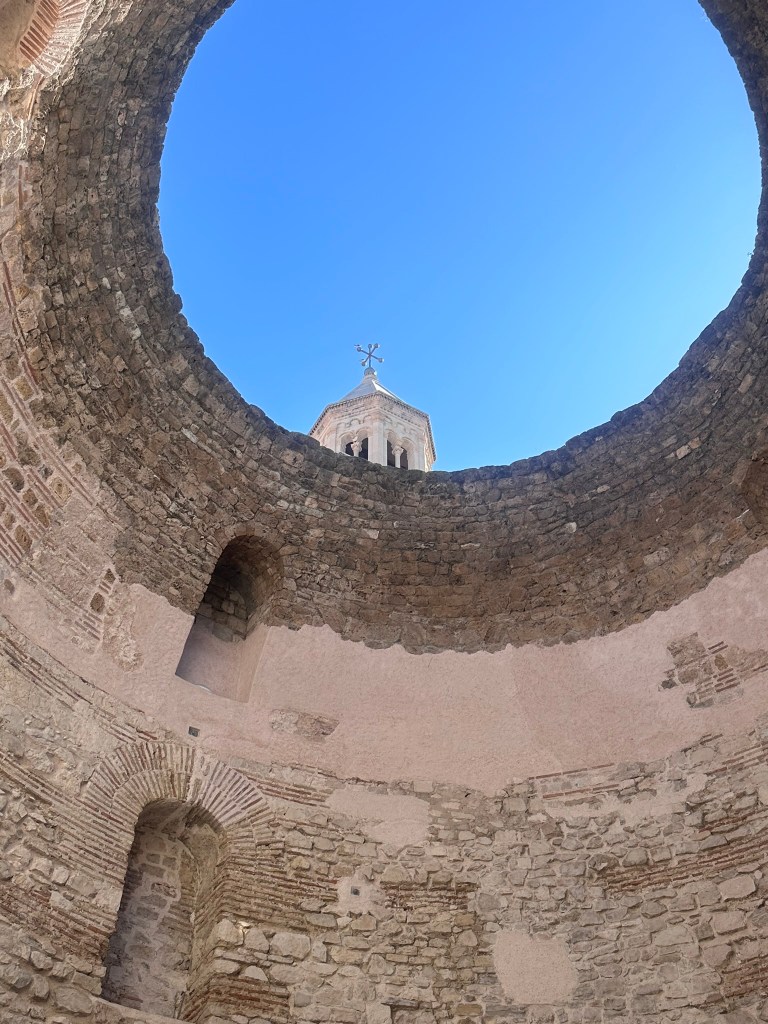
Vestibule– antechamber to emperor Diocletian’s private quarters
Ah, the vestibule! It’s not just any waiting room; it was the special area for Emperor Diocletian. Imagine a round room—an architectural wonder with great sound quality, where even the grumpy senators’ voices could be heard clearly. Diocletian’s bedroom was right above this dome, letting him listen in on anyone who approached. He had good reason to be cautious—many Roman emperors didn’t last long. Interestingly, Diocletian was the only one who died of natural causes. Go figure!
For anyone wanting to meet this important emperor, they had to walk through the Golden Gates of the palace, down what is now known as Diocletian’s Street (not as catchy as “Fifth Avenue,” right?), and through the protyron to enter the impressive vestibule. And you thought your daily commute was tough!
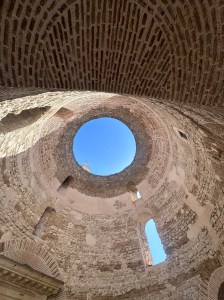
From the outside, the vestibule looks like a simple rectangle, but inside, it’s rounded—fancy! It originally had a beautiful dome and a mosaic ceiling that would impress anyone. The walls were made of marble and featured four empty niches where statues once stood. Today, people come to look at the ‘eye’ where the dome used to be, taking photos as if they’re trying out for a travel magazine. And that oculus? It was meant to let the gods peek down at Diocletian’s royal life. It’s said he might have been inspired by the Pantheon in Rome—because who wouldn’t want some divine attention at their parties?
In the summer, the vestibule attracts local klape because of its excellent sound. These a cappella groups perform traditional Dalmatian folk songs, and we got to see and hear them during our walking tour in June 2024.
The a cappella group
The Cathedral of Saint Domnius: From Mausoleum to Christian Landmark
Entrance fee and opening hours
Entrance fee: There are 4 types of tickets for the Cathedral, depending on how many locations of the Cathedral complex you want to visit. Be aware that you need to be dressed properly to enter the cathedral
Purple ticket (11 euro) includes all 5 sites: The Cathedral, Crypt, Baptistery (Temple of Jupiter), Treasury, Bell tower
Blue ticket (7 euro) includes 3 sites: The Cathedral, Crypt, Baptistery
Green ticket (10 euro) includes 3 sites: The Cathedral, Bell tower, Treasury
Red ticket (8 euro) includes 4 sites: The Cathedral, Crypt, Baptistery, Treasury
Split Cathedral opening hours
Summer opening hours (June 1 – October 30): 08:00 – 20:00 / Sunday: 12:00 – 18:00 Winter opening hours (November 1 – June 1): 09:00 – 17:00 / Sunday: 12:00 – 18:00 The ticket office is open until 30 minutes before closing. The Cathedral is closed on religious and public holidays.
One of the most noteworthy aspects of Diocletian’s Palace is its transformation into early Christian architecture. The Cathedral of Saint Domnius, originally constructed as Diocletian’s mausoleum, serves as a prime example of how the palace’s structures evolved over time. The edifice is characterized by its octagonal shape and circular interior, built using substantial limestone blocks, and features a decorative frieze that depicts scenes from the life of the esteemed emperor.
Following Diocletian’s death in 311 AD, the mausoleum remained unutilized until the 7th century, when it was repurposed by Christians into a church dedicated to Saint Domnius, the patron saint of Split. Notably, it was originally built in 305 AD, with Diocletian interred there after his demise. Moreover, the mausoleum’s strategic location facing the Temple of Jupiter, which was Diocletian’s favored deity, enhances its historical significance. Ironically, the Christians altered the site by dismantling the emperor’s sarcophagus and converting his final resting place into a cathedral honoring one of the victims whom Diocletian had executed in the city’s amphitheater.
Additionally, the cathedral underwent renovations that included the incorporation of a choir and a bell tower, as well as various Christian symbols and artworks. Despite these modifications, the building has largely retained its original Roman architectural elements, resulting in a distinctive amalgamation of pagan and Christian styles. This represents a remarkable cultural synthesis.
Bell Tower–The symbol and the centerpiece of Split
Entrance Fee- It can be visited either by purchasing the individual ticket or as part of the all-in-one cathedral complex ticket (See above)
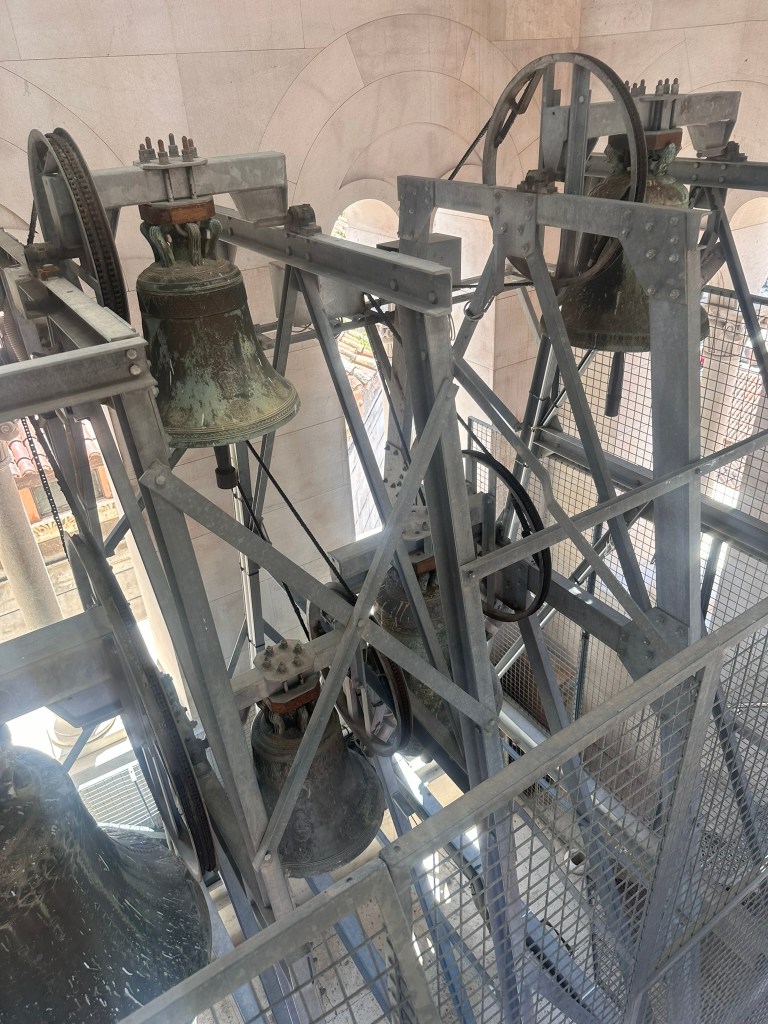
The Bell Tower of St. Domnius in Split, a notable example of Romanesque architecture, was constructed over a period spanning from the 13th to the 16th centuries. Visitors with acrophobia may wish to engage in deep breathing exercises prior to their ascent, as there are 200 steep steps designed to test one’s composure. Approximately halfway up, individuals will encounter a metal step that exhibits a precarious stability, reminiscent of elements from a circus act, challenging conventional notions of safety.
Standing at an impressive height of over 60 meters, the Bell Tower of St. Domnius transcends the status of a typical bell tower; it can be likened to a distinguished model amongst Dalmatian bell towers—both striking and somewhat dramatic. It is believed that construction commenced in the 13th century, yet it appears that work extended over three centuries, suggesting a series of extended intervals. Each level within the tower presents a distinct aesthetic; the lower floors reflect a robust Romanesque design, while the upper levels exhibit characteristics of Gothic and artistic influences.
However, the tower’s exterior underwent an unfortunate transformation at the beginning of the 20th century. This period saw the removal of intricate stone reliefs and sculptures, resulting in a more austere appearance. Additionally, the elegant Renaissance top floor was replaced with a Neo-Gothic style—a decision that seemingly aimed for cohesion but may have appeared excessive. On a positive note, following extensive renovations that included the installation of a new staircase, the bell tower has regained its former glory. Visitors are now encouraged to ascend to the summit and enjoy breathtaking views of the Old Town, all while experiencing a mixture of vertigo and wonder. The experience of climbing the tower proves to be both engaging and memorable.
View from Bell Tower
Egyptian Sphinxes- The oldest denizens of Split
When we think of sphinxes, we often picture ancient Egypt and its great pharaohs. Interestingly, one of these symbols of Egypt has stood for centuries in the heart of Split, at the Peristyle and under the Cathedral of St. Domnius.
This stone masterpiece, made from African black granite, has been in one of Split’s most beautiful squares, a place locals consider the center of the world. It dates back to the time of Pharaoh Thutmose III, making it over 3,000 years old, and is one of the oldest objects in Split. This androsphinx has the body of a lion and a human head, with arms instead of claws, which is unusual for such royal creatures. It also holds a sacrificial bowl, representing a king paying tribute to the gods, a detail not often seen in other sphinxes.
The sphinx arrived thanks to Emperor Diocletian, who was very interested in Egyptian culture. He built his palace in sunny Split and wanted to be buried there, leading to the construction of a mausoleum in his honor.
Diocletian believed in the Egyptian tradition of sphinxes guarding sacred places, so he had twelve brought from Egypt to decorate his palace. He passed away in Split and was buried as he wanted, in the center of the mausoleum, inside a sarcophagus that was later destroyed. This structure has served many purposes over the years but has been the Cathedral of St. Domnius since the mid-7th century, where the remains of Split’s patron saint are kept.
In addition to the sphinx at the Peristyle, there is a headless “companion” in front of the Temple of Jupiter (baptistery) that is also popular. Fragments of other sphinxes, including a red granite head that used to be in Diocletian’s Palace, are displayed in museums and cellars in Split.
Only Intact Sphinx at the PeristyleHeadless Sphinx at the Jupiter temple
Temple of Jupiter/The Baptistry of St John
One of the main attractions in Diocletian’s Palace is the Temple of Jupiter, which now serves as the baptistery of the cathedral. This well-preserved building was originally a Roman temple dedicated to Jupiter, the king of the gods. It highlights the impressive architecture and spiritual importance of Roman religious practices. The temple features its original barrel-vaulted ceiling, showcasing the Romans’ engineering skills, along with a decorative frieze that has intricate carvings of various mythological scenes.
Among the many columns that once supported a grand entrance, only one remains today, standing as a quiet reminder of the passage of time and changes in this sacred space. A notable feature is the black-granite sphinx at the entrance, which was already old when the Romans brought it from Egypt in the 3rd century, representing the cultural exchange of that era. However, its presence became controversial during the early Christian period, as early Christians damaged it, viewing it as a symbol of paganism. This reflects the conflict between the new Christian beliefs and the old traditions. The history, art, and architecture of the Temple of Jupiter make it an interesting spot for visitors at Diocletian’s Palace, helping them understand the region’s rich and complex history.
Temple of JupiterFront door
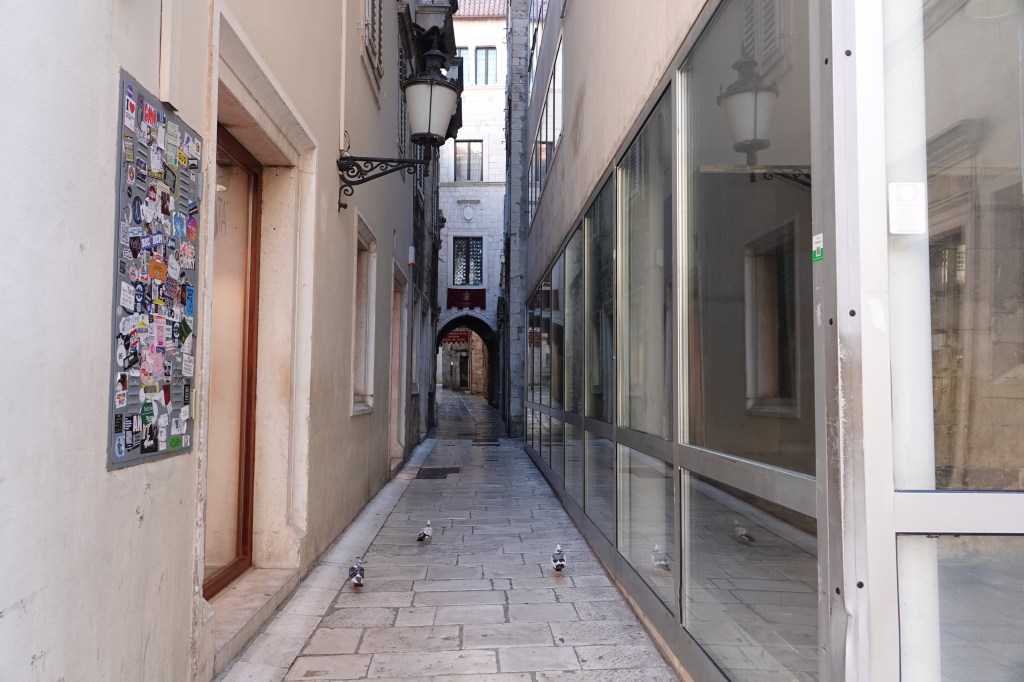
Let me pass street
Right next to temple of Jupiter is the let me pass street..supposedly the narrowest street in split.
Let me pass street-Right next to temple of JupiterLet me pass street
Let Me Pass Street, or Pusti me proć, is a very narrow street in Split, Croatia, known for being one of the world’s narrowest, measuring just over a meter in some sections. The origins of the street are uncertain, with legends suggesting it was created for transporting goods or providing shade to residents during the summer.
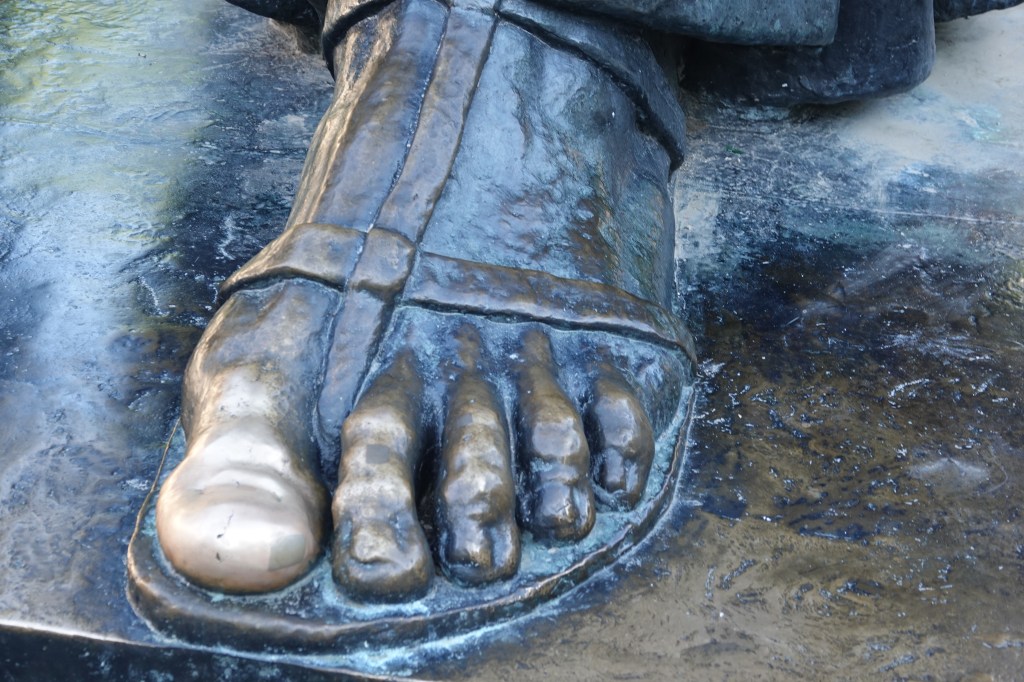
Statue of Grgur Ninski (Bishop Gregory of Nin)and his big toe
Gregory of Nin was a Croatian bishop known for opposing the Catholic Church’s insistence on Latin in services, advocating instead for the use of the national language to enhance understanding of God’s message. He has become a symbol of Croatian culture and independence, with notable statues, including a prominent one in Split. This statue in Split is 28 feet (8.5 meters) tall, designed in 1929 by one of Croatia’s most important artists, Ivan Meštrović. This statue, originally located in Diocletian’s Palace, was relocated in 1941 and now stands outside the Golden Gate. Its unique feature is a gold-colored big toe, which is resulted from people rubbing for good luck regarding births, weddings, and wealth. Each day, many visit to rub the toe before entering the city.
Gates of the Diocletian Palace
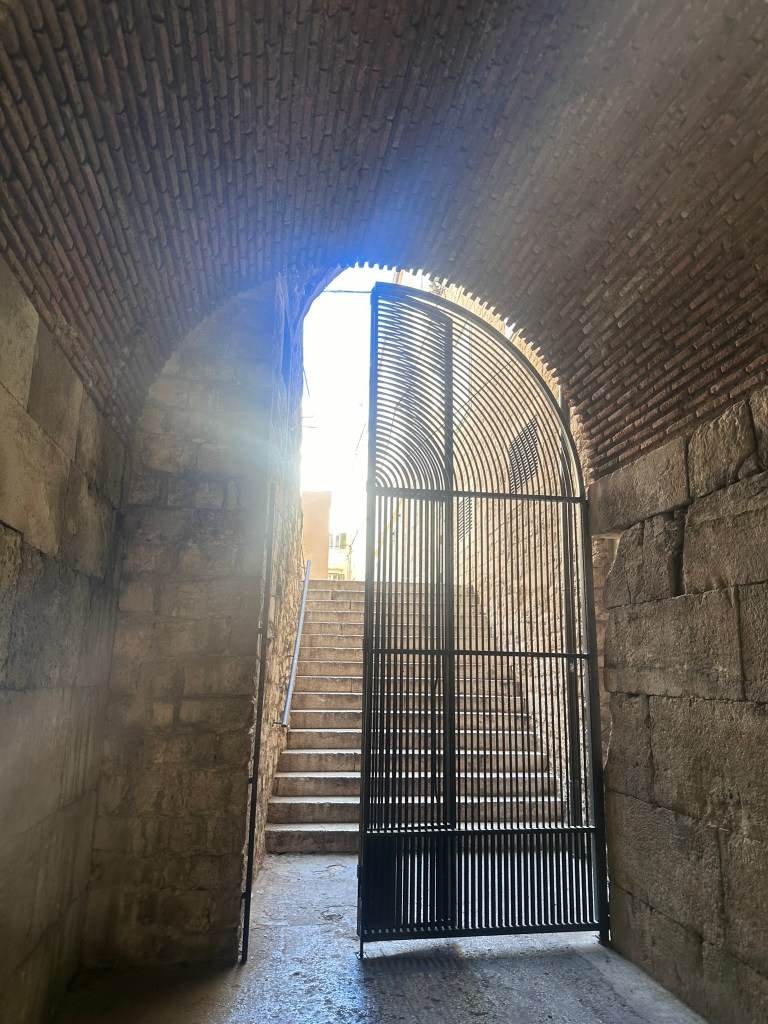
The palace has four entrances: three from the land and one from the sea. The main entrance on the north side is called Porta Aurea or the Golden Gate . The east and west entrances are named Porta Argentea or the Silver Gate and Porta Ferrea or the Iron Gate. The sea entrance is Porta Aenea or the Brass Gate .
Gold GateSilver gate Iron Gate
Decumanus Street serves as a vital connector between the east and west entrances of the ancient site, playing a significant role in the flow of both people and goods. It is interesting to note that this street is divided into two distinct sections: the northern side is primarily designated for servants and the storage of military supplies, reflecting the practical needs of the royal household and its operations. Meanwhile, the southern side is reserved for the royal family, symbolizing the grandeur and exclusivity expected of their living quarters.
On the other hand, Cardo Street begins at the impressive Golden Gate, a landmark that marks the entrance to a realm of historical significance. As it stretches towards the magnificent Peristyle, visitors encounter an open area characterized by elegant arches that form a grand entrance to the emperor’s living quarters. The Peristyle itself functions not only as a passageway but also as a magnificent social space where significant events may have taken place.
Flanking the Peristyle are notable architectural remnants, including the emperor’s substantial octagonal tomb, which has since been transformed into the Cathedral. This stunning structure captures the artistic flair of the era, standing out on the left side of the Peristyle. On the right, the iconic Temple of Jupiter further emphasizes the religious significance of the site. However, it is worth mentioning that the Temple of Cybele and the Temple of Venus, which once graced this area, are no longer present, leaving behind only echoes of their historical existence.
To gain entry into the emperor’s luxurious apartment, visitors must traverse through the Peristyle and continue into the Vestibule, a transition space that marks the encounter between public grandeur and private opulence. This journey through these corridors not only highlights the architectural brilliance of the time but also offers a glimpse into the life and surroundings of one of history’s most powerful figures.
Mosaic and other ruins
A geometric floor mosaic, made by the mosaic workshop from Salona in the late 4th and early 5th century, was discovered in 1905 during the demolition of the building located east of the Vestibule and south of the temenos wall. This exquisite mosaic adorned not only the courtyard but also the porch of a Roman building that stood majestically on the north, west, and south sides. The intricate designs and vibrant colors of the mosaic reflected the artistic skills of its makers, showcasing an elaborate pattern that likely served both aesthetic and cultural purposes. The craftsmanship displayed in this mosaic offers a fascinating glimpse into the architectural and artistic practices of the time, revealing the importance of such decorative elements in enhancing the beauty and grandeur of Roman architecture, as well as its role in turning ordinary spaces into visually stunning environments that delighted those who inhabited or visited the building.
Cellars of the Palace
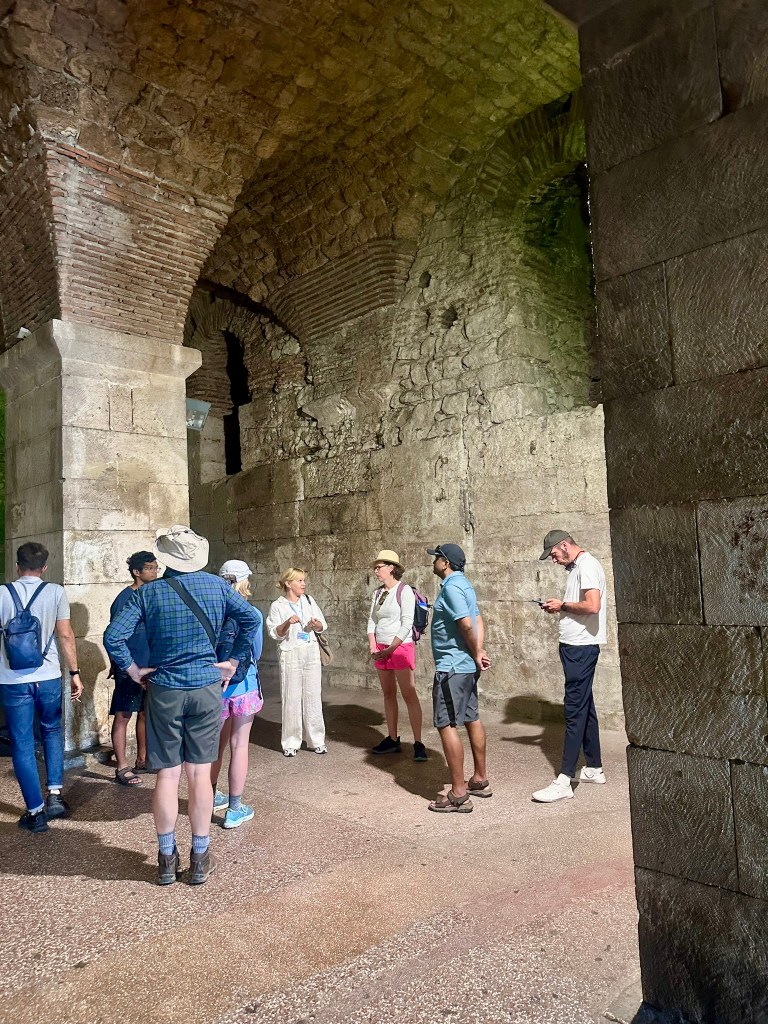
The Cellars of Diocletian’s Palace, found beneath the southern section of the palace, were once the emperor’s private residence. Their design reflects the chambers above, helping researchers understand the architecture. Built on a cliff, the cellars likely aimed to support the southern part of the palace. After the fall of the Roman Empire, they were briefly used before becoming waste pits. Partially filled over time, the cellars were rediscovered in the 19th century and have been excavated since. Today, they are managed by the City Museum and are open to visitors. The cellars have gained popularity recently as key scenes from “Game of Thrones” were filmed here, featuring Meereen, Queen Daenerys Stormborn, and her dragons. The central hall is the only area that can be visited for free. To explore the rest of the substructures, tickets can be purchased at the box office in the west wing and are valid for the entire space. Hours of operation vary by season – the schedule is available on the Split City Museum website.
People Square and Surrounding area
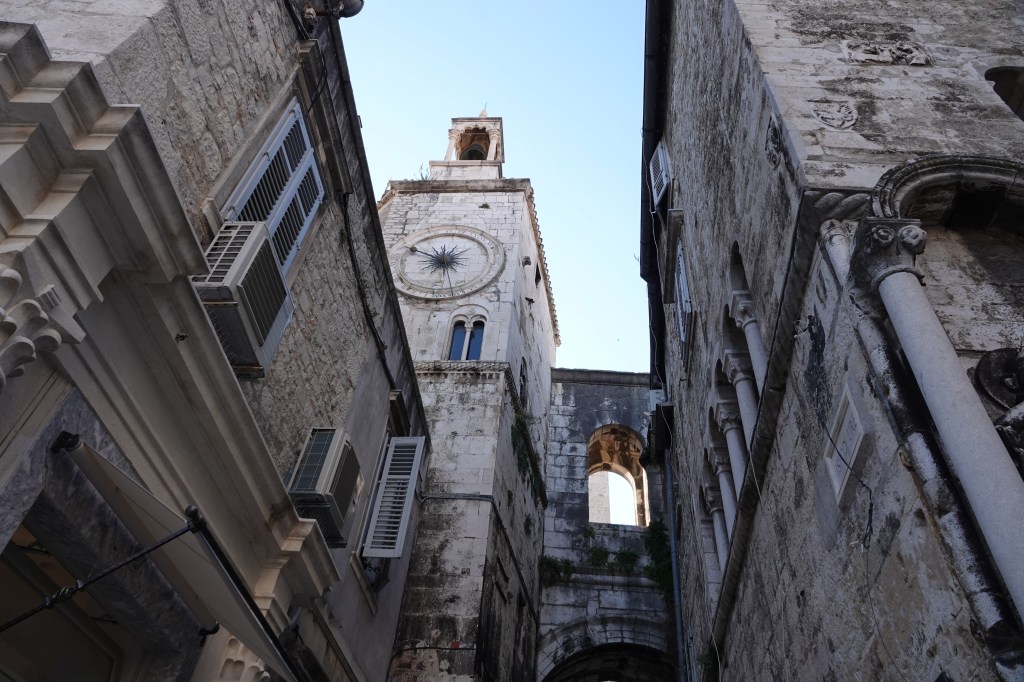
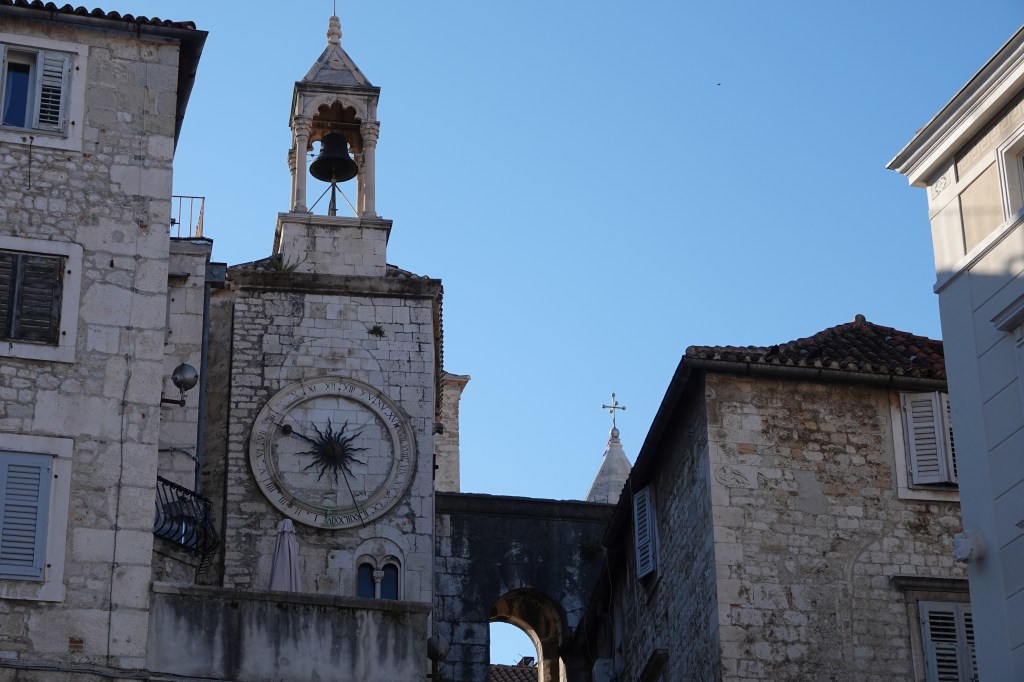
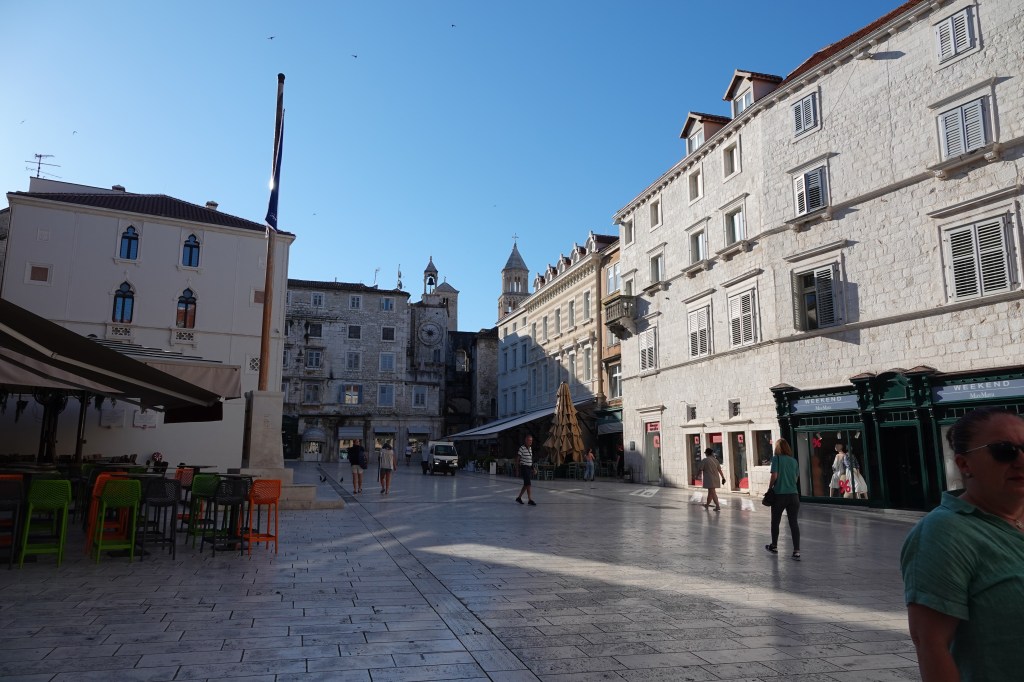
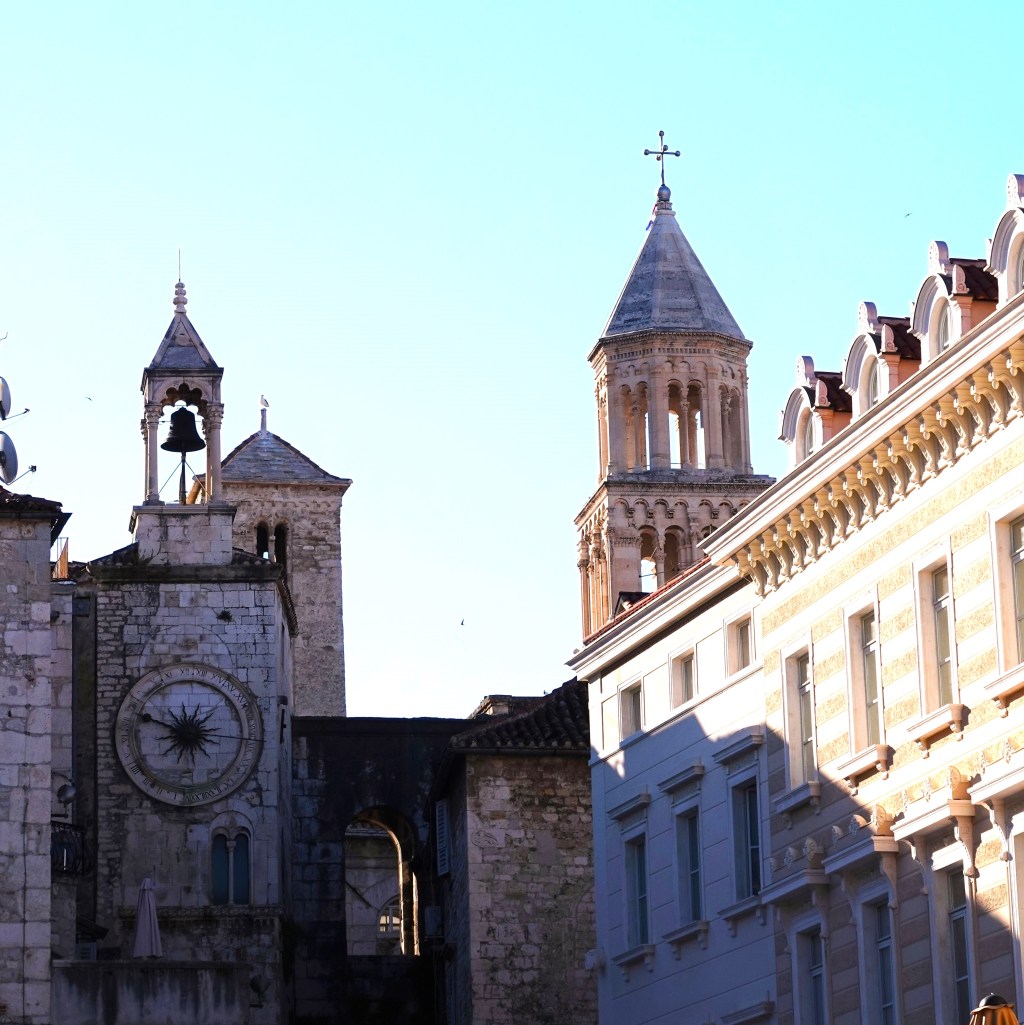
When I was roaming around old town at 7AM, I didn’t know where I was and what I was looking at but liked the old buildings in the random place and took photos of them. Later I did the research to realize that I was in people square. People square is a lively place with magnificent Renaissance and Baroque architecture with charming cafes. Known as Narodni trg in Croatian, it is just a short walk from Diocletian’s Palace . Some of the key buildings things to see in people square include Renaissance clock tower which is one of the oldest buildings in the square and impressive one is perhaps the 15th century Town Hall
People Square
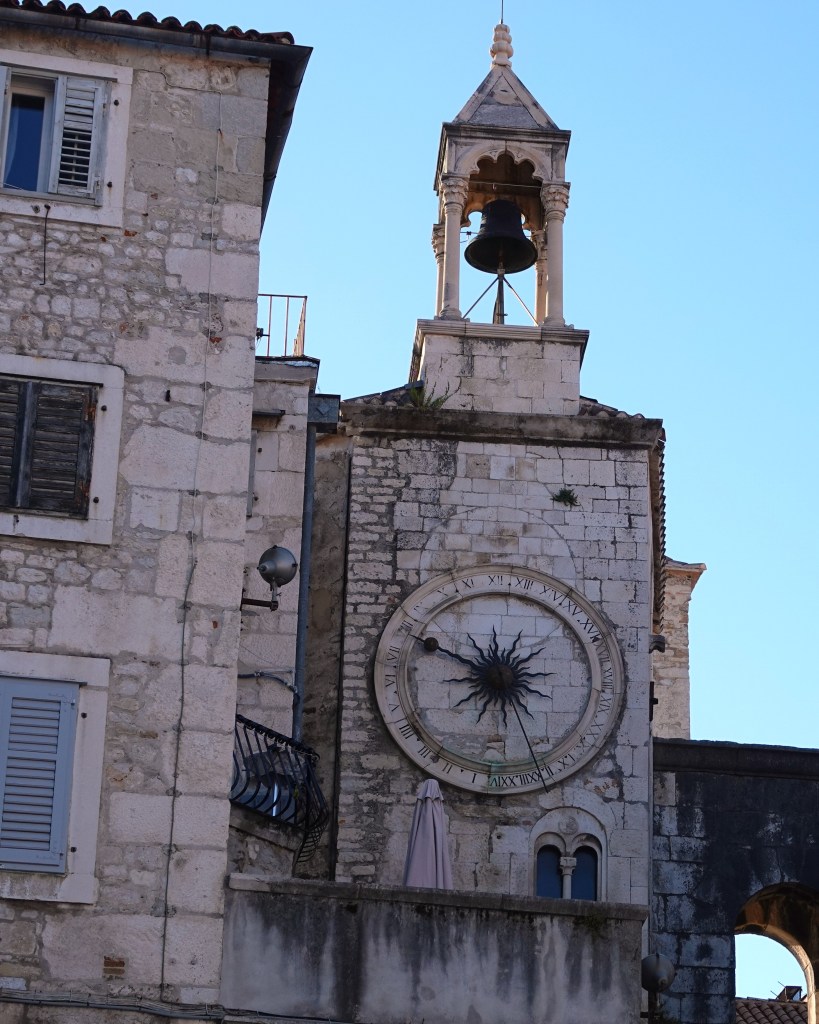
Renaissance clock tower
A Romanesque tower with a Renaissance town clock, dating back to the 15th or 16th century, stands proudly as one of Split’s most cherished symbols. This architectural marvel features a small, but exceptionally beautiful bell tower perched atop, which adds an enchanting silhouette to the city’s skyline. The city clock, remarkable in its design, is uniquely separated into Roman numerals across 24 segments, making it distinctive due to its 24 instead of the typical 12 digits. For centuries, it has been faithfully ticking away the moments on Pjaca, serving as a timeless reminder of the city’s rich history and cultural heritage. Locals and visitors alike gather around this historic site, marveling at its intricate details and the stories it has witnessed, making it not just a functional timepiece, but also a beloved landmark that connects the past with the present in stunning fashion.
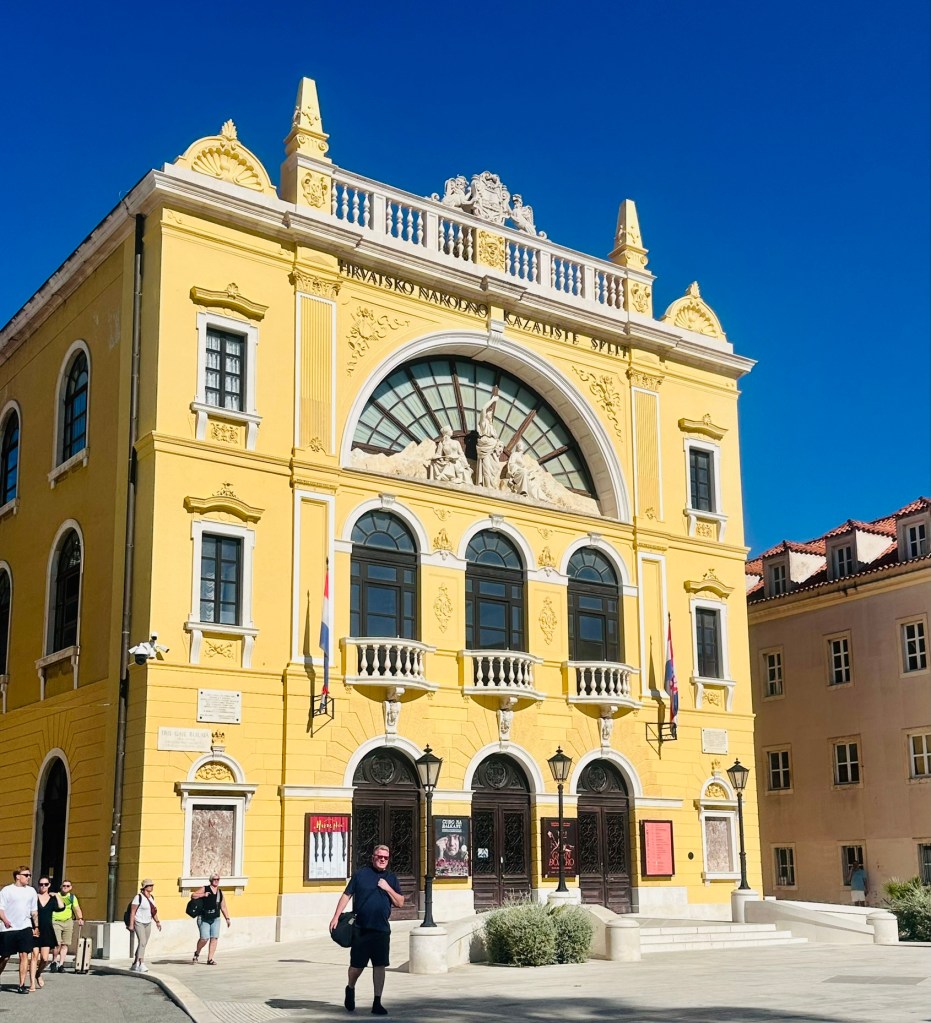
Croatian National Theater building
Walking around old town split in the early morning and being lost of on purpose led to me discover several beautiful buildings including the bright yellow building- Croatian National theater building built in 1893
Croatian National Theater
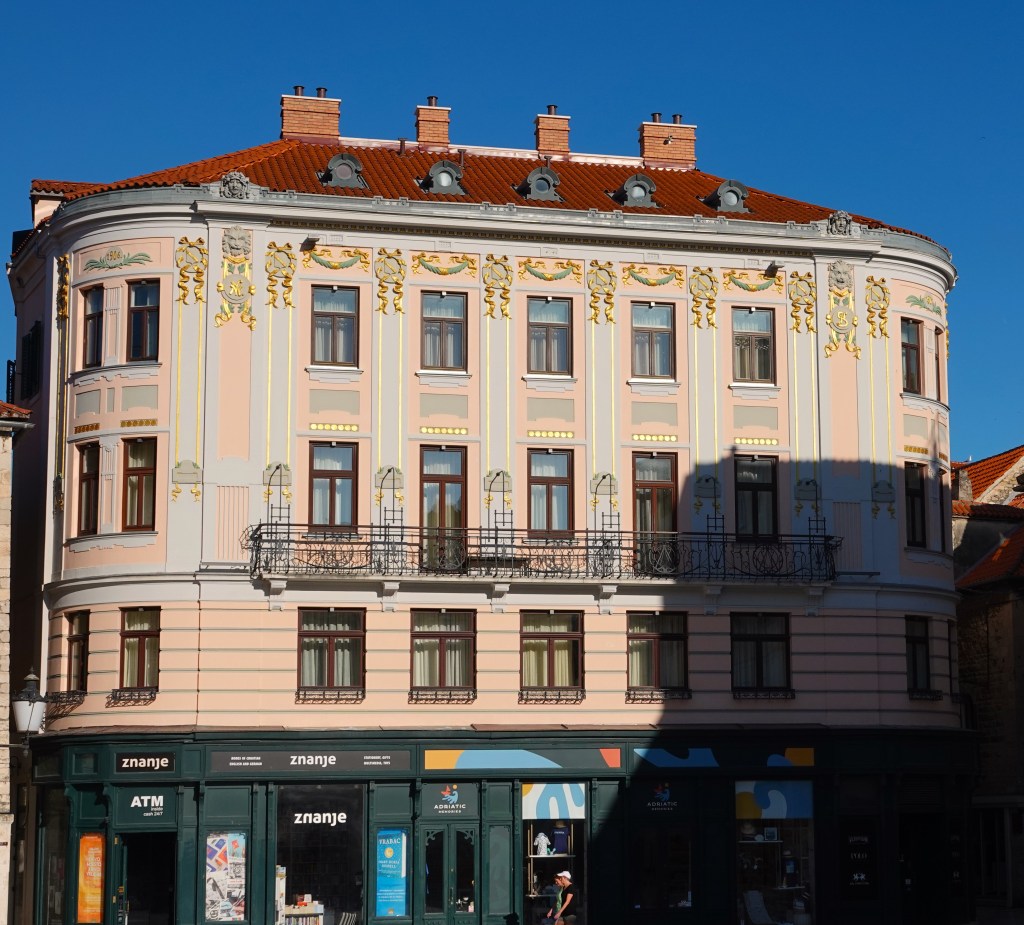
House of Nakic
House Nakić in Split- Built between 1901-1906 as the private house of the furniture dealer Vicko Nakić, this is monumental three-story building with an irregular trapezoidal floor plan with a small inner courtyard and possibly the oldest art Nouveau building in Split. I loved the beautiful design and constrating color of green and yellow
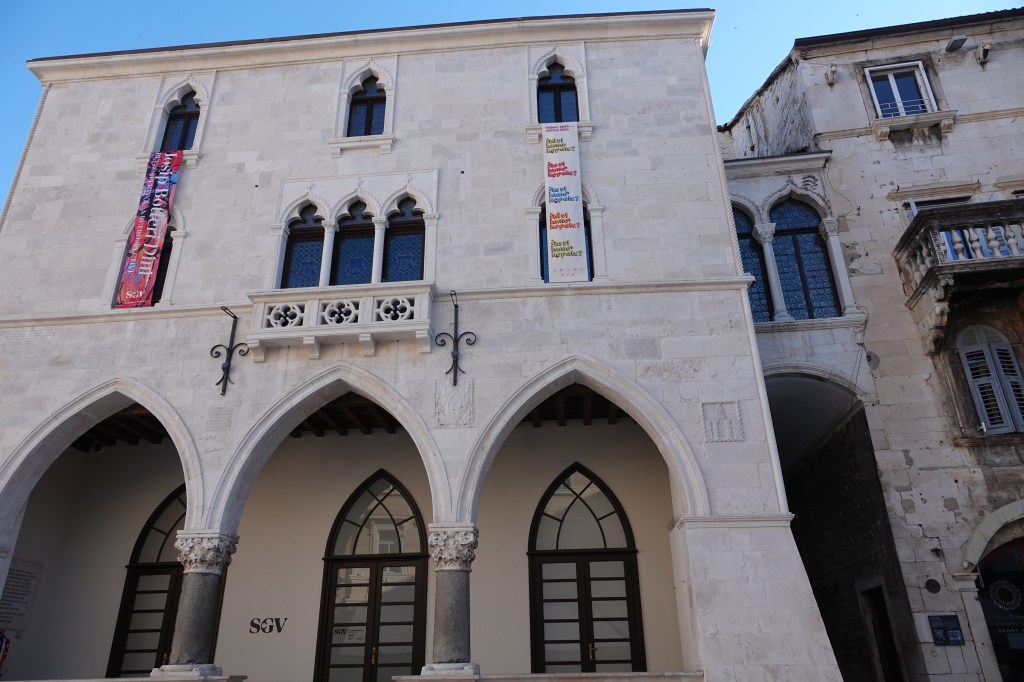
Old town hall
The Gothic-style Old Town Hall is situated in Narodni Square, adjacent to the walls of Diocletian’s Palace. It stands as the sole remaining structure of a complex that was obliterated in 1825, which formerly encompassed the Rector’s Palace, the theater, and the city jail. The building underwent renovation in the neo-Gothic style in 1890. From 1910 until 2005, it served as the ethnographic museum; however, presently, the palace is utilized for temporary exhibitions showcasing works by local artists, as well as for various events. This three-story edifice, during its tenure as the town hall, had its upper levels allocated for administrative functions.
Prokurative Or Republic Square
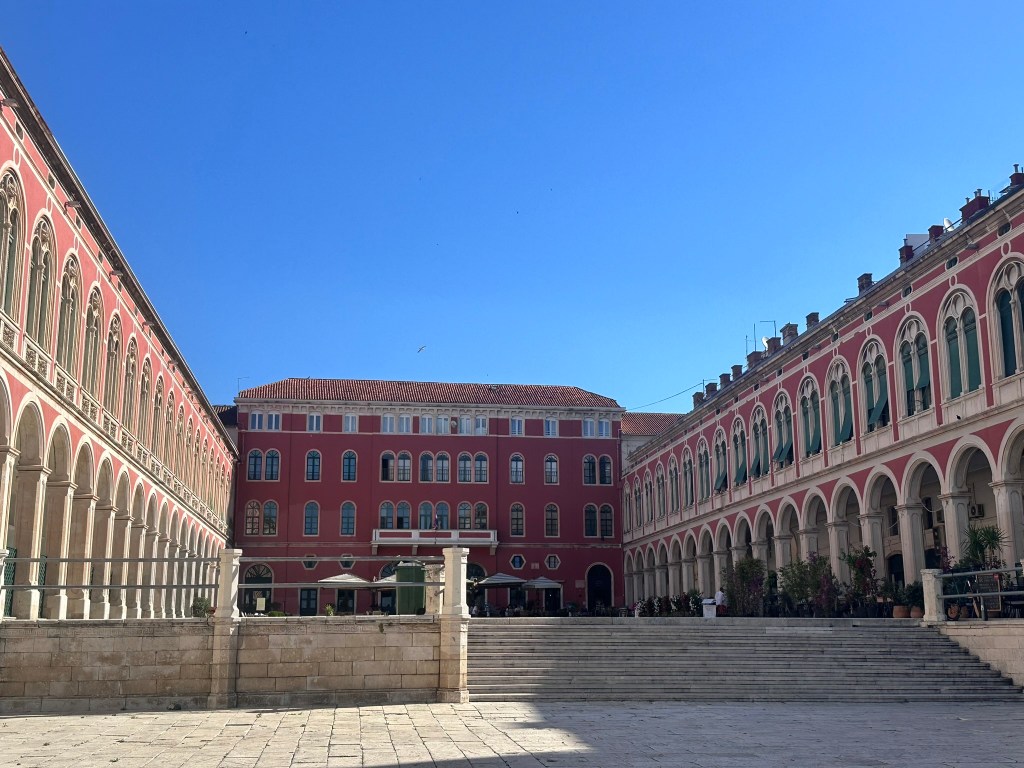
Prokurative, officially known as Republic Square, is inspired by Italian architecture and resembles St. Mark’s Square in Venice. Located on the Riva, it is named after the arches of the neo-Renaissance buildings that surround it on three sides. The square is open on the south side, offering a lovely view of the harbour and waterfront. The construction of Prokurativa began in the mid-19th century under the mayor Antonio Bajamonti, showcasing Split’s support for Italian tradition. This is reflected in the colonnade and the designs above the windows. The square is a popular spot for cultural events, especially music festivals, and local bars and restaurants attract many residents. During summer, it buzzes with activity thanks to numerous cafés offering various types of food.
Final Thoughts
Split is beautiful city with so much to offer both in terms of great views of Adriatic sea, culture and history. We enjoyed our 3 day stay in Split and surrounding area. Staying close to old town definitely has advantage as you can explore the old town and palace without crowds even during peak summer.












 Peaks to Palaces