Off the beaten path in Hampi- Chakra Thirtha, Coracle ride and riverside temple ruins

There are places in Hampi where history feels loud—grand mandapas, towering gopuras, bazaars that once echoed with royal processions. And then there are places where history whispers. Chakratirtha is a rare spot. Mythology, river, stone, and silence unite in a way that feels almost otherworldly.

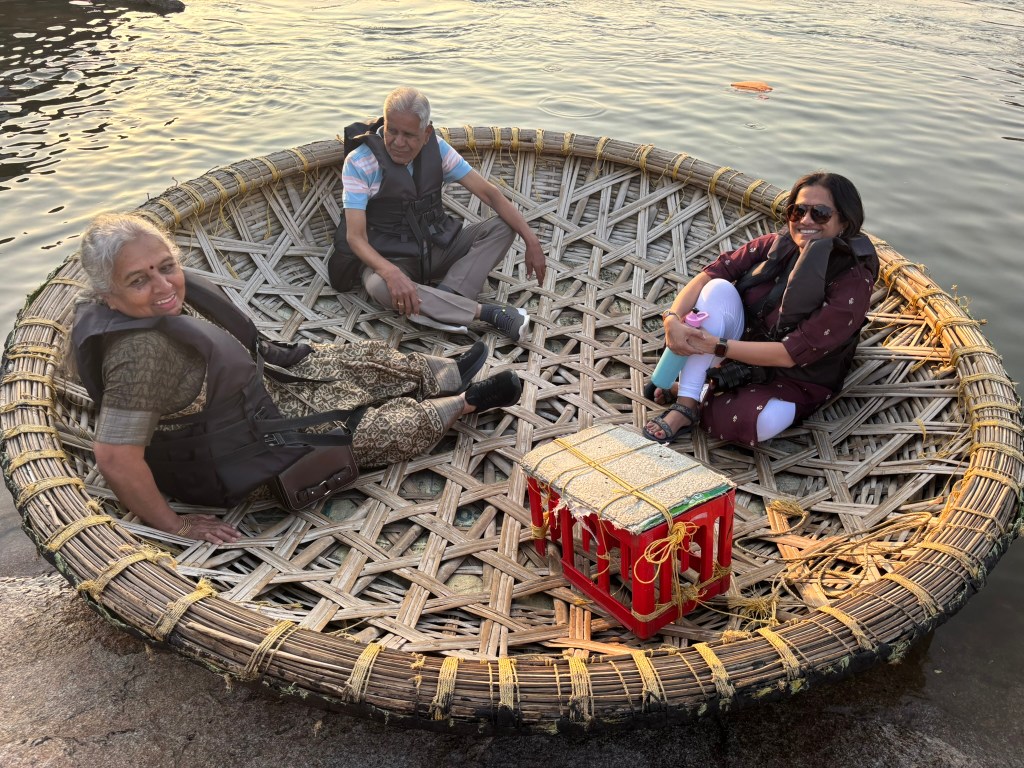
The coracle ride and a visit to the river ruins weren’t part of our itinerary. Nevertheless, they turned out to be among our best experiences. I highly suggest taking a guided tour of the ruins, as there are no markings or directions. Also, we rented the entire theppa, which made it easier to do what we wanted. Sunset is the best time for this visit

  1. Chakratirtha Where the River Swirls with Legends
  2. Setting Off on the Coracle: A Journey Into Stillness
  3. Stopping at the Secret Shrines Along the River
    1. 🕉️ Sahasralinga: A Thousand Lingas in Stone
    2. 🛌 Anantasayana: Vishnu in Eternal Repose
  4. Other river ruins worth visiting
  5. Narasimha Temple: A Quiet Shrine Revealed by the River
  6. The Kampabhupa Pathway: Echoes of Ancient Pilgrims
  7. Final thoughts

Chakratirtha Where the River Swirls with Legends

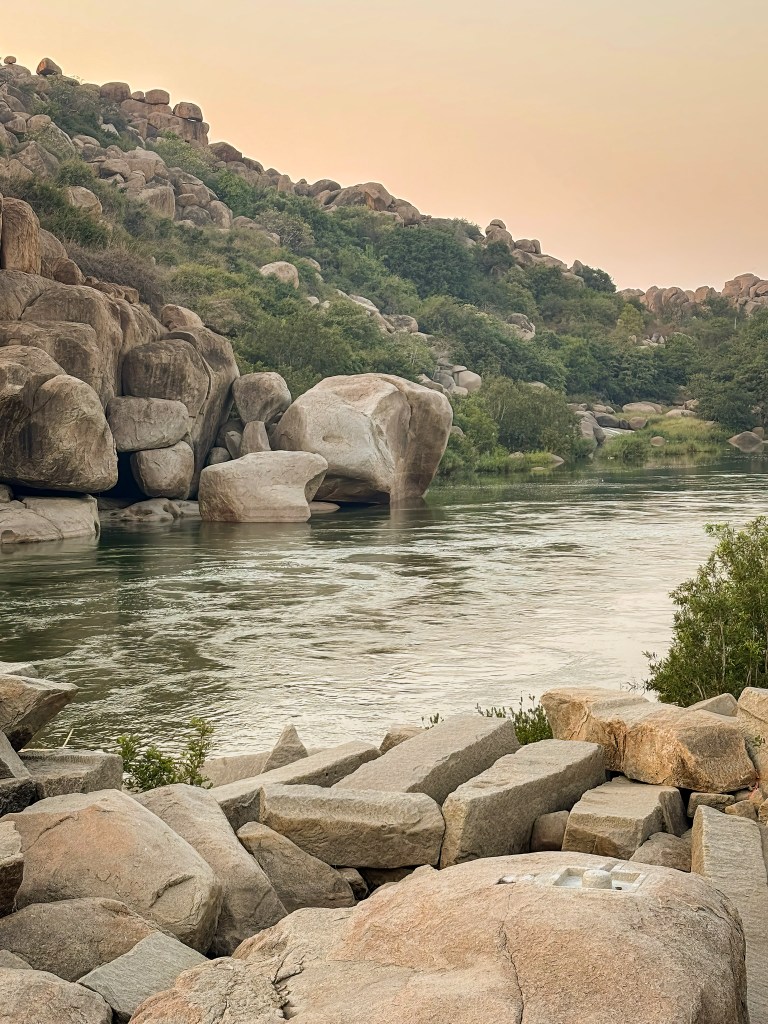
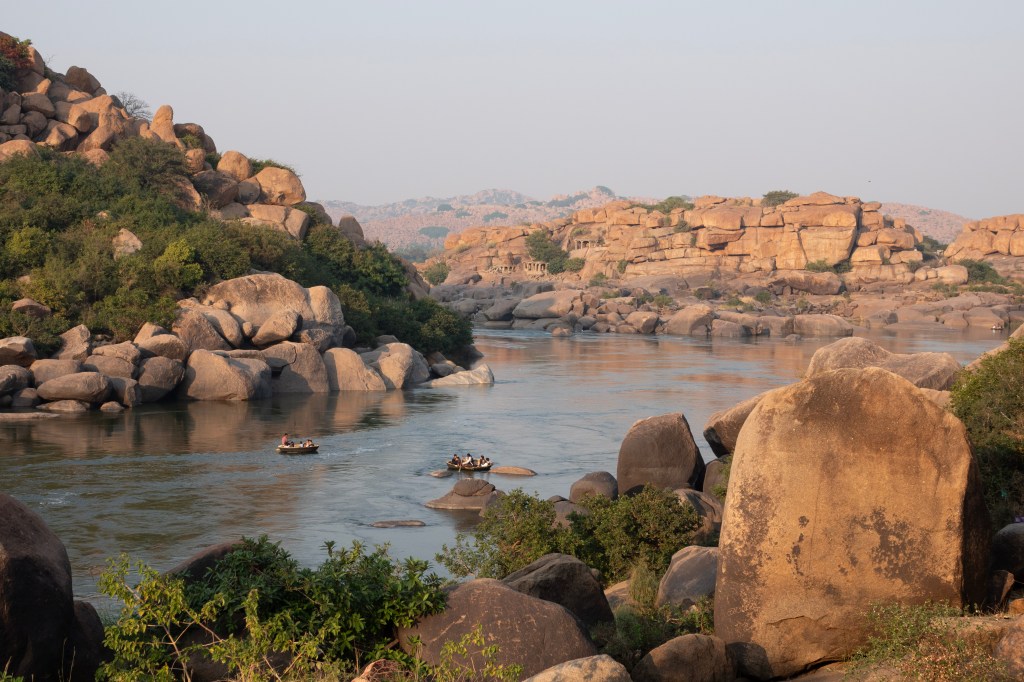
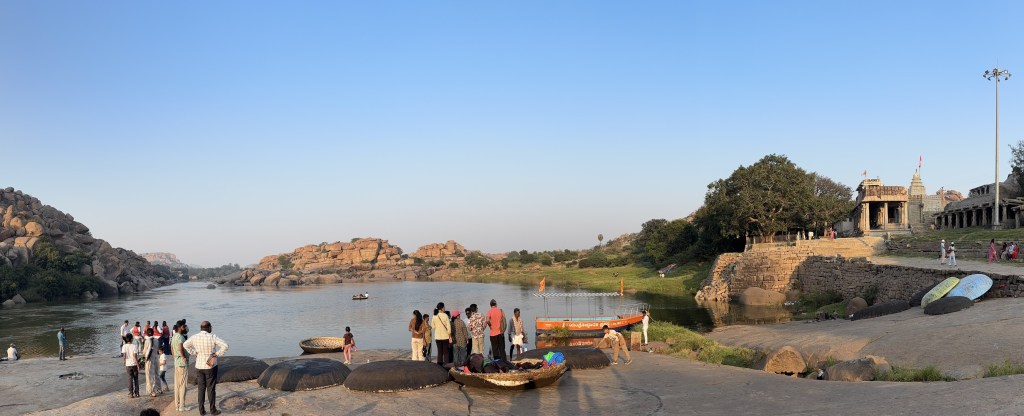
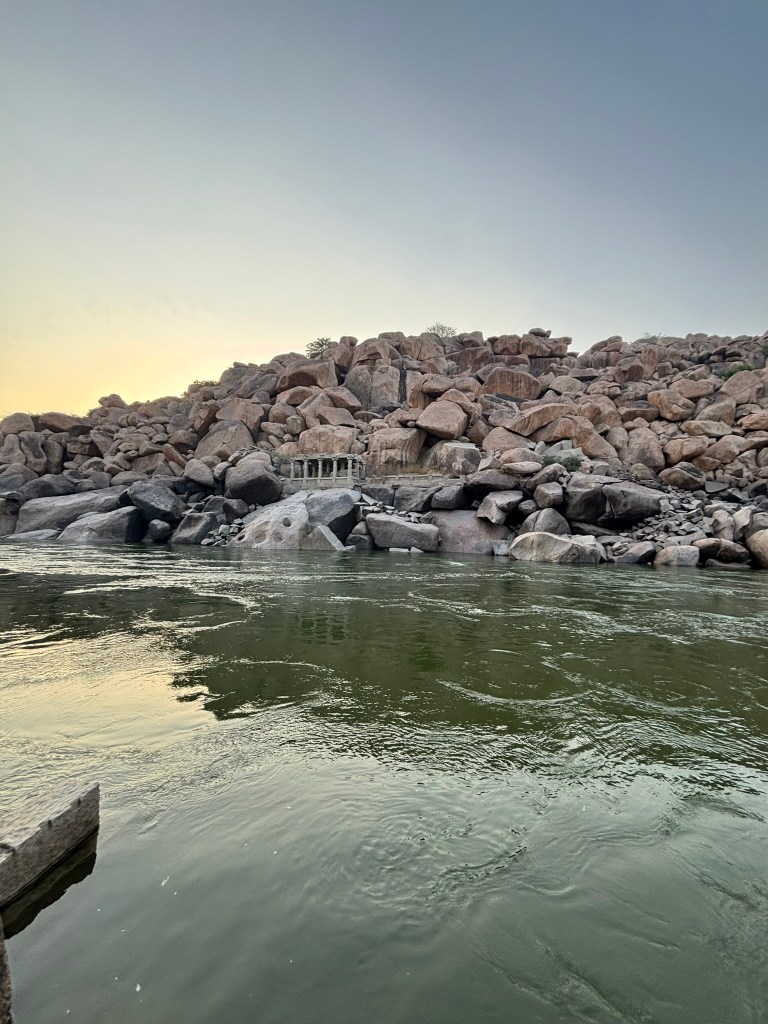
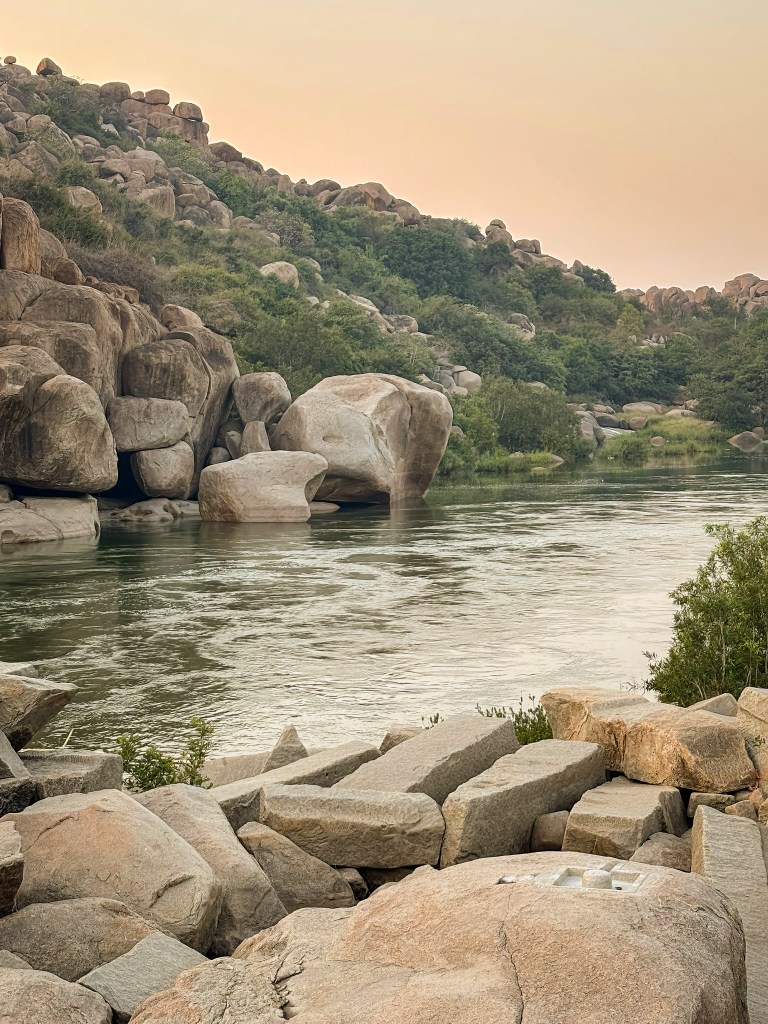
Chakratirtha—literally “the sacred water body that swirls”—sits at the valley point between Matanga Hill and Rishyamukha Hill. Here, the Tungabhadra narrows, bends, and gathers force, creating a natural whirlpool that locals believe carries divine imprints. On auspicious days, pilgrims report seeing the forms of Rama, Sita, and Lakshmana in the swirling waters.

This is also the spot where, according to legend, Lord Shiva handed the Sudarshana Chakra to Lord Vishnu. The river, ever in motion, is said to echo that cosmic exchange.

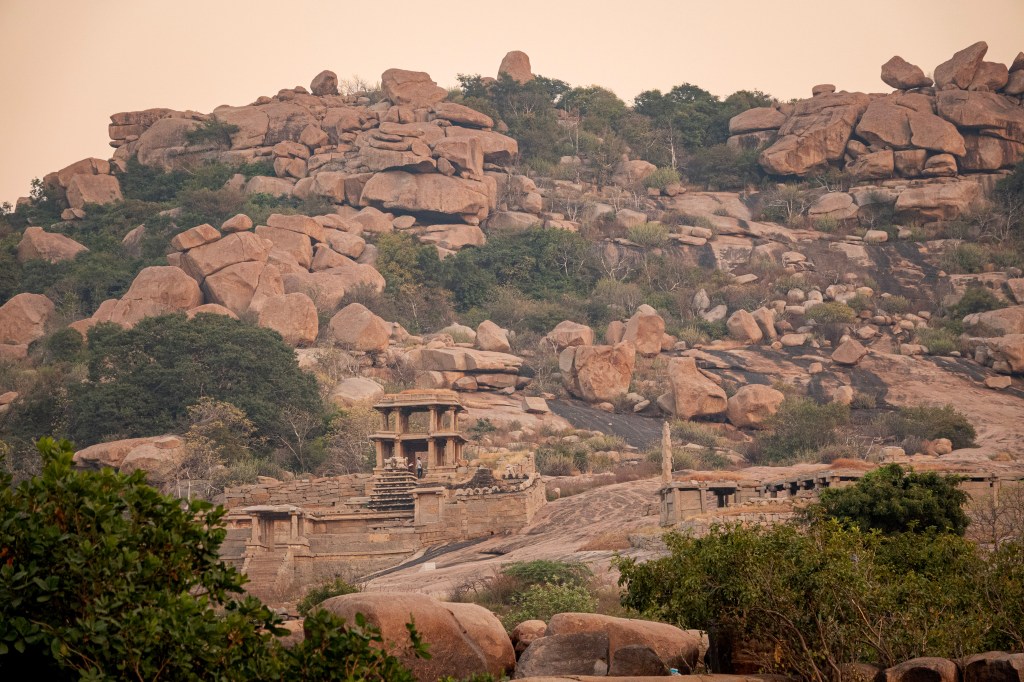
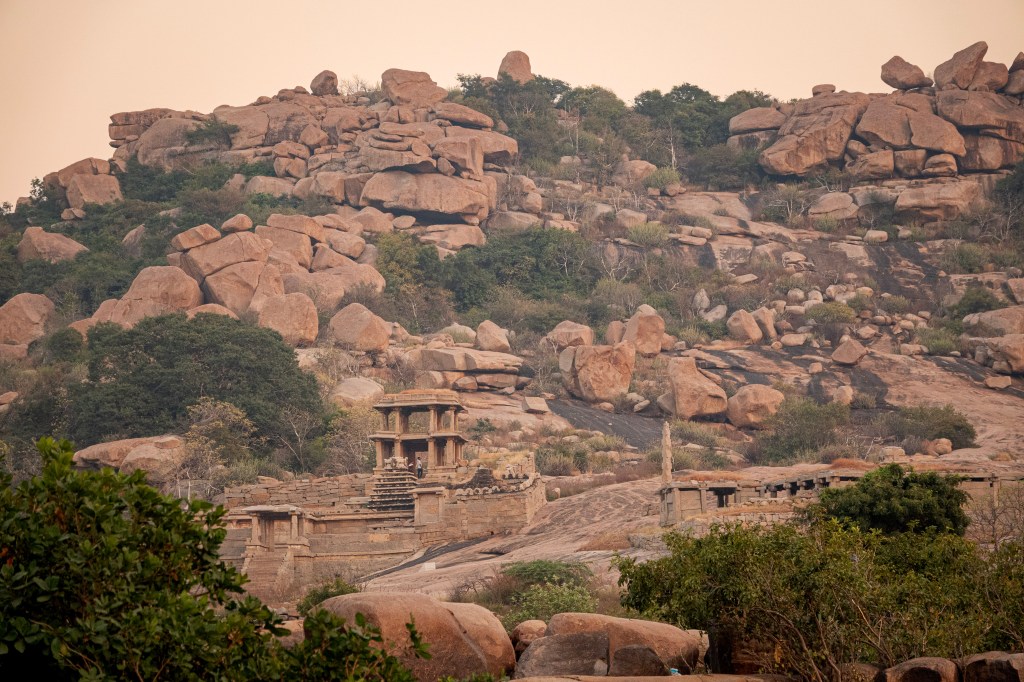
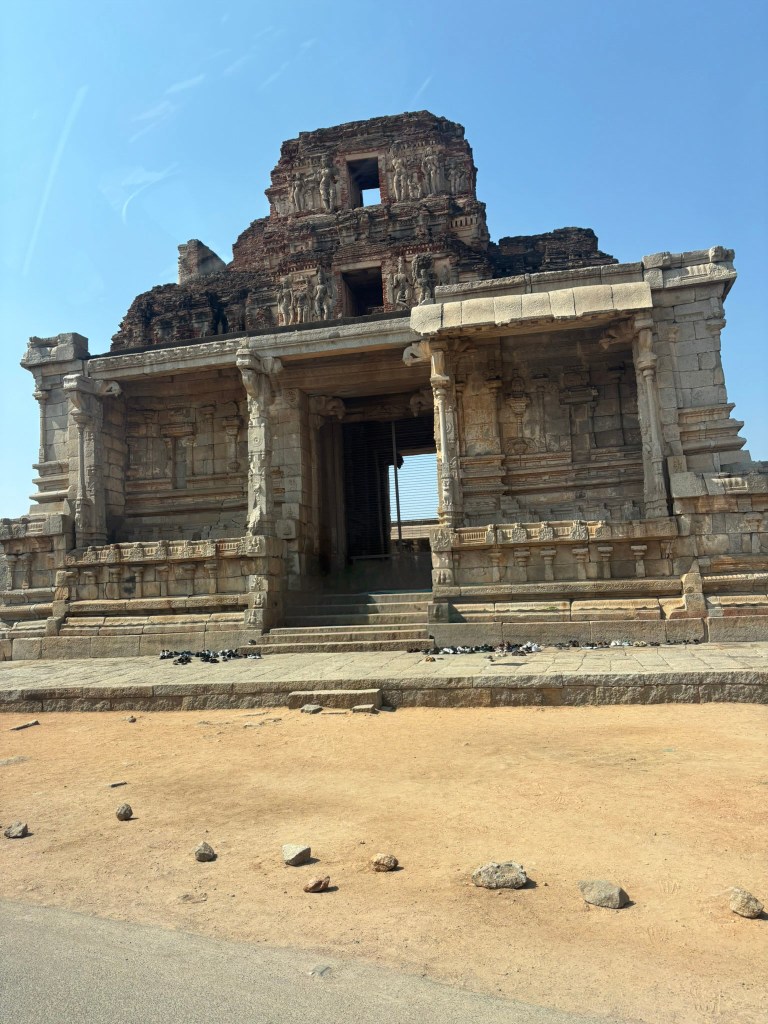
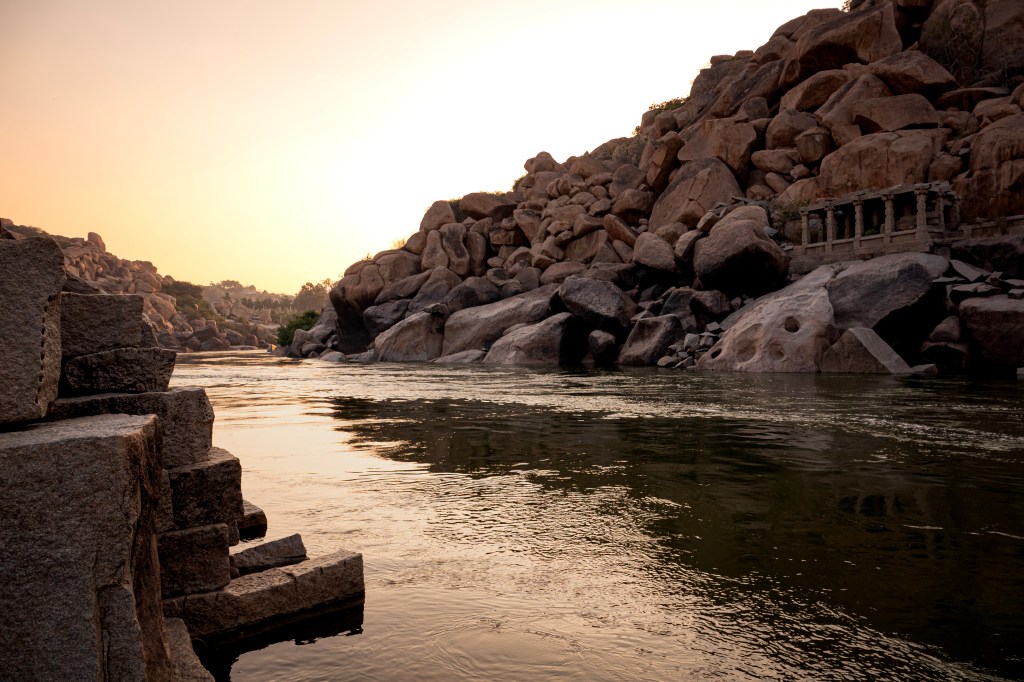
Pilgrims still take a holy dip here before climbing the steps to the Kodandarama Temple—a shrine carved into a massive boulder. At the Kodandarama temple, Rama stands with a bow in hand. Sita is to his left. Lakshmana and Hanuman are by his side. The nearby ancient pavilions are weathered yet dignified. They have sheltered generations of devotees. People have paused here to rest or pray. Others have simply breathed in the place’s sanctity.

Setting Off on the Coracle: A Journey Into Stillness

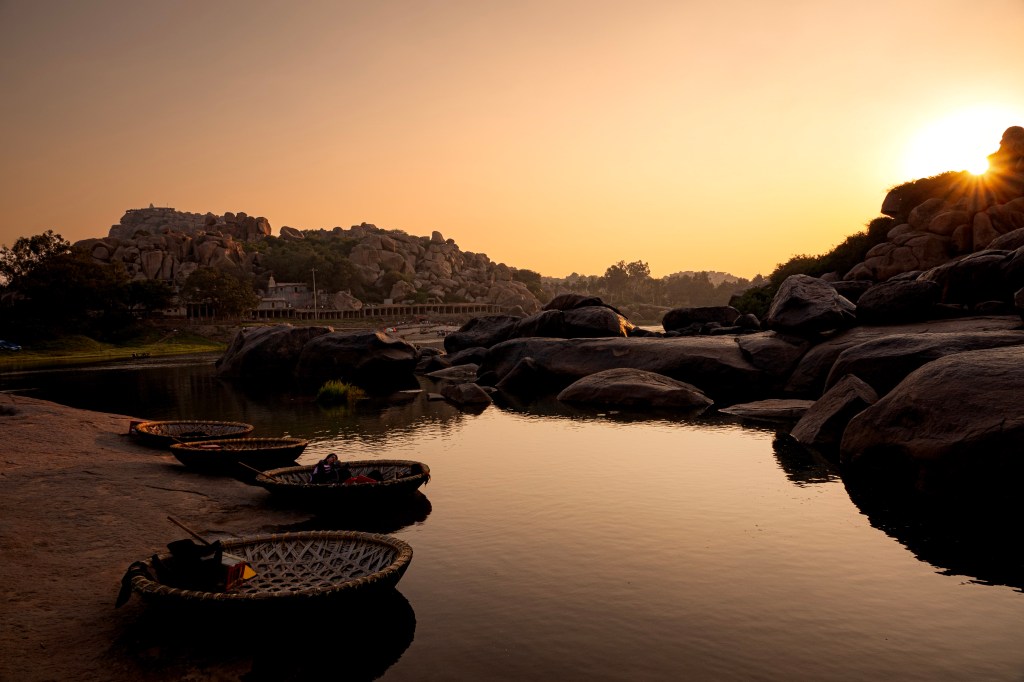
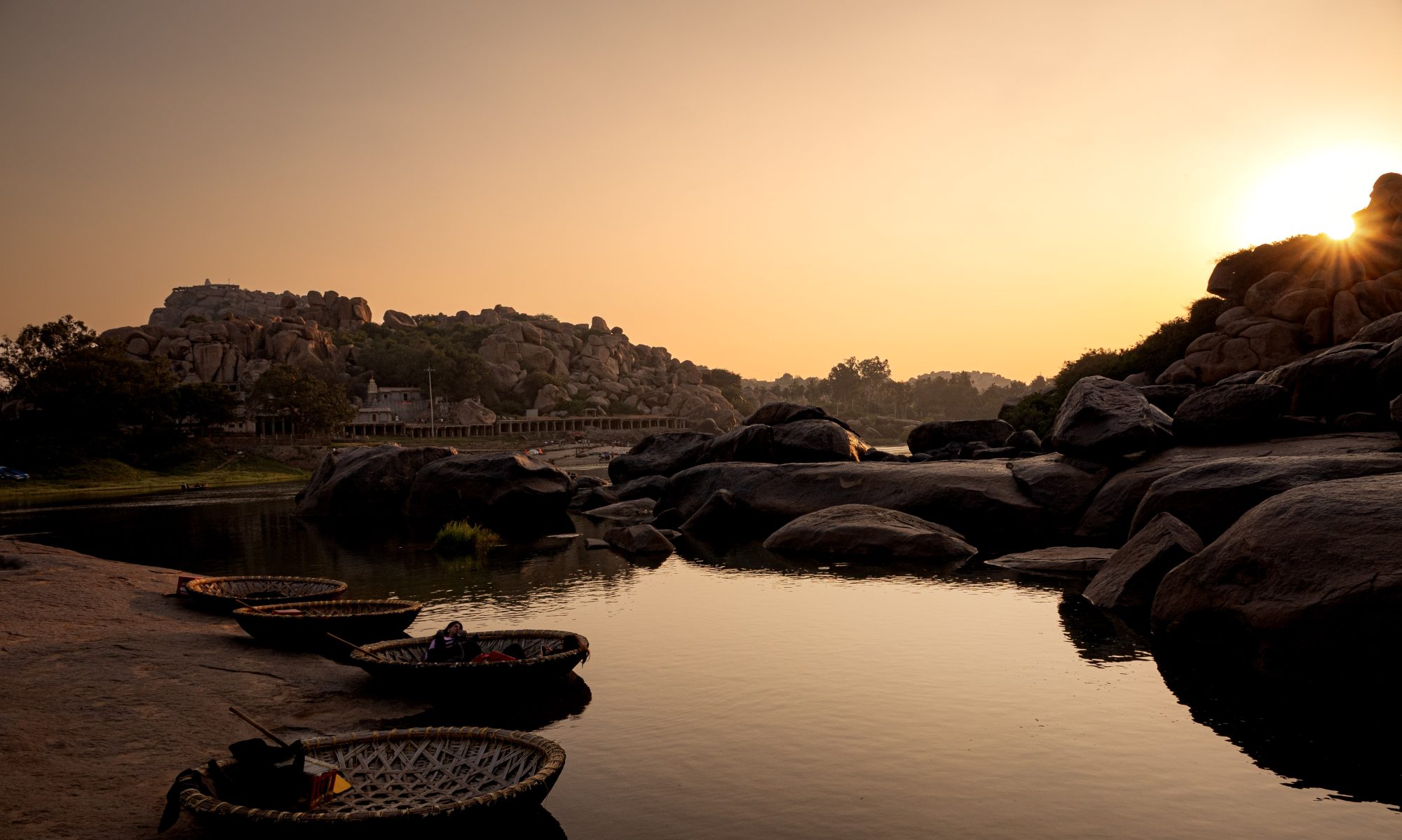
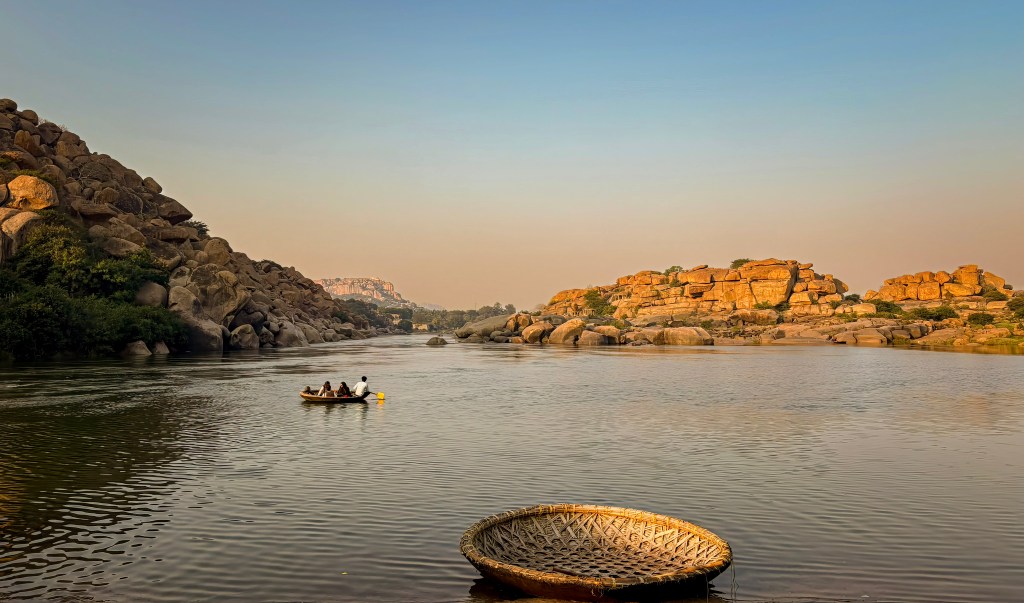
From the flat rocky bank—etched with Shiva lingas, footprints, and devotional carvings—you’ll spot coracles drying in the sun. These round bamboo boats, tar‑coated and impossibly light, are your gateway to one of Hampi’s most serene experiences.

There’s no motor, no rush—just the rhythmic dip of the oar and the soft lap of water against bamboo. It’s the kind of silence that makes you notice everything. You see the shimmer of weeds drifting downstream. You notice the play of light on boulders. You hear the faint echo of temple bells carried by the wind.

A coracle ride at Chakra Tirtha is one of Hampi’s most iconic experiences, blending ancient transportation with spiritual sightseeing. Locally known as Teppa or Dongi, these circular boats have glided across the Tungabhadra River for centuries

The Chakra Tirtha Experience

The ride at Chakra Tirtha is highly scenic. It navigates a narrow, boulder-strewn stretch of the river.

  • Key Highlights: Rides typically pass the Anantashayana Vishnu carving. It features a massive reclining Vishnu relief. You will see the Sahasra Linga, comprising 1,008 Shiva Lingas carved into a single rock bed. The rides also showcase diverse riverside ruins.
  • Cost & Duration: A 30-minute ride typically costs ₹500 per person. A full-hour ride (covering more ruins and islands) costs ₹800 to ₹1,000. We hired the entire coracle for 3 of us. We paid approximately 6000 per hour. It was a more intimate guided tour with the boatman. I was pleasantly surprised to see life jackets being provided for this ride.
  • The “Spin”: For an adventurous touch, boatmen often give the coracle a high-speed spin in the water upon demand. 

History of the Theppa or Coracle

The coracle is one of the world’s oldest boat designs, used for over 2,000 years for fishing

  • Ancient Origins: In the 16th century, the Portuguese traveler Domingo Paes marveled at these “round basket-boats.” He noted their ability to carry up to 20 people.
  • Strategic Design: The circular, bowl-like shape was perfected for Hampi’s unique environment. It allows the boat to run aground. This prevents capsizing, making it ideal for the river’s strong currents and shallow, rocky beds.
  • Traditional Construction:
    • Frame: A lattice of split bamboo or willow shoots.
    • Skin: Historically made of animal hides (bullock or horse), modern coracles now use heavy-duty plastic or PVC sheets.
    • Waterproofing: The exterior is coated with bitumen (tar) or resin to guarantee total water tightness.
  • Legacy: During the Vijayanagar Empire, they were vital for transporting grains, construction materials for temples, and ferrying pilgrims to holy sites

Stopping at the Secret Shrines Along the River

The beauty of the Chakratirtha coracle ride is that it doesn’t just take you across the river. It takes you into Hampi’s hidden spiritual landscape.

🕉️ Sahasralinga: A Thousand Lingas in Stone

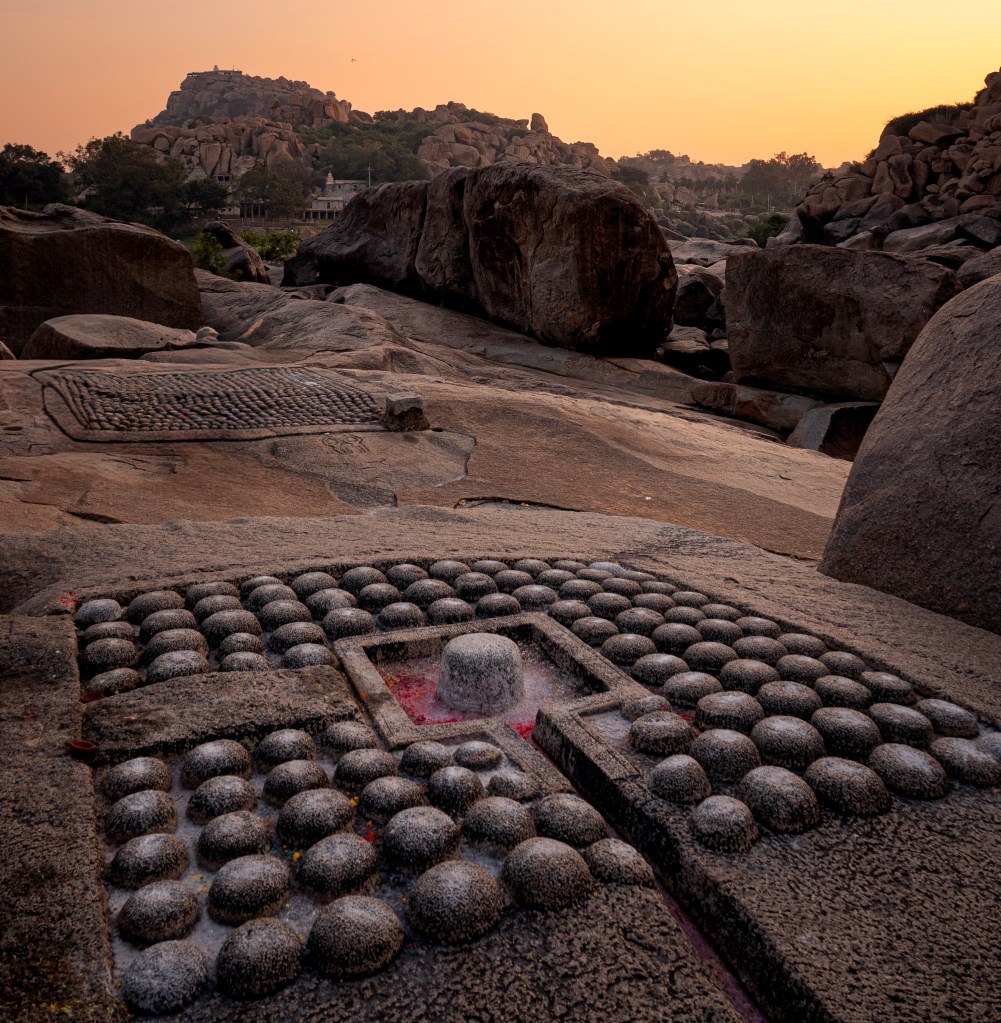
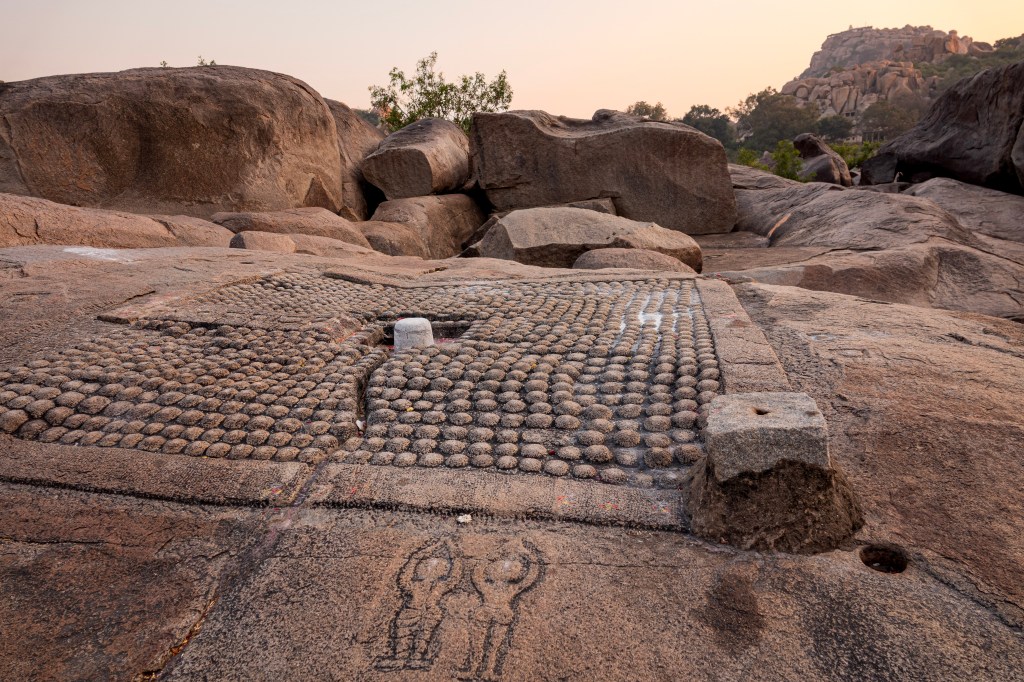
You glide a short distance downstream and come to a quiet stretch of riverbank. Our coracle stopped here. We were guided towards the hidden temples. The first of these is Sahasra Linga or Koti linga. Reaching this location required some boulder-hopping, and there is no clear direction. I don’t think we would have found this place without our boatman leading the way.

Sahasra Linga is a significant rock-cut site. It features two primary groups of lingas: one set of 108 and a larger, symmetrical grid of 1,008.

Location & Access

  • Proximity: It is located a short distance (approx. 400–500 meters) east of the Chakra Tirtha bathing ghat, along the southern bank of the Tungabhadra River.
  • Accessibility: Reaching the site by land requires a challenging trek over uneven boulders.
  • Visibility: The carvings are best viewed during the dry season (December to May). River levels are low during this time. Many carvings can become submerged during the monsoon.

Why were lingas carved into the rock bed? I wasn’t able to find a clear answer to the origin of these remarkable carvings. Some researchers suggest that the carvings date back to the Vijayanagara Empire. These intricate designs were likely meant for worship and reflection in an open-air sanctuary. The second theory is that these lingas might have been crafted by devotees. They could have created them as a form of devotion and reverence. Additionally, our guide mentioned that a sage created these carvings. He wanted to offer a convenient alternative for worshipers who could not visit the famous Koti Lingas spread across Hampi.

Symbolism: The number 1,008 is spiritually significant, corresponding to the Shiva Sahasranama (the thousand names of Lord Shiva).

🛌 Anantasayana: Vishnu in Eternal Repose

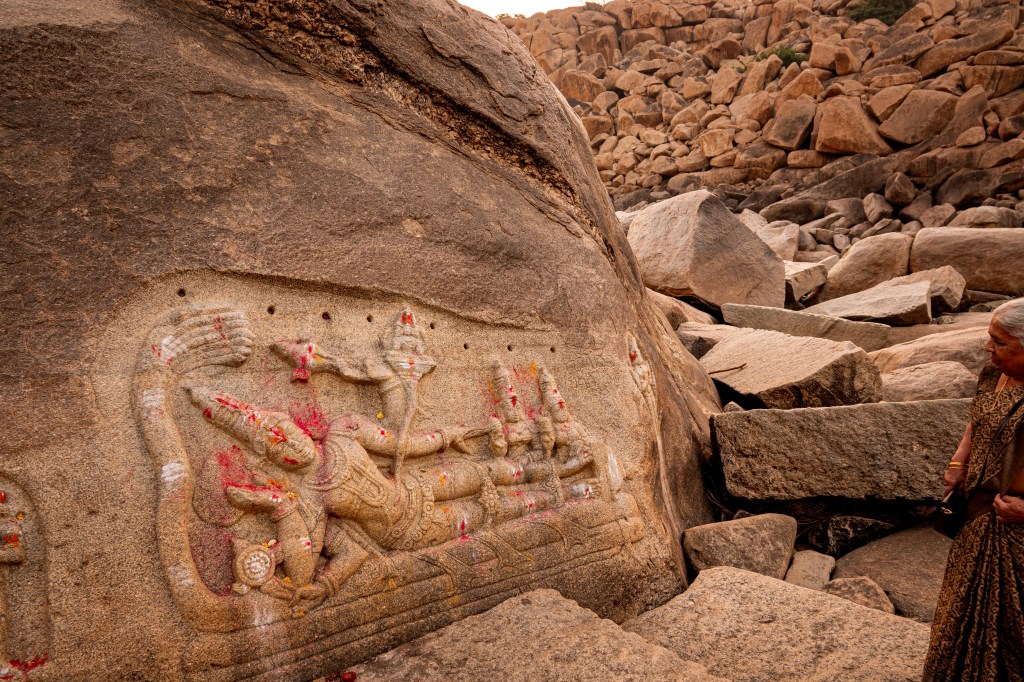
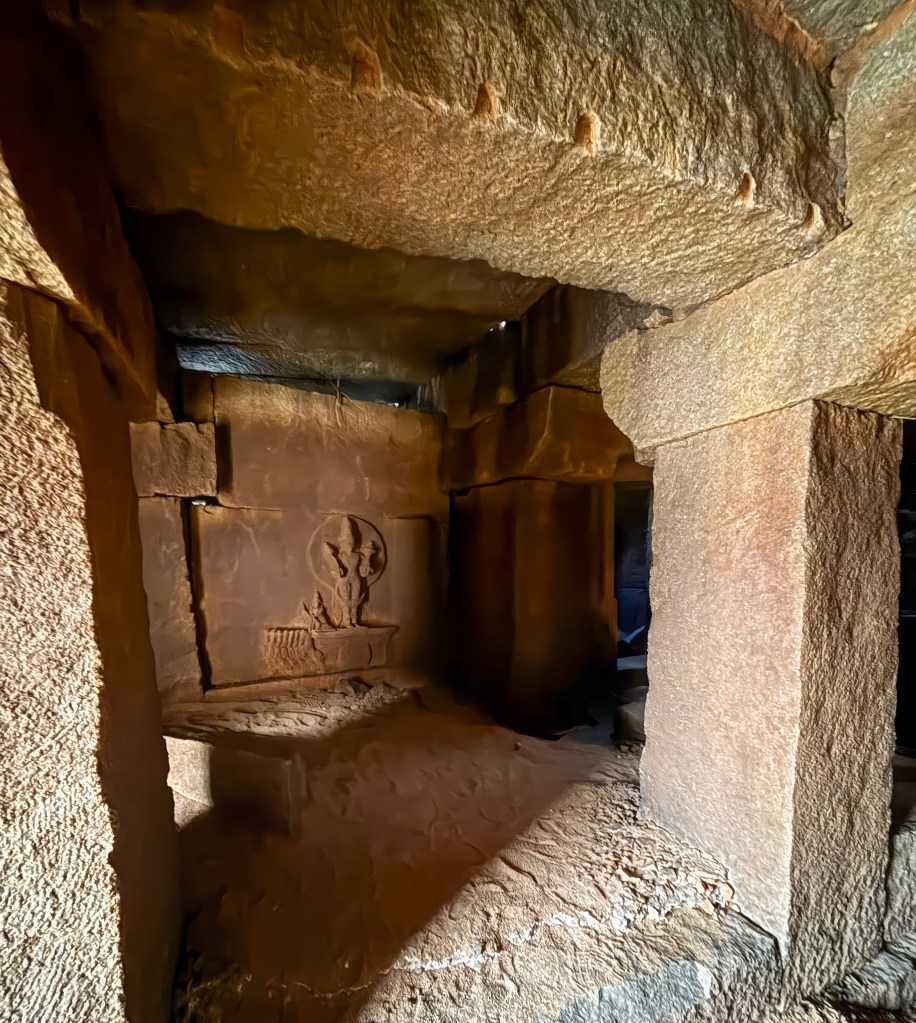
Further along the river, tucked between boulders and half-hidden by the landscape, is one of Hampi’s most peaceful carvings. It is Anantasayana, the reclining Vishnu.

Here, Vishnu rests on the serpent Adishesha, eyes half-closed, the world held in balance by his cosmic sleep. The carving is weathered, softened by centuries of wind and water, but its serenity is unmistakable.

There’s something profoundly calming about arriving here by coracle. You step onto the warm rock. The river flows quietly behind you. Suddenly, the entire scene feels like a meditation.

Other river ruins worth visiting

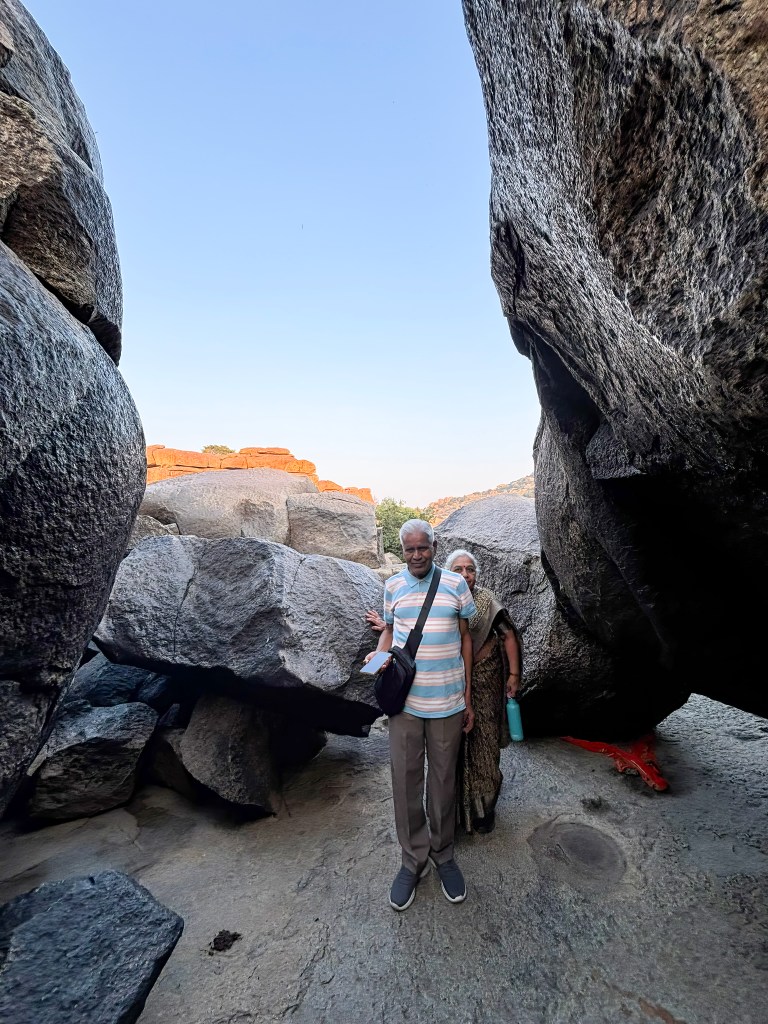
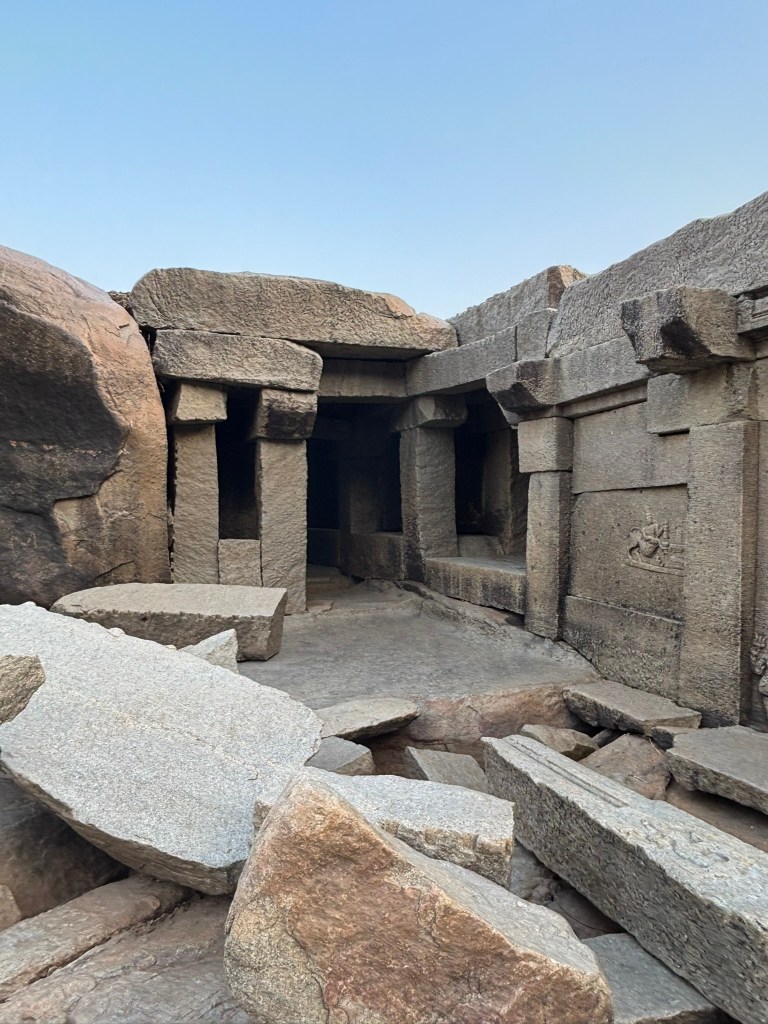
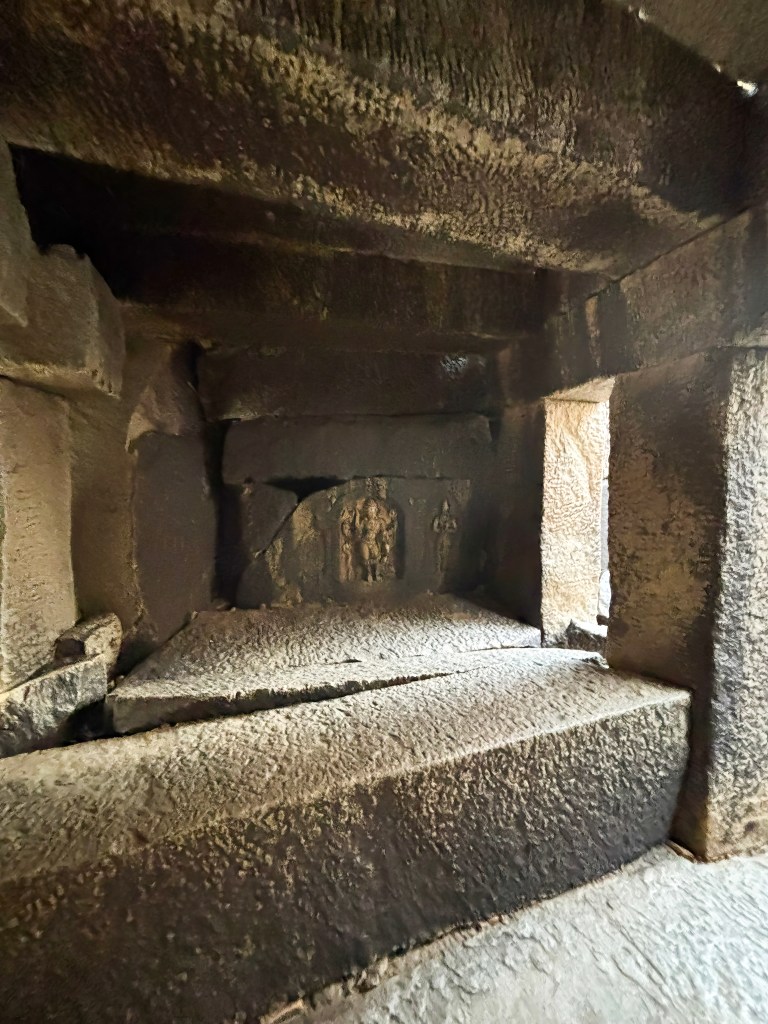
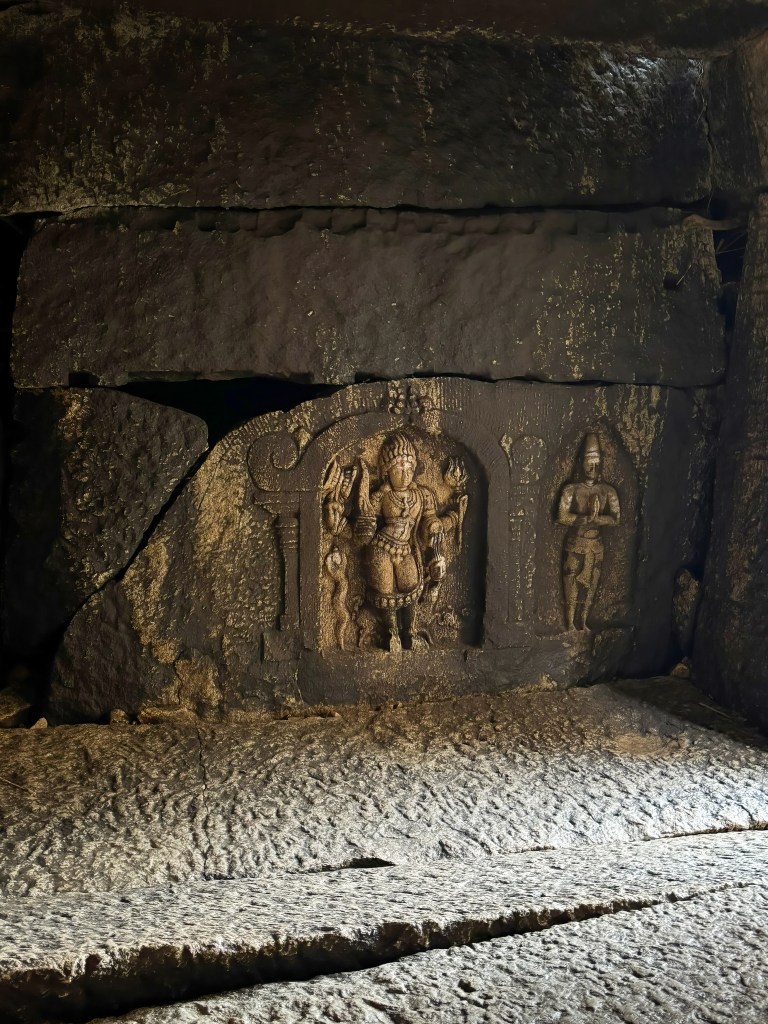
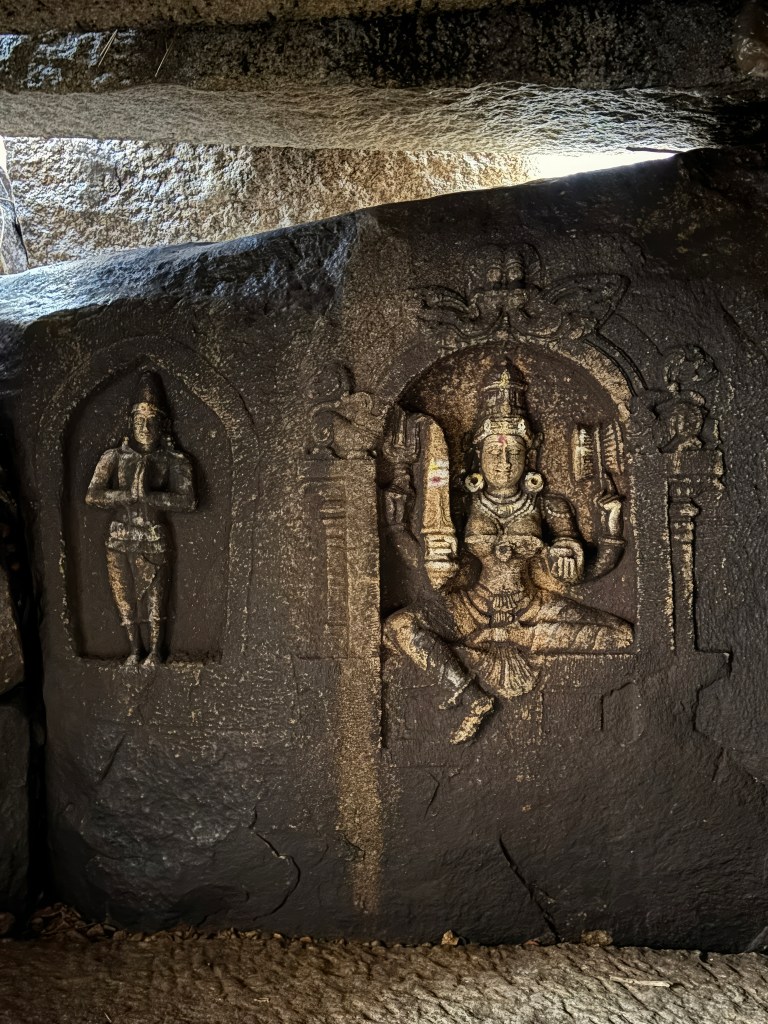
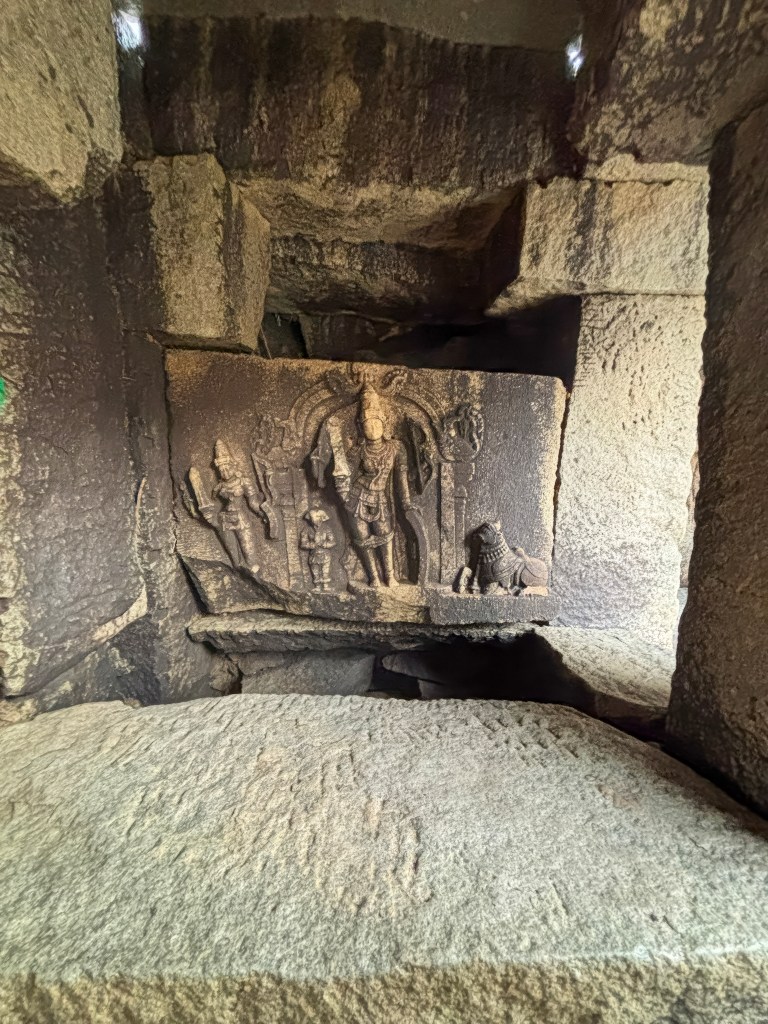
There are also a few other ruins that are worth visiting. One of them is a small sanctuary accessible by crawling under a boulder.

Several gods, including Surya riding on his chariot, are carved into the rock here. You can also see a pavilion built for devotees on the riverbank. Another noteworthy sight is a rock that strikingly resembles an elephant. This natural marvel has captured the imagination of many. Our guide mentioned that the coracle operators, when water levels are low, take passengers under the majestic Elephant Rock. This provides a unique perspective on this ancient marvel. During the monsoon season, though, the temple and its carvings are submerged. It only emerges again with the changing tides and seasons.

Narasimha Temple: A Quiet Shrine Revealed by the River

You can also visit the Narashimha temple on the same coracle ride. We ran out of time and couldn’t visit the temple. A short walk takes you through scattered boulders and ancient stone steps. They lead you to the temple. Its weathered facade blends seamlessly into the rocky hillside. The temple is a multi-story structure with characteristic Vijayanagara-style pillars. It has three sanctums originally dedicated to different forms of Vishnu: Venugopala, Lakshminarasimha, and Vishnu-Purushottama.

The Kampabhupa Pathway: Echoes of Ancient Pilgrims

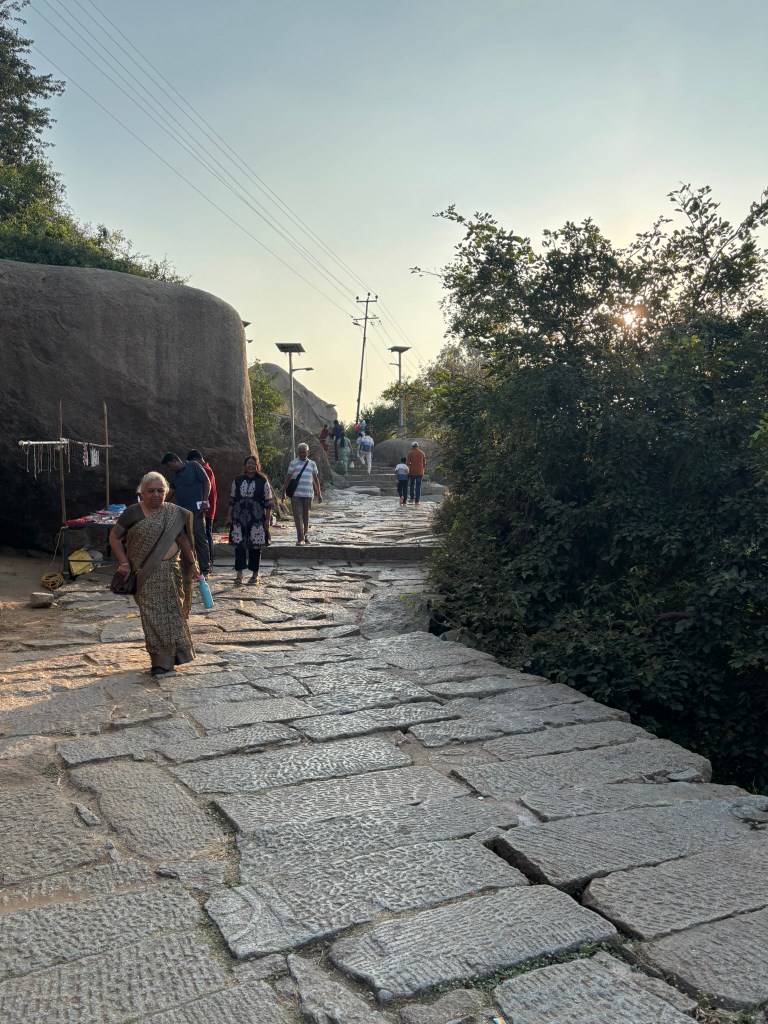
As you return toward Chakratirtha, you may notice the broad stone pathway running along the river—the Kampabhupa Pathway. Built in the 14th century by Kampabhupa, son of Vira Harihara Raya, this ancient route once connected Virupaksha Bazaar to the sacred riverbank and onward to Vittalapura.

During high waters, the path disappears completely, as if the river reclaims it for a while. But when visible, it’s a beautiful reminder of the pilgrims who walked this very stretch centuries before you floated past in a coracle.

Final thoughts

A coracle ride at Chakratirtha isn’t just a river crossing—it’s a slow unfolding of Hampi’s quieter stories. The sacred whirlpool, the Kodandarama Temple, the secret shrines of Sahasralinga and Anantasayana, the ancient pavilions and pathways… each stop feels like a page from a living epic.

By the time you return to the rocky bank, the sun warm on your shoulders and the river’s rhythm still in your body, you realize this journey has left its own swirl within you—gentle, sacred, unforgettable.

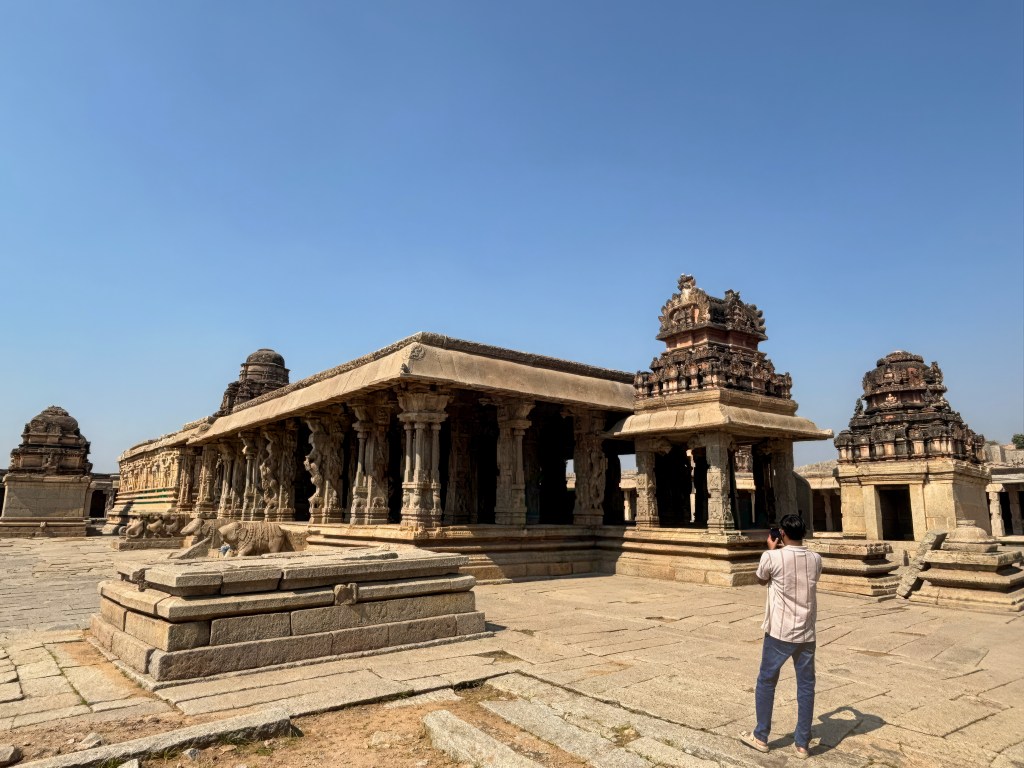
Krishna Temple, Hampi — A Royal Monument of Victory and DevotionKrishna Temple

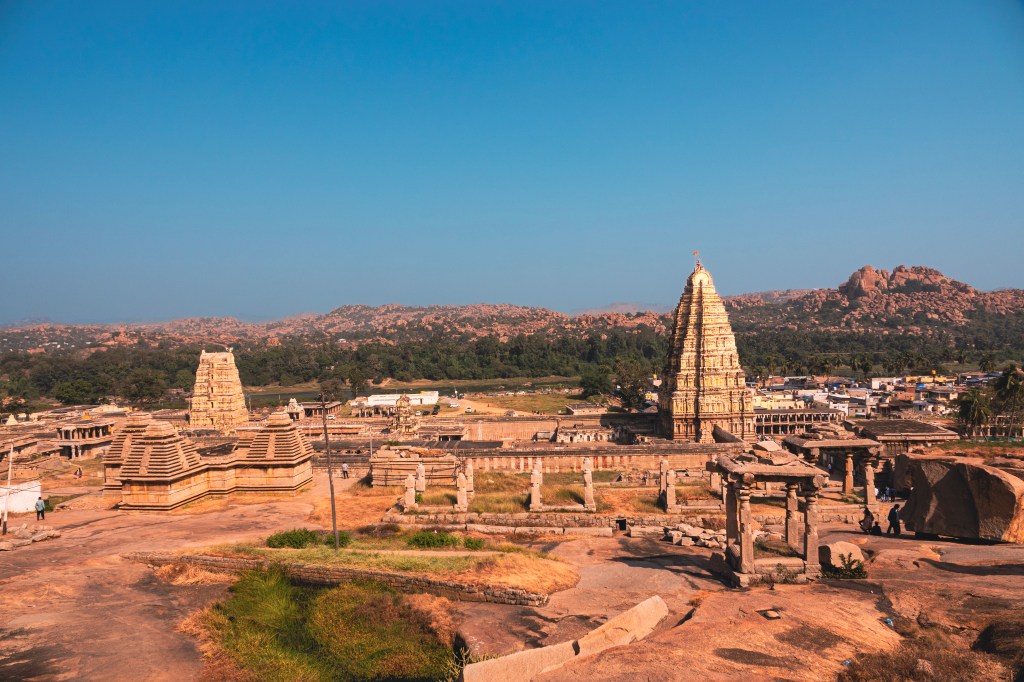
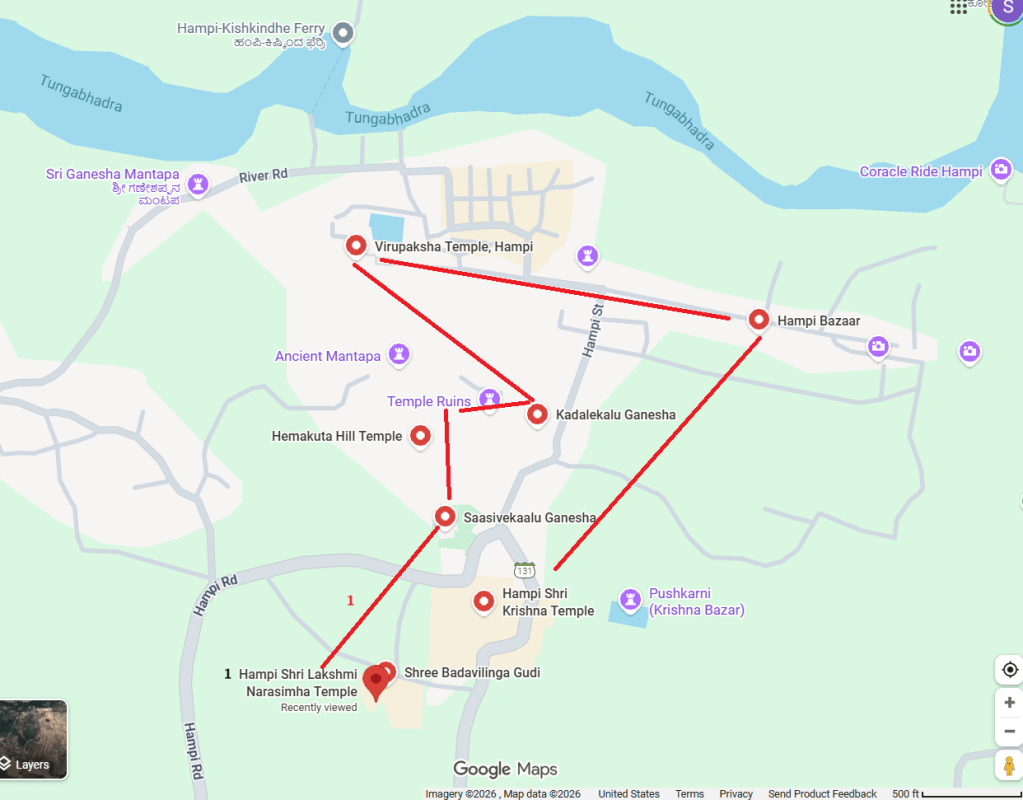
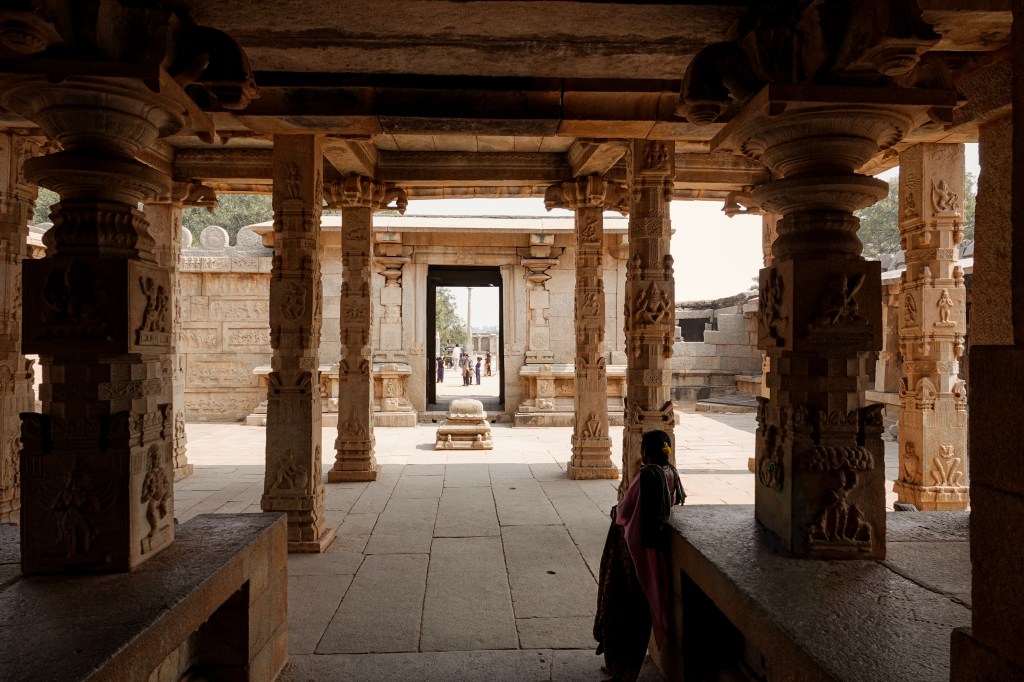
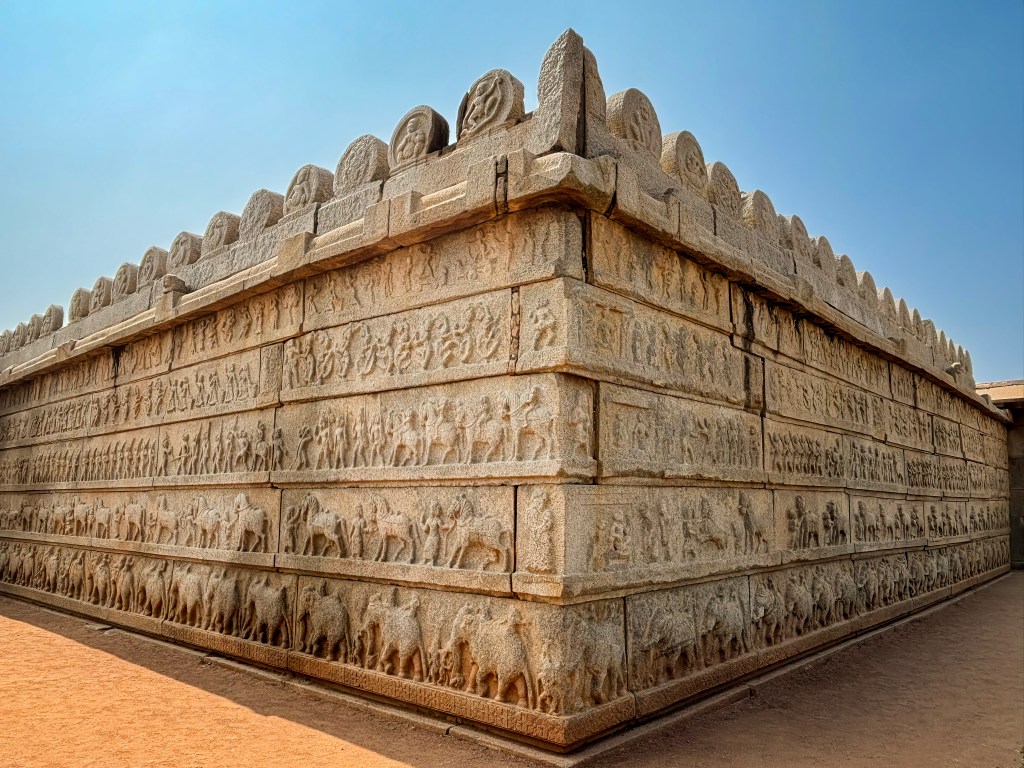
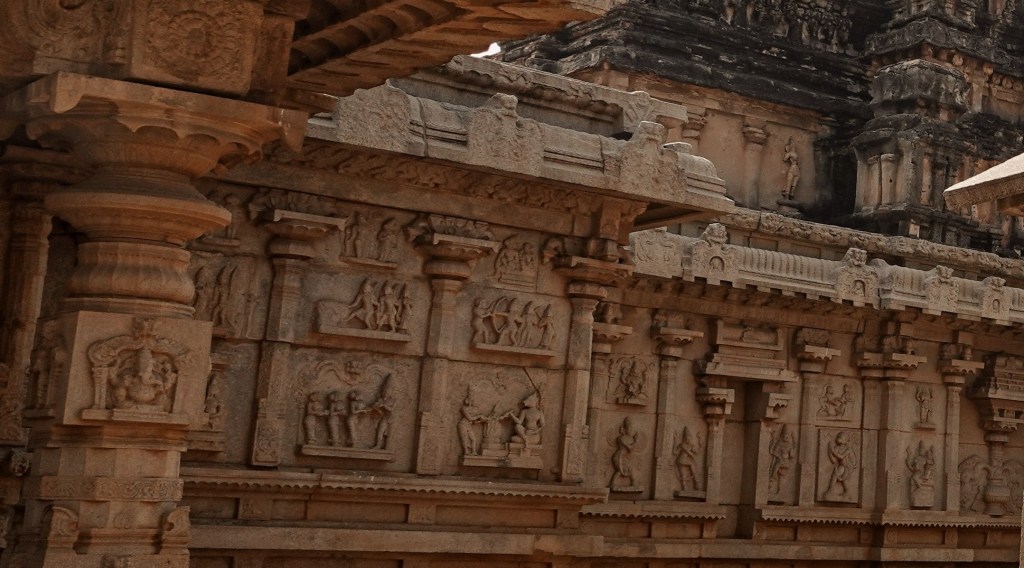
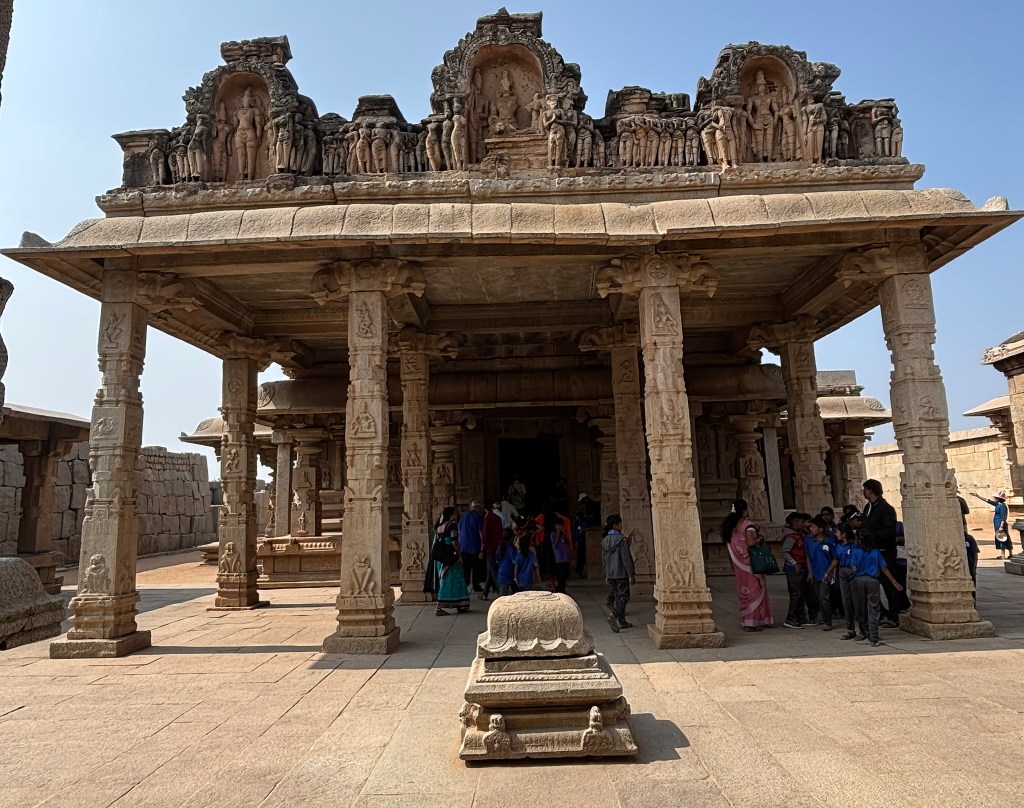
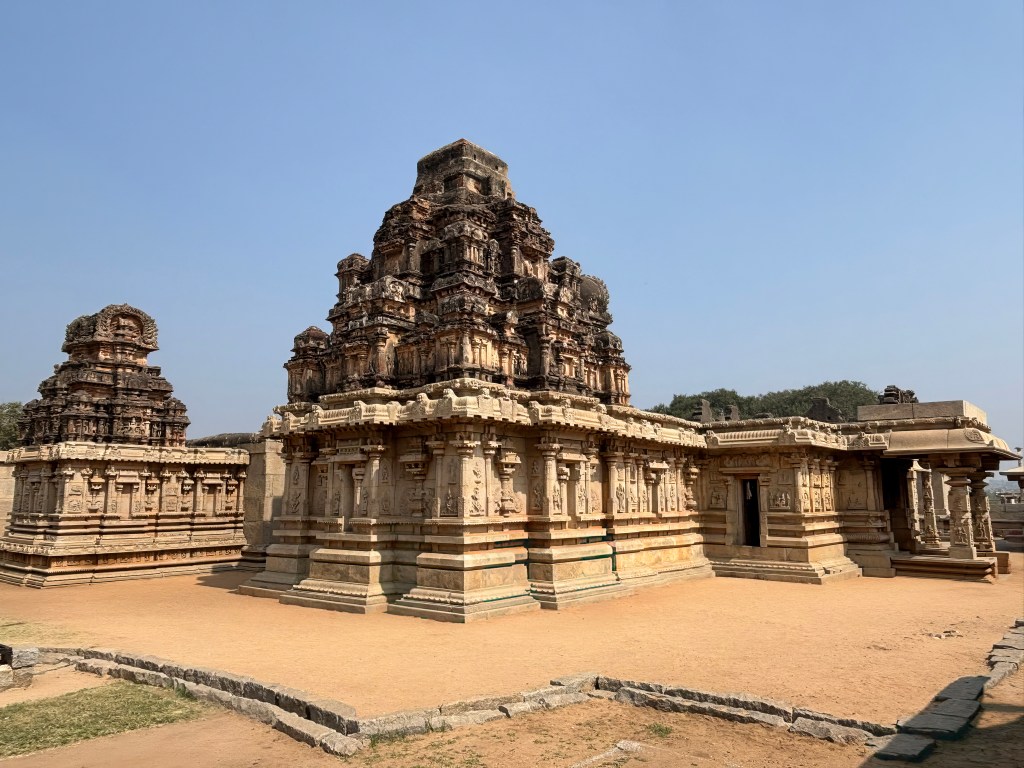
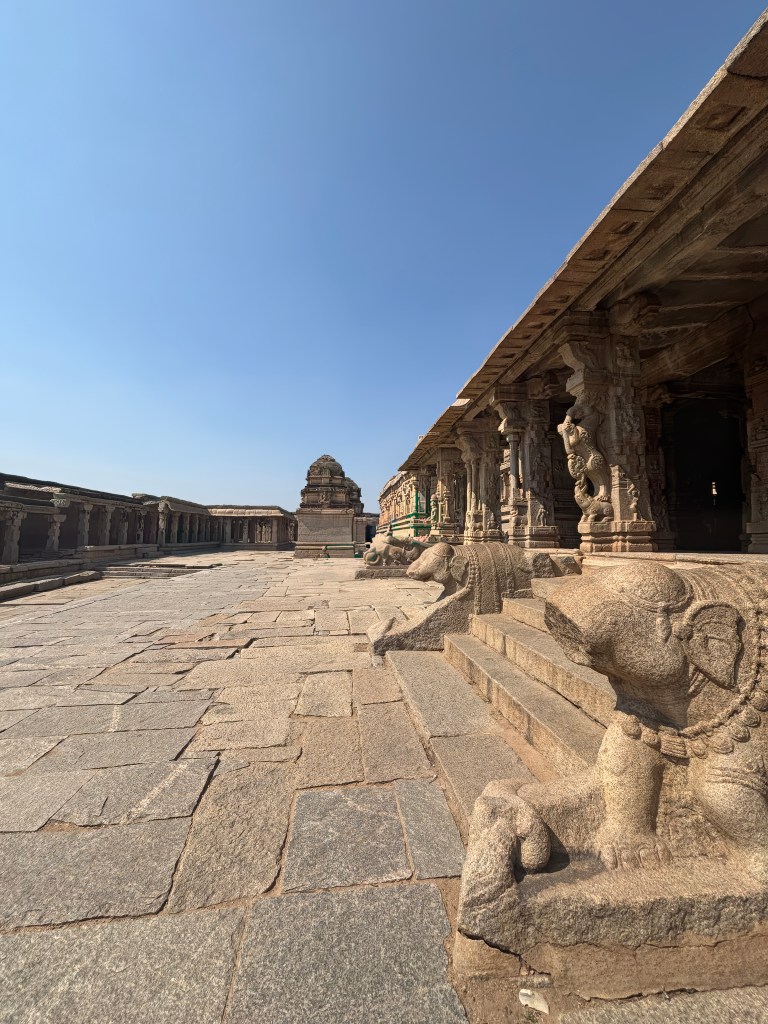
Traveling south from the Virupaksha complex, the road leads to Kamalapura. The landscape then opens into Krishnapura, another historic quarter of Hampi’s sacred center. At its heart stands the Krishna Temple. It is a grand monument commissioned in 1515 CE by the Vijayanagara emperor Krishnadevaraya. This was to commemorate his celebrated victory over the Gajapati rulers of Orissa. The temple once housed a granite icon of the infant Krishna. This icon was seized from the fort at Udayagiri during this campaign. It is now preserved at the Government State Museum in Chennai.

A Temple Anchored in its Urban Landscape

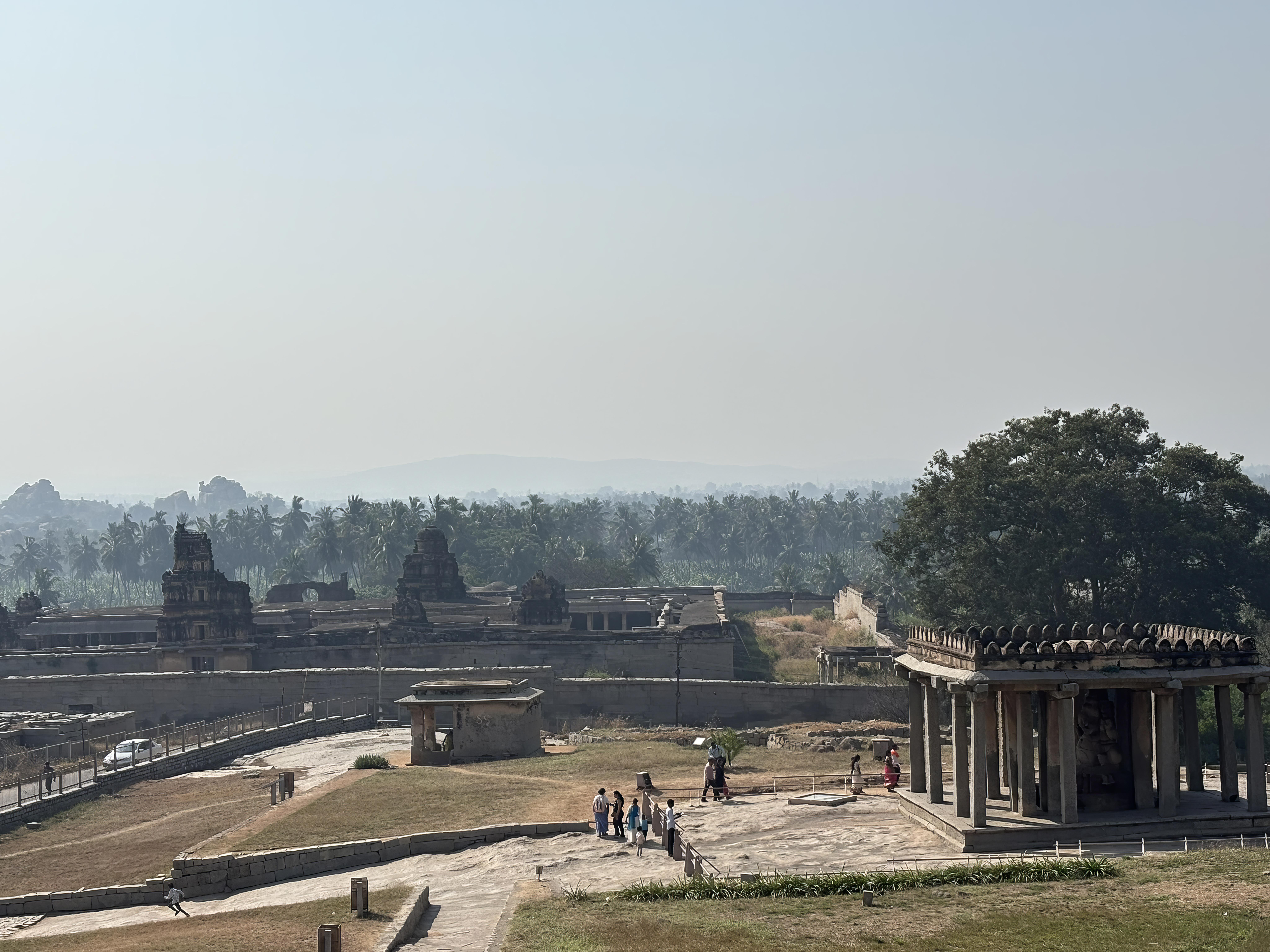
Like other major shrines in Hampi, the Krishna Temple is aligned with a broad bazaar street extending eastward. Today, this street sits at a lower level than the temple itself. Its colonnades are partly engulfed by fields of sugarcane and banana plantations. This setting creates a striking contrast between cultivated greenery and monumental stone.

A few metres north of the bazaar lies a rectangular tank. It is framed by additional colonnades and crowned by a small pavilion that rises from the water. This tank is nestled beneath a rocky overhang. It forms one of the most picturesque corners of the complex. If you have time, this is a good place get some nice photos.

The Grand Gopura: A Royal Statement

The eastern entrance gopura immediately announces the temple’s royal origins. Though now dilapidated, its frontal portico remains impressive for the sheer height of its granite columns. These columns were recently reset during conservation efforts. Above them rises the brick superstructure, only partially preserved, but still bearing traces of plaster sculptures. Among these are battle scenes on the western face. These scenes possibly depict Krishnadevaraya’s Orissa campaign. Later renovations have simplified many of the original figures.

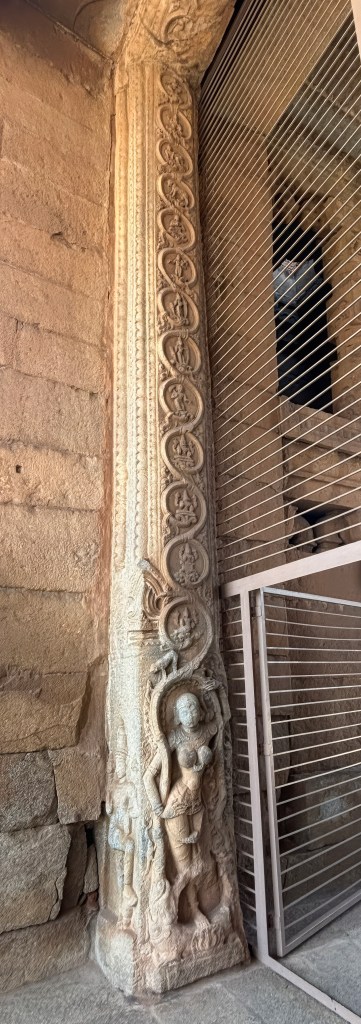
Within the gopura passageway, the doorway jambs are carved with elegant maidens entwined with creepers. A charming hare‑in‑the‑moon motif appears between nagas on the underside of one lintel. This is a delightful detail easily missed by hurried visitors.

Inside the Temple: Mandapas, Shrines, and Royal Inscriptions

A large inscription slab stands at the centre of the walled compound. Krishnadevaraya himself set it up. It records his military exploits and benefactions. The carving is somewhat hastily executed, but the monument remains a valuable historical record of the emperor’s reign.

The temple layout follows the classic Vijayanagara sequence:

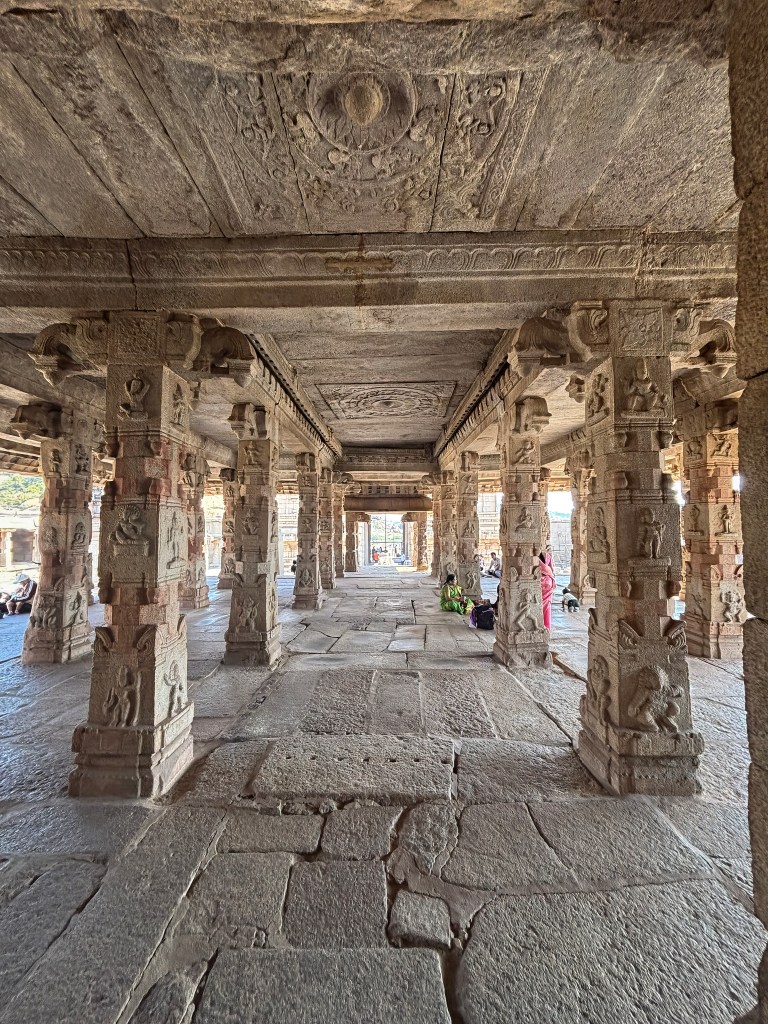
  • a 25‑bay open mandapa,
  • an enclosed nine‑bay mandapa with side porches,
  • and a towered sanctuary surrounded by an unlit circumambulatory passage.

Minor shrines occupy the outer corners of the enclosure. A double‑sanctuaried goddess temple stands to the north. It adds to the ritual complexity of the site.

Layers of Construction and Adaptation

Along the inner perimeter is a continuous colonnade. It is interrupted on the south side by a passageway. This leads to an earlier pavilion‑like gateway. This older structure became part of the Krishna Temple complex. It was crowned with a brick tower. This illustrates the Vijayanagara habit of integrating pre‑existing buildings into new architectural schemes.

Beyond this lies an outer-walled enclosure, where a curious six‑domed structure stands. The building is built of rubble coated in plaster. It has internal arches and steps leading to the roof. The building features holes in the domes. These are clear evidence that it once served as a granary. Its presence highlights the temple’s significance as a sacred space. It also emphasizes its role as a center of economic and administrative activity.

Final Thoughts on the Krishna Temple

The Krishna Temple is one of those places in Hampi where layers of history feel unusually close to the surface. You sense Krishnadevaraya’s ambition in the soaring gopura. You also feel the devotional pulse that once centered around the now‑empty sanctuary. Even in its ruined state, the complex carries the unmistakable imprint of royal patronage. It is a temple built not only for worship. It commemorates a moment of triumph that shaped the empire’s identity.

Architectural Wonders of Badami Cave Temples

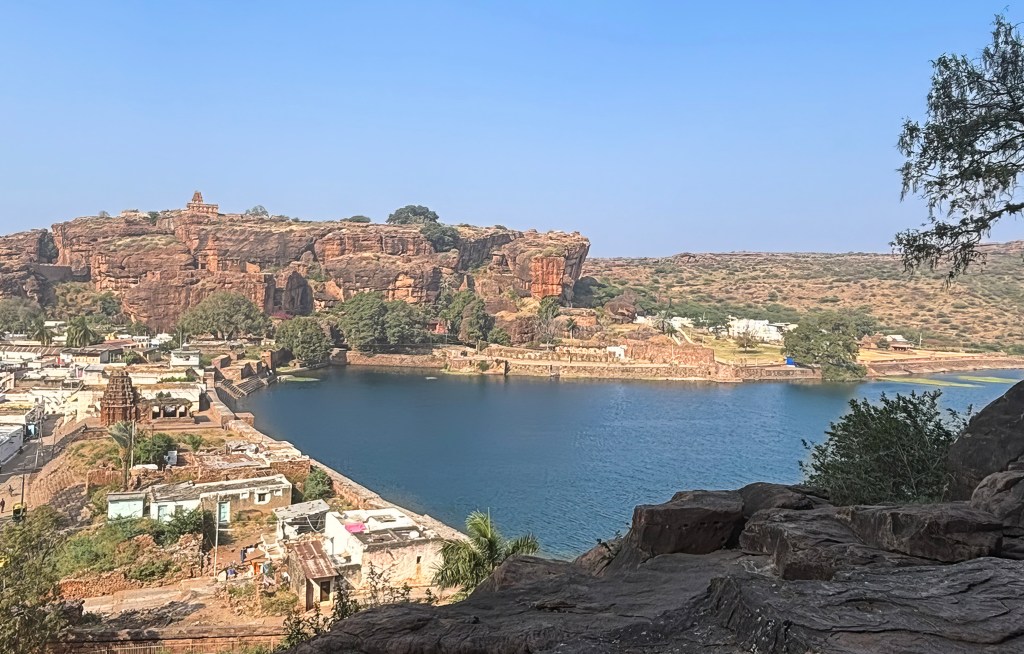
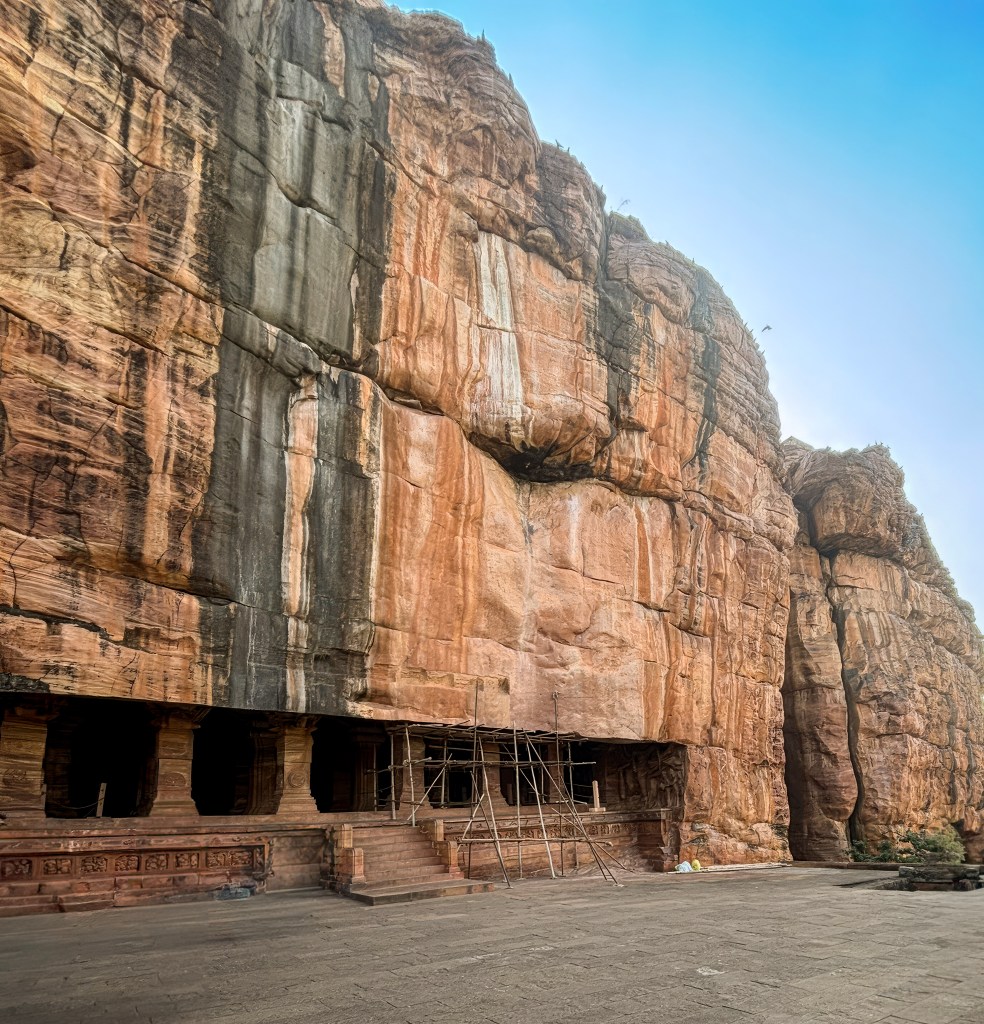
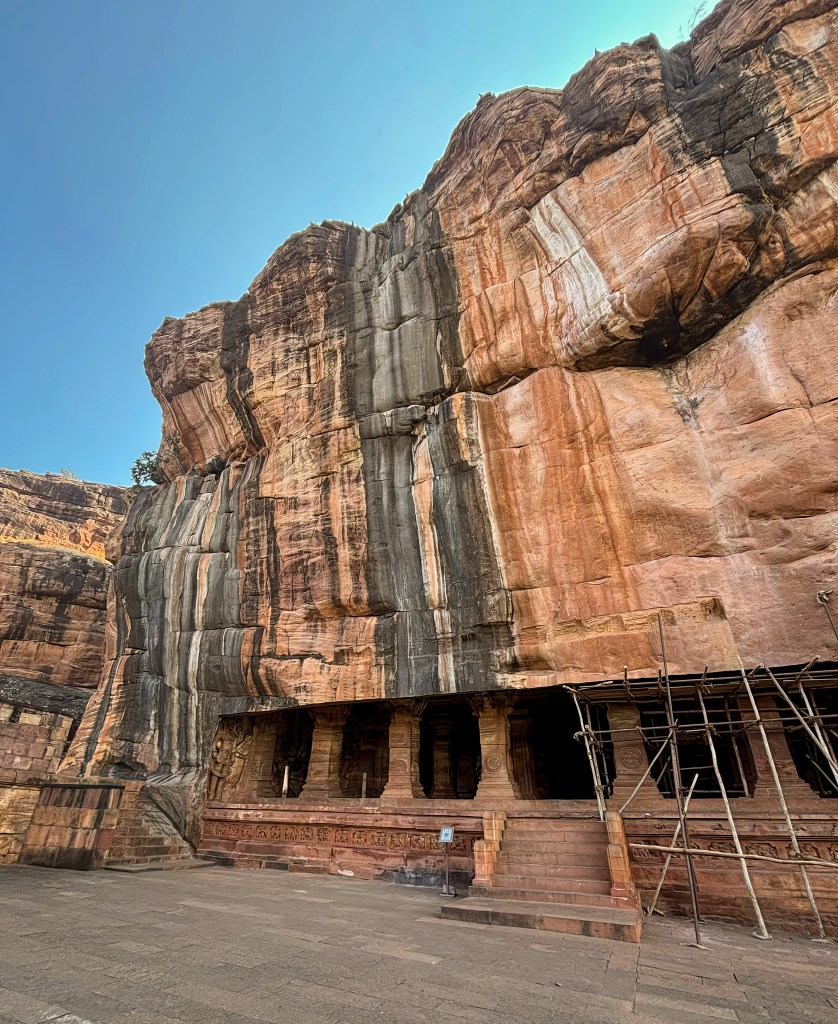
The Badami Caves are carved into dramatic cliffs overlooking the emerald Agastya Lake. They are more than just monuments; they are a masterclass in ancient artistry. These four rock-cut temples showcase the cosmic dance of Shiva. They also highlight the serene presence of Jain Tirthankaras and the majestic incarnations of Vishnu. Together, they offer a rare window into a time of profound religious harmony.

The temples are directly carved into the hills. It is astonishing to see the precision and the skill of the artists who carved these sculptures. The intricate details etched into the stone reveal a high level of technical ability. They also show a keen eye for detail. They also demonstrate a deep understanding of the spiritual significance of these structures. Each curve and contour seems to breathe life into the rock, showcasing the artists’ dedication and passion for their craft.

  1. Cave 1-Key Architectural & Artistic Features
    1. The Nataraja Sculpture
    2. Symbolic Deities
    3. Ceiling Art
    4. Structure
  2. Cave 2 Key Architectural & Artistic Features
    1. Trivikrama
    2. Architectural Details of Cave 2
    3. Photo Ops near Cave 2
  3. Cave 3-Key Architectural & Artistic Features
    1. Vishnu as Anantasayana
    2. Trivikrama/Vamana
    3. Varaha
    4. Narasimha
    5. Harihara
    6. Unique Features of Cave 3
  4. Cave 4-Key Architectural & Artistic Features
    1. Architectural & Historical Context
    2. Major Sculptures
  5. Final Thoughts

Cave 1Key Architectural & Artistic Features

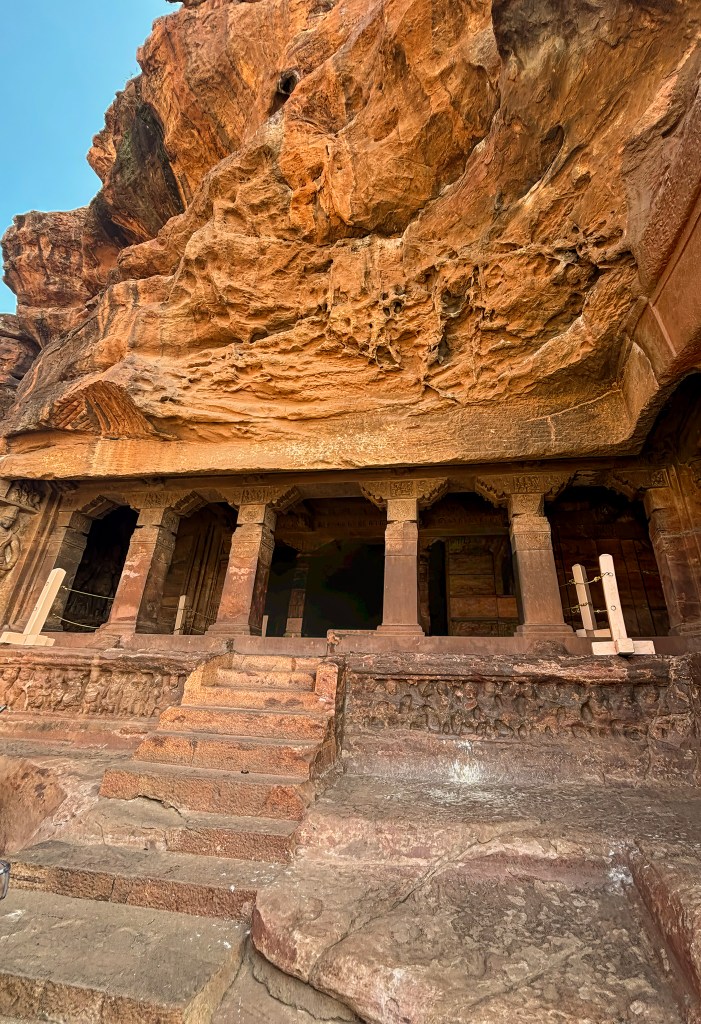
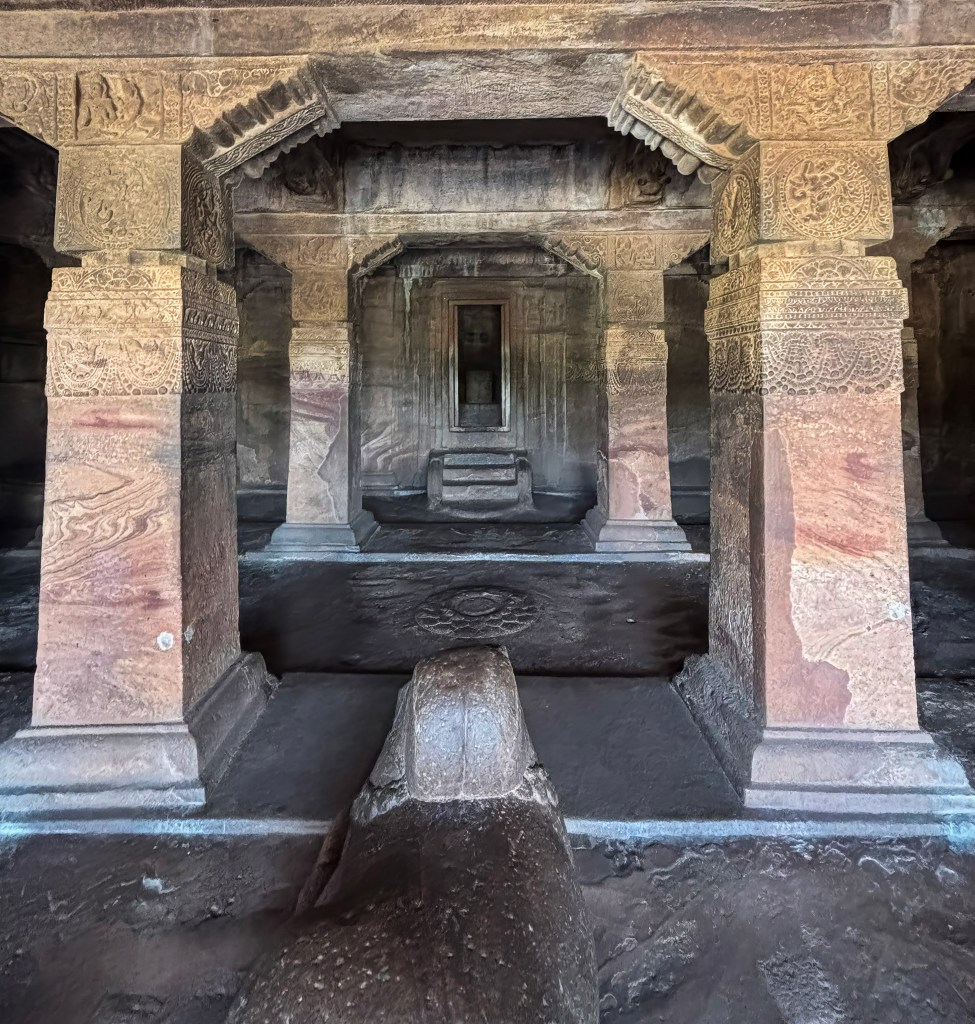
Cave 1 is the first and lowest of the cave temples. Carved from soft red sandstone, it is primarily dedicated to Lord Shiva

The Nataraja Sculpture

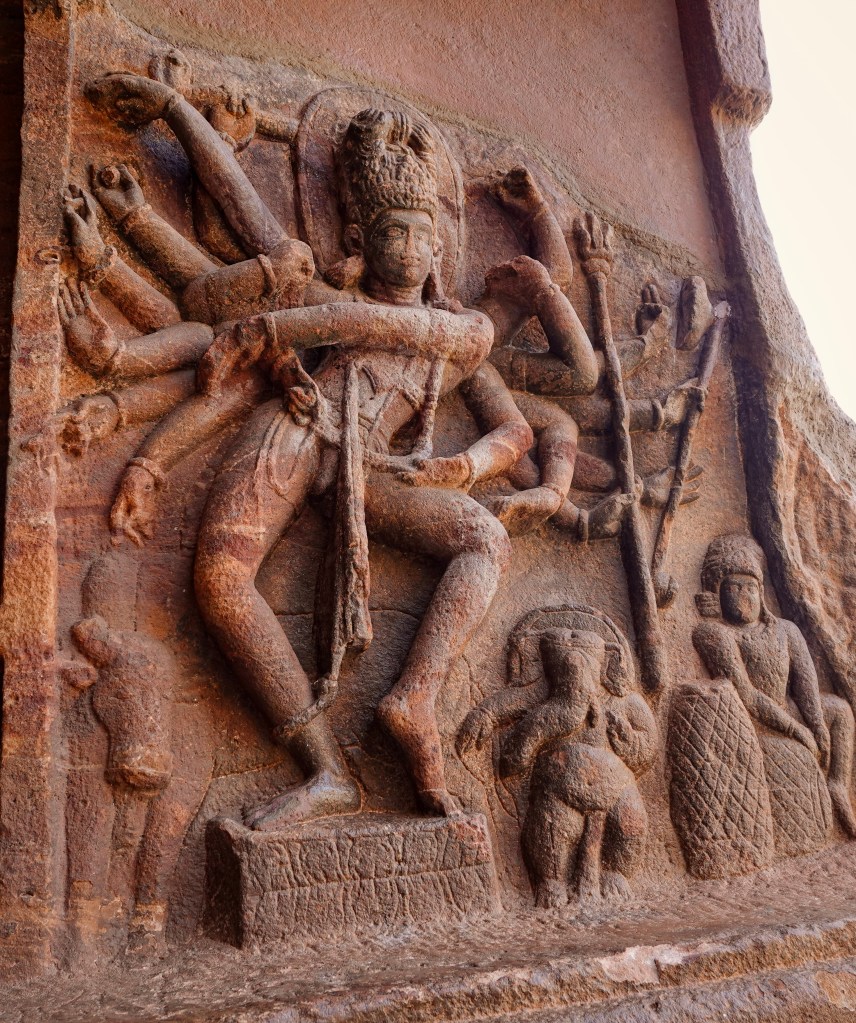
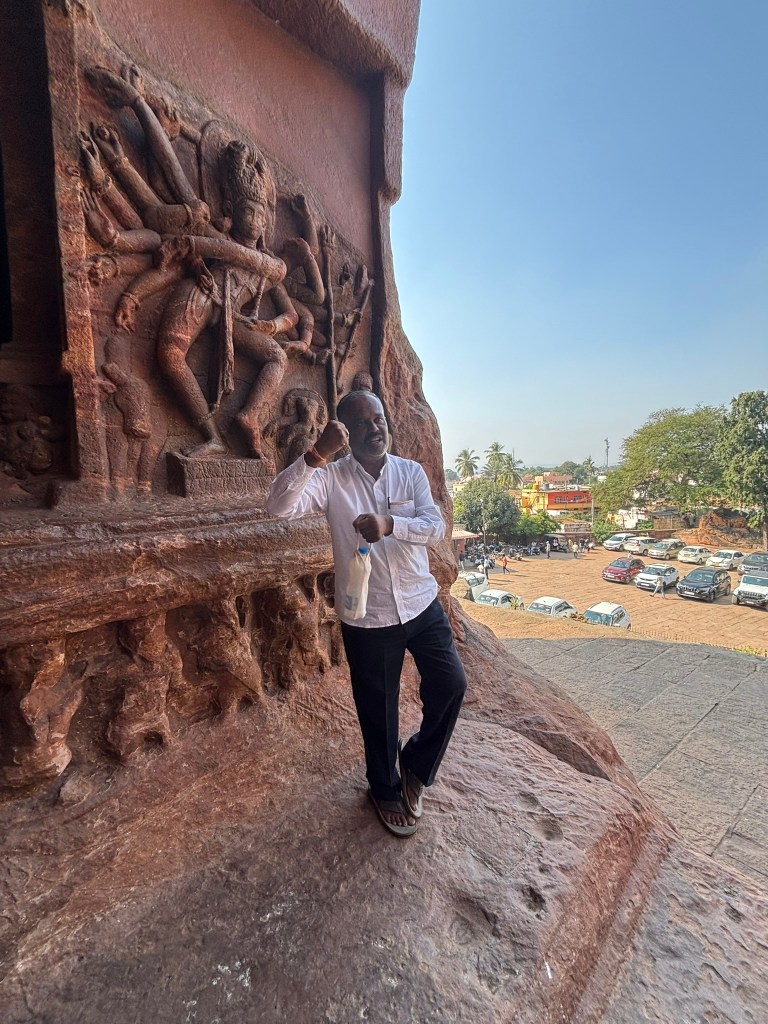
The cave’s most iconic feature is a 5-foot-tall relief of Nataraja, the 18-armed dancing Shiva. This masterpiece is noted for its mathematical precision. It depicts roughly 81 Bharatanatyam dance poses through different arm combinations.

The 81 Poses Explained – The sculpture depicts Shiva performing the Tandava dance. Its most remarkable feature is the arrangement of his 18 arms (9 on each side) in a specific geometric pattern: 

  • Permutation & Combination: Art historians note that by pairing any of the 9 hands on the left with any of the 9 on the right, a dancer can visually derive 81 distinct Bharatanatyam dance poses (karanas).
  • Geometric Precision: The arms are arranged in a pattern that Swiss art historian Alice Boner described as a “cosmic wheel” or time division.
  • Symbolic Gestures: Each hand either holds a symbolic object—such as a drum, trident, serpent, or axe—or is formed into a specific Natya mudra (symbolic hand gesture) used in classical Indian dance. 

It is advised to have a guide when visiting Badami cave temples. Our guide was able to show us the most important features of each cave, including the Shiva idol and its meaning

Symbolic Deities

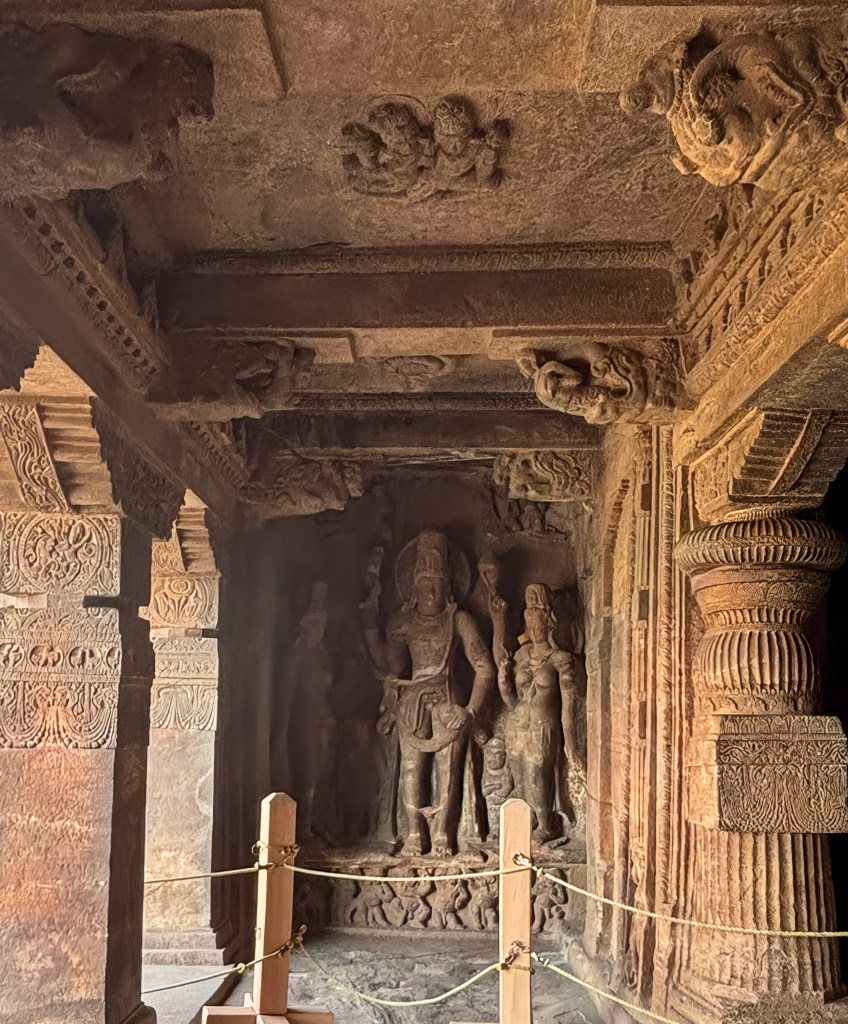
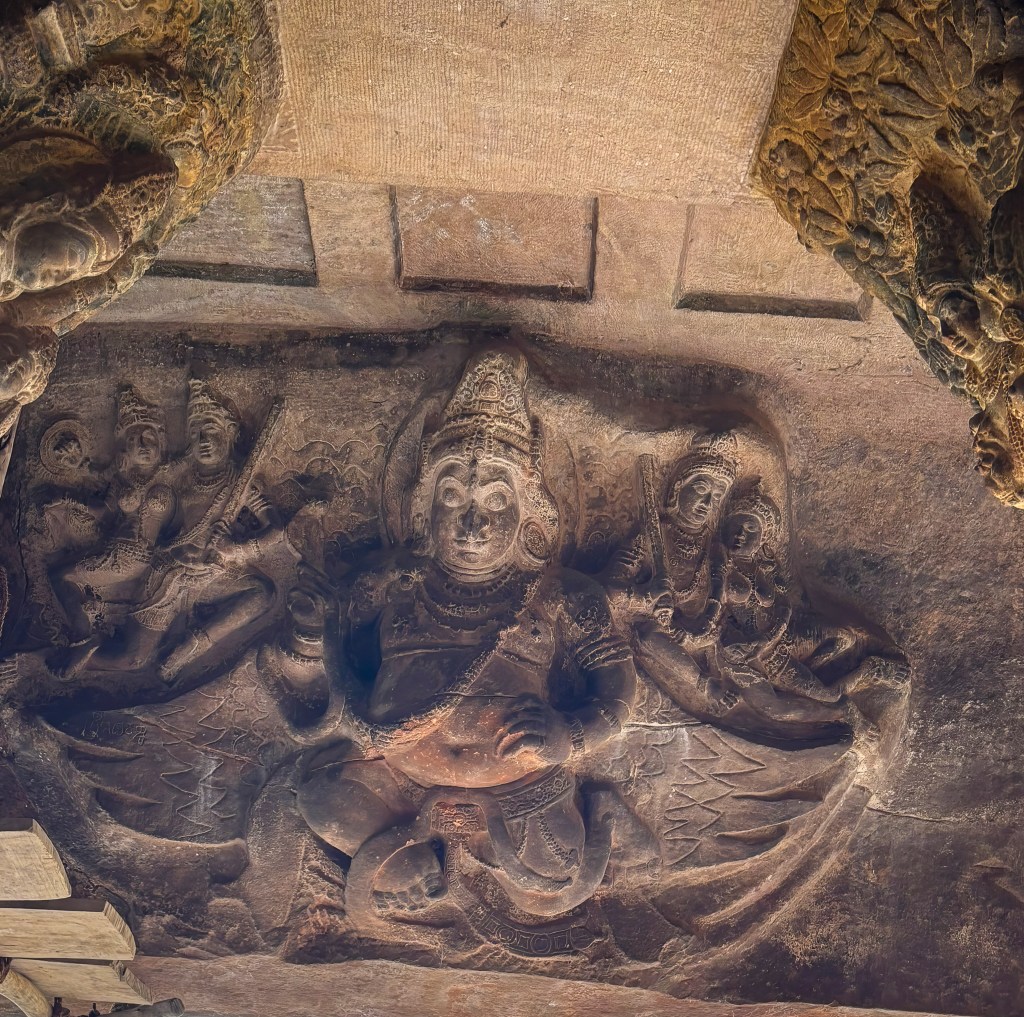
  • Harihara: A 7.75-foot fused sculpture representing half-Shiva and half-Vishnu, flanked by their consorts, Parvati and Lakshmi.
  • Ardhanarishvara: A relief depicting the composite form of Shiva and Parvati as half-male and half-female.
  • Mahishasura Mardini: A striking relief of Goddess Durga slaying the buffalo demon.

Ceiling Art

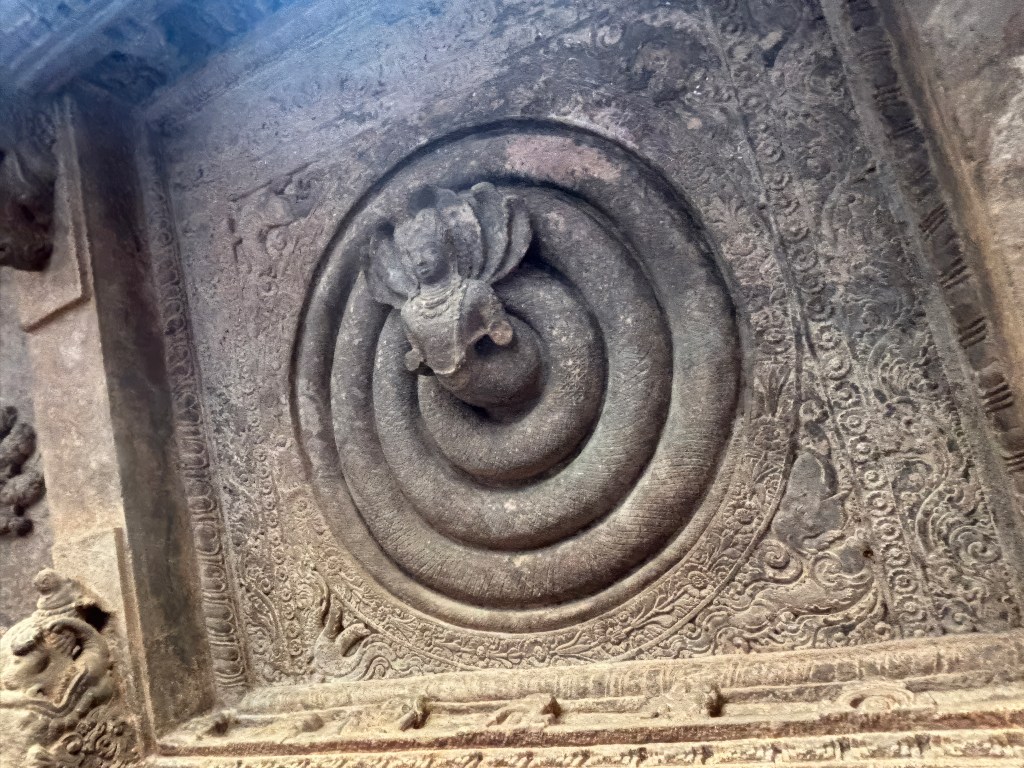
The roof features intricate panels, including a prominent Nagaraja (King of Serpents) motif with a coiled body and human torso.

Structure

The temple has a traditional layout. It consists of a pillared verandah (mukha-mandapa), a central pillared hall (maha-mandapa), and a small sanctum (garbhagriha) at the back. The sanctum contains a Shiva Linga.

Cave 2 Key Architectural & Artistic Features

Cave 2 of the Badami cave temples, dating to the late 6th or early 7th century CE. It is primarily dedicated to the Hindu god Vishnu. The temple honors Vishnu and his avatars. It is located above and to the east of Cave 1 and is accessed by climbing approximately 64 steps. Cave 2 is the least refined and resembles a smaller version of Cave 3.

Trivikrama

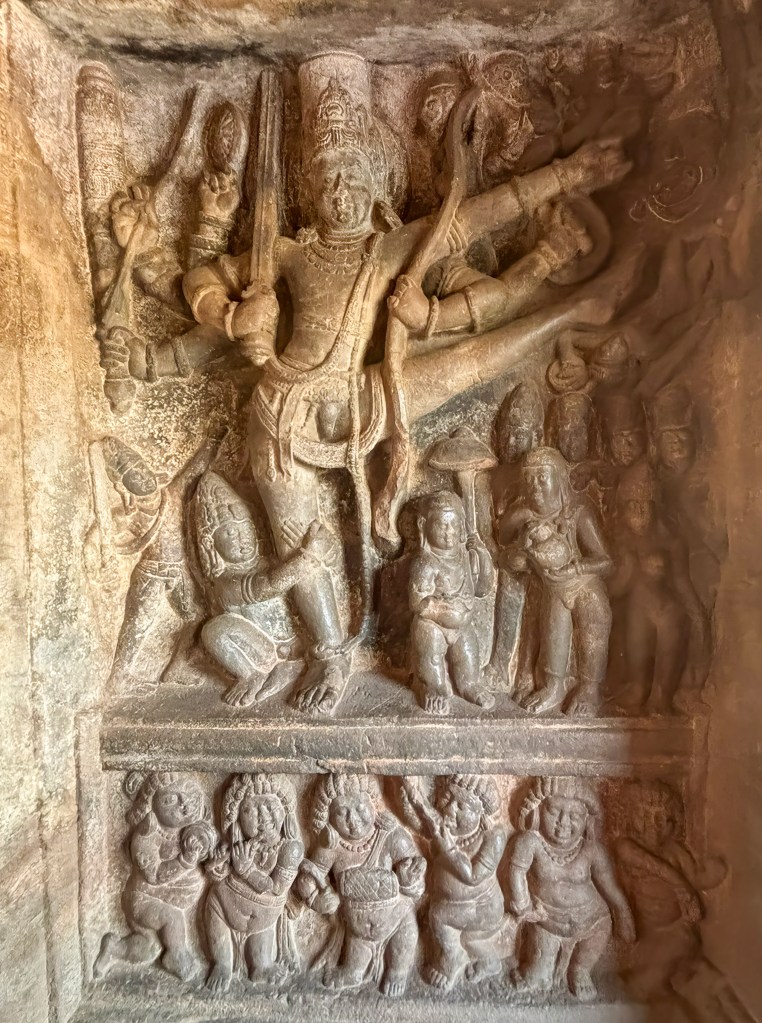
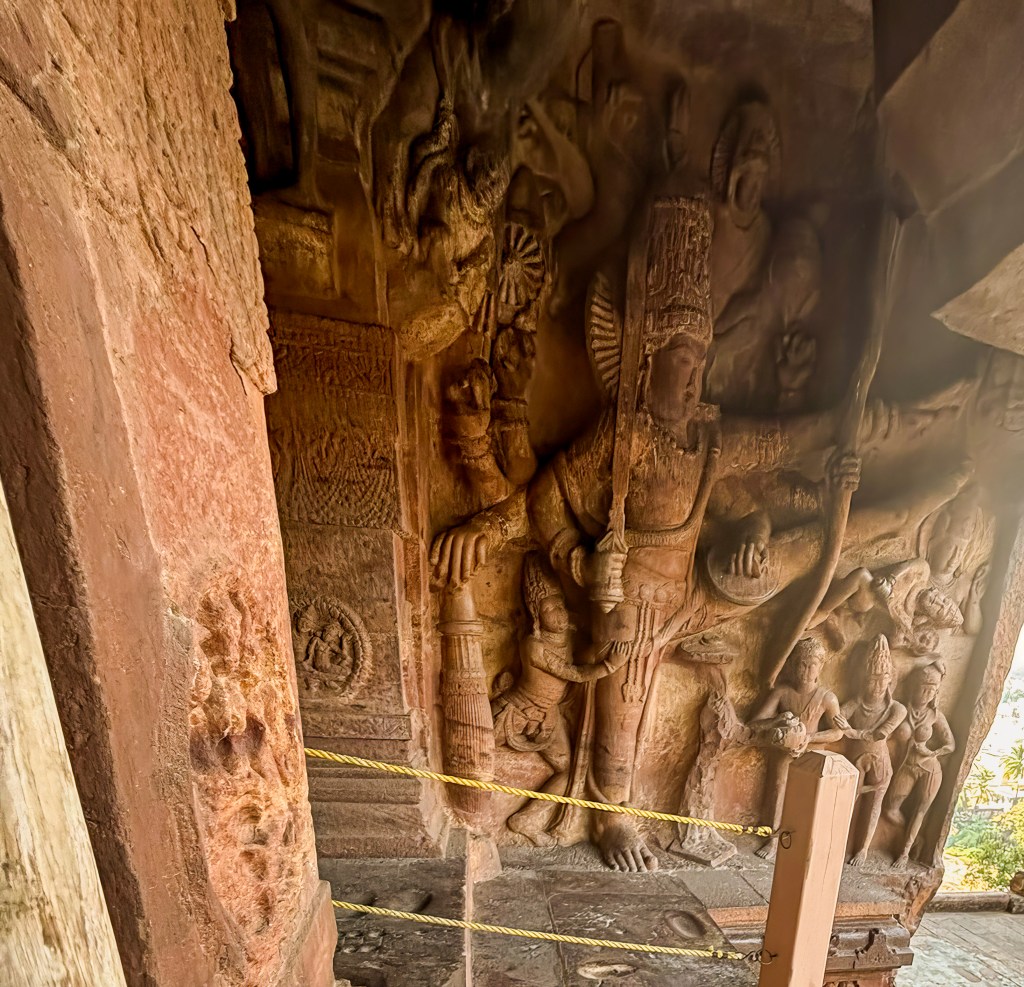
The largest relief in the cave depicts the legend of Vishnu in his Trivikrama form. In this depiction, he is portrayed as a giant taking one of three massive steps. These steps are meant to master the earth, abyss, and sky.

The sculpture depicts Vishnu as Trivikrama, an eight-armed form. Key features visible in the carving include: 

  • The Deity: Vishnu is shown with one foot firmly on the ground. His other foot is raised high in the sky. This depicts him measuring the universe. He is holding various attributes, such as a sword and a shield. 
  • Surrounding Figures: At the bottom left, a figure is believed to be Bali’s son. He is shown holding the lord’s leg in devotion. 

Explanation of the Legend of Trivikrama

  • Vamana Avatar: The legend describes the dwarf Brahmin Vamana. He is an avatar of Vishnu. Vamana approached the generous Asura King Mahabali during a grand ritual. 
  • Three Steps of Land: Vamana requested just three “feet” or steps of land. Mahabali granted this request despite warnings from his preceptor.
  • Trivikrama Form: Upon receiving the grant, Vamana transformed into the giant, cosmic form of Trivikrama (meaning “three steps”). 
  • Measuring the Universe: With his first step, he covered the entire earth and the netherworlds. With his second step, he covered the heavens. 
  • The Third Step: Overwhelmed, King Mahabali offered his own head for the third step. By doing this, he fulfilled the promise and showed devotion.
  • Varaha: Another prominent sculpture shows Vishnu in his Varaha (boar) avatar. He rescues the Earth Goddess, Bhudevi, from the cosmic ocean and the demon Hiranyaksha.
  • Other Deities: The cave features sculptures related to the birth of Lord Krishna. It also includes his childhood and other figures from the Bhagavata Purana.

Architectural Details of Cave 2

  • Layout: The cave shares a similar layout to Cave 1. It features a pillared verandah (mukha-mandapa). There is also a central pillared hall (maha-mandapa) and a small, square sanctum (garbhagriha) deep inside
  • Ceiling: The roof features intricate panels with bas-relief carvings. These include a notable “Matsya Chakra” (wheel with sixteen fish spokes). There is also a variety of swastika patterns. Friezes of flying couples (gandharvas and vidyadharas) and the churning of the ocean (Samudra Manthan) are also present.
  • Style: The artwork in Cave 2 is primarily in the northern Deccan style of architecture. Traces of colored paint on the walls and ceiling suggest that the cave was once adorned with fresco paintings. These paintings are similar to those found in Ajanta. 

Photo Ops near Cave 2

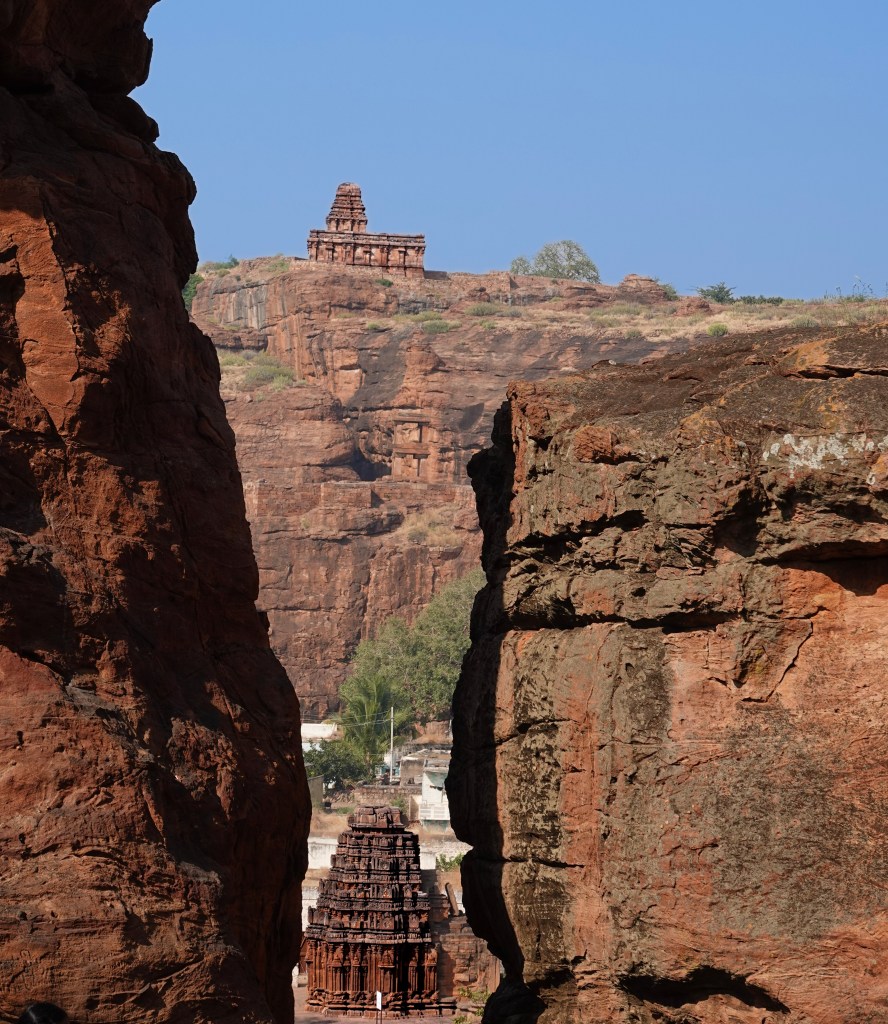
You get a great view of the lake and the town from Cave 2. Also, you can take a photo of the North fort and the Yellamma temple. You will see a lot of people taking this photo, but if you stand outside cave 2, you get a really nice shot like below

Cave 3-Key Architectural & Artistic Features

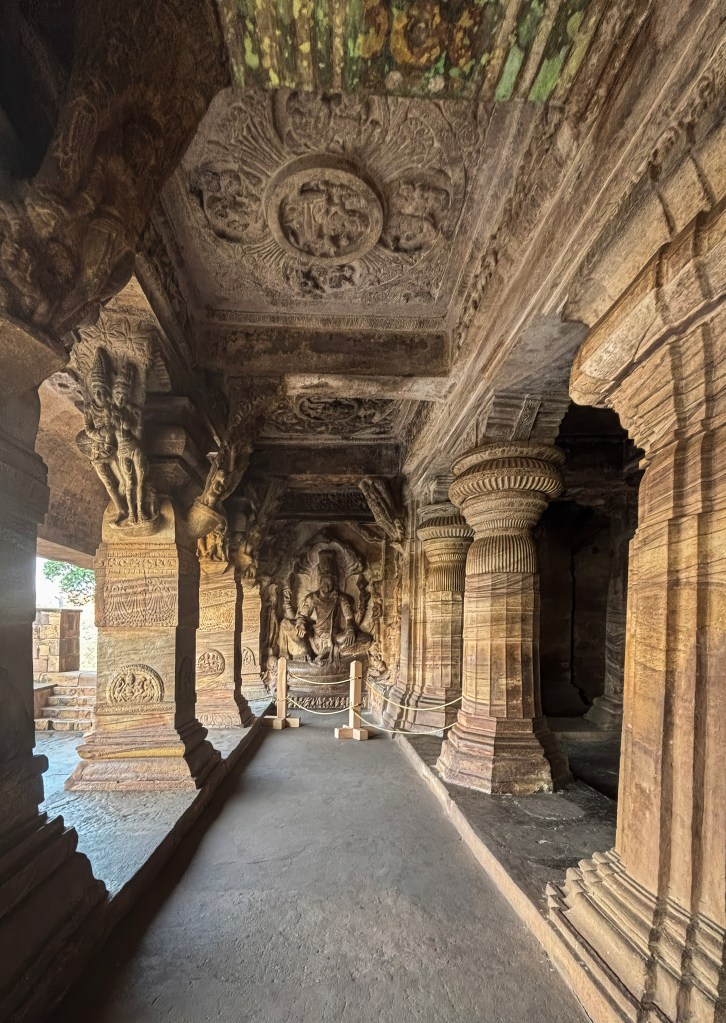
Cave 3 is the largest of the Badami cave temples. It is most intricately carved and dedicated primarily to Lord Vishnu and his various avatars. It is the only cave with a confirmed dedication date of November 1, 578 CE. This date is recorded in an Old Kannada inscription. Thus, it is the oldest firmly dated Hindu cave temple in the Deccan region. The cave showcases a sophisticated blend of northern Nagara and southern Dravida architectural styles. It features a large pillared veranda (mukha-mandapa) and a main hall (maha-mandapa), leading to a small, empty inner sanctum (garbhagriha). 

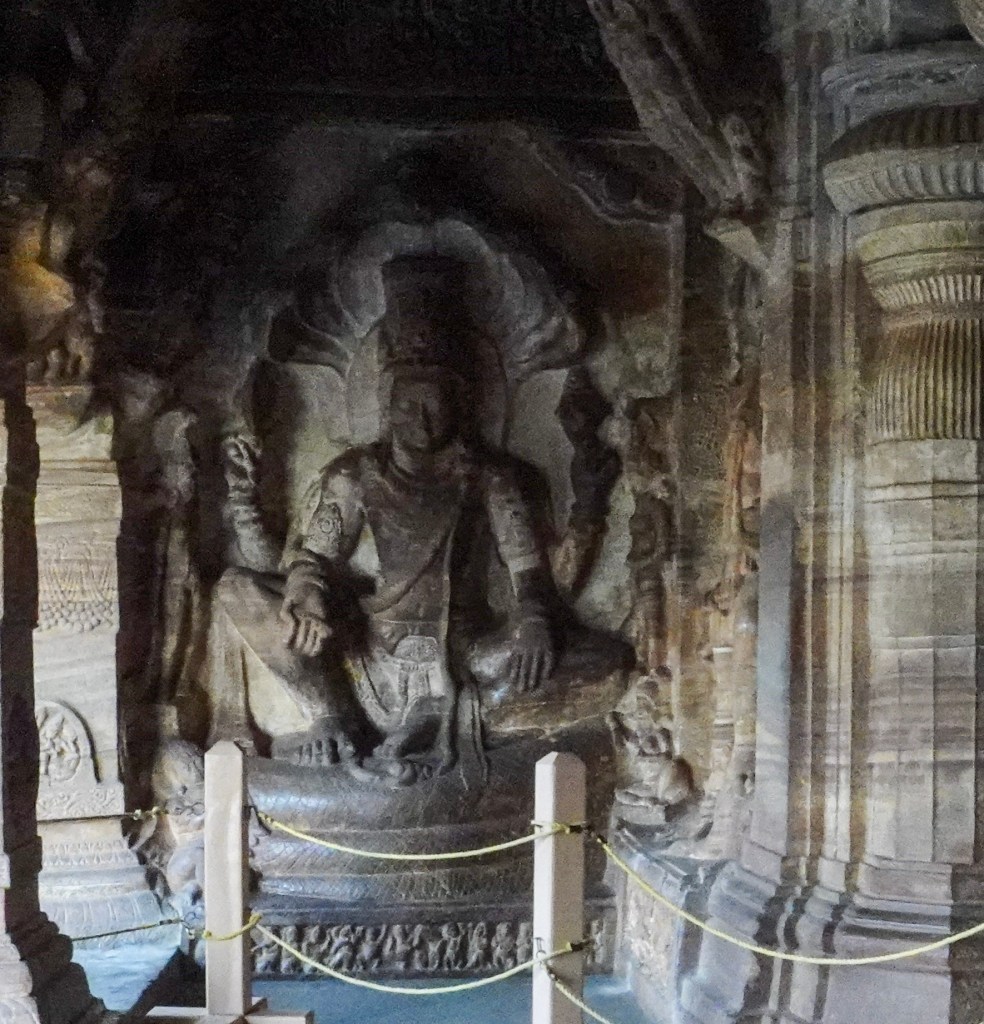
Vishnu as Anantasayana

A unique sculpture of Vishnu shows him in his Anantasayana sitting in a regal posture. The coiled cosmic serpent, Sheshanaga (Ananta), forms the seat and the hood of the canopy. The carving is detailed with other figures; Vishnu’s consorts, Bhudevi and Sridevi, are seen on either side. Garuda (Vishnu’s vehicle) is seated on the floor to the left. 

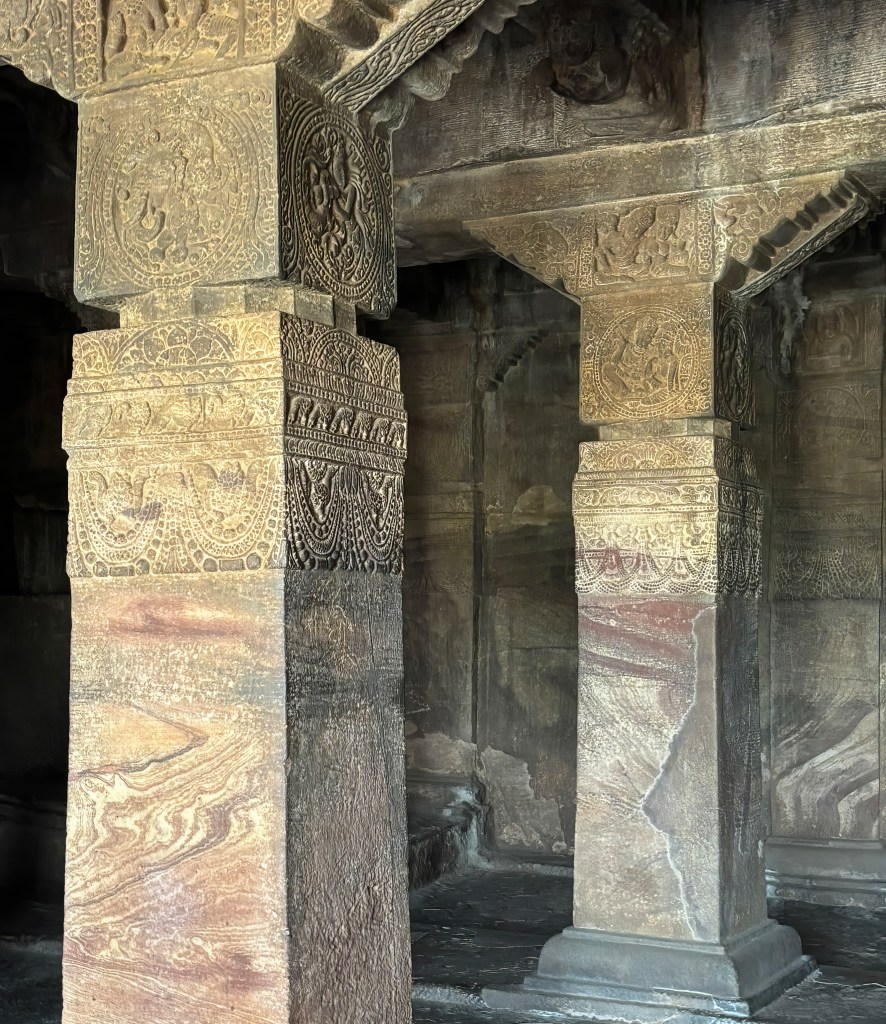
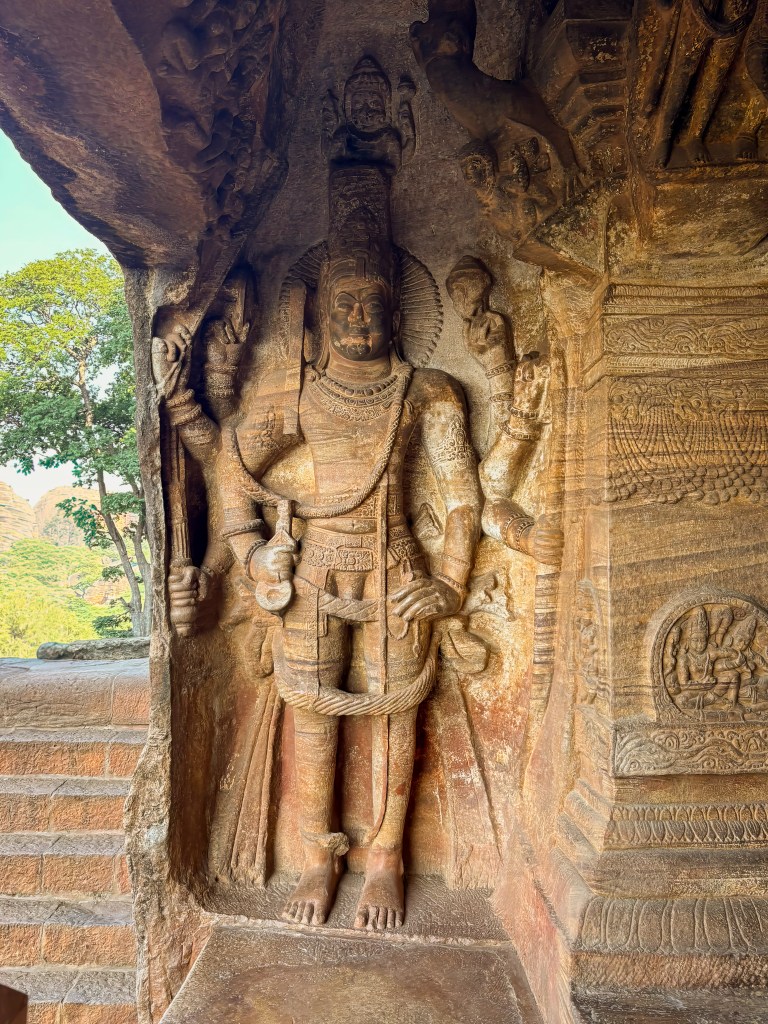
The entire front Veranda is beautiful with great carvings and columns. Don’t forget to look up and appreciate the carvings on the ceiling.

Trivikrama/Vamana

A colossal relief depicting Vishnu in his dwarf avatar, Vamana, transforming into Trivikrama to stride across the universe. This is very similar to the one seen in Cave 2.

Varaha

A massive carving of Vishnu as a boar rescuing the Earth Goddess, Bhudevi can be seen on the opposite wall of the Anantasayana

On the wall column next to Varaha is the inscription giving the name of the royal patrons of the monument. This inscription shows that this cave was consecrated on Nov 1st, 578.

Narasimha

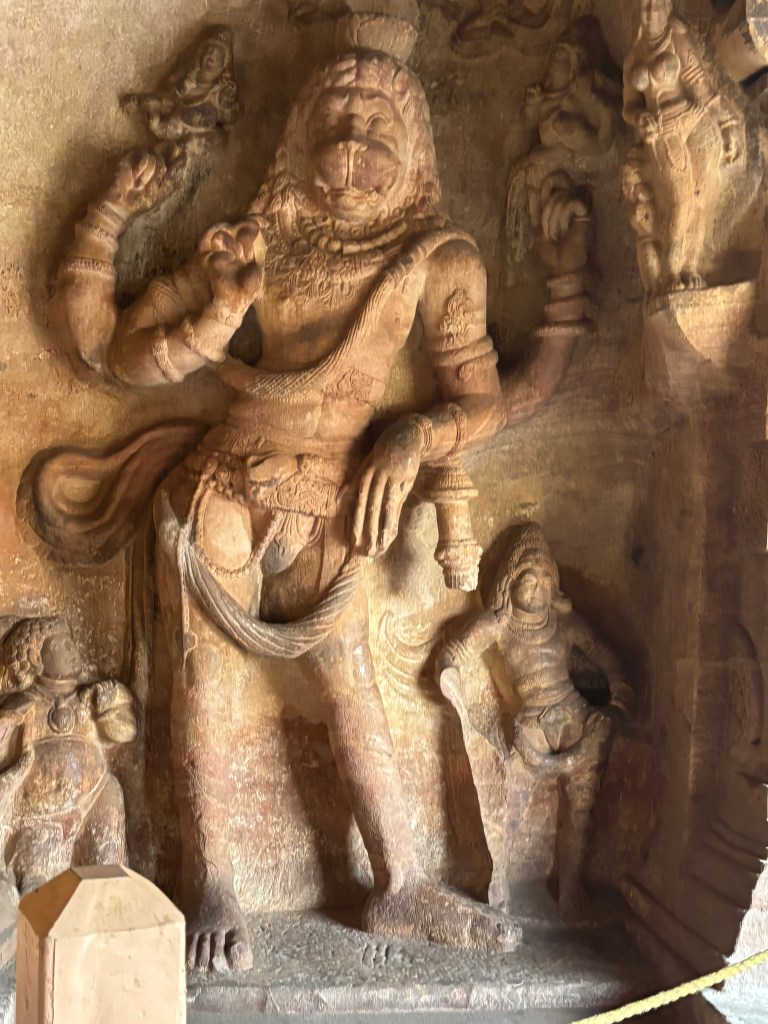
A standing, eight-armed figure of the man-lion avatar, which is depicted in a benevolent form.

Harihara

A powerful seven-foot-tall sculpture of Harihara can be seen in Cave 3.

Harihara is a composite deity in Hinduism, representing the fused form of Lord Vishnu (Hari) and Lord Shiva (Hara). This specific sculpture portrays the left half as Shiva and the right half as Vishnu. he sculpture is shown with four hands, displaying attributes of both gods. The left side (Shiva’s half) is accompanied by the goddess Parvati, and the right side (Vishnu’s half) is accompanied by the goddess Lakshmi

Unique Features of Cave 3

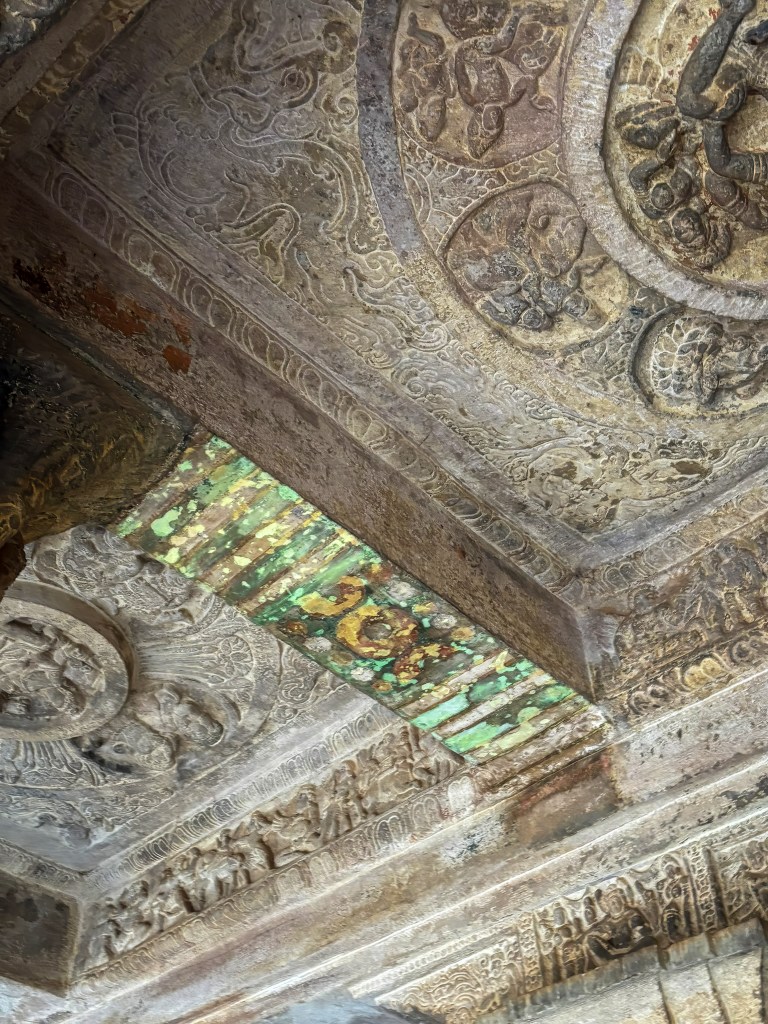
  • Fresco Paintings: Traces of ancient fresco paintings, some of the earliest surviving evidence in Indian art, are visible on the ceiling panels, which depict deities like Brahma, Indra, and Varuna.
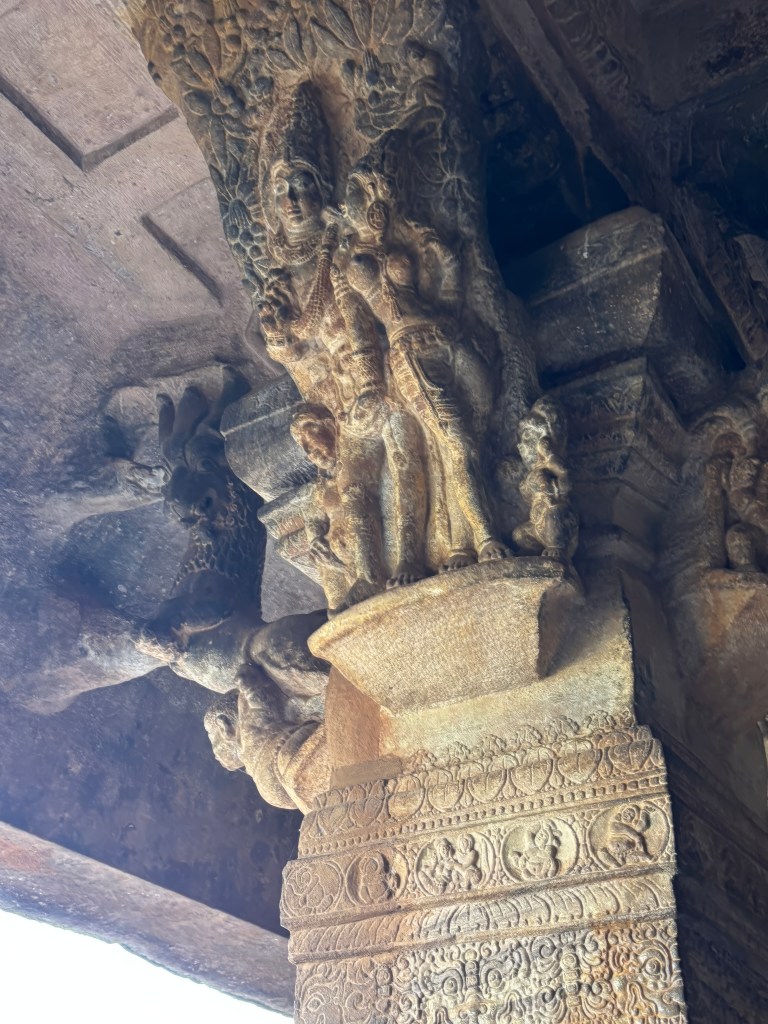
  • Intricate Pillars: The pillars are highly ornate, featuring detailed carvings of human figures, mythological characters, and mithuna (amorous) couples.
  • Ceiling Art: The ceiling has a “Navaranga” (nine-section) design with a central lotus medallion on the floor below it, surrounded by carvings of the Ashta Dikpalas (guardians of the eight directions)

Cave 4-Key Architectural & Artistic Features

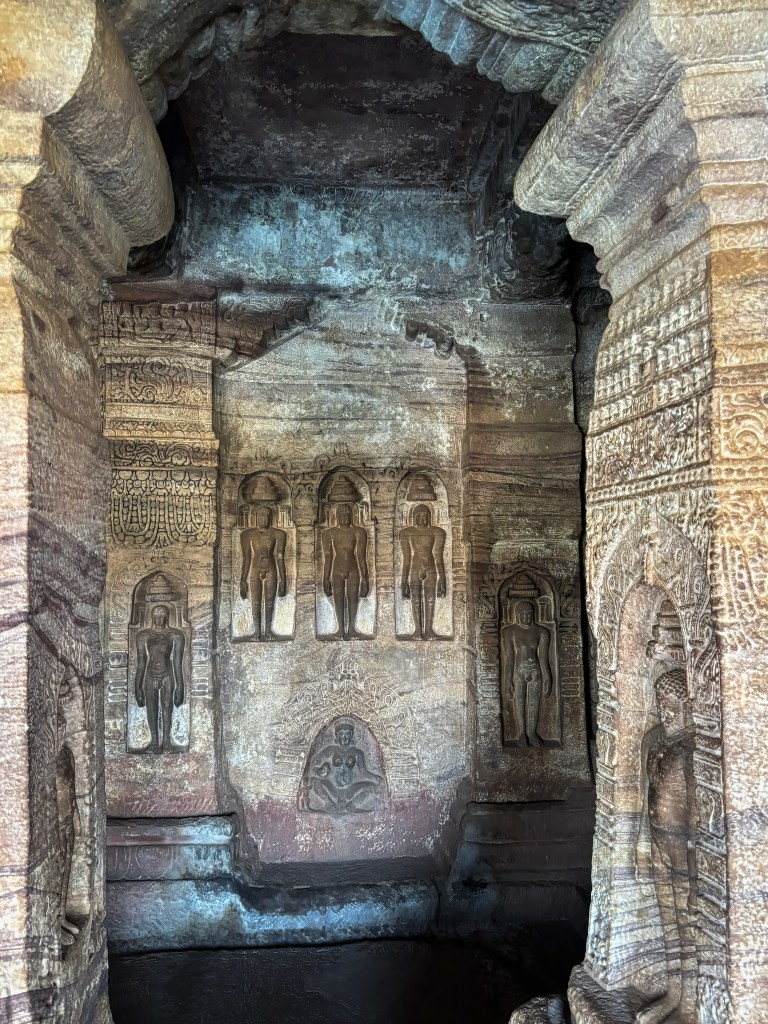
Cave 4 is the smallest and highest of the four major rock-cut temples in Badami. Unlike the first three, it is exclusively a Jain temple, illustrating the religious pluralism of the Early Chalukya period.  The less intricate drawings and crude carvings suggests that the cave-temple might be the latest of the series

Architectural & Historical Context

  • Dating: It was excavated in the late 7th or 8th century CE, significantly later than the Brahmanical caves. Further embellishments were likely added up to the 11th or 12th century.
  • Structure: The cave follows a slightly modified layout with an open verandah (mukhamandapa), an oblong antechamber (ardhamandapa), and a main sanctum (garbhagriha). 

Major Sculptures

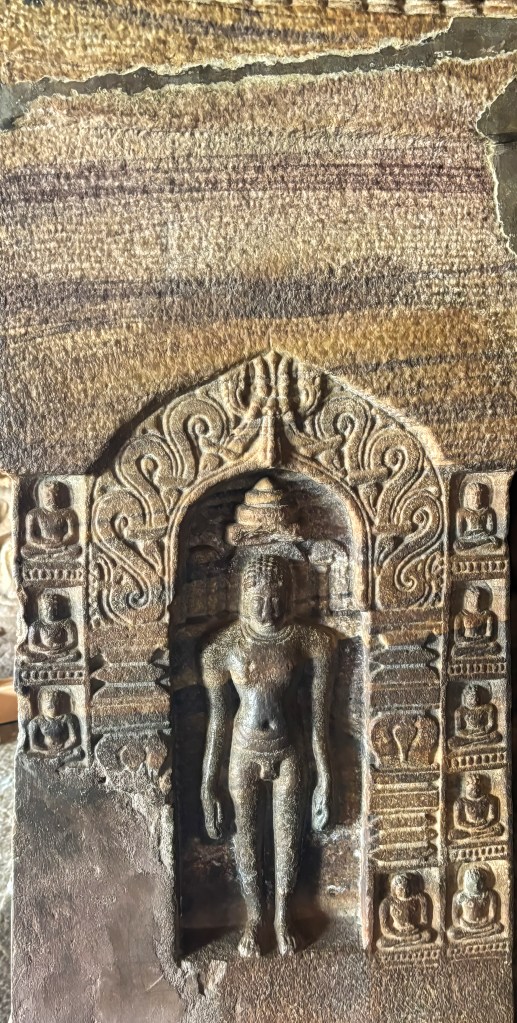
The cave is renowned for its detailed depictions of Jain Tirthankaras and deities in the Digambara (sky-clad) tradition. 

Digambara tradition—one of Jainism’s two primary paths. This sect translates to “sky-clad.” It represents the pinnacle of asceticism. Monks renounce all worldly possessions, including clothing. This renunciation demonstrates total detachment from the material self. For travelers, the serene, nude sculptures of Tirthankaras are the most striking evidence of this faith. The legendary Bahubali is depicted in such deep, motionless meditation that vines wind around his limbs. Beyond the stone carvings, the Digambara philosophy emphasizes a life of extreme non-violence (Ahimsa) and spiritual purity, offering a fascinating glimpse into a culture that views the entire universe—the sky itself—as its only garment

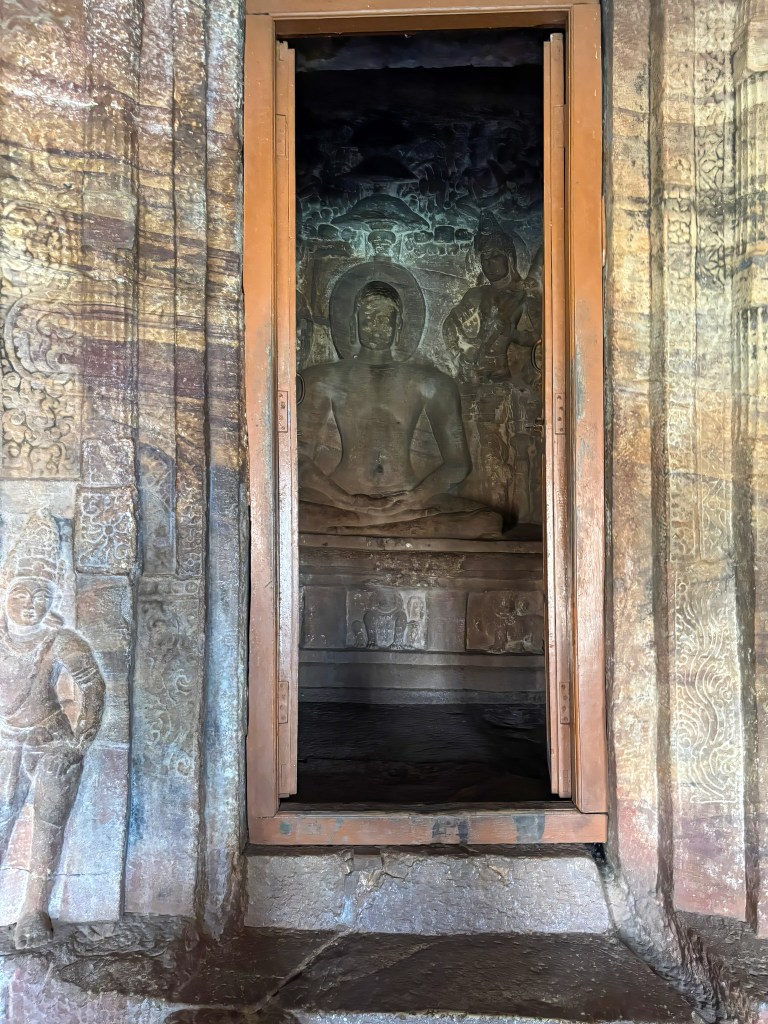
  • Lord Mahavira: The central shrine houses the 24th Tirthankara, Mahavira, seated on a lion throne. A 12th-century inscription near this image records the death of a pious woman named Jakkave.
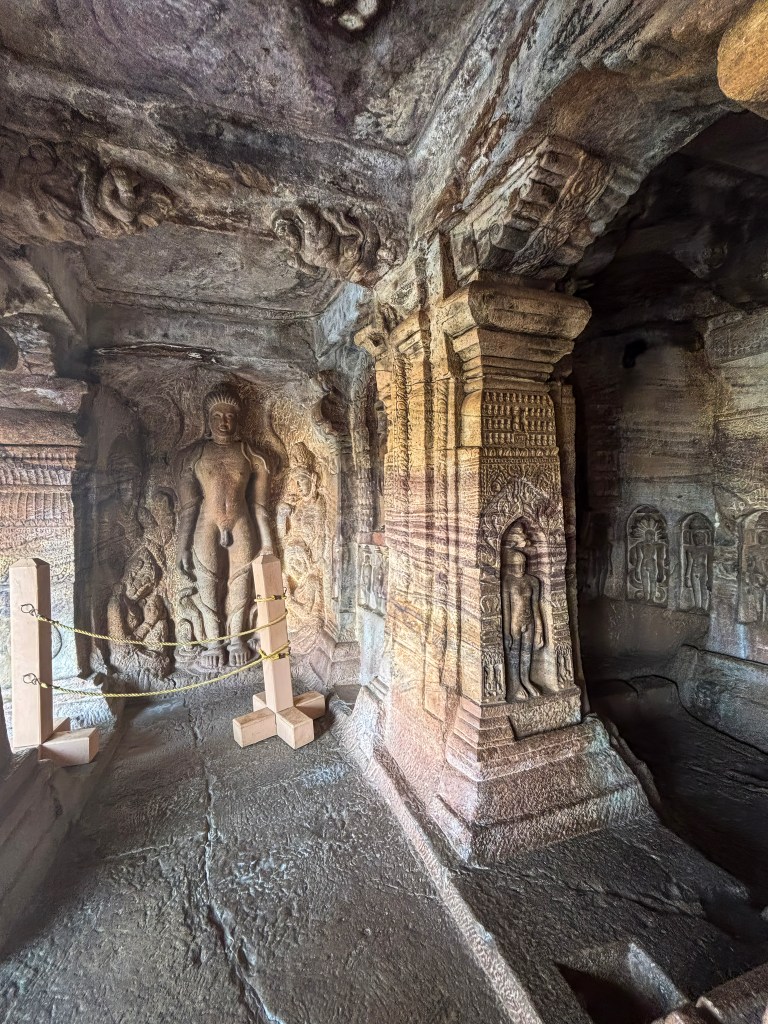
  • Parshvanatha: A life-size relief on the right side of the verandah depicts the 23rd Tirthankara in meditation, protected by a five-headed cobra hood.
  • Bahubali (Gommateshwara): On the left side, Bahubali is shown in the Kayotsarga (standing) posture. This is one of the earliest known representations of Bahubali in South India. It is notable for the vines (madhavi) shown winding around his legs during his long penance.
  • Other Figures: Smaller carvings of all 24 Tirthankaras, along with Jain deities such as PadmavatiIndrabhuti Gautama, and the female monks Brahmi and Sundari, adorn the pillars and walls

Final Thoughts

A visit to the Badami Cave Temples is a journey into an underrated gem of Indian architectural history. It offers a rare fusion of natural beauty and ancient human ingenuity. It is highly recommended for history lovers and photographers alike, offering stunning views and intricate carvings that will leave you awestruck.

Essential Travel Takeaways

  • Plan for a Full Experience: The four main caves can be explored in a couple of hours. However, the area around Badami offers much more. Spend at least a full day in Badami itself. This includes visiting Agastya Lake, the Bhuthanatha Temples, and Badami Fort. Stay for two to three days. Take day trips to the nearby UNESCO World Heritage sites of Aihole and Pattadakal. This will complete the heritage circuit.
  • Optimal Timing is Key: The best time to visit is between October and March. During this period, the weather is cooler and more pleasant for outdoor exploration. For the best light, aim for an early morning visit to the caves. To avoid crowds, consider planning your ascent for the late afternoon. This way, you can catch a mesmerizing sunset over the lake and cliffs.
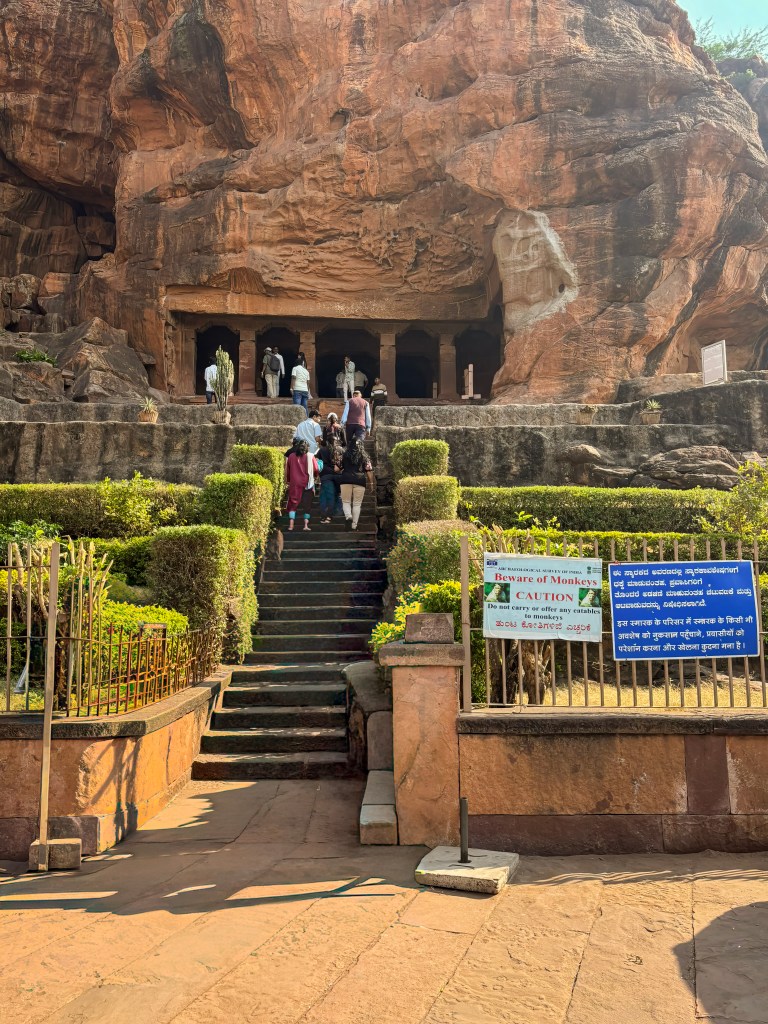
  • Physical Preparation: Be ready for a physical climb. The caves are accessed by a series of steep, uneven rock-cut steps. Sturdy, comfortable footwear with good grip is essential. There is no wheelchair access. The climb is manageable for most people but requires careful navigation, especially with children or the elderly.
  • Hire a Guide: Hiring a local guide is highly recommended. They can help you truly appreciate the rich history and symbolism. They will also point out the intricate details of the Hindu and Jain carvings.
  • Mind the Monkeys: The area is home to many monkeys. Do not carry food or water bottles openly, as they can be quite cheeky and snatch items from your hands

Explore Hampi’s Monolithic Ugra Narasimha Statue

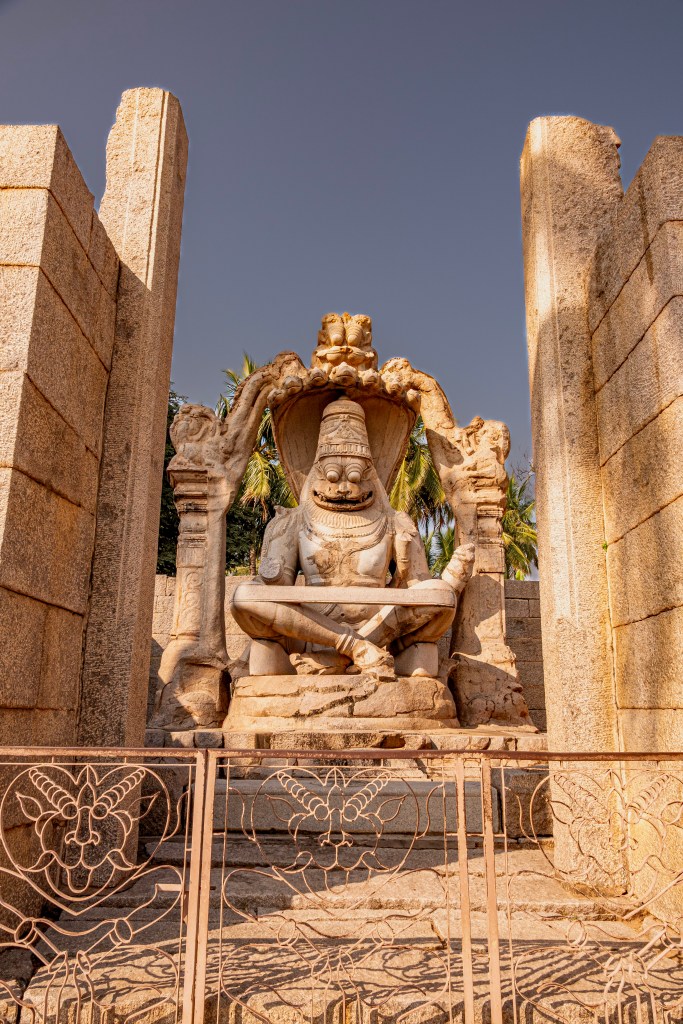
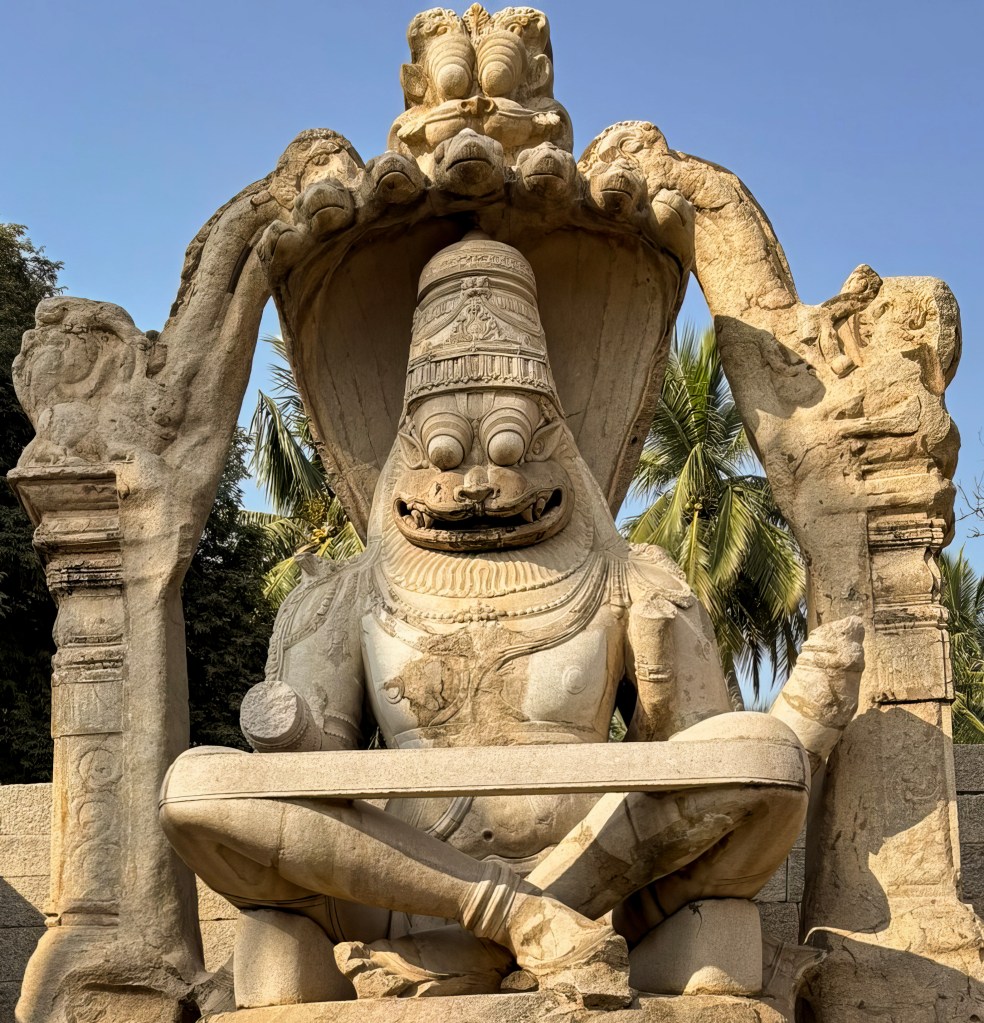
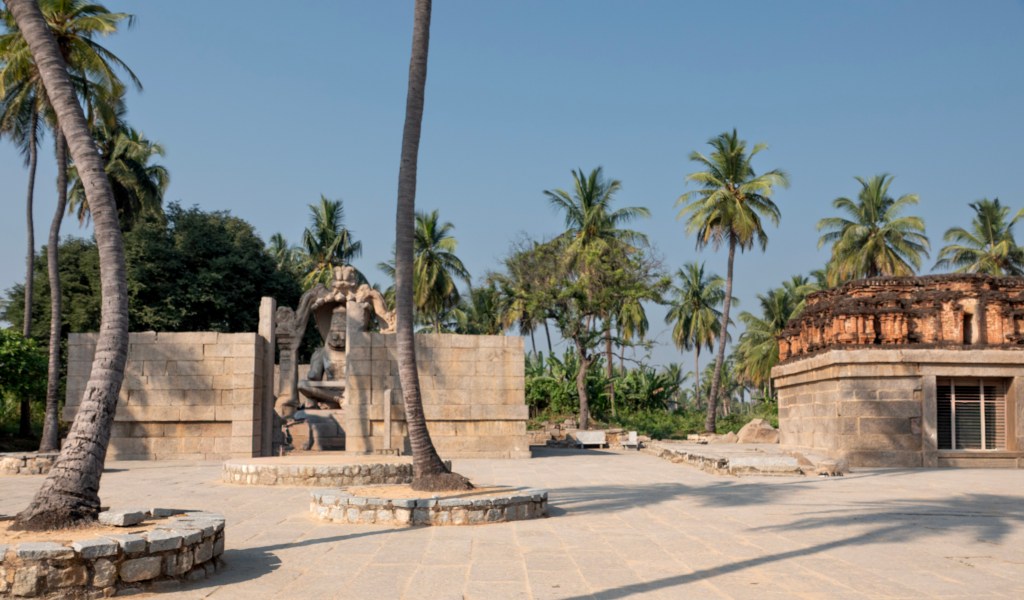
The monolithic Ugra Narasimha statue in Hampi is a massive, 22-foot (6.7m) tall sculpture of Vishnu’s half-man, half-lion incarnation, carved from a single rock in 1528 by order of King Krishnadevaraya, known for its intimidating expression but originally featuring Goddess Lakshmi on his lap, a consort figure destroyed by invaders in 1565. This remarkable statue not only showcases the exceptional craftsmanship of the artisans of that era but also reflects the rich cultural and religious heritage of the Vijayanagara Empire. As visitors approach, they are drawn to the intricate details of Narasimha’s fierce visage, which embodies both strength and protection.
Key Features & History:

  • Monolithic: Carved from one large granite boulder in 1528.
  • Size: Stands approximately 6.7 meters (22 feet) tall, making it Hampi’s largest monolithic statue.
  • Iconography: The statue depicts Narasimha, the half-man, half-lion avatar of Vishnu, seated in a cross-legged yoga posture (Padmasana).
  • Serpentine Canopy: He is sheltered by the seven hoods of Adishesha (the serpent god), which serve as a canopy over his head.
  • Makara Torana: The entire sculpture is framed by a Makara torana (an arch featuring mythical crocodile-like creatures) topped with a Kirtimukha (lion-like “face of glory”).
  • Unique Features: The statue is famed for its large, bulging eyes and fierce expression, symbolizing its “Ugra” (ferocious) form.
  • Missing Elements: Originally, a smaller statue of Goddess Lakshmi sat on his left lap; today, only her broken hand remains visible on Narasimha’s back due to damage in 1565.
  • Temple Structure: The original temple chamber has been completely destroyed, leaving the statue exposed to the sky without a roof.
  • Restoration: The Archaeological Survey of India (ASI) restored the statue, adding knees and a yogapatta (yogic band), leading to its alternative name, Yoga Narasimha.
  • Location: Found near the Badavilinga Temple at the base of Hemakuta Hill. 

Badavalinga Temple

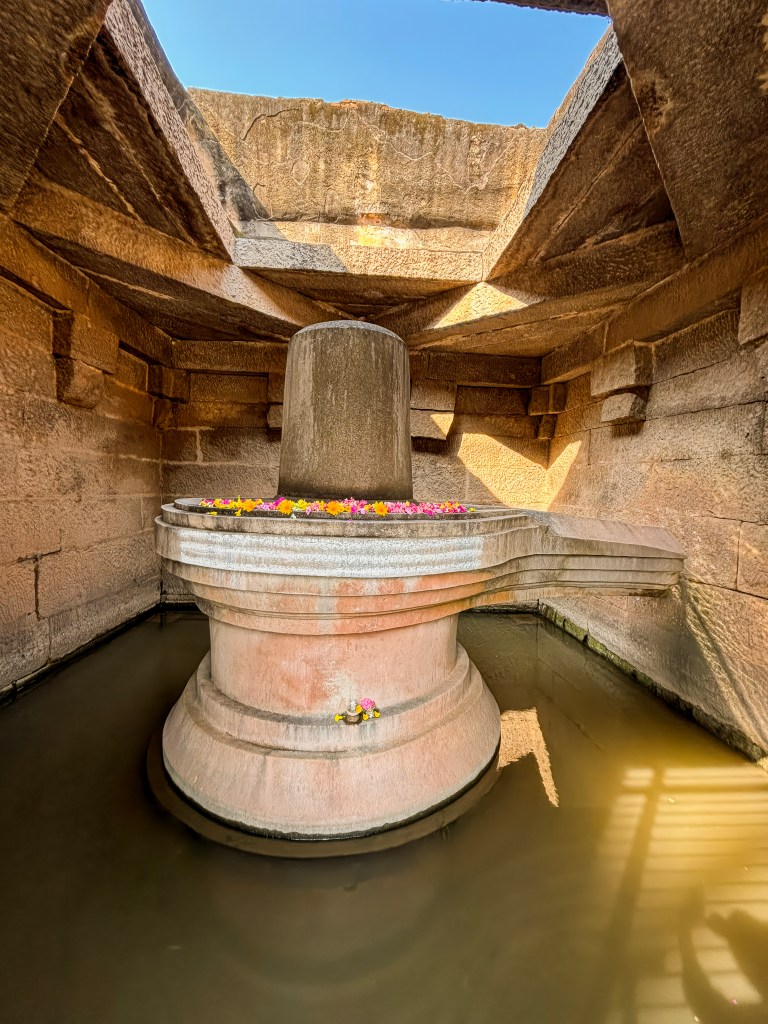
Right next to Laskmi Narashimha temple is the Badavalinga temple that houses largest monlithic Siva Linga in this area. The linga is partially submerged in water which flows thorough aquaduct from Thungabhadra river 1 Km away.

Key Details

Architecture: The 3-meter (10-foot) high Shiva Linga is carved from a single black stone and features a carved mark representing Lord Shiva’s three eyes. The temple chamber lacks a permanent ceiling, allowing natural light to illuminate the Linga.

Location: The temple is located near the popular Lakshmi Narasimha Temple in Hampi, a UNESCO World Heritage site. It’s easily accessible and about 1 km from the town center.

Hours: It is open daily from 6 AM to 6 PM. Some sources mention longer hours from 5 AM to 9 PM.

Entry Fee: There is no entry fee to visit the temple, and photography is allowed.

Legend: The name “Badavilinga” is derived from the local language words Badava (poor) and Linga, as it is believed to have been commissioned by a poverty-stricken peasant woman during the Vijayanagara Empire.

    These 2 temples are great starting points for appreciating what Hampi has to offer