After roaming around the old Quebec city, my friend and I took a break on a bench in front of Château Frontenac. A sculpture that stood in the middle drew my attention. I had been in Qubec city for a couple of days. I spent a lot of time taking photos of the Château Frontenac and Place d’Armes public park. In the middle of the park is a Gothic fountain on which stands the Faith Monument (monument de la Foi) and this statue is next to the Faith Monument. Somehow, I had missed the statue until that moment. I decided to take a photo and try to find more information. I couldn’t find much in my quick Google search. But something about the sculpture seemed familiar, and I had a nagging feeling that I had seen it somewhere before.

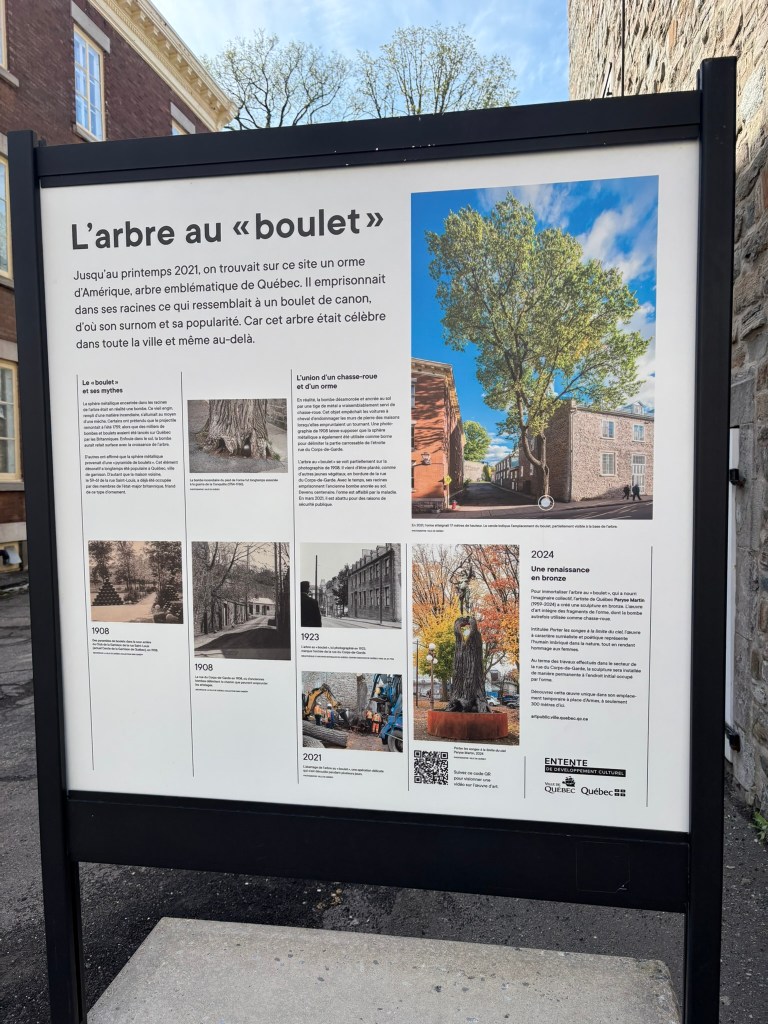
After coming home, I was downloading the photos. I saw a picture of a sign. I had taken it in front of one of the old houses on rue St-Louis that morning. This was before I saw the sculpture. The sign had the photo of the sculpture. Since everything was in French, I didn’t understand what it was until I used Google Translate.
Story of Ball and the Chain Tree
Just beyond the grandeur of Château Frontenac, where cobblestones echo with centuries of footsteps, a tree once stood. It held a secret in its heart. Locals called it the Cannonball Tree—L’Arbre au Boulet. It was an American elm that had cradled a rusting iron sphere for over a century. Legend has it that the cannonball was a relic from the 1759 Battle of the Plains of Abraham. Truth or not, the story stuck, and so did the awe.
Time, as it always does, wore the tree down. Disease crept in. The roots weakened. And in 2021, the city bid farewell. But not with silence—with reverence.
The cannonball was carefully removed by the Canadian Armed Forces, and the tree’s trunk was preserved. Today, in front of Château Frontenac, a sculpture stands—crafted from the very wood that once held history in its bark. It’s not polished to perfection. The grain is rough, the form organic. It doesn’t try to erase the past—it honors it.
This is wabi-sabi in its purest form: the beauty of what remains after loss. A tree that once bore the weight of war now offers a place for reflection. Tourists pause, not just for photos, but for silence. For story. For the reminder that even in decay, there is dignity.
Québec City didn’t just lose a tree. It gained a monument to impermanence.


 Peaks to Palaces