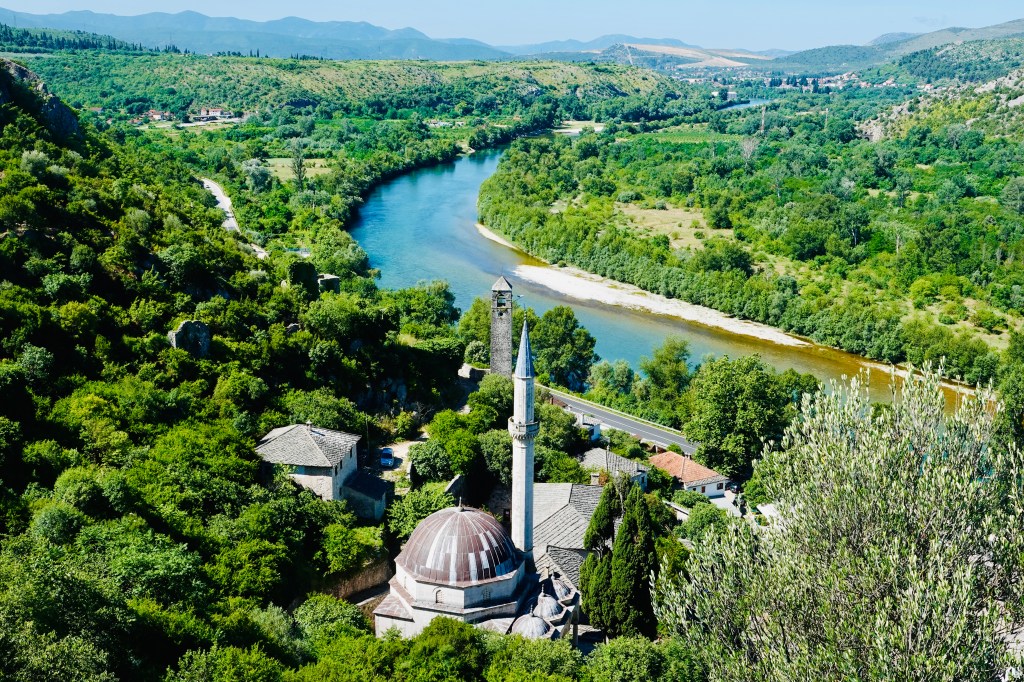
Pocitelj, a small village in the Herzegovina region of Bosnia and Herzegovina, is famous for its well-preserved Ottoman-era architecture and UNESCO World Heritage List status. It’s about 30 kilometers south of Mostar, and the easiest way to reach it is by car via the E73 highway.
Pocitelj has a history of over 600 years and is an important cultural and historical site in Bosnia and Herzegovina. In the 16th century, the village came under Ottoman rule, leading to the construction of buildings such as the Hadzi-Alija mosque, the Sahat-kula (clock tower), and the Gavrankapetanovic-Kuca (Gavrankapetanovic house) which represent typical ottoman styled architecture.
Main landmarks of Pocitelj
Hadzi-Alija Mosque was built in 1563, is considered to be one of the oldest mosques in Bosnia and Herzegovina. The mosque’s distinctive stone walls and minaret are typical of Ottoman-era architecture. We didn’t go inside the mosque but according to our guide, pre-covid, people were allowed inside and hopefully they will open it to public soon.
Sahat-kula (Clock Tower), built in the 17th century, is an iconic landmark in Pocitelj. Standing at over 20 meters tall, this stone tower served as a way for villagers to tell time. Despite the missing clock face, visitors can still climb to the top to enjoy stunning views of the surrounding countryside. Unfortunately, the clock face was melted for its metal during the war time.
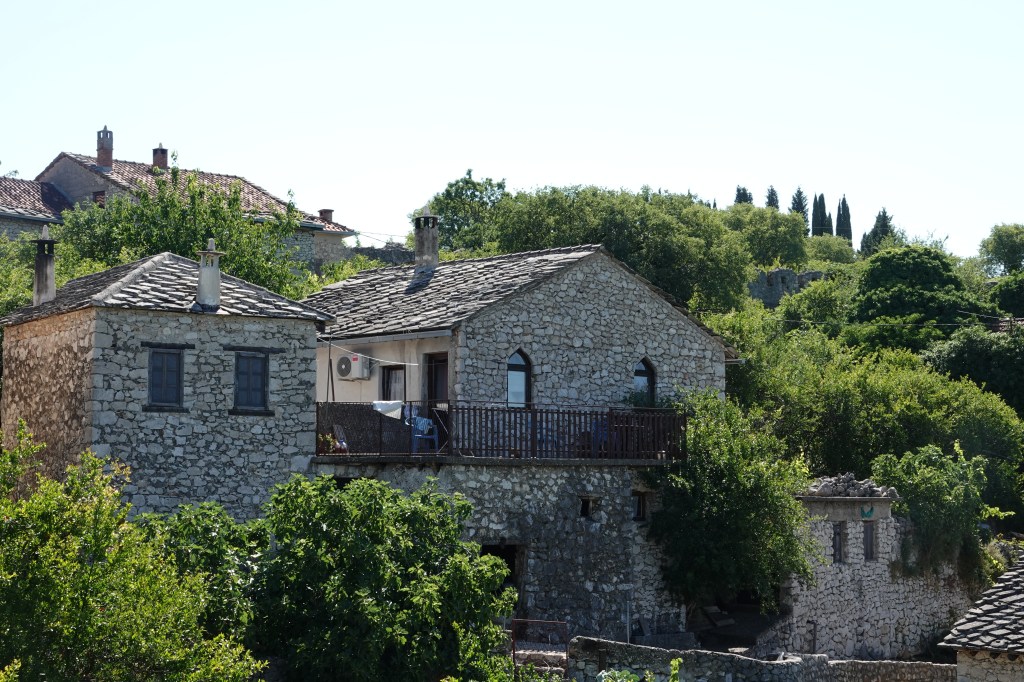
Gavrankapetanovic-Kuca is a prime model of Ottoman-era residential architecture from the 17th century. It boasts traditional stone walls, a red-tile roof, and well-preserved interior showcasing original furniture and decor used by the family.
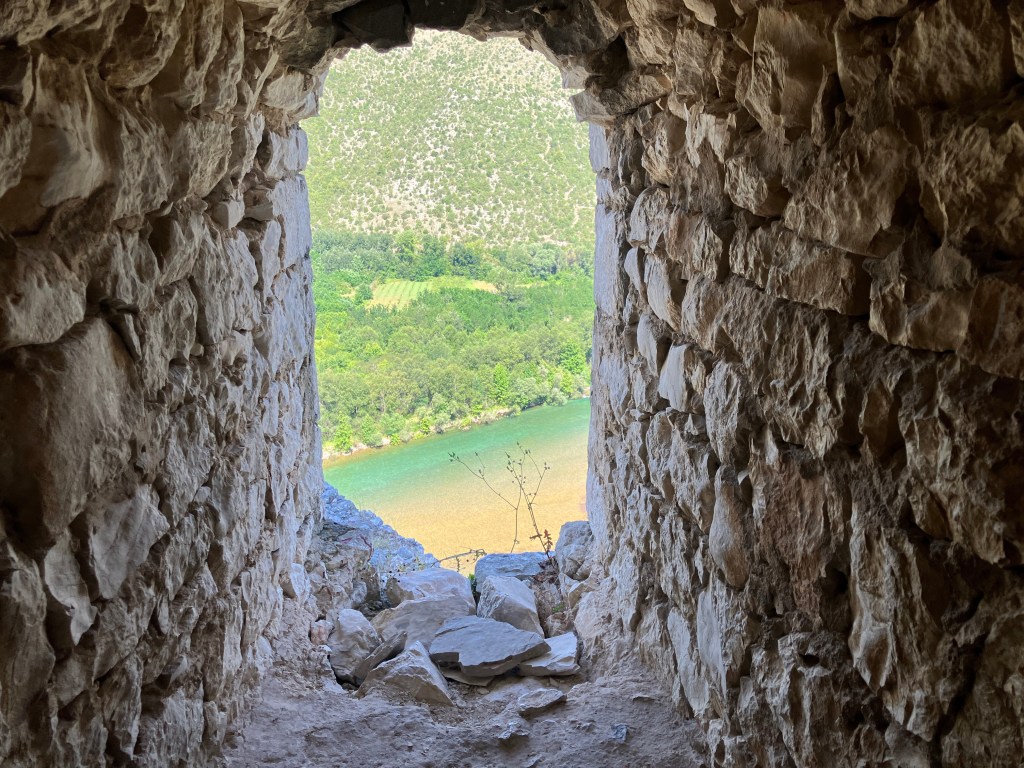
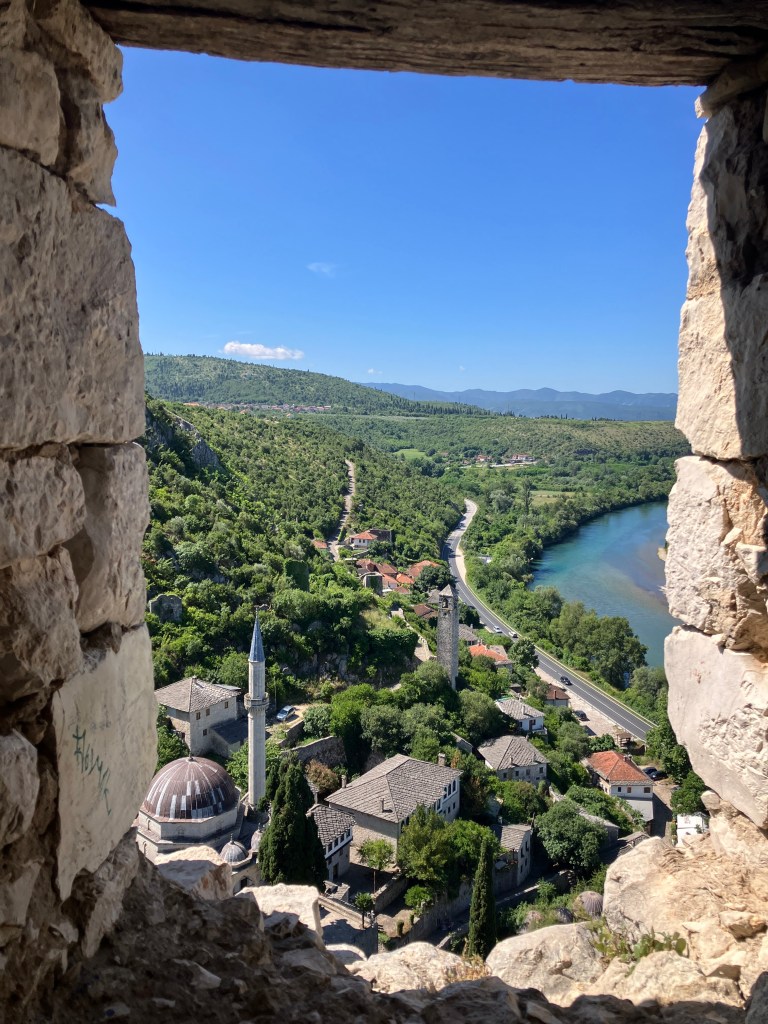
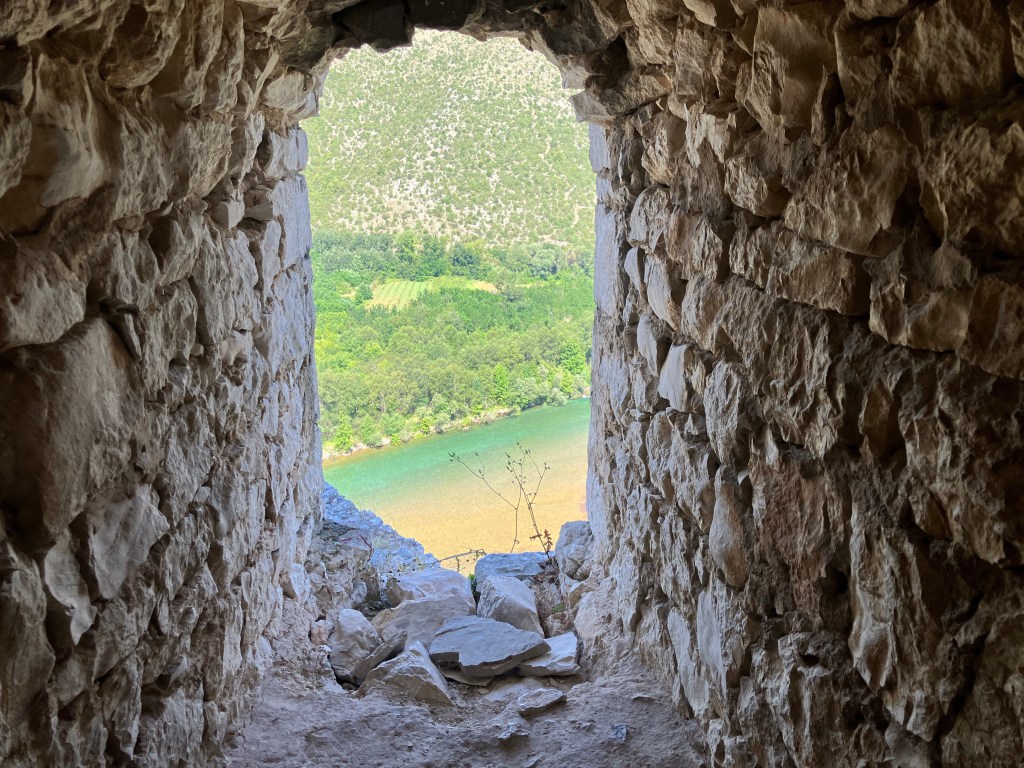
Citadel or the fortress – The stone walls of the fortress are intact, and you can climb to the top to get an amazing view of the valley and surrounding areas
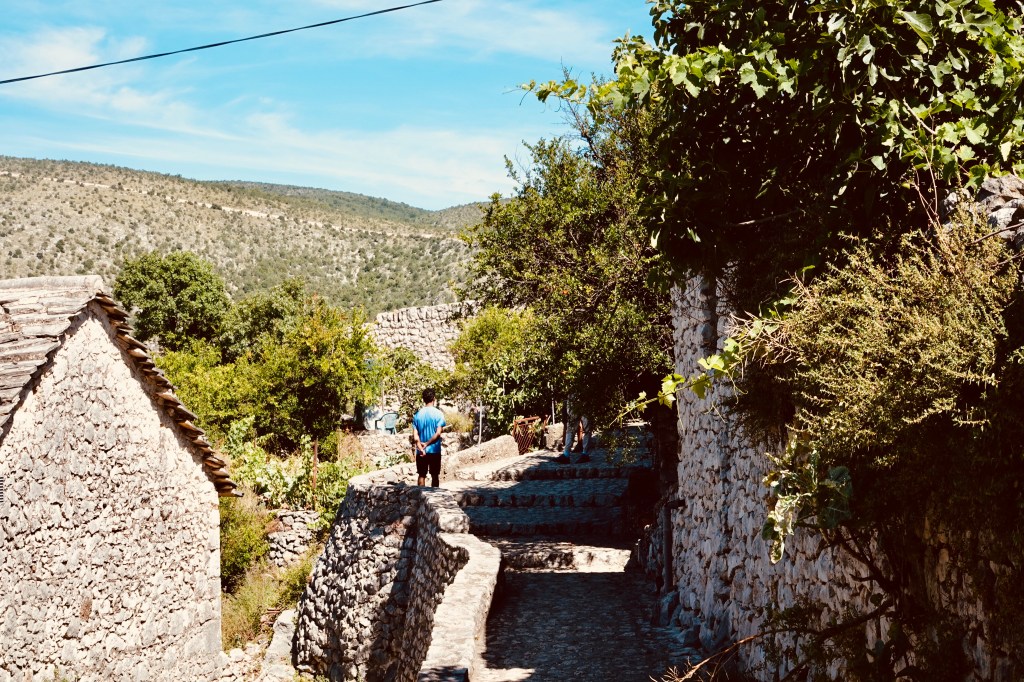
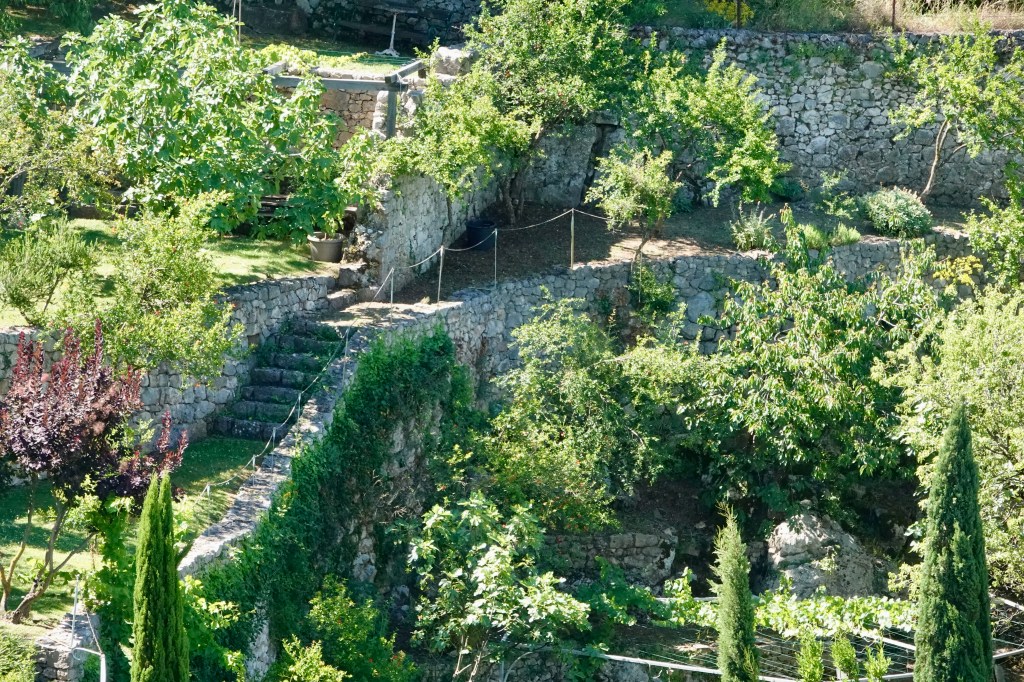
Houses -There are still about 20 families that live in the village and call it home. We stopped by one such home that sold home grown figs, pomegranate juice, honey etc. Just walking around village gives you fascinating glimpse ottoman era
Final thoughts:
Village of Počitelj is a great stopping point on your way from Dubrovnik to Mostar or as a day trip from Mostar before heading to Kravica waterfalls. You can spend 1-2 hours roaming around the village.
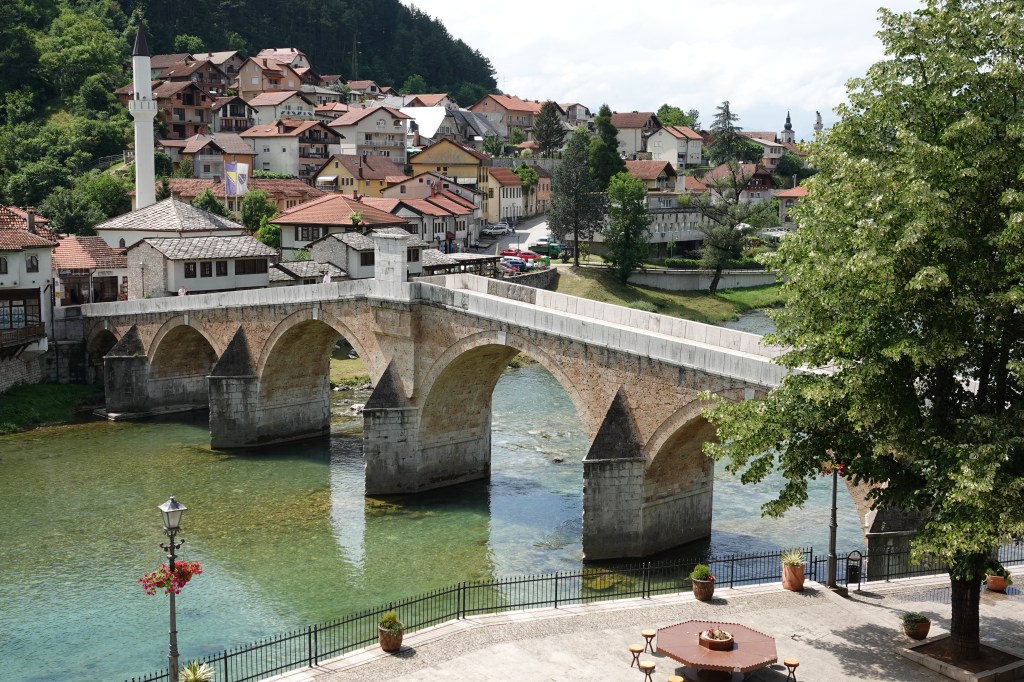
Konjic is the town that connects Herzegovina with Bosnia and our guide jokingly said that Konjic is the “&” in Bosnia & Herzegovina. We visited Konjic on our Bosnia trip and did white water rafting in the Neretva River. Konjic like other cities in Bosnia, blends history, and nature especially popular for white water rafting and in fact when we were inn Konjic, they were holding the European rafting championships on the river.
Built in 1682, the Old Bridge in Konjic is one of the most beautiful bridges from the Ottoman period in Bosnia and Herzegovina. The bridge, made of stone and consisting of six arches, is considered the point where Herzegovina merges with Bosnia. Alongside Mostar’s Old Bridge, Trebinje’s Arslanagića Bridge, and the Mehmed-paša Sokolović Bridge in Višegrad, the Old Bridge in Konjic is a significant cultural and historical monument of the country, declared a national monument of Bosnia and Herzegovina. Unfortunately, the original Old Stone Bridge was demolished on March 3, 1945, during the withdrawal of the German army, and a wooden structure stood in its place for a long time, serving as a crossing over the Neretva River. In 1962, the bridge was reconstructed with a concrete structure, restoring it to its original state. The renovated bridge was reopened on June 16, 2009, with the assistance of the Government of the Republic of Turkey.
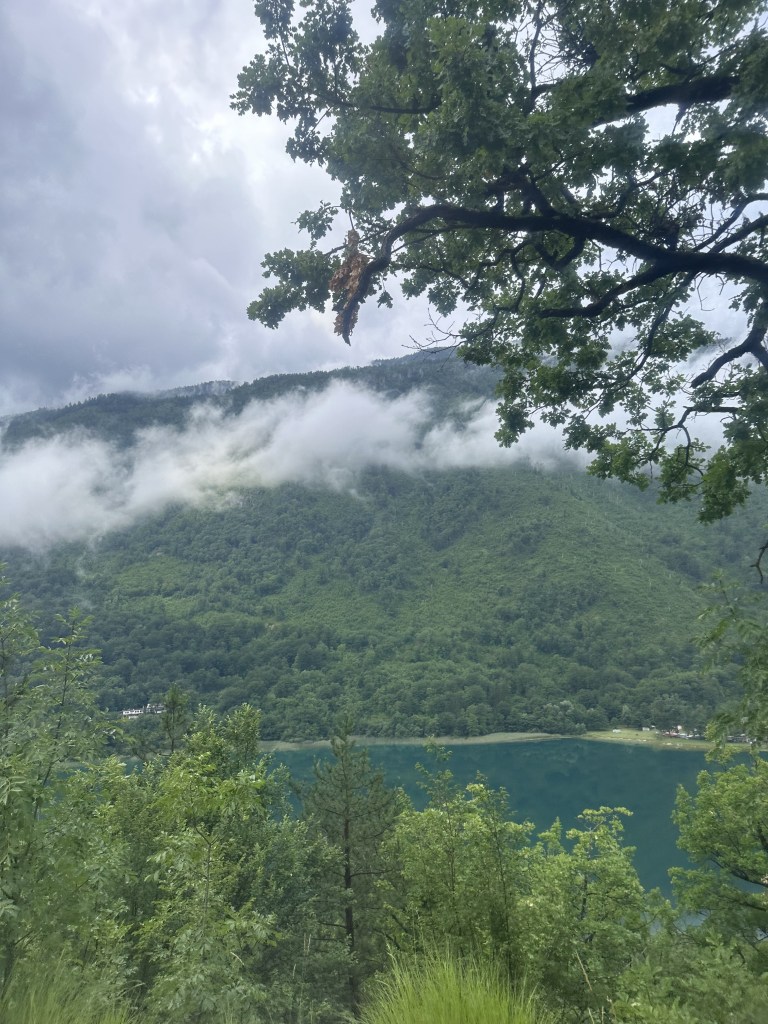
Boracko lake
Located about 20 kilometres from Konjic, Boračko Lake is a glacial lake that lies at the base of Mount Prenj. We stopped here on the way to our white water rafting start point but I would definitely love to go back and explore this lake more. There are some bed and breakfast places near the lake and it is supposedly really beautiful in fall season. For more on this lake, check out this blog
White water rafting on Neretva River
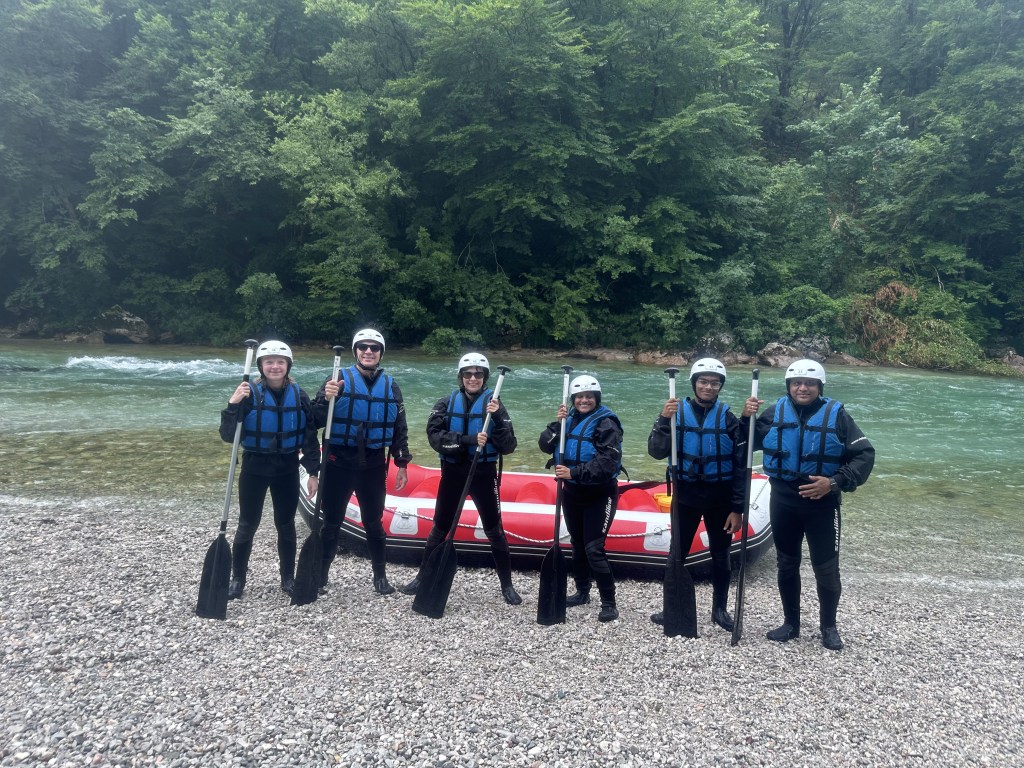
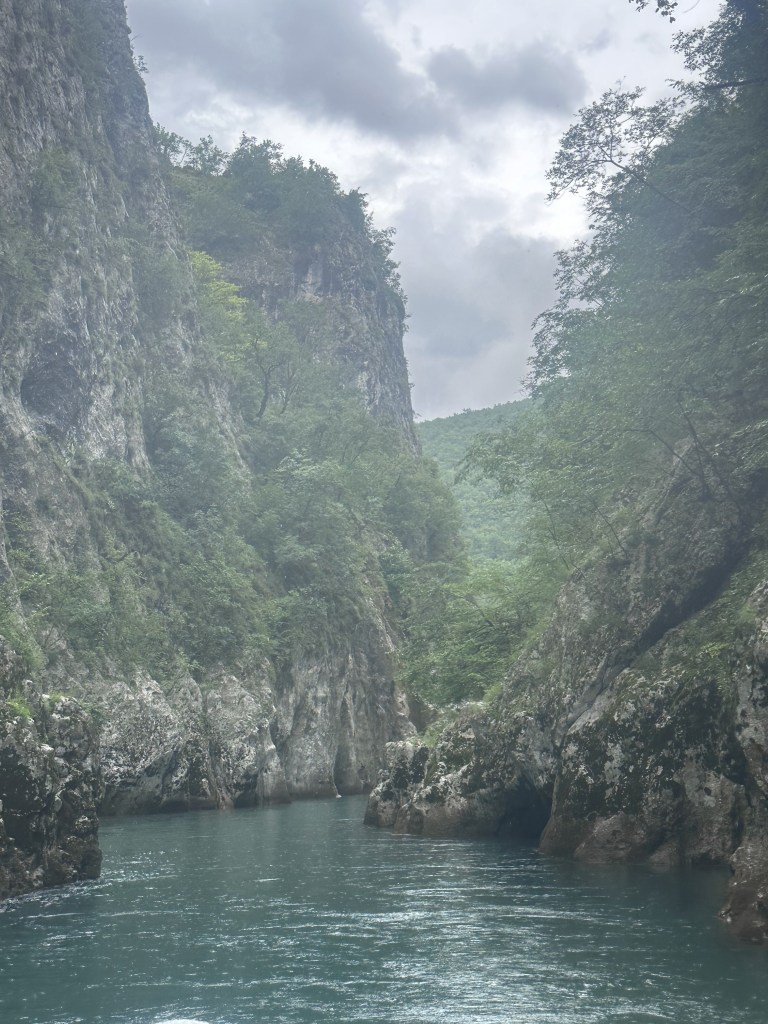
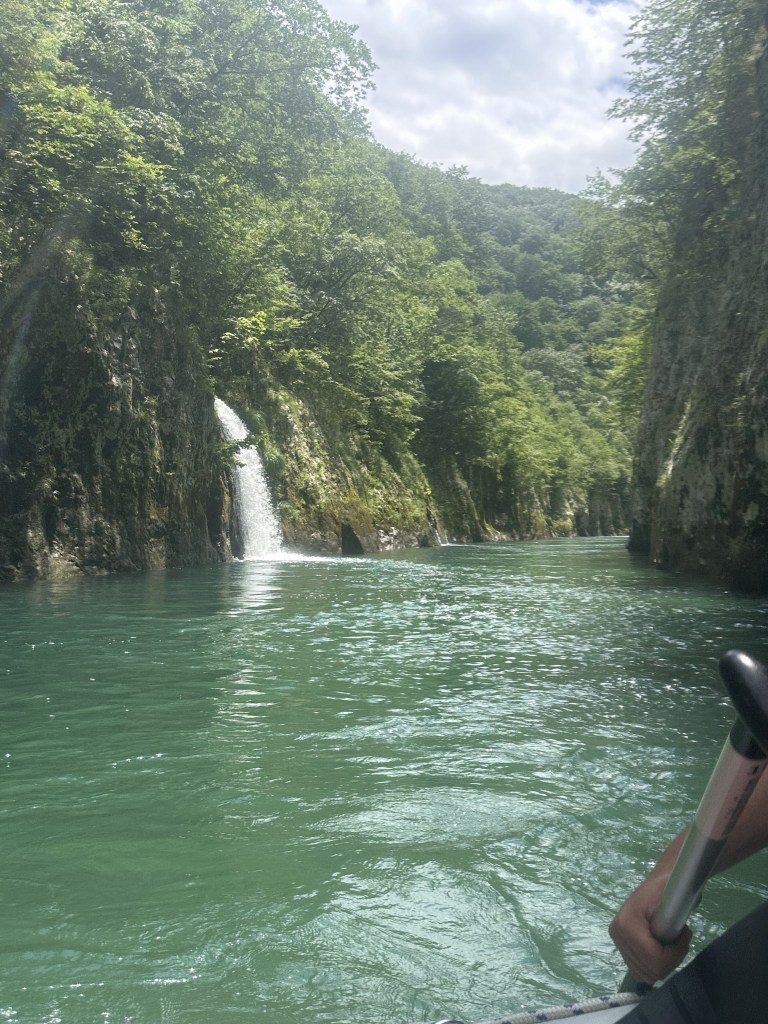
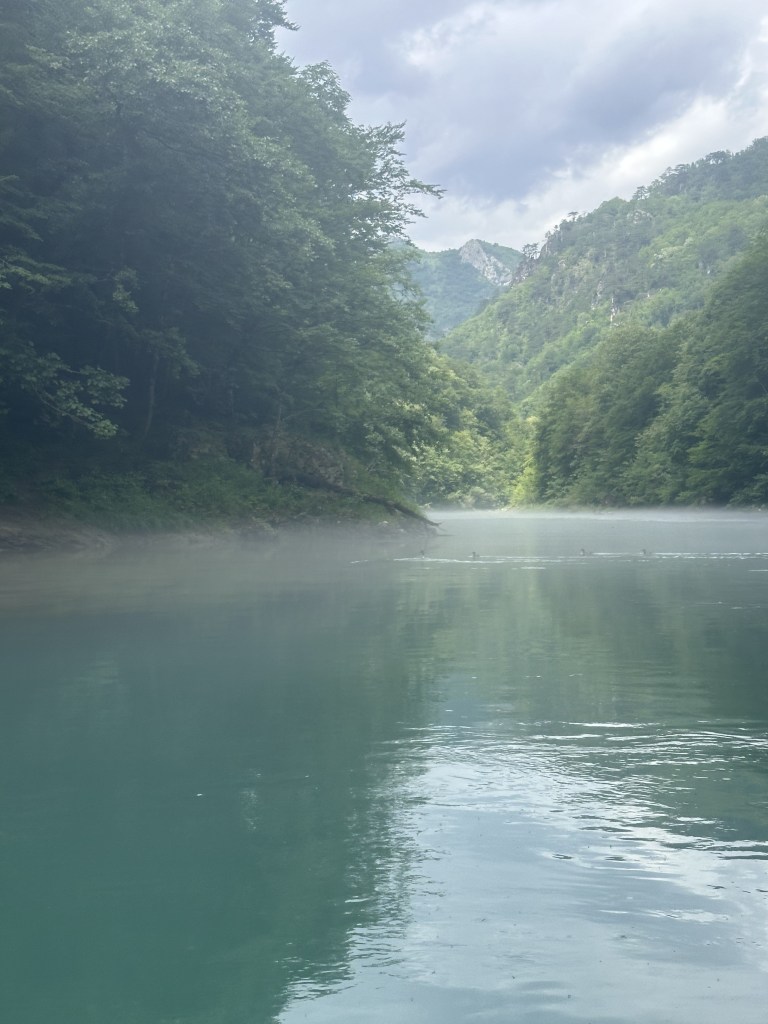
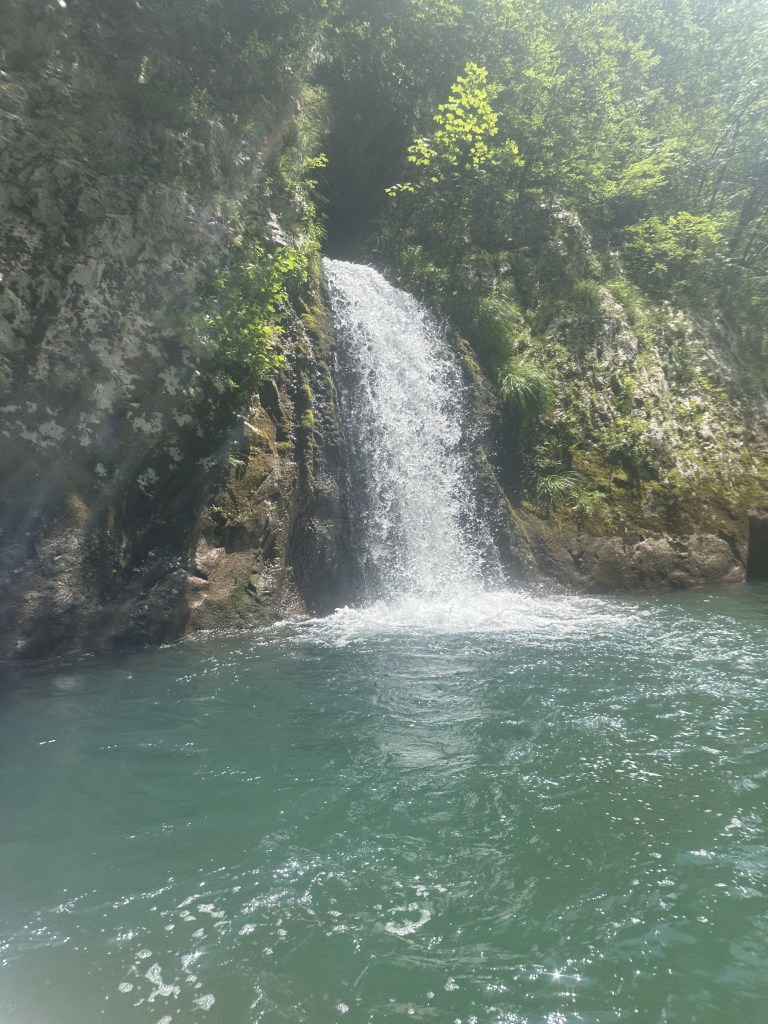
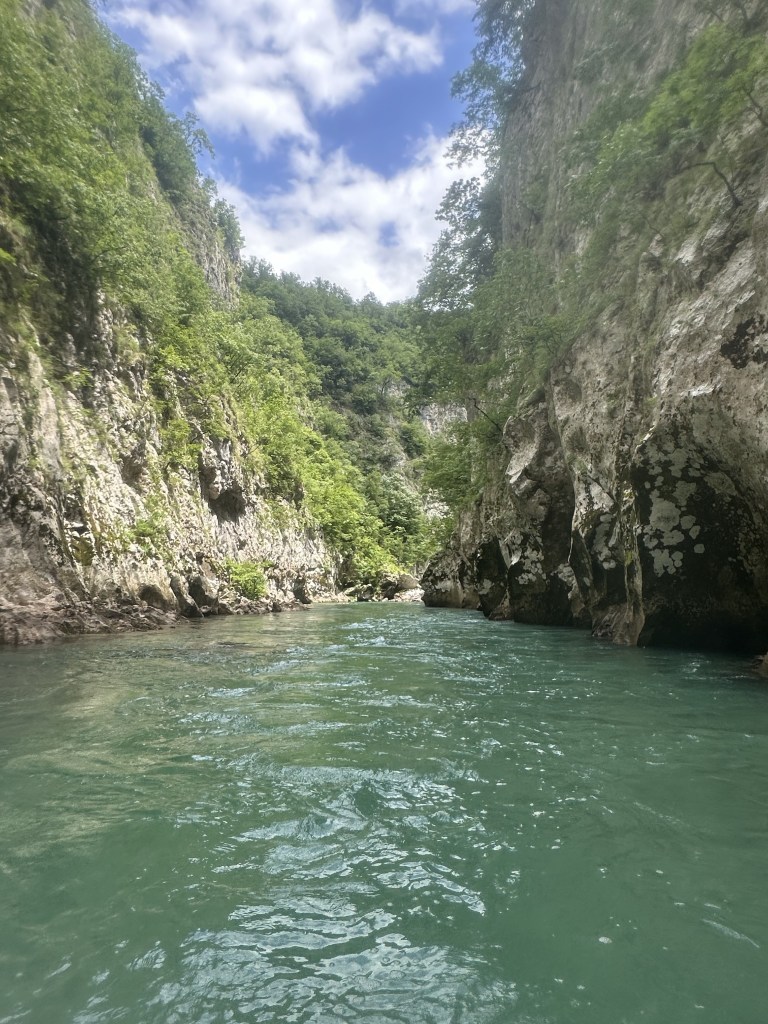
Rafting on the Neretva River is a popular activity in Konjic, and we did ours through Visit Konjic rafting company. There are several providers, and they all seem to follow the same route. When we did our rafting in mid-June, 2024, we were on the only ones on the entire 22 km path, but our guide informed us that during peak season of July and August, there might be as many as 100 rafts on the water. We enjoyed having this amazing canyon to ourselves and felt like the scenery is right out of middle earth with lush green tress, waterfalls and beautiful canyons. During June, the rapids were level II and III and very manageable.
The white rafting take place in 26 kilometers long, the Rakitnica canyon that separates the Bjelašnica and Visočica mountains and connects Bosnia and Herzegovina and is one of the deepest canyons in Europe. Most rafting tours start from village of Glavatičevo and end near the bridge of Konjic.
A typical itinerary for white water rafting looks like below and since we did this during off season, we started around 11 AM.
Arrival to Rafting Base Camp – Once we reached the base camp, we were given wet suits and changed into water shoes. After the safety briefing, off we went to the starting point in a minivan.
Departure towards the rafting start location in Glavaticevo -It takes about and hour to reach the starting point at village of Glavatičevo. The drive is beautiful and goes through the beautiful mountains. On the way to the village, we stopped at the Boracko Lake lookout point for photos.
Rafting start at – 12:00 After ariving to start point in Glavaticevo,we got in the rafts and started our descent towards Rakitnica Canyon where we did a 30 min stop for some snacks and swim.
Rakitnica Canyon Swim Stop -The first leg of the journey ended when we reached to the point where Rakitnica tributary river meets Neretva. This place is beautiful and we appreciated the crystal-clear waters and surrounding mountains.
Second leg of the Journey – 14:30 After a nice relaxing swim stop, we started on our second leg and arrived back at the base camp around 3.30PM. After a warm shower and a change of clothes, we had traditional Bosnian lunch made by the hosts.
Starting pointRakitnica river joining Nerevta river Waterfall in the canyon
Tito’s bunker on Zlatar mountain
Officially named the “Armijska Ratna Komanda” (ARK D-o), Tito’s bunker was built between 1953 and 1979. It served as an atomic shelter to protect the military command and 350 members of President Tito’s government in the event of a nuclear attack during the Cold War. It is now a museum and visit it when you are in Konjic
Final Thoughts
Konjic is a beautiful place and has lots to do. We did a day trip from Sarajevo, but you can definitely spend couple of days here to truly appreciate all Konjic has to offer.
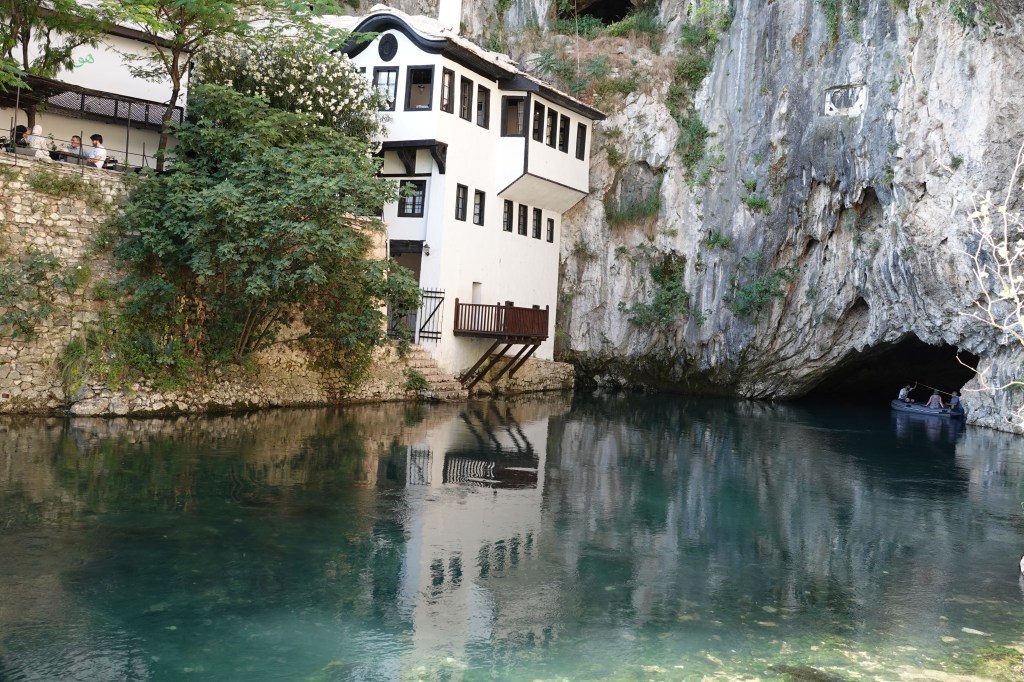
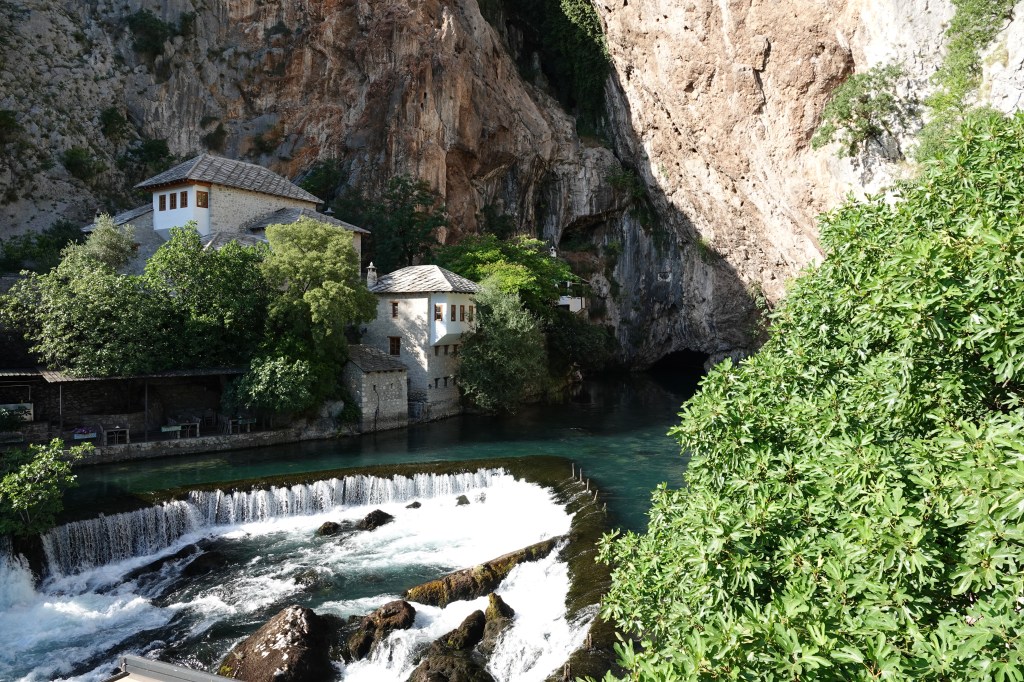
The village of Blagaj na buni is located about 10 km (6 miles) from Mostar that could be reached by bus or car. The main attraction of the village is the Tekke or Tekkja – a place of spiritual retreat and reflection for Dervish monks. The unique feature of this Tekke is that it is built on a solid rocky soil at the right side of the source of the Buna River. A very high cliff stretches above the Tekija (240 meters high). On top of the cliff, you can see the remains of Stjepan Vukcic-Kosaca’s fort-town from the Middle Ages. The Buna River that flows adjacent to the monastery emerges from under the massive Karst stone formation after traveling over 19 kms underground.
Spring of Buna River
Blagaj Tekke the dervish retreat
The primary purpose of the structure was to serve as a dervish Zikr praise-chanting (praising God and His names) venue and a retreat, and it is still active religious complex with Zikir praise chanting happening 3 times a week. The tekke was built around 1520 and it features elements of both Ottoman architecture and Mediterranean style. The dervishes follow a mystical strand of Islam in which the peaceful contemplation of nature plays a part, hence the Tekke’s idyllic positioning next to the river.
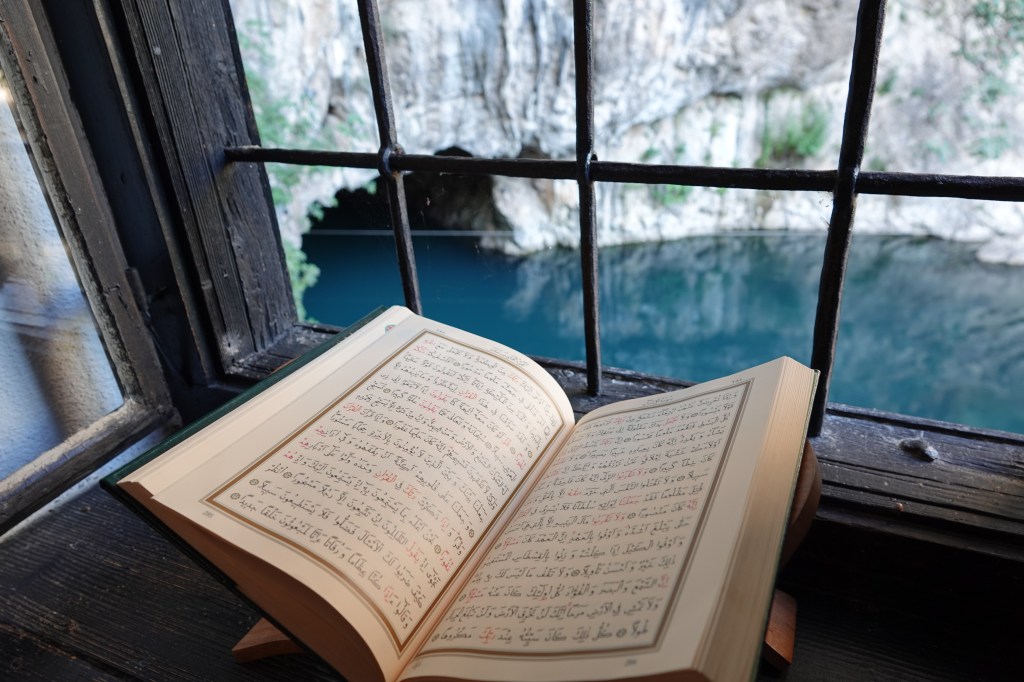
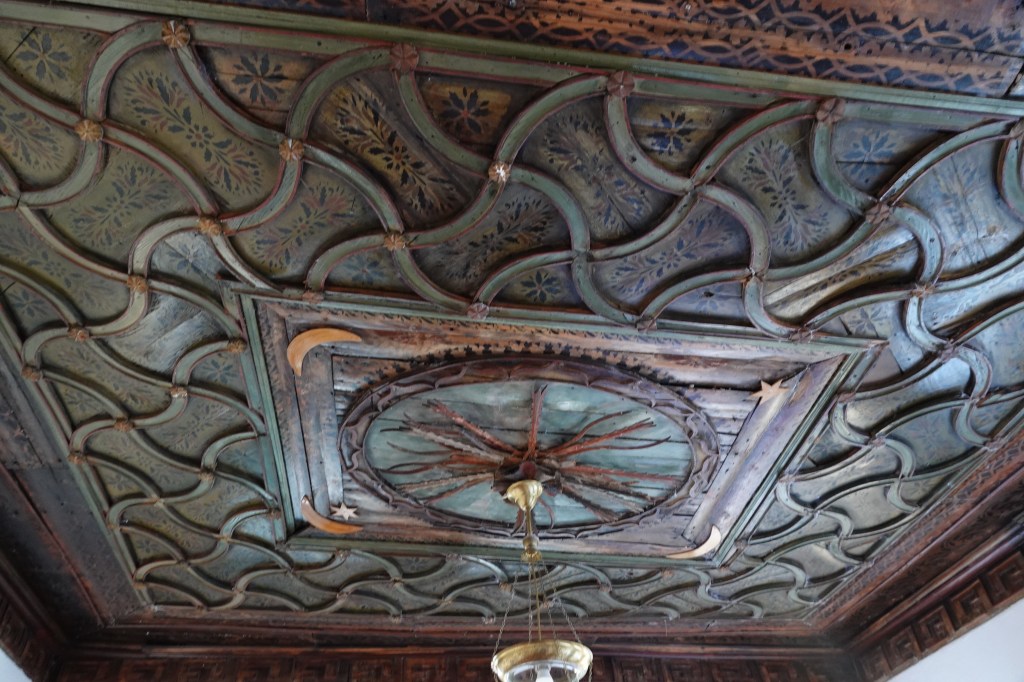
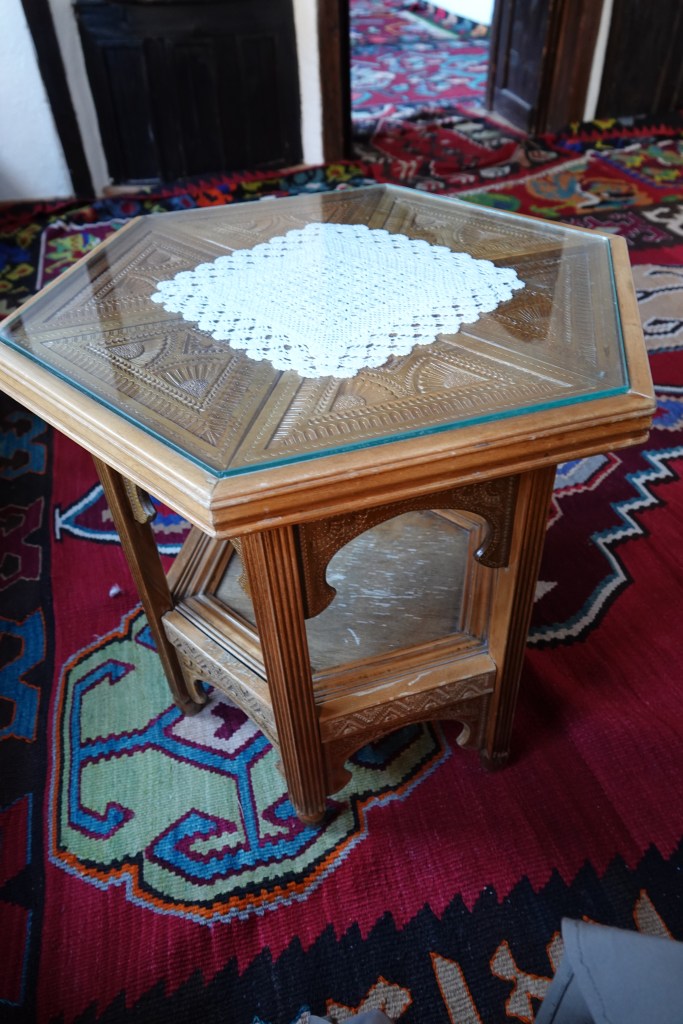
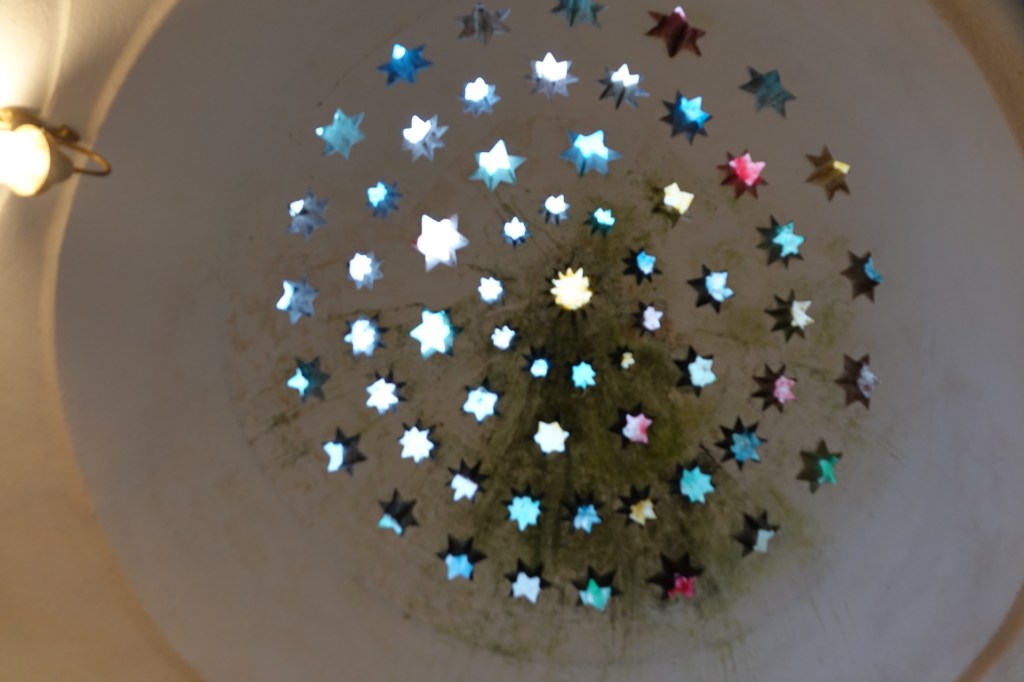
You can go inside the building by paying 10 marks and there are several different rooms including a kitchen, guest house, hammam, a room for praying, tombs, and a courtyard. There are some interesting features including the perforated dome in the hammam and beautiful wooden ceiling of semahana, or the room used to perform zikr (religious chanting).
Best place to take photos of the Tekke
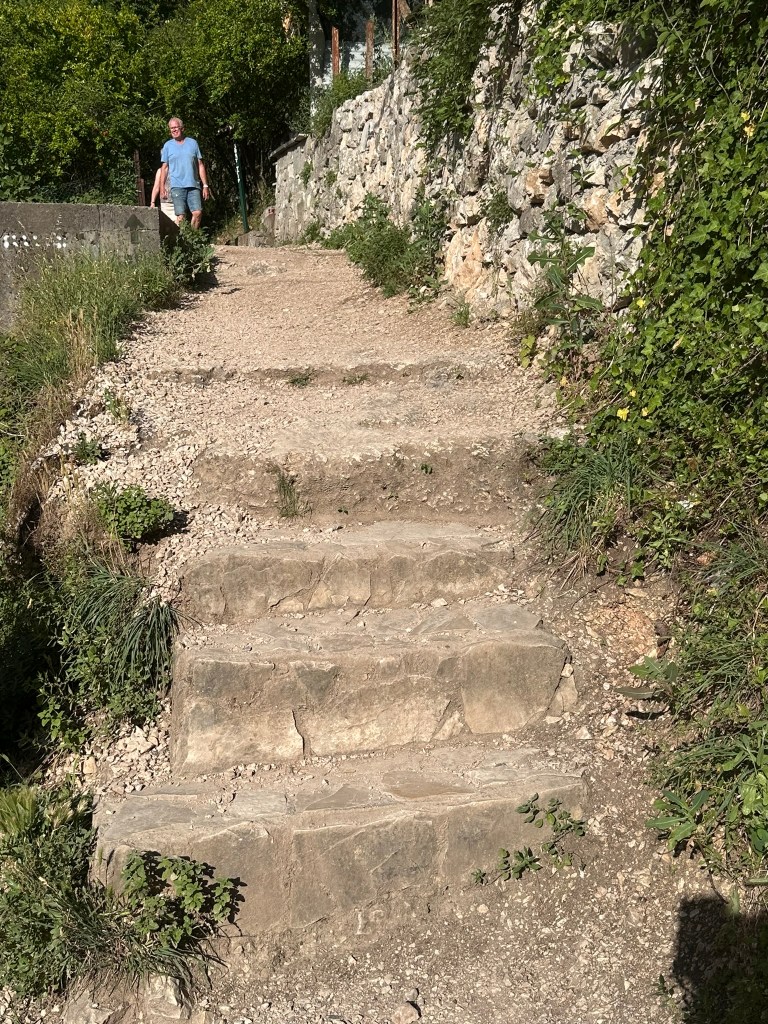
To get the iconic reflection of the Tekke in the water, you need to get the other side of the river. Cross-over the first bridge and walk behind the restaurants until you see a set of stairs that lead to the viewpoint.
Stairs leading to other side of the river to get the iconic photos
Entrance fee
There is an entrance fee to go inside the Tekke- It is 10 marks/ 4-5 euros. Women are expected to cover their head and arms as well as wear long skirts. These are provided free of cost at the entrance.
Other things to do around Blagaj
There are several restaurants around Blagaj and you can get traditional food and drinks and enjoy the peaceful surroundings.
Jablanica: Where Natural Beauty Meets Historyand Gastronomy
Halfway between the cities of Sarajevo and Mostar is the town of Jablanica. It is located in the beautiful Neretva River valley and is known for its natural beauty, cultural heritage, and roasted lamb. We stopped here on our way to Mostar after whitewater rafting in Konjic, another charming little town about 20 km away.
Jablanica has several notable attractions, including the picturesque man-made Jablanica Lake, perfect for boating and fishing, as well as the pristine Neretva River, which offers rafting and kayaking. The high peaks of Mt. Prenj and Mt. Čvrsnica are known for their challenging hiking trails, making it a paradise for nature lovers. Along with incredible nature, Jablanica steeped in history specially played key role in second world war.
Jablanica Bridge- A thrice destroyed bridge
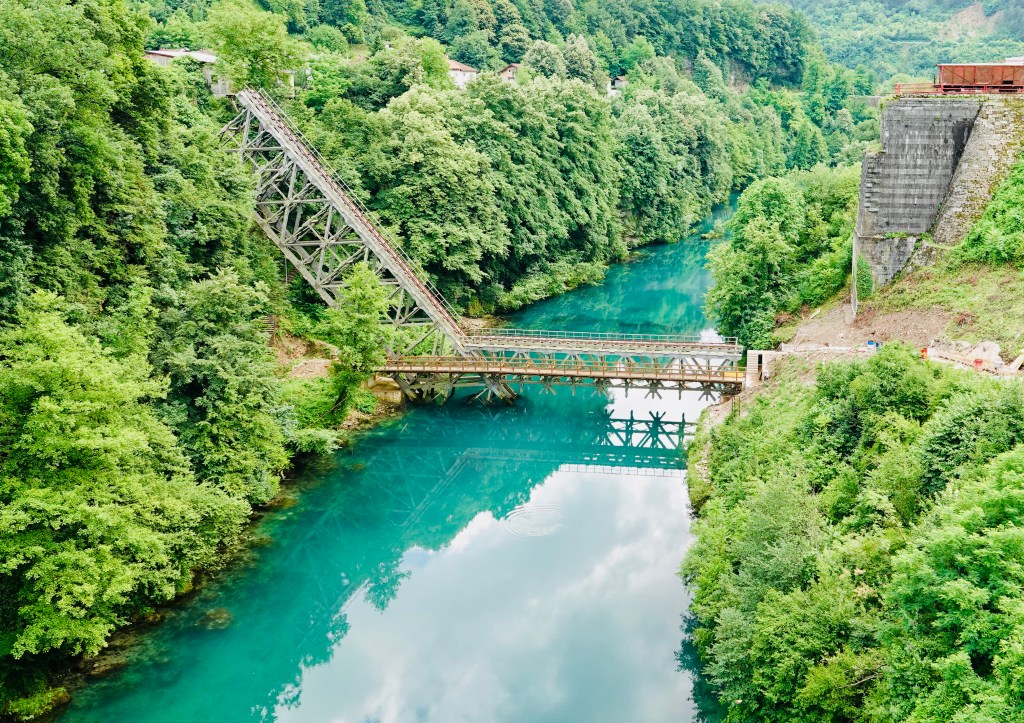
Jablanica Bridge
Jablanica Bridge holds a significant place in history, having witnessed destruction and restoration multiple times. The first instance was a clever ruse, orchestrated to outwit Nazi forces during World War II. Subsequently, the bridge fell victim to an actual attack, succumbing to the ravages of warfare. Remarkably, its story continued to unfold even after the war, as it was reconstructed for the filming of “The Battle of Neretva,” only to be meticulously destroyed once again as part of the movie production. Each of these events contributed to the bridge’s enduring legacy, perpetuating its role as a symbol of resilience and historical significance.
Visitors can explore remnants of the conflict and visit the Museum of Battle for the Wounded, offering an immersive experience into the town’s historical significance and the bravery of those who fought for freedom.
The Battle of Neretva movie and Pablo Picaso’s poster
The movie “Battle of the Neretva” depicts the true story of the Yugoslav partisans fighting against the Nazi invaders during World War II. In a powerful gesture, Picasso created the poster for this movie and incorporated elements from his artwork “The Rape of the Sabine Women” into the film’s poster, symbolizing the battle against oppression. Picasso declined payment for his work, requesting instead a box of the finest Yugoslav wine containing 12 bottles.
Roast lamb on Lamb alley
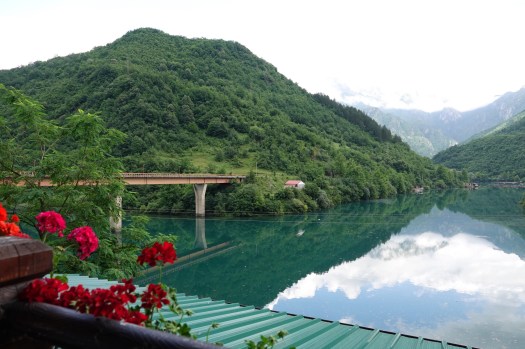
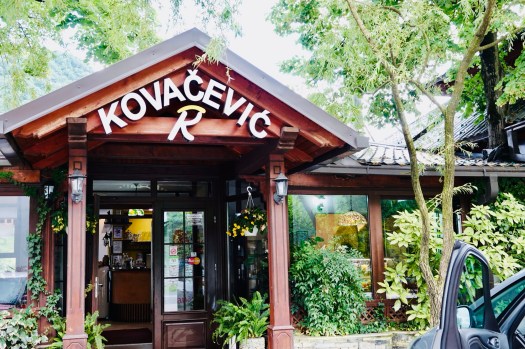
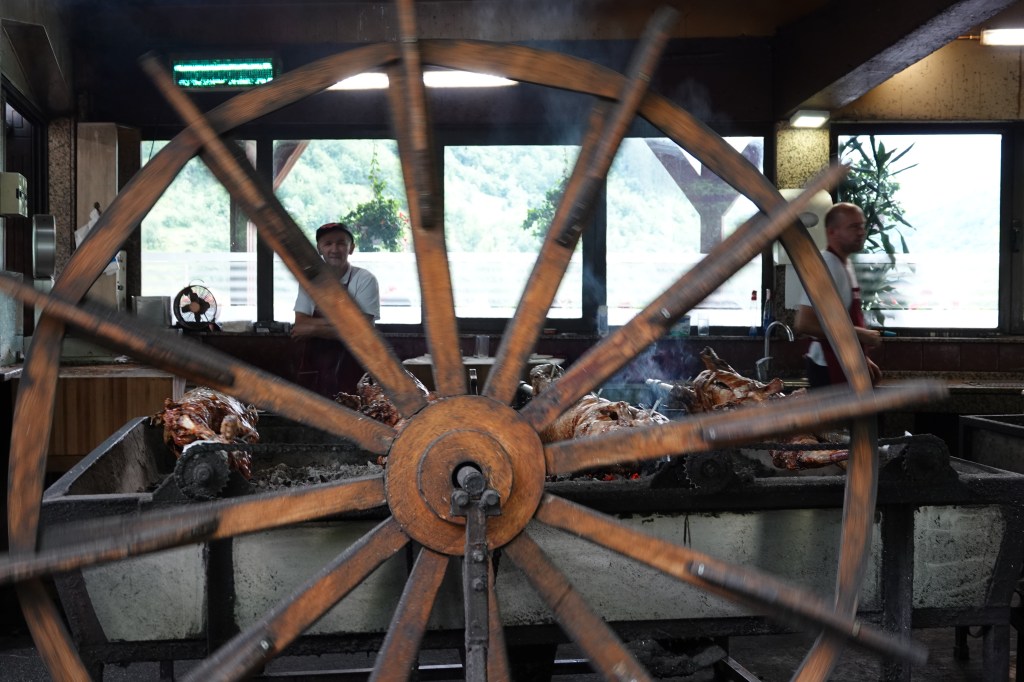
The Jablanica area is known localy well known for its ‘jagnjetina’, lamb meat made in old tradition of roasting sheep over an open fire brought fame to a series of restaurants on the main road (M17) south of the town. This part of M17 is known as lamb alley. Our friends from Mostar suggested that we should try Restoran Kovacevic Jablanica not only for the lamb but also for the view form the restaurant. We stopped at the restaurant for the view (mostly vegetarians in our group) and it was absolutely beautiful. In most the restaurant on lamb alley you can watch the sheep being roasted on a spike in the traditional way
View from the kovacevic restaurant
Final thoughts
We stopped at Jablanica on our way to Mostar after spending most of the day white water rafting in Konjic but Jablanica definitely needs more time than we spent to truly appreciate all it has to offer. There are a few tour companies that offer specific 1-3 day trips( sich as visitJabalnica to Jablanica and based on what we saw, 2 days in Jablanica might be good to truly appreciate the place
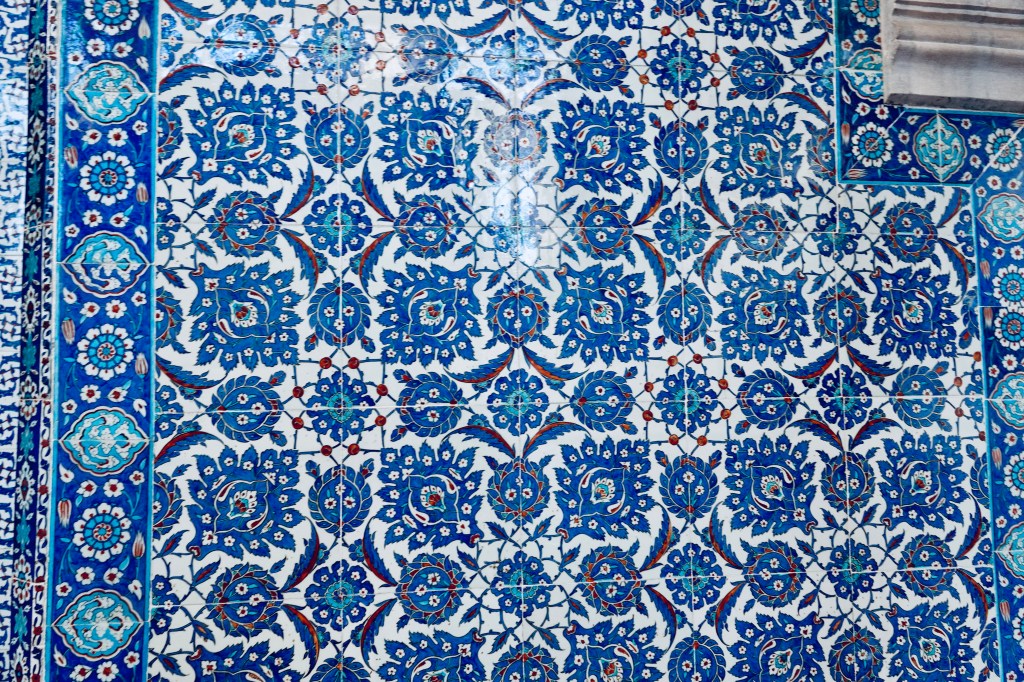
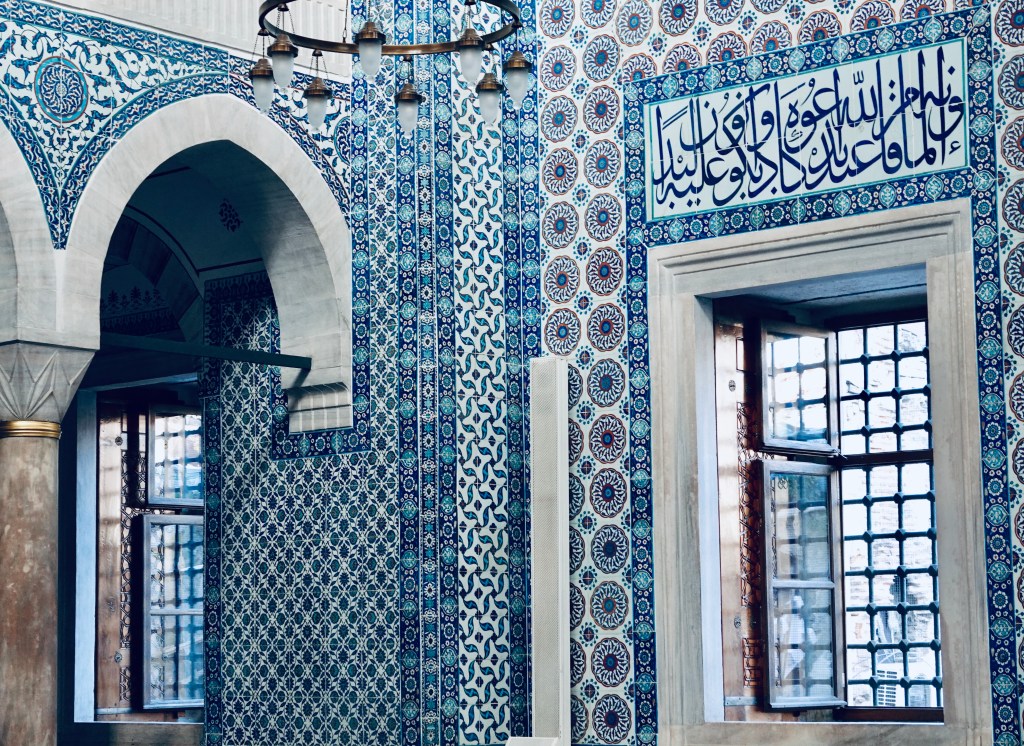
There are over 3000 mosques in Istanbul, the most famous being the Blue Mosque or the Sultanahmet Mosque. The blue mosque gets its name from the interior of the mosque that is lined with more than 20,000 blue colored, handmade ceramic tiles from İznik, which are richly decorated with flowers, trees, and abstract patterns. Above the tiles the walls are painted with various motifs, also in a blue color. However, three are 2 other mosques in Istanbul that also have the blue interior and covered in Iznik tiles– Sokullu Mehmed Pasha Mosque, and Rustem Pasha mosque.
Rustem Pasha mosque- a hidden gem
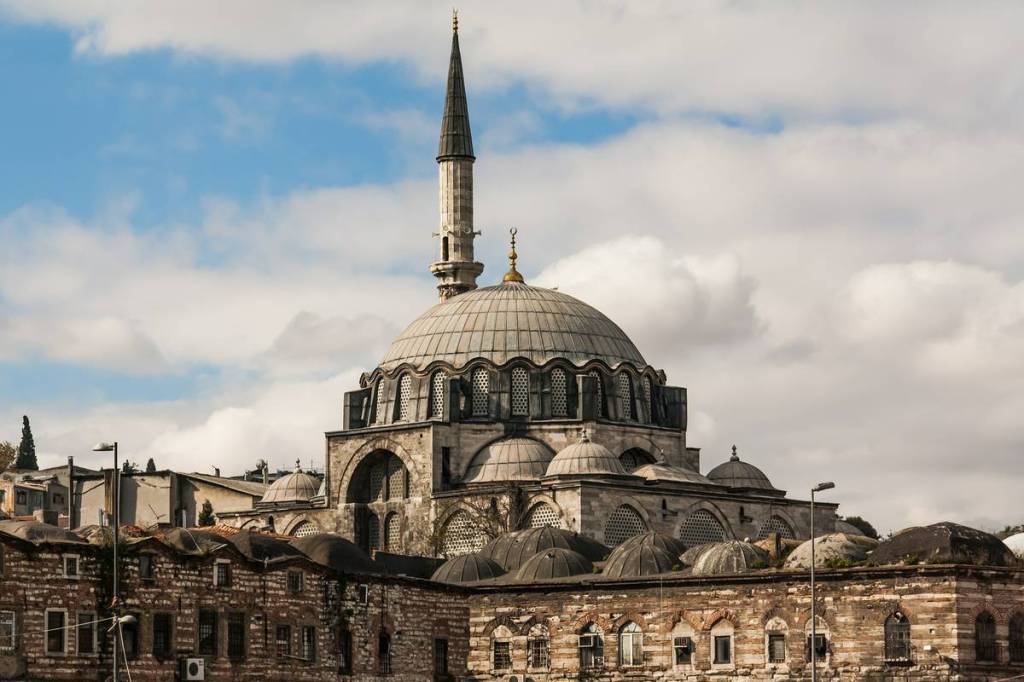
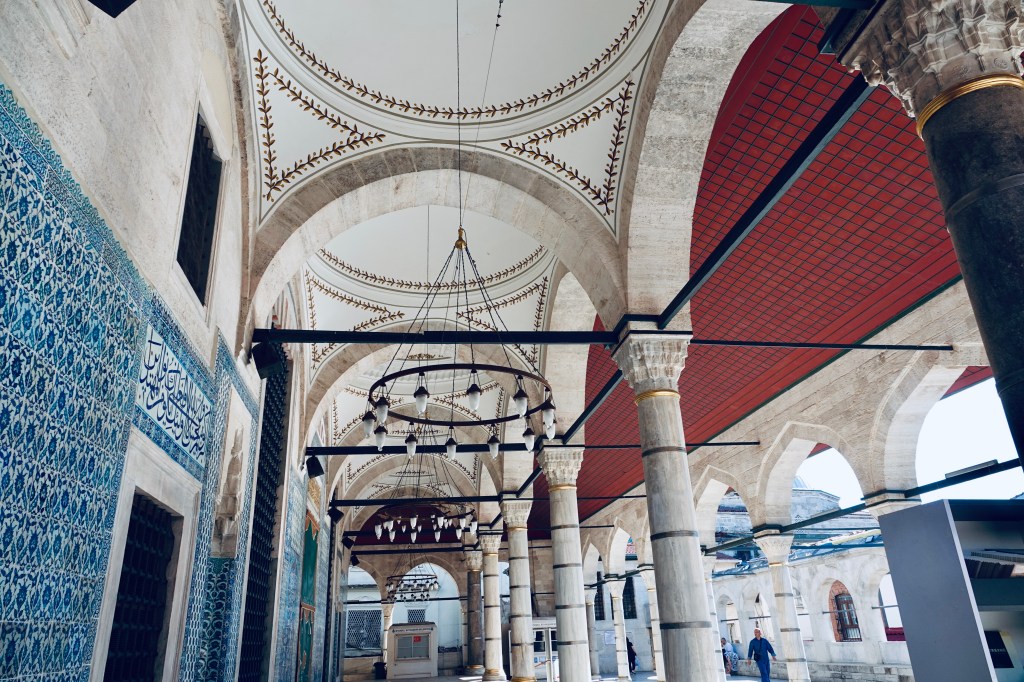
Rüstem Pasha Mosque, a hidden gem and magnificent work of Mimar Sinan, nestled in the bustling market of Istanbul near Golden horn is a miniature version of the iconic Blue Mosque without the crowds. In fact, when we visited on a Thursday afternoon in June of 2024, there were only 3 other people in the mosque. We had visited blue mosque earlier that afternoon and it was buzzing with 100s of people.
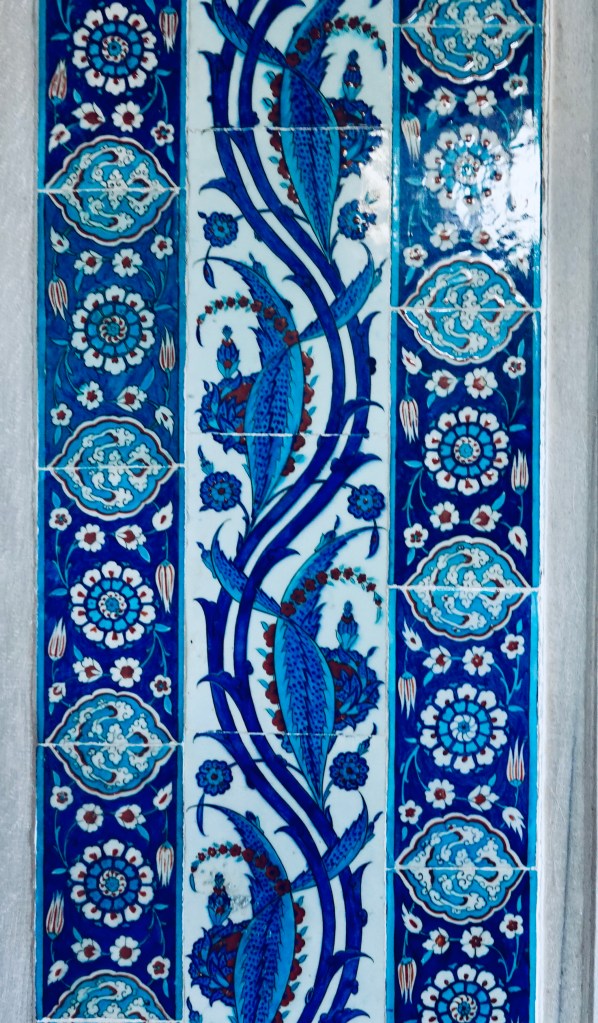
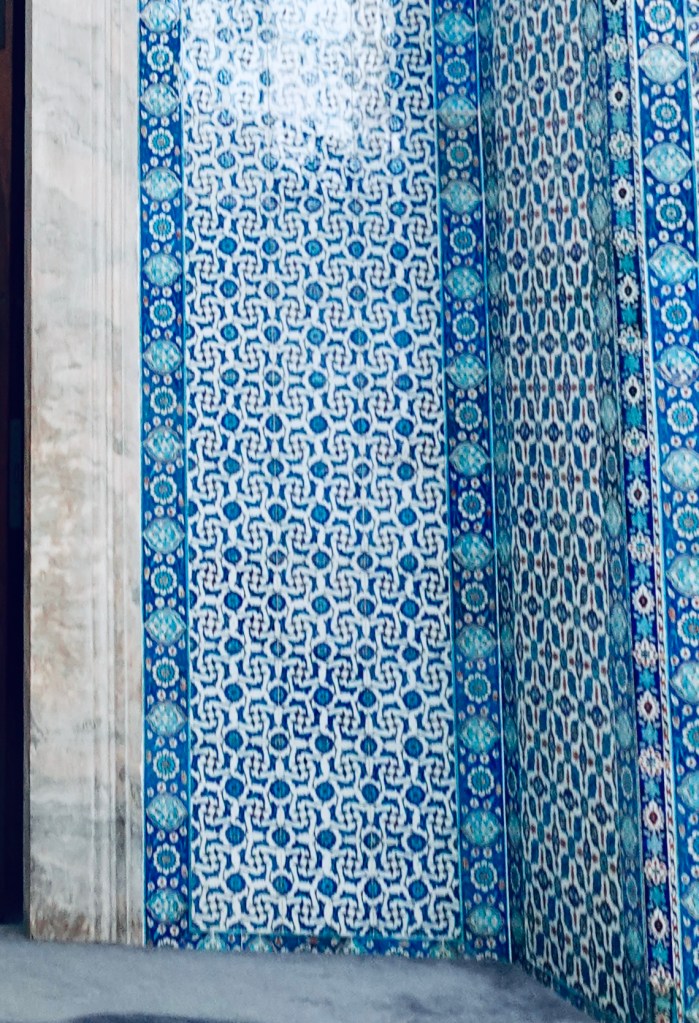
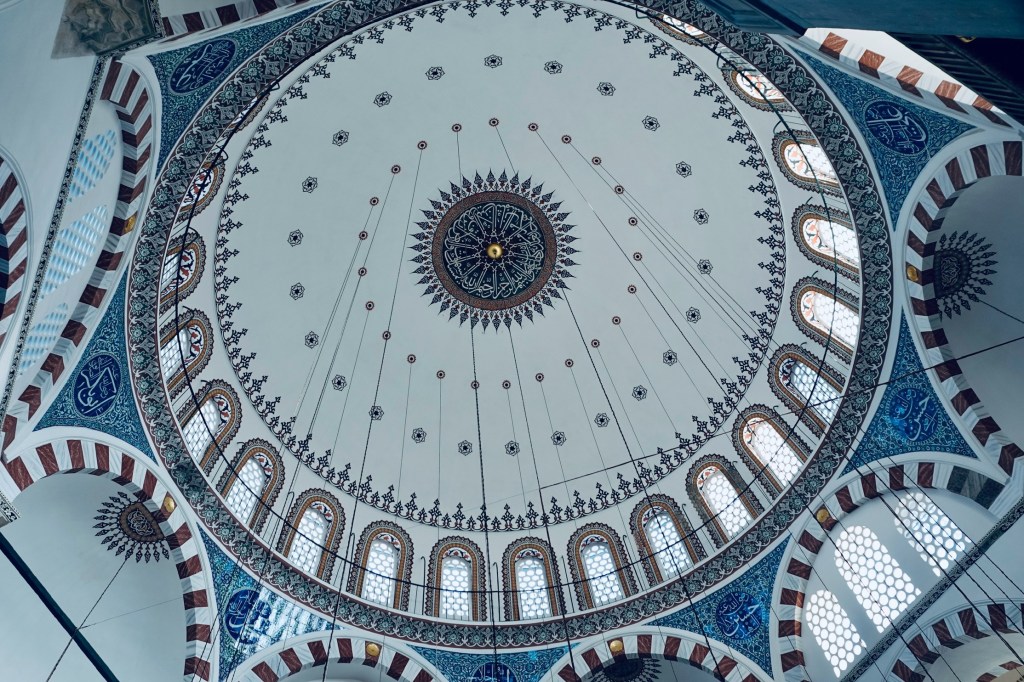
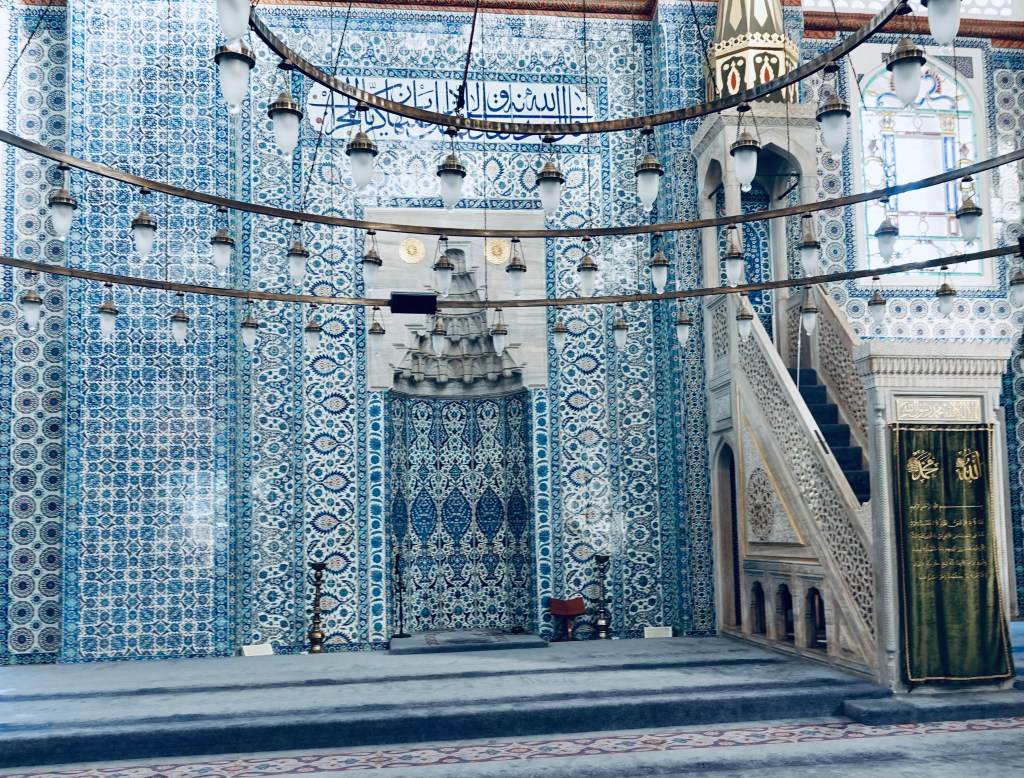
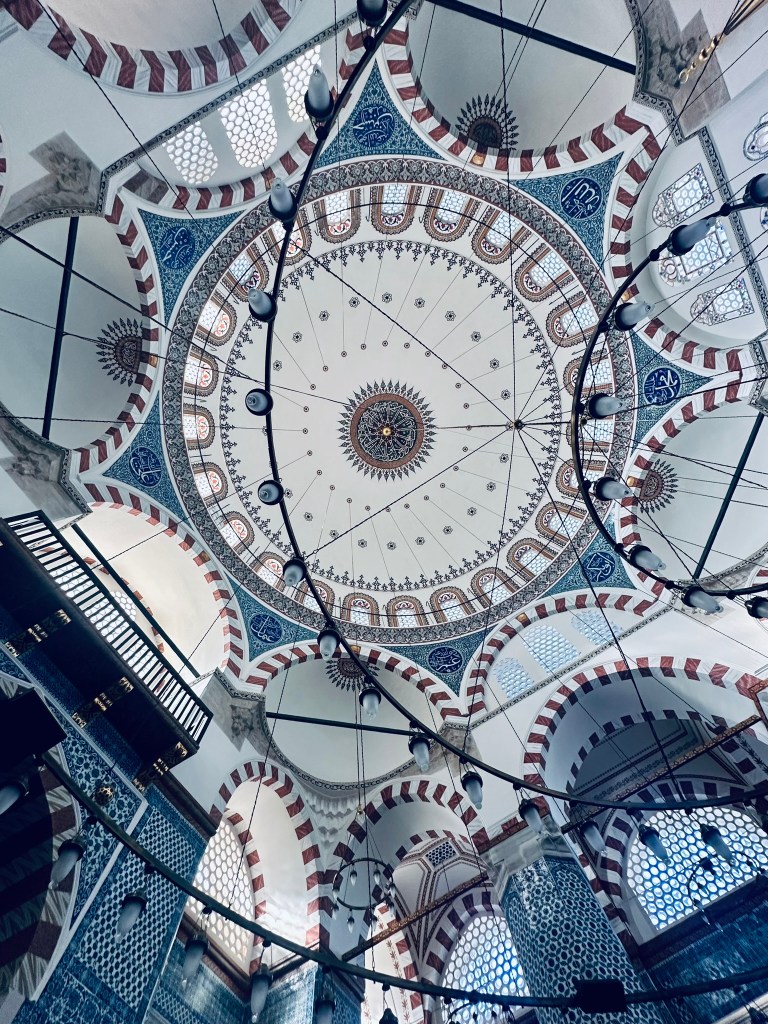
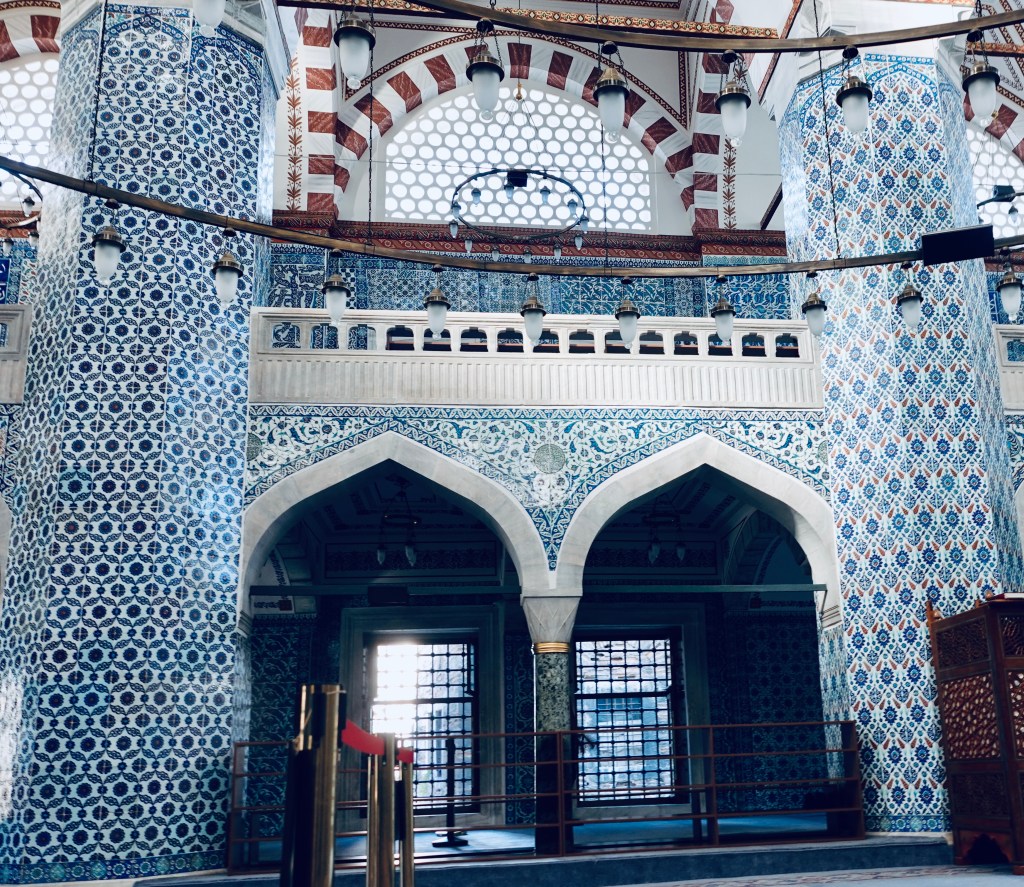
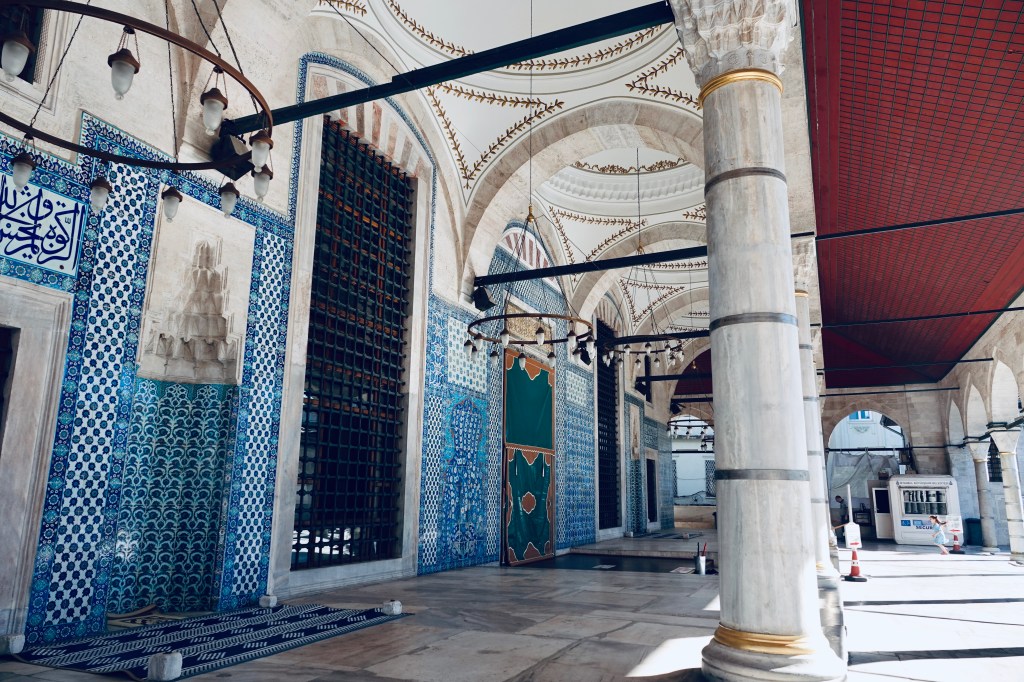
The mosque was designed and built in 1561 by the renowned Ottoman imperial architect Mimar Sinan for Grand Vizier and son-in-Law of Suleiman the magnificent- Rüstem Pasha. The mosque is built in a rectangular shape with semi domes around the main dome that are seated over four elephant feet and columns. Both inside and outside are made of white marble and interior of the mosque is one of the most embellished mosques with 7227 pieces of hand-made Iznik tiles containing 36 tulip motifs and 5 different colors. 850 of these tiles have calligraphy written on them.
Dome of Rustem Pasha MosqueMihrab of Rustem Pasha mosqueDome of Rustem Pasha MosqueElephant columns
Where is Rustem Pasha mosque located
Address: Rüstem Paşa, Hasırcılar Cd. No:62, 34116 Fatih/İstanbul, Türkiye
Rustem Pasha mosque can be challenging to locate but it is close to Spice Bazar and Yeni Camii mosque and located in the Hasırcılar Çarşısı (Strawmat Weavers Market) in the Tahtakale neighborhood of the Fatih district . From Yeni Cami, head toward the Spice Market, turning right up a small road at a large coffee shop. Further down this small street there are set of access stairs on Hasırcılar Caddesi and another on the small street that runs right (north) off Hasırcılar Caddesi towards the Golden Horn. At the top of the stairs, there’s a terrace and the mosque’s colonnaded porch
rustem pasha mosqueEntrance to the mosqueOutside courtyard
RÜSTEM PASHA MOSQUE OPENING HOURS (2024)
Rüstem Pasha Mosque is open daily from 10 am to 6 pm, with closures during prayer times and religious holidays such as Ramadan.
Entrance fee
There is no fee to enter but it is an active mosque and please be mindful of prayer hours
Final thoughts
Rustem Pasha mosque is a magnificent masterpiece of Mimar Sinan and definitely worth a visit and you can appreciate the intricate design of the Iznik tiles without the crowds of the blue mosque
The Bosnian War (1992–95) had a significant impact on the cultural landscape of Bosnia and Herzegovina. As a former Yugoslav republic with a multiethnic population comprising Bosniaks (Bosnian Muslims), Serbs, and Croats, the war sparked bitter fighting among these groups and involvement from the Yugoslav army. The resulting death toll of over 100,000 people, mostly Bosniaks, left emotional scars and deep ethnic and political divides across the region. Despite the suffering, we found Bosnians to be generous and kind people. The war has certainly influenced their perspective on life, as our guide mentioned that many Bosnians prefer to work until they have enough money to live a comfortable life rather than being rich.
During our time in Bosnia, the impact of the war was evident everywhere. The destruction caused by the conflict was unmistakable, particularly with iconic structures like the 427-year-old Mostar stone bridge, which was destroyed during the war and subsequently rebuilt. Additionally, the Sarajevo city hall, once the national library, fell victim to fire in 1992, resulting in the destruction of two million books, articles, and magazines that had reflected the multicultural life of the region under the Ottoman and Austro-Hungarian empires.
Sarajevo roses- Everything but a flower
During the siege of Sarajevo from 1992 to 1995, the city endured relentless bombardment by enemy forces. On average, over 300 shells rained down on the city each day, reaching a devastating peak of 3,777 shells on July 22nd, 1993. When mortar rounds struck concrete surfaces, they left behind distinctive fragmentation patterns resembling flowers, which were later filled with red resin, earning them the name “Sarajevo Roses.” These marks serve as silent memorials people who lost their lives at each location during the siege. Scattered across Sarajevo, these blood-like stains stand as a poignant reminder of the war and the city’s resilience. For more information about the Siege of Sarajevo, you can visit Memories of a War.
Approximately 200 Sarajevo Roses were originally present throughout the city, but due to lack of upkeep and the rebuilding of the city, only about 28 remain. Despite the difficulty of being so close to reminders of death every day, it is important to remember what happened in Sarajevo. You can find one of these roses in front of the Sacred Heart Cathedral, another one close to City Hall, and one near the entrance of the Tunnel of Hope.
Sarajevo Rose at Sacred Heart Cathedral
Mortar holes in Mostar
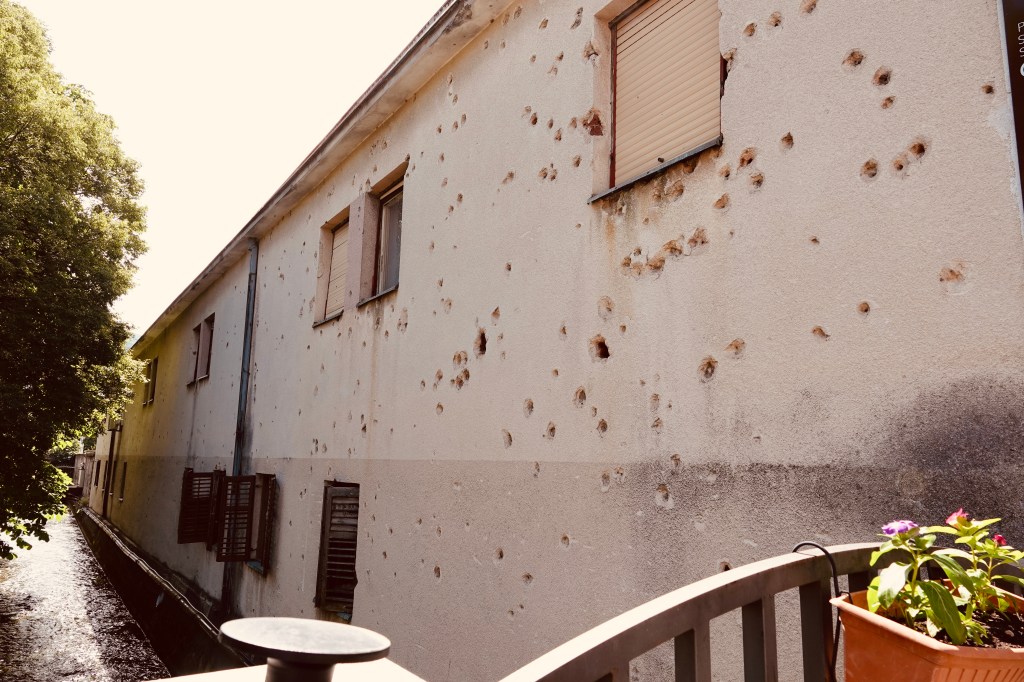
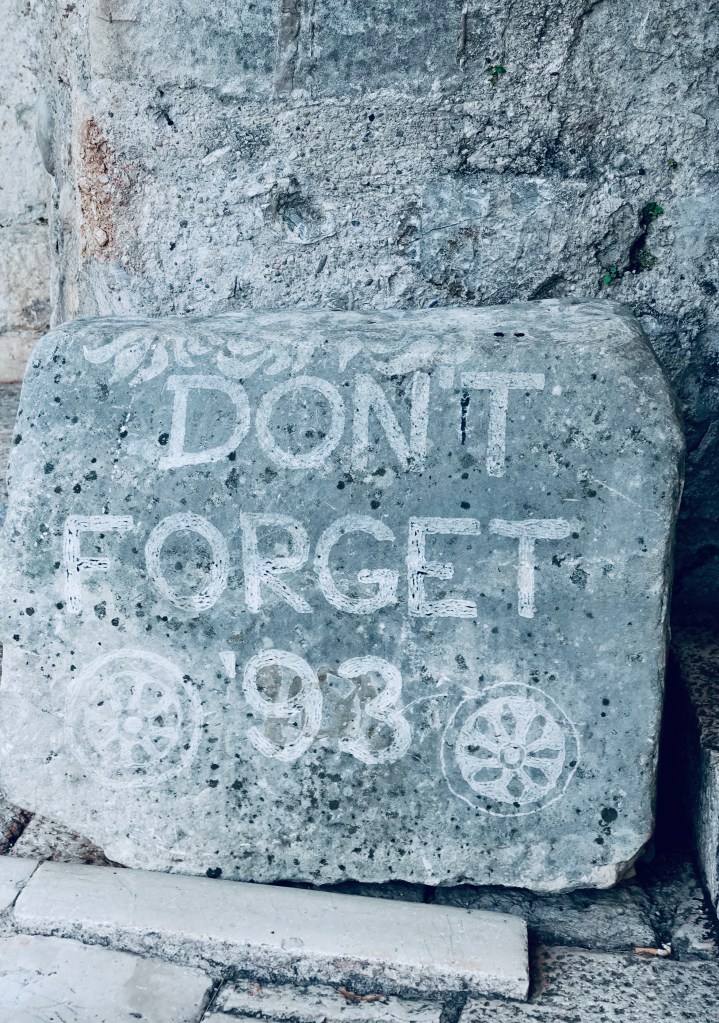
The battles scars in Mostar are much more visible compared to Sarajevo. Decades after the ending of the war, there are still many empty and abandoned buildings. Ther are many building in the old town Mostar close to the bridge that was riddled with holes from the mortar attached, and visible bomb damage. Near the stone bridge, there is a rock wit inscription that stats Don’t forget 93 referring to the war on the Onescukova street that served as the war frontline.
Stories told by our guides
Most of the guides that we hired were old enough to remember the war and lived through it. One of our guides, Stefan, who spent three days with us in Croatia, told us that he was only two years old when the war happened, but he lost his father during the conflict. Growing up without a fatherly figure to guide him, Stefan got into a lot of trouble with his friends from school. He mentioned that not having a father wasn’t that unusual and he wasn’t treated as anything special, as most of his classmates also had lost their patents in the war.
In Mostar, we stayed in a house owned by friends of friends who fled to Atlanta, US during the war, and the house was completely demolished. The family rebuilt the house, and we were fortunate to stay with them and hear first-hand about their war experiences and how it had completely changed their lives. The host had worked as a hotel manager in Mostar before the war, and the hotel was completely destroyed. He took us to a local restaurant right across from the damaged hotel, which is finally being rebuilt.
“Christmas Eve/Sarajevo 12/24”
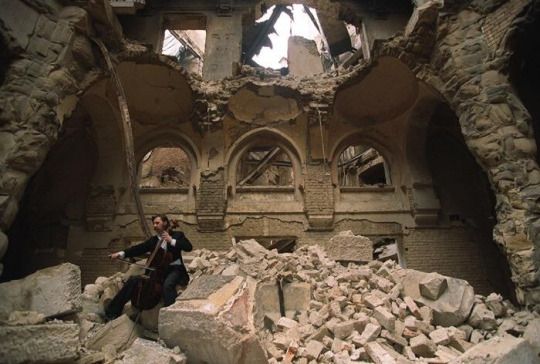
Photo: Cellist Vedran Smailovic in the bombed National Library in Sarajevo Credit: Michael Evstafiev/AFP/Getty Images
Vedran Smailovic brought hope to Sarajevo during very difficult time in Bosnian war. In 1992, a group of people waiting to buy bread in a market were hit by mortar shells, resulting in 22 deaths. Vedran Smailovic, a well-known cellist in the city, was deeply affected by this event. The following day, he went to the spot, which was covered in flowers as a tribute, and started playing his cello. He hadn’t planned it, but he did it instinctively, and as people gathered around him, there was a sense of healing. He played there for 22 days, in honor of the 22 who had been killed, performing the same piece, Albinoni’s Adagio in G minor. Despite the presence of snipers on the hills, the cellist continued to play, risking his life. For another two years, he played at various locations in the city, amidst the ruins, dressed in a white shirt and black tailcoat, as if he were on stage in an orchestra. He soon became a symbol of courage for Sarajevo and the world. This story has been immortalized by Trans-Siberian Orchestra’s “Christmas Eve / Sarajevo” – iconic instrumental piece tells the story of Vedran Smailović during Bosnian war. I have this heard this song so many times during Christmas and didn’t realize it based on Vedran until I was visited Sarajevo. If you want to, you can watch the Trans-Siberian song /video here
All these stories are poignant reminders of horrors of war and effect on the cultural fabric of the country and its people. They also show the resiliency of the people and perseverance of hope despite unimaginable horrors.
Don’t watch the clock; do what it does. Keep going
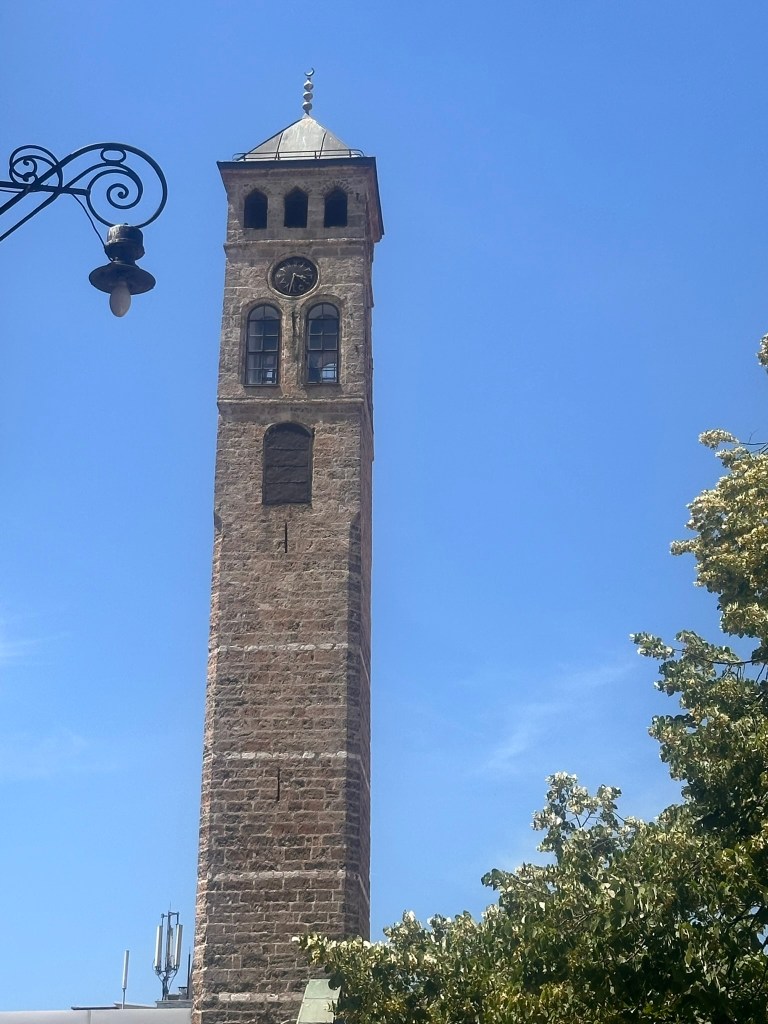
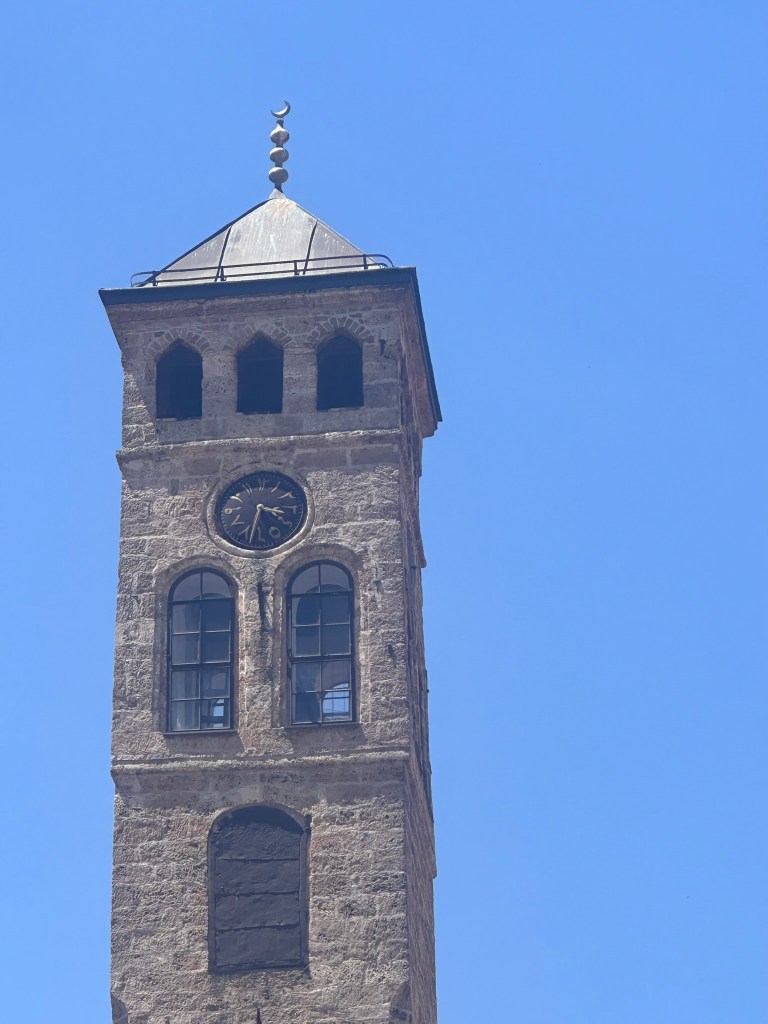
Right next to the Gazi Husref-bey mosque in old town Sarajevo, stands a clock tower known as Sahat-Kula that displays time in a unique way, following lunar “a la turca” time which means that time is set according to that day’s sunset, when its hand must be firmly on 12. Without a manual reset, the clock would stop functioning within a week. The times of prayers are also determined according to the Clock Tower, and during Ramadan the Clock is responsible for determining the time of iftar (breaking fast). The clock tower was built in the 16th century by Gazi Hursref Bey, and in 1876, after the original clockface was broken, the current one was installed and has been working since then.
Muvekit (clock keeper)
Since the sunset changes every day depending on the season, the clock must be regulated often, and this is the job for the muvekit or the clock keeper. Current clock keeper is Mensur Zlatar, has a regular job as a jeweler near grand Gazi Husrev-beg mosque and his second job is to keep the clock tower running. Twice a week since 1967, Zlatar has climbs the 76-step tower of Sahat-Kula, to set the time.
Even during the 1990s war in former Yugoslavia, when Sarajevo was under siege for 1425 days and it was dangerous for people to go out as snipers from surrounding hills would shoot any civilian, Zlatar still climbed the steps of Sahat-Kula to set the time every week. He scaled it back to once a week during the war and since then has resumed his twice-weekly climb (This Man Keeps Time on the World’s Last Lunar Clock)
And that’s the heart of wabi-sabi—not the perfect tick of a quartz watch, but the weathered hands of a man who climbs for time. A clock that needs human touch. A ritual that has lasted because it’s flawed, fragile, and yet enduring.
Where modern life seeks precision, Sahat-Kula answers with presence.
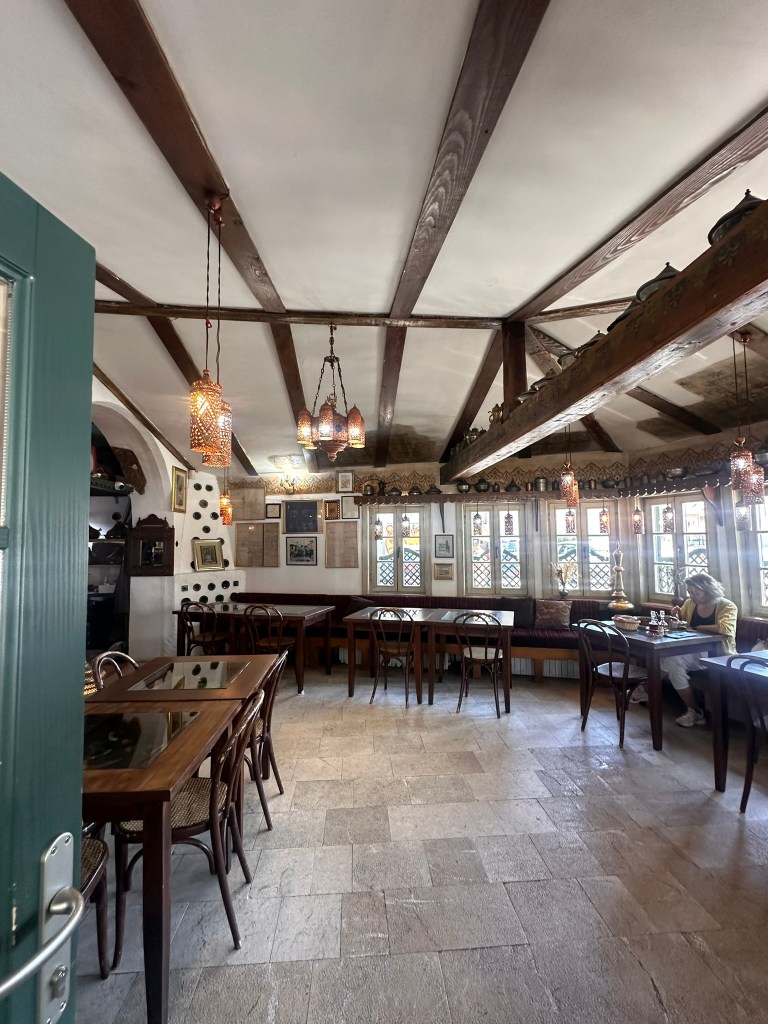
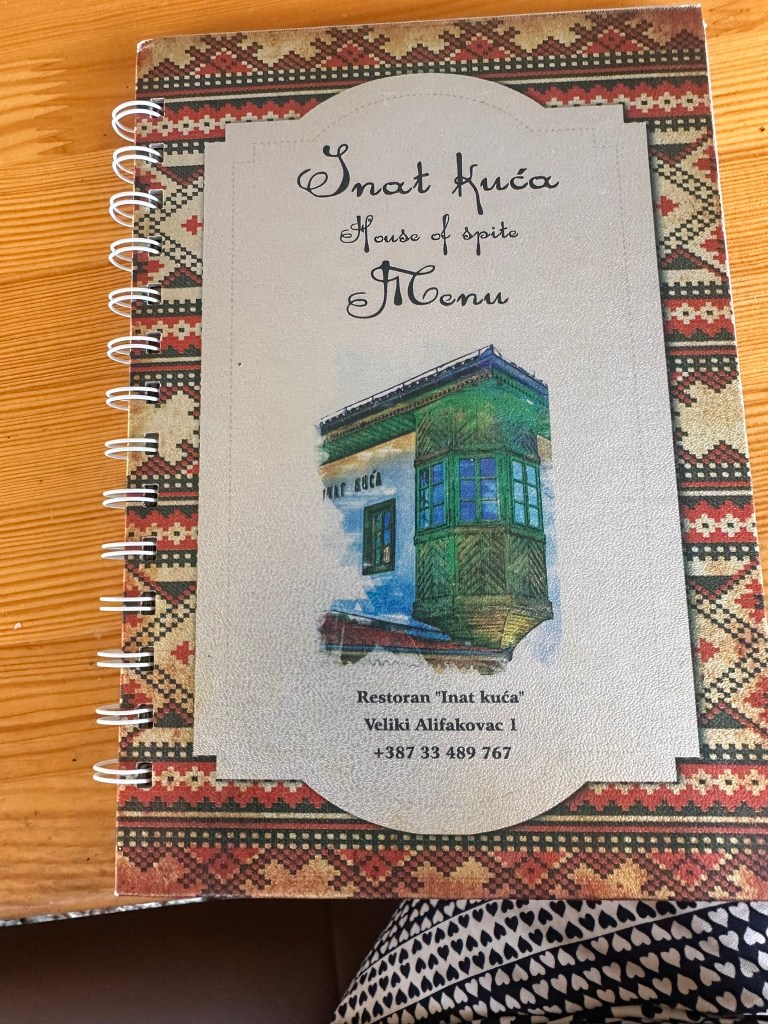
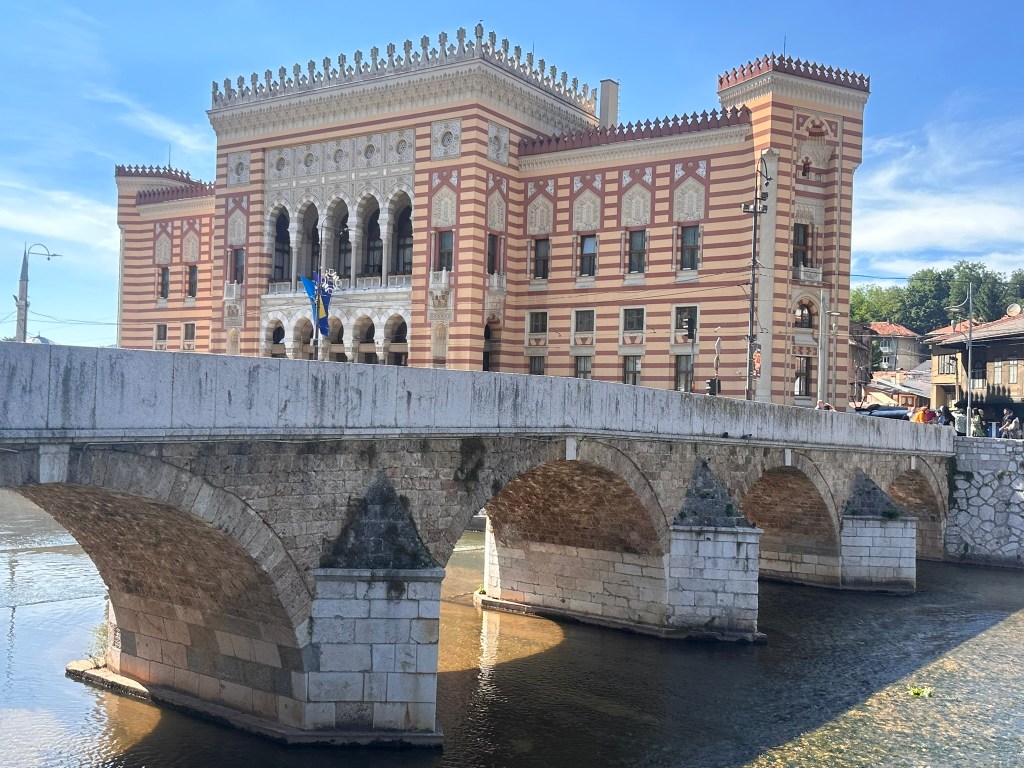
Right opposite to the City hall in Sarajevo, across the bridge there is a unique Bosnian restaurant named Inat Kuća, or “House of Spite”. More than being just an oddly named restaurant, this place was once a house that belonged to a Bosnian man named Benderija. I decided to check out this place out of pure curiosity and sat outside the patio and drank Rakija and people watched.
Inside the house of Spite restaurant
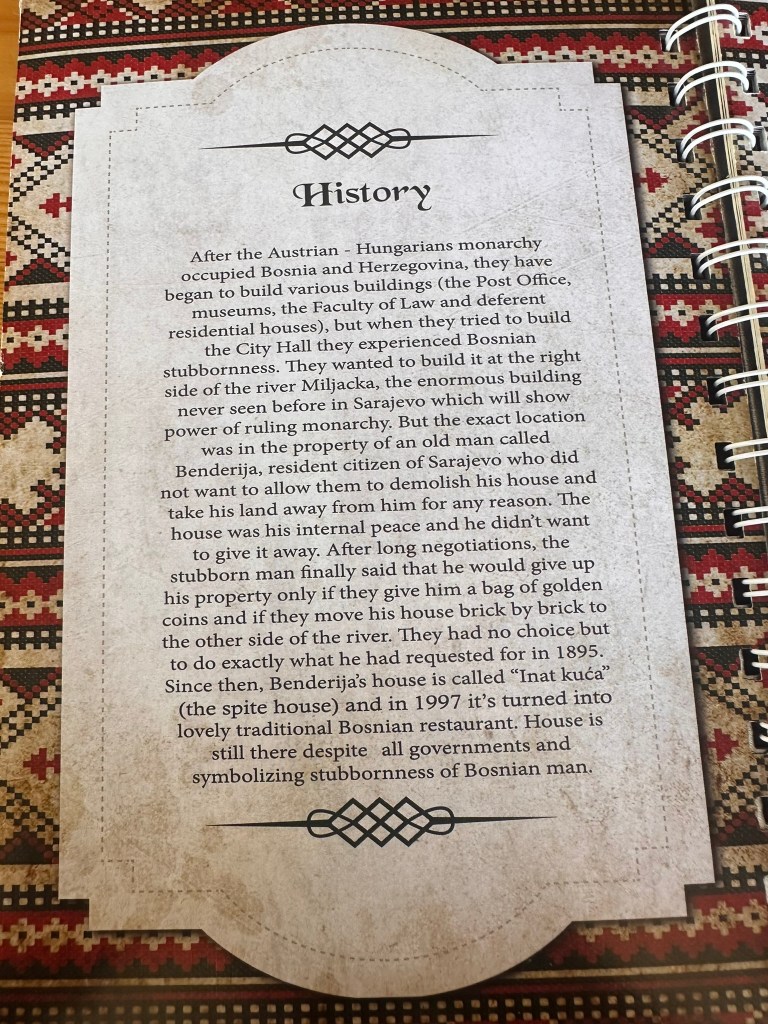
The restaurant menu also talks about the history of the place and why it is called house of spite. As the story goes, the house was originally located across the river where the current city hall resides. In the late 19th century, Austria-Hungary was transforming Sarajevo into a model colony. As part of this makeover, they began constructing a magnificent city hall. However, an elderly Bosnian man Benderija stood in their way. Despite generous offers, he refused to let them demolish his house. After lengthy negotiations between the old man and the city (with even the Austro-Hungarian Minister of Finances getting involved) until finally, in 1895, he agreed to sell his property for the extravagant price of a sackful of gold ducats, but with one condition: the authorities would have to move his Ottoman-era house, brick by brick, and rebuild it on the other side of the river.
According to our guide, the old man spent every day of the move sitting in the middle of a nearby bridge, smoking cigarettes and watching the workers transport each brick across the river. When the house was finally rebuilt, it was aptly named Inat Kuća, or the House of Spite.
City hall from house of Spite
The food and drink were really good and views are definitely worth it to visit this place.
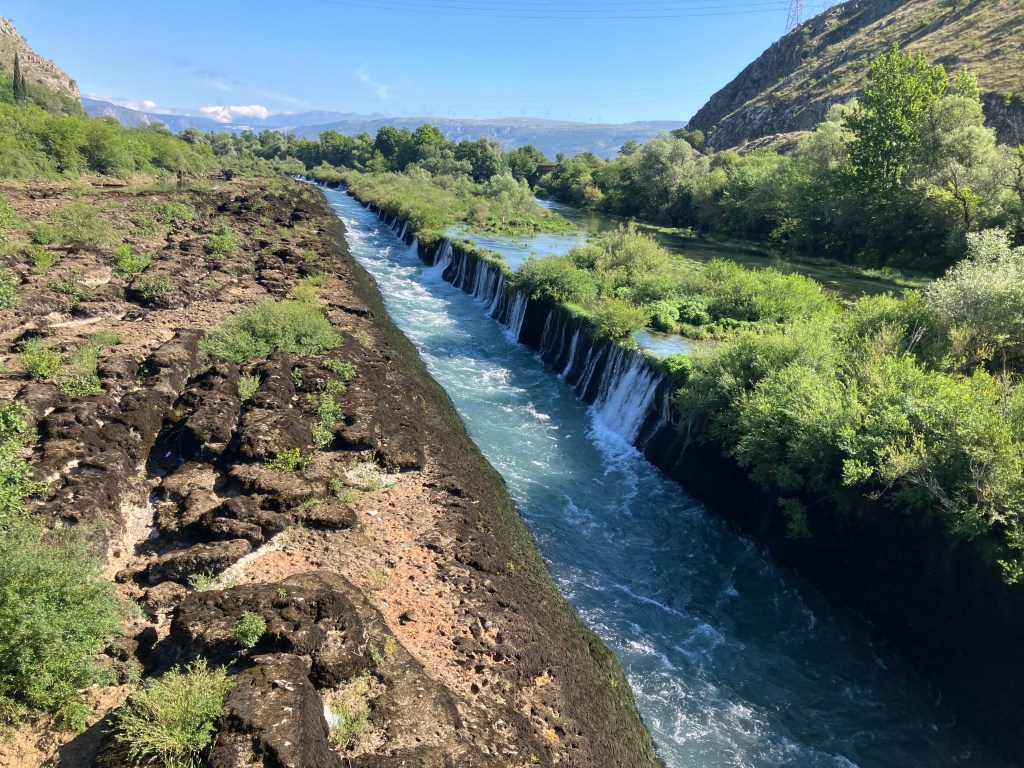
Location: The canals are situated just south of Mostar, near the M-17 highway. They mark the confluence of the Neretva River with its left tributary, the Buna. We stopped here on our way to Počitelj from Mostar. It is about 12Km from Mostar
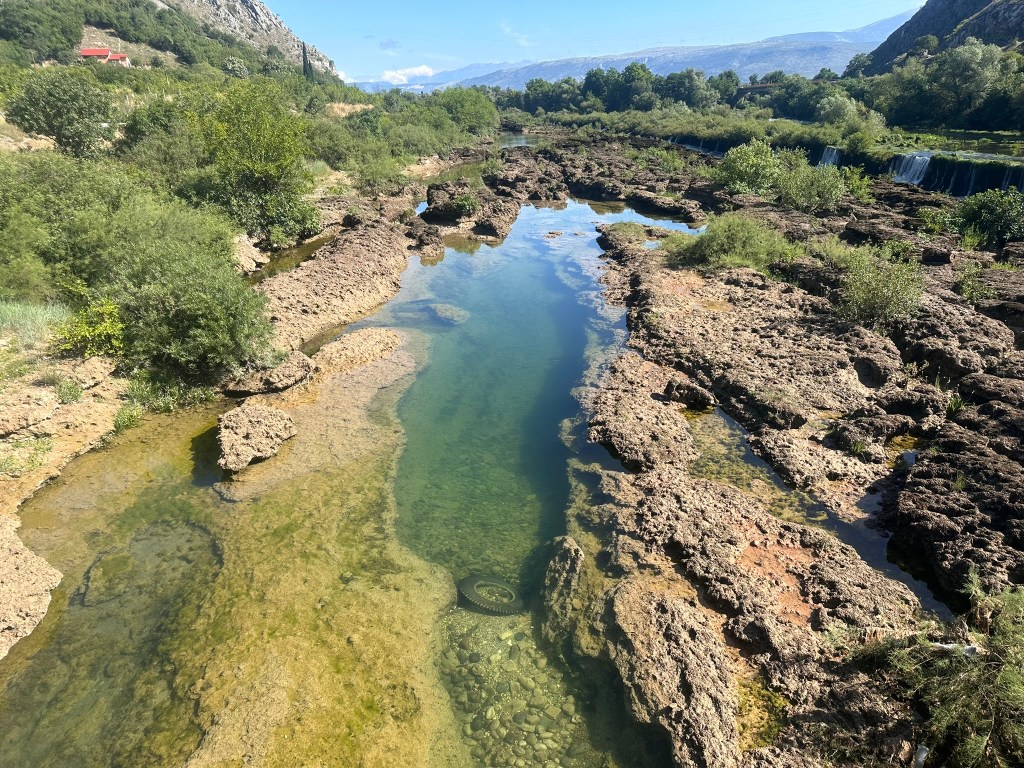
What is it: It is natural wonder where narrow channel of the Neretva River merges with the Buna River (Same River that originates from cave at Blagaj) over travertine barriers. Unlike typical confluence of rivers, at this place, the rivers flow next to each other, and merge through a series of waterfalls.
It is best to visit this place in the summer when river water is low, and the canals can be seen in their full glory. During winter months, snow melt creates a high water in the river, and you won’t be able to see the canals and waterfalls in their full glory. The Neretva River is slightly more than three meters wide in that part, and the rivers join in a length of about 300 meters and continue towards Adriatic Sea.
Even though it is more popular now, when we visited Buna canals in mid-June, 2024, we were the only tourists other than a lone bicycle rider that had stopped to take photos. The bridge to the Buna canals runs close to old Ćiro railway, now converted into bike path.
Kayaking and Canoeing- Another claim to glory for Buna canals is that in the eighties, these canals were used for World and European Kayaking championships as these canals provide natural water pathways that are difficult and demanding than anything man could create.
If you are in Mostar or travelling towards Split from Mostar, Buna Canals is definitely a great stop to appreciate the beauty of Bosnia and Herzegovina.









 Peaks to Palaces