Exploring Hemakuta Hill: A Journey Through Myth and Architecture

Hemakuta Hill is one of Hampi’s most quietly enchanting landscapes. It’s a place where mythology, early temple architecture, and sweeping granite vistas come together. Rising gently above the Virupaksha Temple complex, this hill holds some of the region’s oldest shrines.
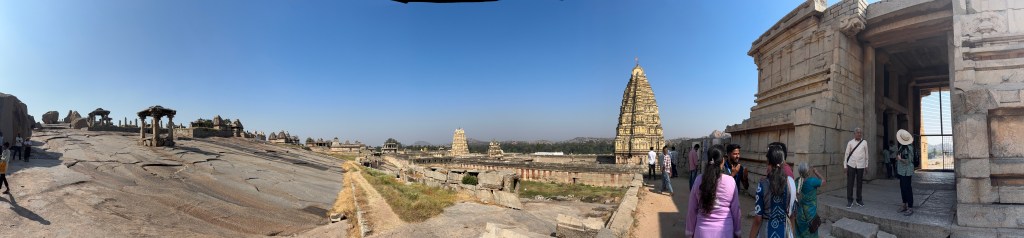
A Sacred Hill of Gold and Fire

Local folklore gives Hemakuta its luminous name. According to mythology, Lord Shiva performed penance on this very hill long ago. This was before he agreed to marry Pampa, who is often identified with Parvati. She was a local goddess whose devotion moved him deeply. When Shiva finally consented to the marriage, it rained gold on the hill. Since hema means gold in Sanskrit, the place became known as Hemakuta, the “Hill of Gold.”

Another legend adds a dramatic layer to this sacred landscape. Kama, the god of love, once tried to distract Shiva from his penance. He wanted to help Pampa win Shiva’s affection. Enraged, Shiva opened his third eye and reduced Kama to ashes right here on Hemakuta. When Kama’s wife Rathi pleaded for mercy, Shiva relented — restoring Kama, but only in spirit, not in physical form. This myth of destruction, compassion, and rebirth deepened Hemakuta’s association with Shiva. It inspired generations to build shrines to him across the hill.
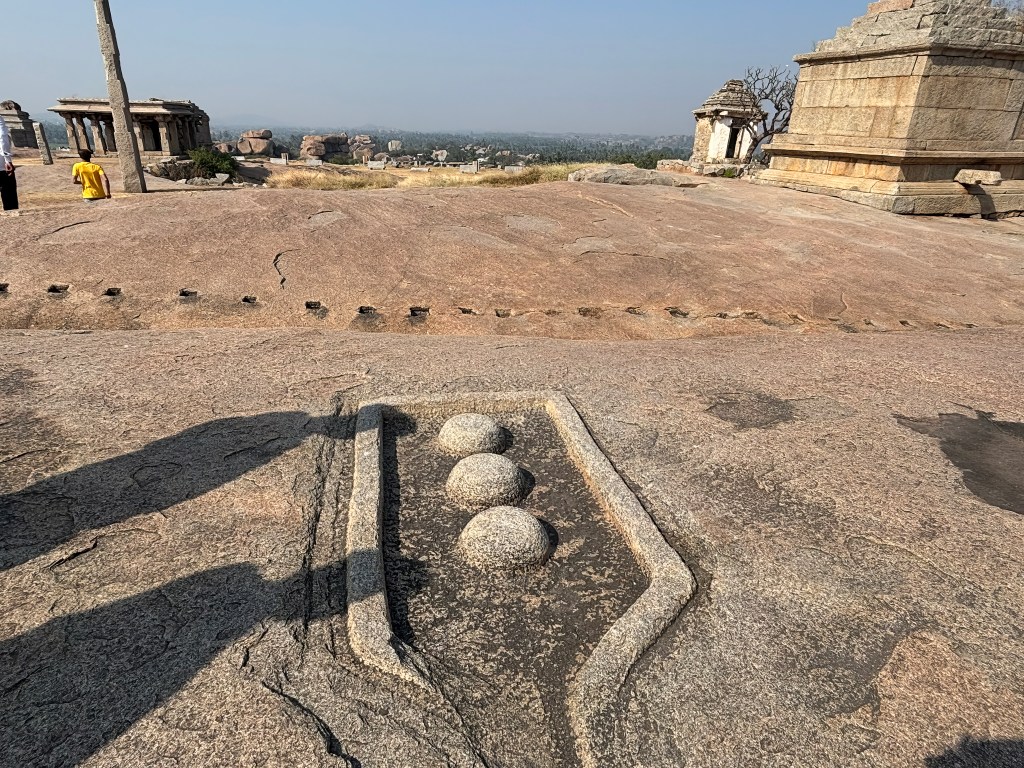
Walking Through Early Vijayanagara History

A modest 15th‑century gopura entrance on the western side marks the beginning of the Hemakuta complex. It opens into a fortified zone of small shrines. These shrines are some of the best-preserved examples of pre‑ and early‑Vijayanagara architecture. These temples sit dramatically on a sloping granite shelf.
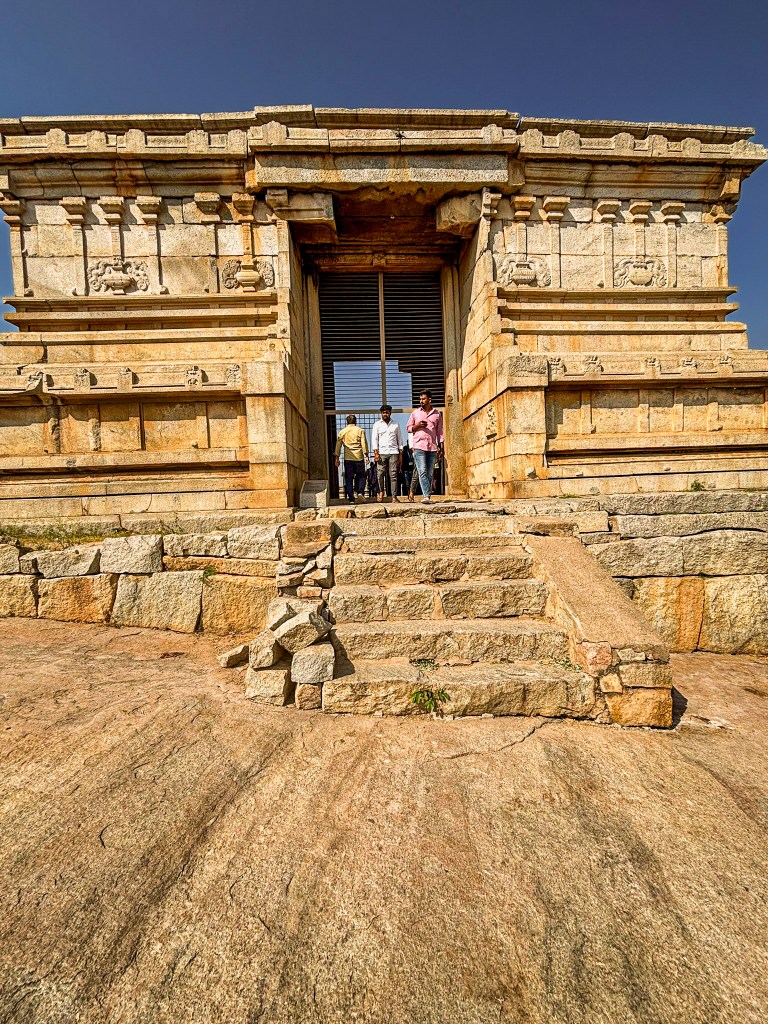
Centuries ago, a processional path connected the Tungabhadra River to the Virupaksha shrine. It then climbed through a series of pavilion-like gateways to the summit of Hemakuta. When Krishnadevaraya expanded the Virupaksha complex in the early 1500s, this ancient route was severed. The gateways persist, including a striking double-storeyed pavilion near the top. This pavilion offers panoramic views of the Tungabhadra valley.
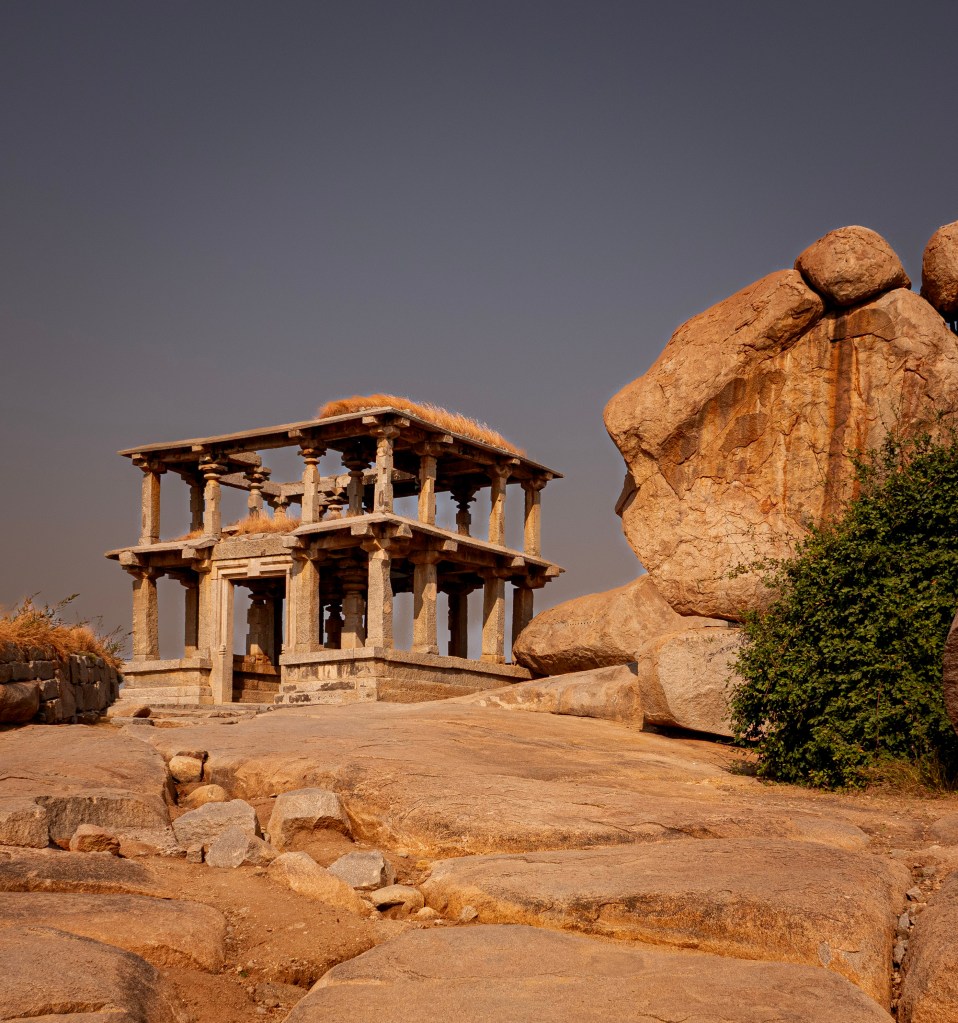
Architecture of the Hemakuta Group of Temples

The architecture of the Hemakuta temples is unlike anything else in Hampi. They are deeply rooted in the Deccan traditions of the 13th and 14th centuries. Their clean lines and minimal ornamentation often lead visitors to mistake them for Jain temples.

Most of the temples here are compact, triple‑chambered structures crowned with pyramid‑like granite roofs. On the northern side of the hill, several shrines follow the Trikutachala style. Three sanctums are placed perpendicular to one another. They all open into a shared central hall. This layout creates a sense of balance and quiet symmetry, perfectly suited to the contemplative atmosphere of the hill.
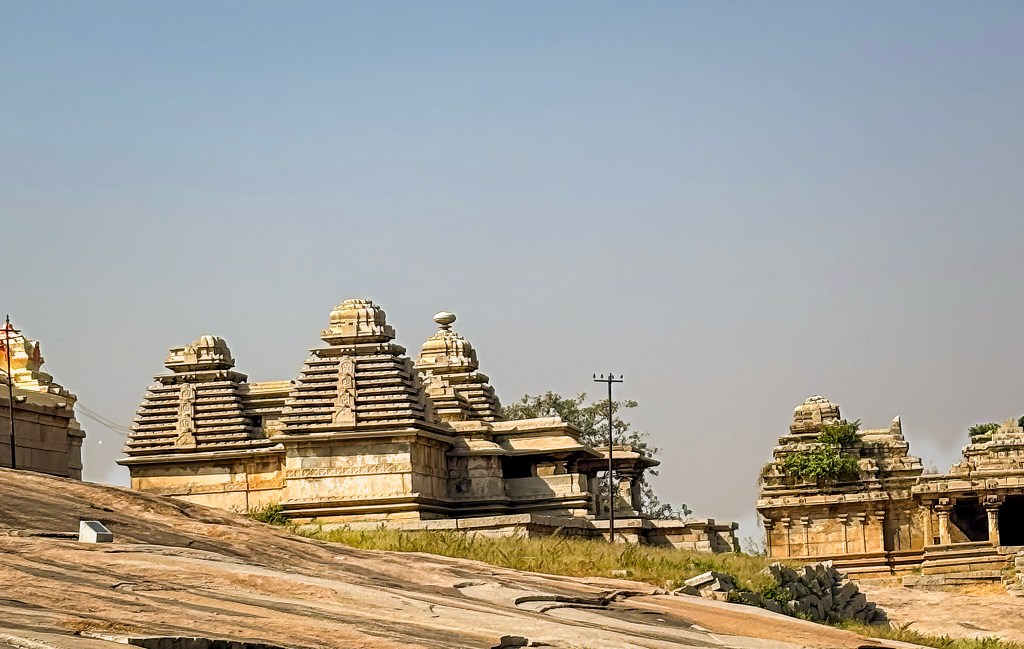
The outer walls are almost entirely plain. A delicate horizontal chain of floral motifs is the only interruption. It wraps around the structures. Other signature features include fluted foundations. The curved eaves gently overhang the walls. These details soften the granite’s stark geometry.

As you wander across the hilltop, you’ll encounter dozens of such shrines, scattered across the undulating sheet of rock. The largest and most elaborate clusters lie on the northern slope, facing the Virupaksha Temple complex. These are among the oldest surviving temples in Hampi, predating the Vijayanagara Empire itself.
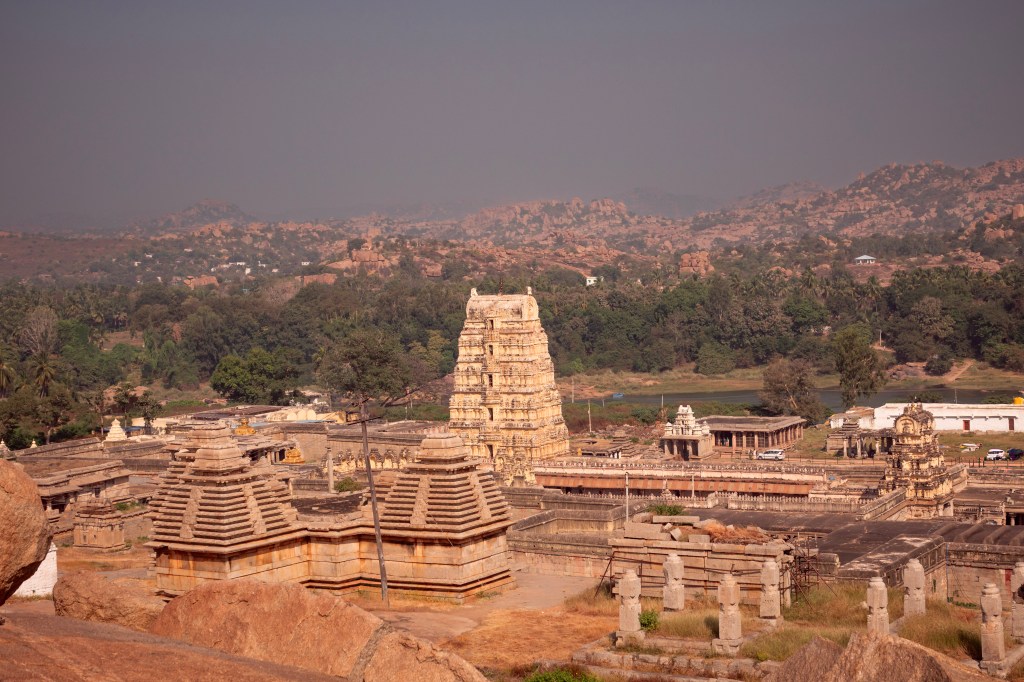
Sacred Corners and Hidden Gems

Further south, the landscape shifts. A small pond is next to a shrine known as the Mula Virupaksha Temple. This shrine is believed to be older than the grand Virupaksha Temple below. Its whitewashed hall features cubical pillars typical of pre‑Vijayanagara design. The porch opens directly onto the water. This is one of the few shrines on Hemakuta Hill that remains actively worshipped.
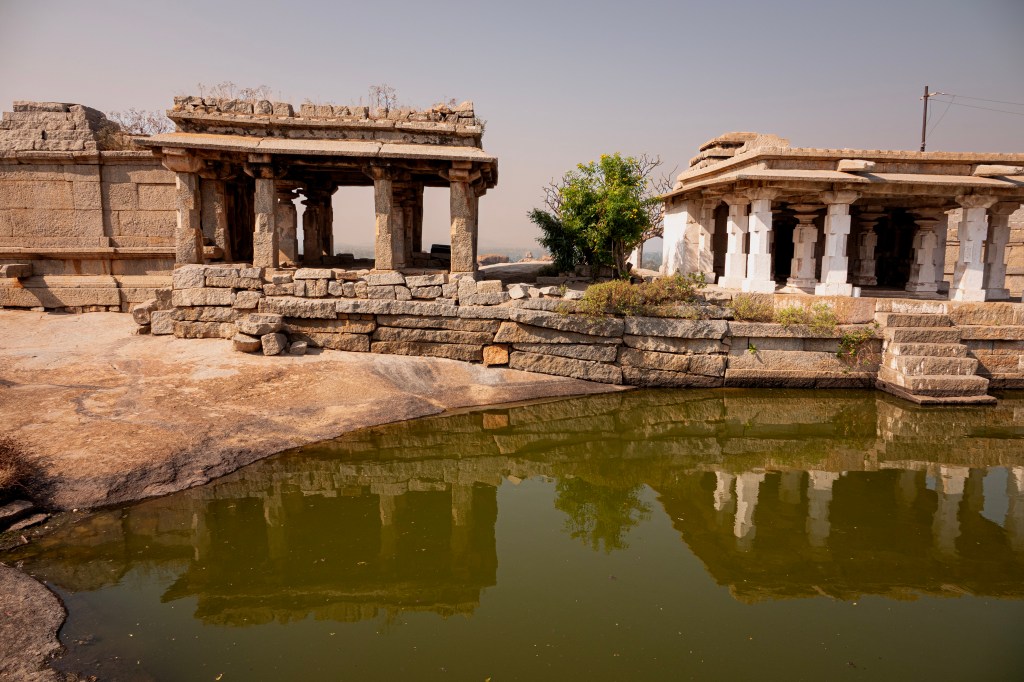
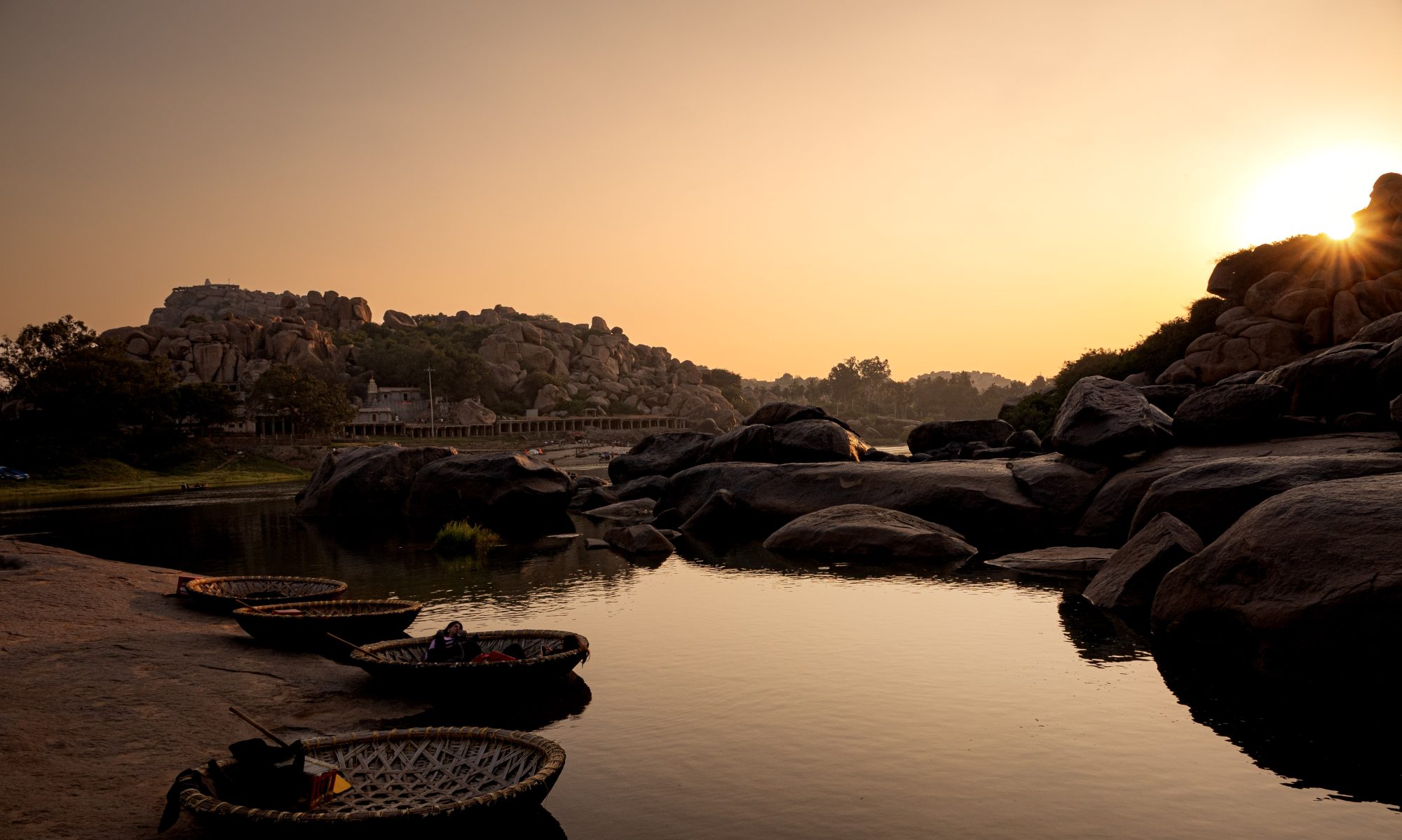
Just behind it stands a tiny chamber-like shrine with a pyramid roof, housing an image of Hanuman. This quiet corner is one of the best spots to watch a Hampi sunrise or sunset.

As you continue southward, the hill offers a natural balcony. It overlooks the Krishna Temple and Sasivekalu Ganesha. You can also see the twin monuments of Lakshminarasimha and Badavilinga. Here you’ll also find the two‑storeyed southern gateway, another remnant of the ancient processional path. Several temples in this area feature tall monolithic lamp posts, standing like silent sentinels before the shrines.
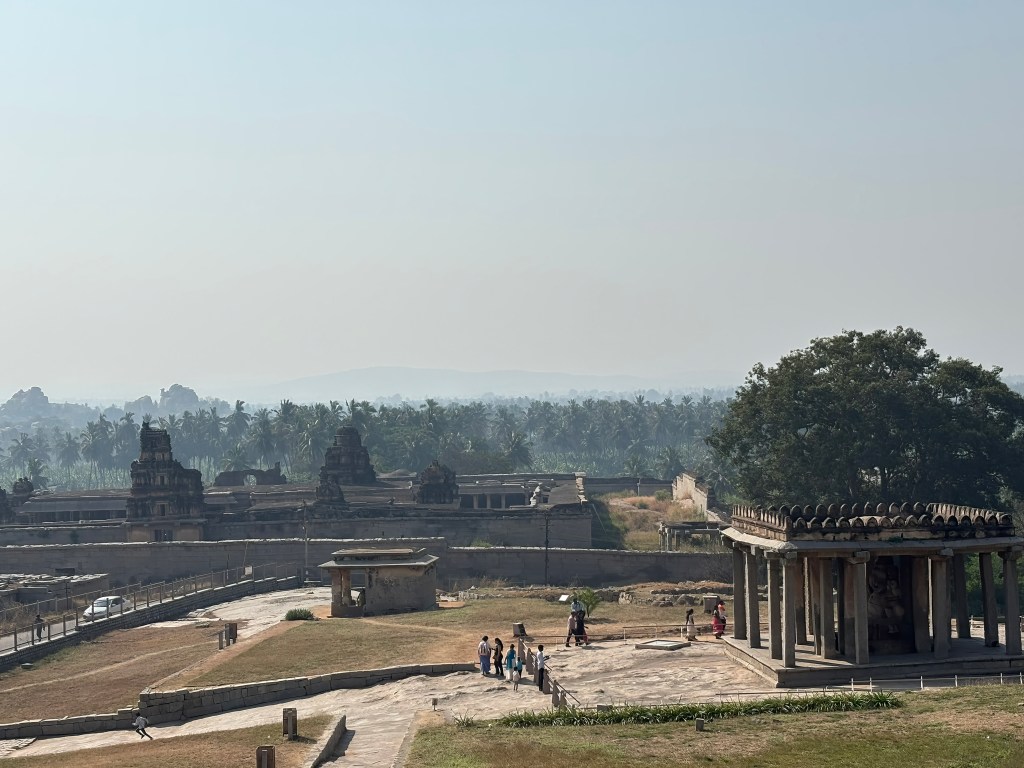
Krishna temple and Sasivekalu Ganapathi temple from Hemakuata hill

The entire hill is encircled by an ancient fortification wall. It is now broken in places but still traceable along the granite’s contours. It hints at the strategic and sacred importance Hemakuta once held.

A Hill That Holds Its Stories Lightly

Despite being at the very heart of Hampi, Hemakuta Hill feels surprisingly serene. You can easily spend hours wandering its slopes. Discover shrines tucked between boulders. Absorb the quiet stories etched into every surface.

Hemakuta is not a place of spectacle — it is a place of origins. It is a hill where gods once walked. Kings once prayed there. The earliest architectural whispers of Vijayanagara still linger in the wind.

The Magnificent Ganesha Statues of Hampi: A Cultural Insight

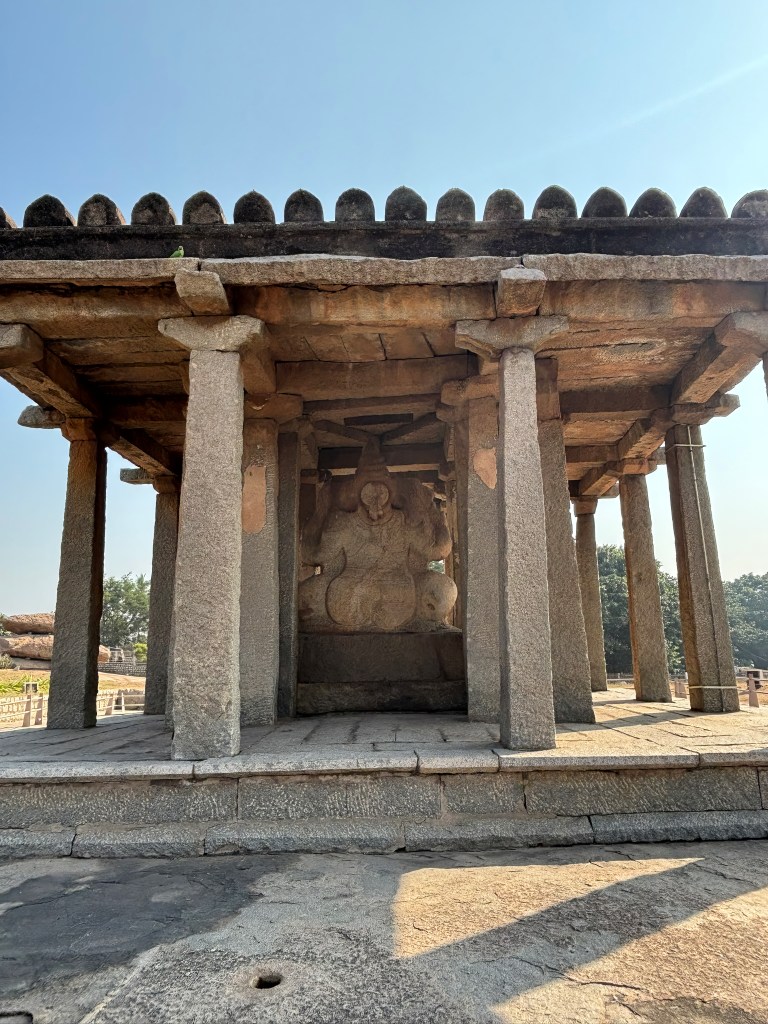
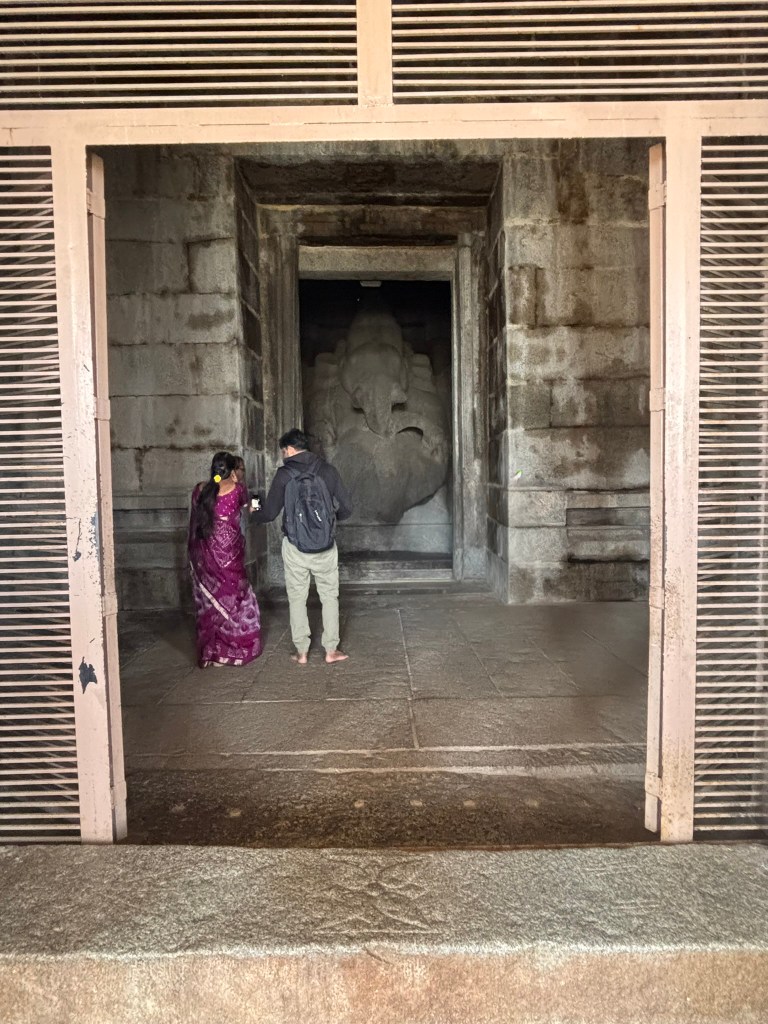
The Sasivekalu and Kadalekalu Ganesha temples are two of Hampi’s most significant monolithic shrines. They are located on the slopes of Hemakuta Hill. Both statues are carved from single granite boulders and exemplify the classical Vijayanagara architectural style.

Sasivekalu Ganesha- Meaning Mustard seed Ganesha. Legend has it that it was commissioned by a mustard seed seller and hence the name. Walk behind the open pavilion to see a female form representing the mother of Ganesha.

  • Physicality: Stands 2.4 meters (8 feet) tall.
  • Iconography: Depicts Ganesha with a snake tied around his belly to prevent it from bursting after a large meal. He is seated in a half-lotus posture with four arms holding a goad, noose, broken tusk, and modak. A unique feature on the back depicts a giant hand, suggesting Ganesha is sitting in the lap of his mother, Goddess Parvati.
  • Structure: Housed in an open, 16-pillared mandapa (pavilion) with a brick and mortar roof in the Indo-Saracenic style. 

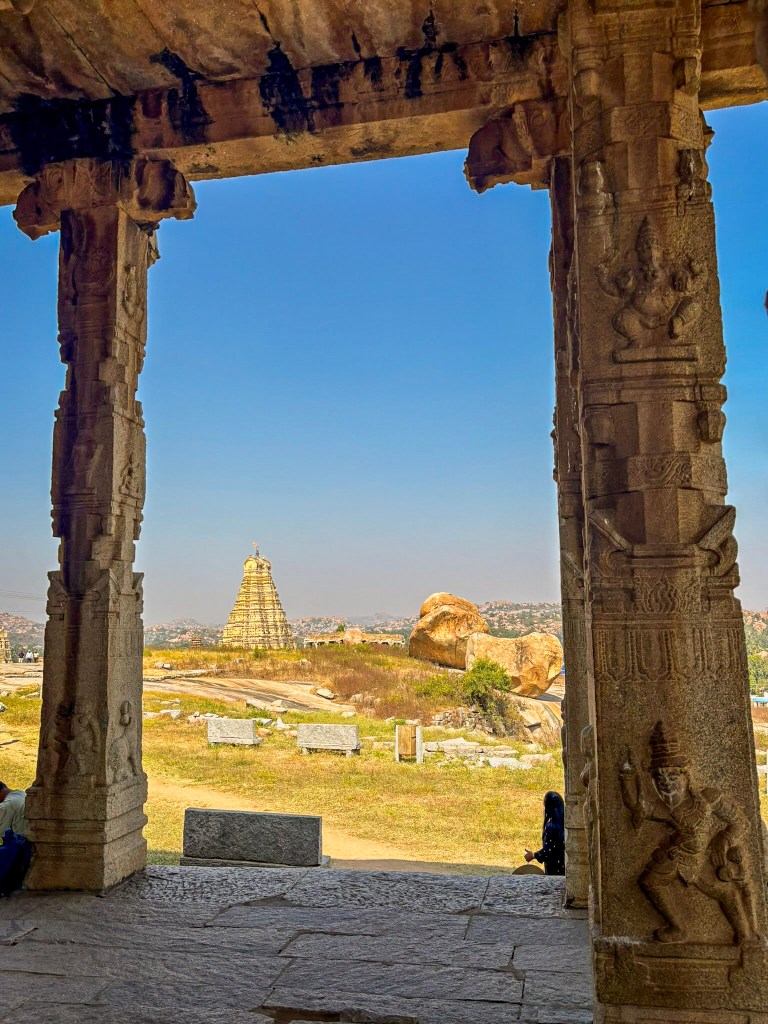
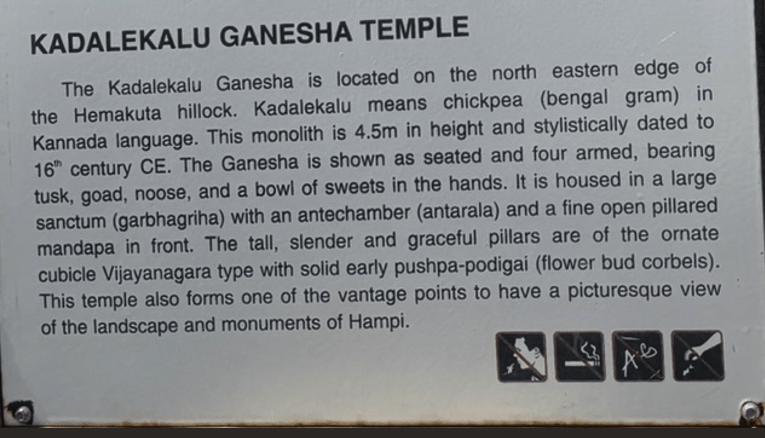
Kadalekalu Ganesha– Meaning Bengal gram Ganesh due to the belly resemblance to Bengal Gram. The open mandapa of this temple has some great views of the surrounding area of Hampi

  • Physicality: Significantly larger at 4.5 meters (15 feet) tall.
  • Iconography: Named for its belly’s resemblance to a Bengal gram (Kadalekalu).
  • Structure: Features a formal temple layout with a large sanctum (garbhagriha) and an open-pillared mandapa with unusually tall, slender granite pillars adorned with intricate mythological carvings

Final Thoughts

Standing before the Sasivekalu and Kadalekalu Ganesha statues, it’s impossible not to feel the quiet power that defines Hampi. These monolithic forms are one modest and intimate, and the other towering and majestic. They capture the spirit of a city that once pulsed with royal ambition and artistic brilliance. What moved me most was how effortlessly Hampi blends myth and landscape, history and humanity. A mustard-seed seller commissioning a deity, a mother’s presence carved subtly into stone, a belly shaped like a Bengal gram—these details remind you that even in an imperial capital, ordinary lives and tender stories shaped the sacred,

The Architectural Wonders of Chalukyan Temples

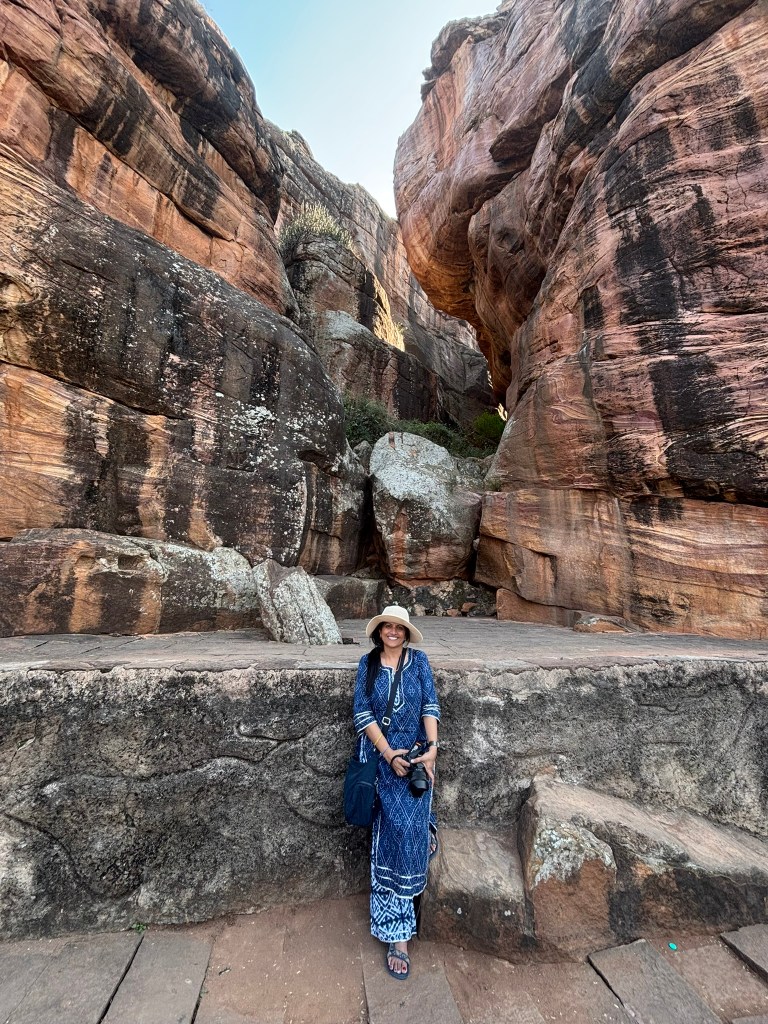
I grew up in North Karnataka, and man, going back to Badami after nearly 40 years was such a trip down memory lane! Driving through those quiet villages with their familiar names and vibrant green fields felt both like home and a dreamy fairy tale. The last time I checked out those temples, I was only 10 or 12 and didn’t really get how stunning they were. But now, after traveling to over 30 countries and living in a country that’s just 250 years old, I totally see the incredible history and timeless beauty of these spots in a whole new light!

Northern Karnataka really knows how to keep you on your toes. One minute you’re cruising through sleepy little villages, and the next, BAM—you’re in front of temples that seem frozen in time. Aihole, Badami, and Pattadakal aren’t just old ruins—they’re like chapters in the story of Indian temple architecture, showcasing how the Early Chalukyas experimented with ideas, refined them, and mastered their craft between the 6th and 8th centuries CE.

This journey is a pilgrimage for anyone who loves history, architecture, or the thrill of watching ideas evolve in stone.

Aihole: The Architectural Laboratory

Aihole is where the Chalukyas began dreaming in stone. With more than 120 temples, it feels like a vast workshop where artisans tested forms, proportions, and techniques that would later define South Indian temple architecture.

More about Aihole from the blog

Lad Khan Temple

One of India’s oldest structural temples, the Lad Khan Temple (5th century CE) still carries the memory of wooden prototypes. Its flat, sloping roof and sabha‑mandapa layout make it feel more like an early assembly hall than a shrine—because that’s exactly what it once was.

Architectural Insight Early Chalukyan builders used post‑and‑lintel construction, fitting massive sandstone blocks without mortar. Precision joints—like mortise‑and‑tenon—held everything together.

Ravana Phadi Cave Temple

A short walk away, the Ravana Phadi Cave (6th century CE) showcases the Chalukyas’ growing mastery of rock‑cut architecture. Inside, a magnificent 10‑armed Nataraja commands the space, surrounded by dynamic carvings of Durga and other deities.

Meguti Jain Temple

Perched on a hillock, the Meguti Jain Temple (634 CE) is the only dated monument in Aihole. Its inscription—the famous Aihole Prashasti—records the achievements of Pulakeshin II and offers rare historical clarity.

Badami: Refinement in Red Sandstone

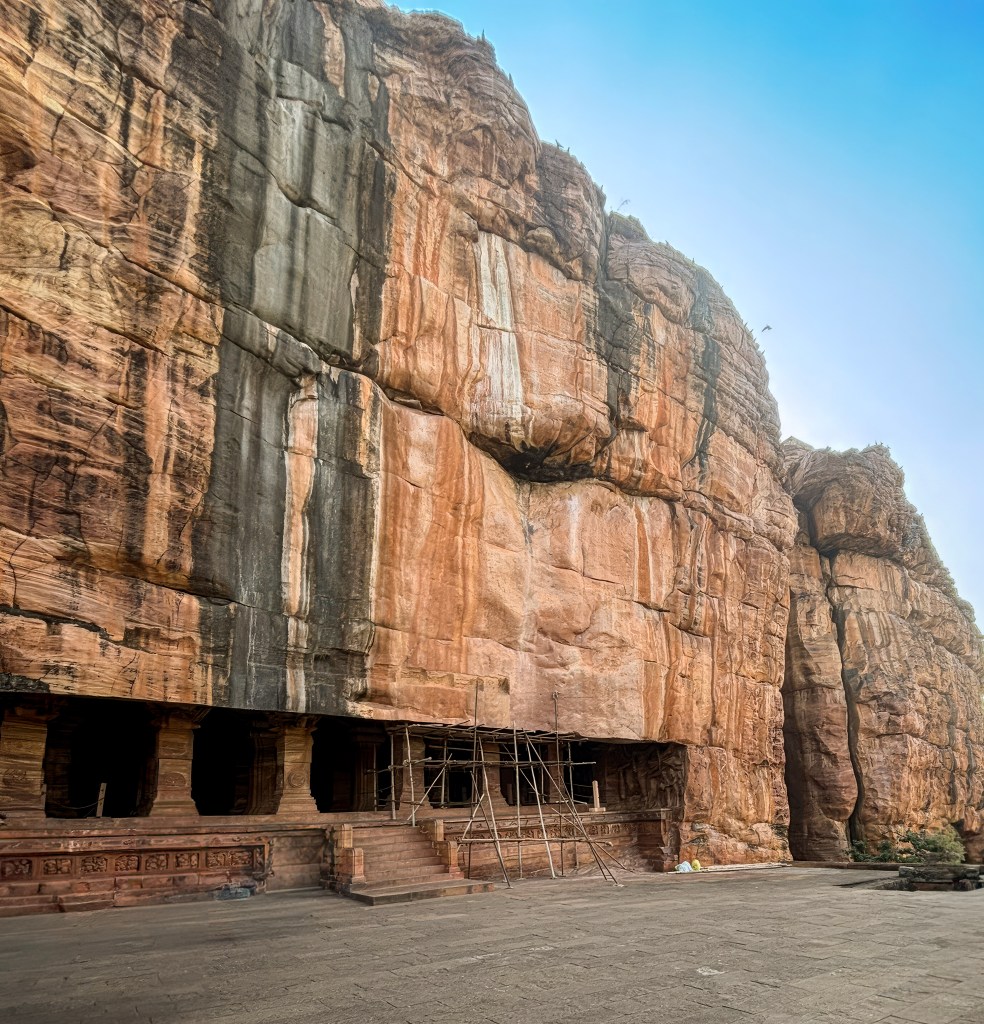
If Aihole is the sketchbook, Badami is the gallery. Once the Chalukyan capital, Badami’s dramatic cliffs cradle some of India’s most exquisite cave temples.

Cave 1: Shiva’s Dance

Dedicated to Shiva, Cave 1 features an 18‑armed Nataraja frozen mid‑movement. The sculptural energy is electric.

Cave 2: Vishnu’s Cosmic Form

Here, Vishnu appears as Trivikrama, his leg stretching across the universe. The refinement in carving marks a clear evolution from Aihole.

Cave 3: The Masterpiece

Dated to 578/579 CE, Cave 3 is the largest and most ornate. Its narrative friezes, pillars, and proportions reflect a confident artistic maturity.

Cave 4: Jain Serenity

The final cave honors Jain Tirthankaras, a testament to the region’s religious inclusivity.

Rock‑Cut Technique Badami’s caves were carved using a subtractive method—artisans removed stone to reveal halls, pillars, and sanctums within the cliff face.

Pattadakal: The Grand Synthesis

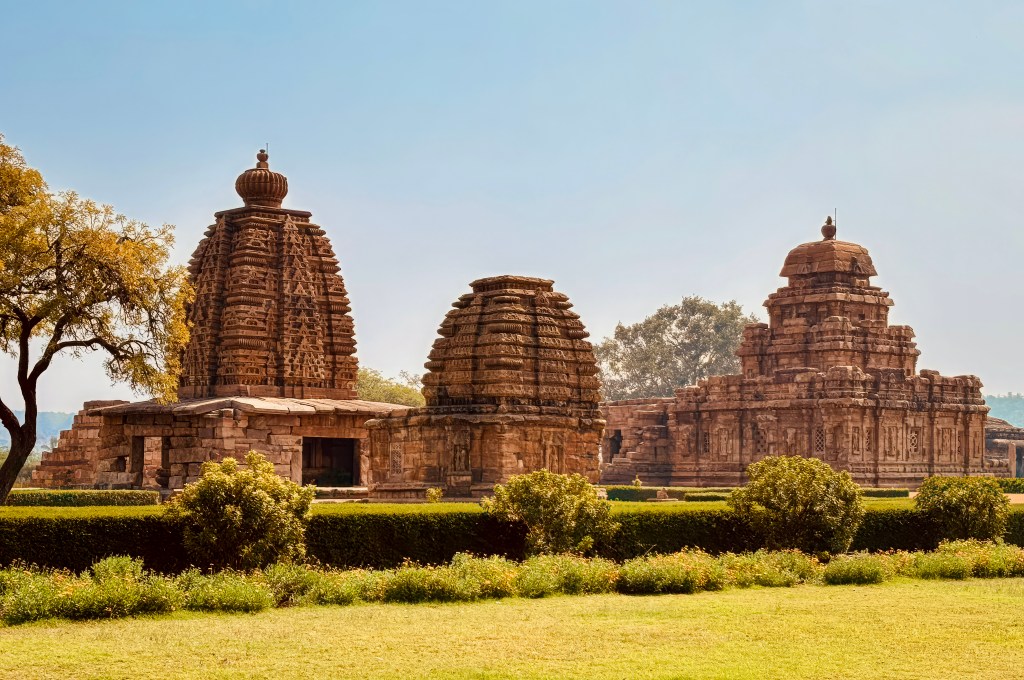
A UNESCO World Heritage Site, Pattadakal is where the Chalukyas’ architectural experiments reached their zenith. This was the royal coronation site, and the temples reflect a confident blend of Nagara (North Indian) and Dravidian (South Indian) styles—what we now call the Vesara style.

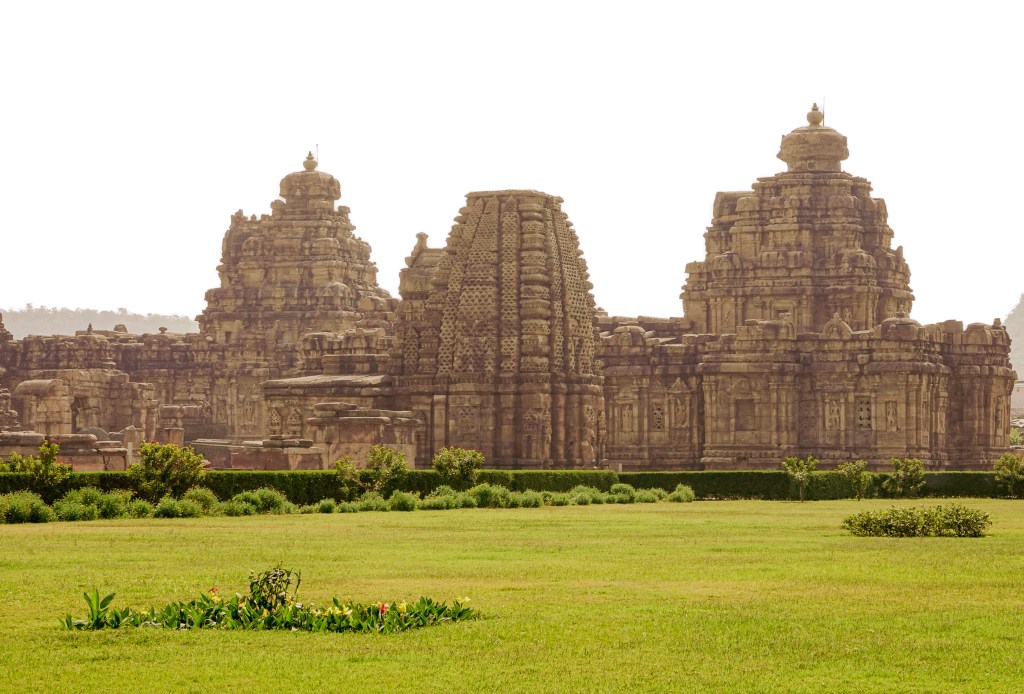
Virupaksha Temple

Built around 740 CE by Queen Lokamahadevi, the Virupaksha Temple is a Dravidian masterpiece. Its layered vimana, sculpted friezes, and harmonious proportions later inspired the Kailasa Temple at Ellora.

Mallikarjuna Temple

A near twin to Virupaksha, this temple was built by another queen, Trailokyamahadevi. Subtle differences in detailing make it a fascinating companion piece.

Papanatha Temple

A true Vesara gem, Papanatha blends Nagara and Dravidian elements. Its Ramayana panels are some of the most expressive in the region.

How the Chalukyas Built Their Legacy

Materials & Methods

  • Locally sourced sandstone
  • Post‑and‑lintel construction
  • Precision joints instead of mortar

From Wood to Stone

Early temples mimic wooden structures(eg. Ladkhan temple), marking a pivotal architectural transition.

Layouts & Plans

  • Sandhara (with circumambulatory path)
  • Nirandhara (without)
  • Square, rectangular, and apsidal plans

Fusion of Styles

  • Nagara: Curvilinear shikhara
  • Dravidian: Pyramidal vimana
  • Vesara: Their harmonious blend

Travel Tips for Visiting the Chalukyan Sites

  • Best season: October–February – December’s a solid month, but just a heads up, a lot of schools have their trips planned then. The temples get packed with schoolkids, but they don’t stick around for too long. Just hang tight until one group heads out, and snap your pics before the next bunch rolls in!
  • Carry water—these sites involve walking and open sun
  • Hire a local guide at Pattadakal for deeper context
  • Combine all three sites in a 2‑day itinerary or along with Hampi as a 4–6-day itinerary

Suggested Reads

  • “The Chalukyas of Badami” – K.A. Nilakanta Sastri
  • “Indian Temple Architecture” – Adam Hardy

Nearby Attractions

  • Mahakuta Group of Temples
  • Banashankari Temple
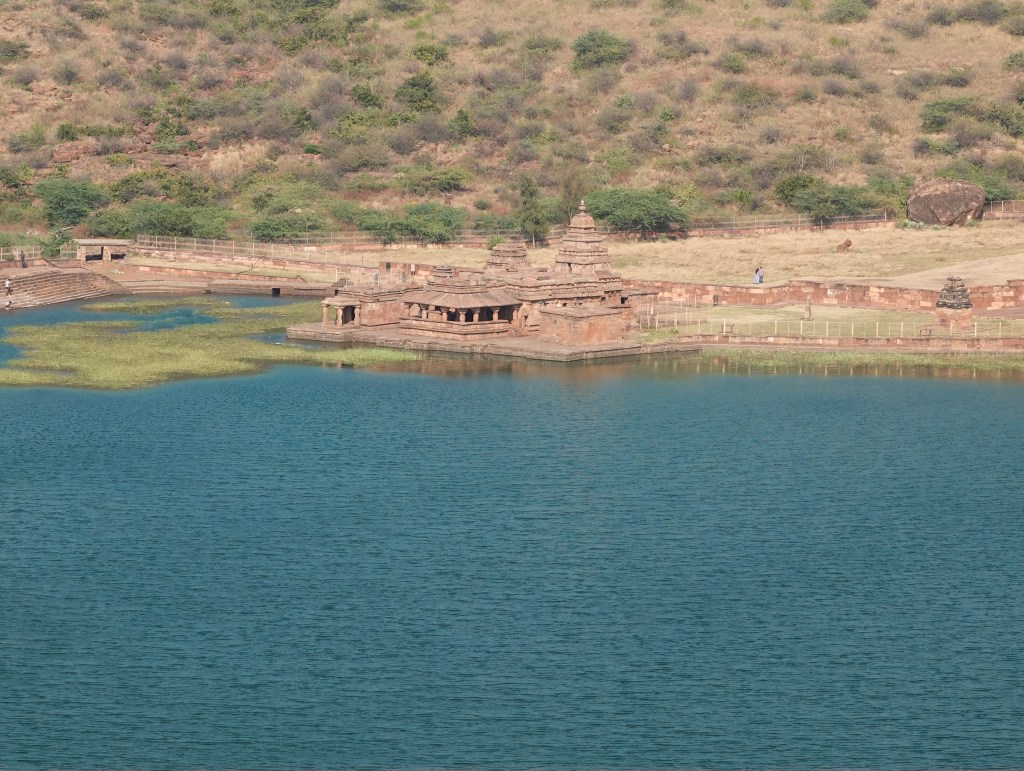
  • Bhutanatha Temples by the lake in Badami

Final Thoughts

Traveling through Aihole, Badami, and Pattadakal feels like watching an idea take shape—from early sketches to a fully realized masterpiece. The Chalukyas weren’t just building temples; they were building a legacy of experimentation, innovation, and artistic courage.

If you’re drawn to places where history feels textured and alive, this ancient triad of temple towns will stay with you long after you’ve left their sandstone silhouettes behind.

Virupaksha & Mallikarjuna: Twin Temples of Pattadakal

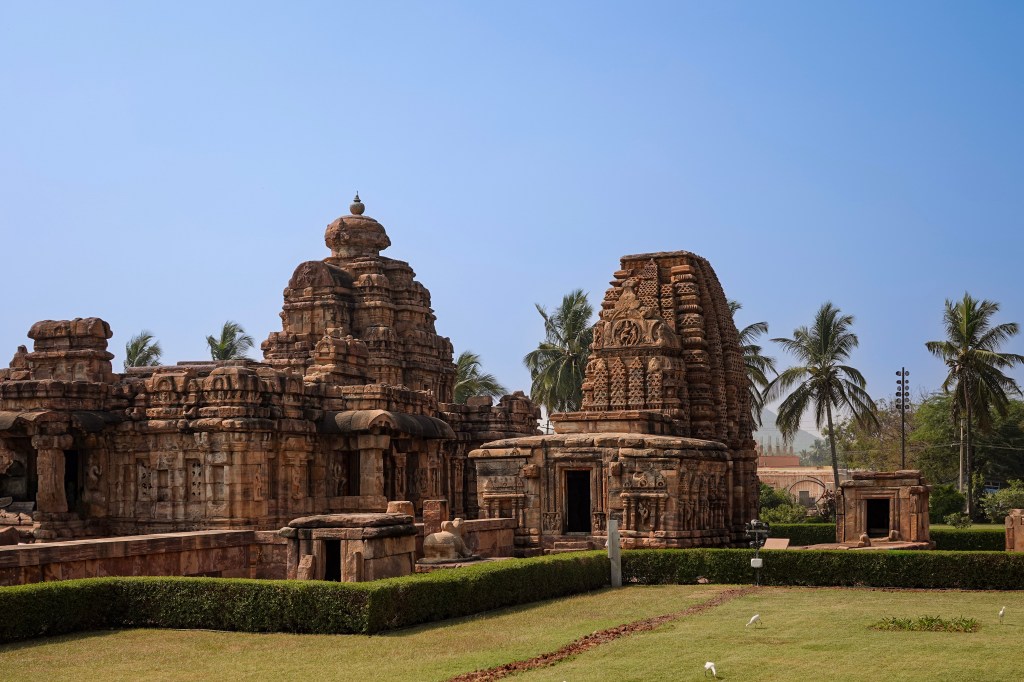
Deep in the heart of Karnataka, where the Malaprabha River curves gracefully, lies Pattadakal. It is a UNESCO World Heritage site. This site is the spiritual “cradle of Indian temple architecture”. Travelers exploring the Chalukyan heartland will find the Virupaksha and Mallikarjuna temples as the most magnificent chapter of this stone-carved story.

A Royal Tale of Two Queens

These “twin” temples were not merely religious structures. They were grand political statements commissioned around 745 CE by two sister queens Lokamahadevi   and Trailokyamahadevi. These masterpieces were built to celebrate their husband, King Vikramaditya II’s victory over the Pallavas. They represent the pinnacle of Dravidian (Southern) architecture in northern Karnataka.

What to Expect on Your Visit

  • The Masterpiece (Virupaksha): This temple is often hailed as the site’s “crown jewel.” The Virupaksha Temple is the only one in the complex that remains an active place of worship today. Its architectural excellence was so profound that it later inspired the world-famous Kailasa Temple at Ellora.
  • The Delicate Twin (Mallikarjuna): Standing just beside its neighbor, the Mallikarjuna Temple mirrors Virupaksha’s layout. It offers its own unique charm. The charm includes a distinctive hemispherical tower dome. It also has some of the most delicate narrative carvings in the complex.
  • Stone-Carved Epics: Both temples function as stone libraries. As you walk through their pillared halls, you will discover incredibly detailed friezes. These friezes depict scenes from the Ramayana, Mahabharata, and Panchatantra.

Virupaksha Temple Architecture

  • Style: Primarily Dravidian style, described as a fully developed example that served as a model for later grand temples, including the Kailasa temple at Ellora.
  • Vimana (Tower): Features a tall, four-story tower with a square top (sikhara). The verticality is emphasized by the structure.
  • Plan: It has a large, square plan from the base to the sikhara. The complex is extensive, consisting of a main shrine, a large pillared hall (mandapa) with three porches, a Nandi pavilion, and peripheral sub-shrines enclosed by a compound wall with massive gateways (gopurams).
  • Carvings: Known for highly ornate carvings of Hindu deities and detailed narrative panels from the RamayanaMahabharata, and Panchatantra.
  • Unique Feature: It is the earliest known full temple complex in the Chalukyan series with a fully formed architectural plan. 

Mallikarjuna Temple Architecture

  • Style: Also built in the Dravidian style, it is a slightly smaller version of the Virupaksha temple.
  • Vimana (Tower): It has a four-story tower, but it is crowned with a hemispherical or circular top (griva and sikhara), a key difference from the Virupaksha temple.
  • Plan: It shares a similar square plan and layout to its twin, including a large pillared hall and a Nandi mandapa.
  • Carvings: The temple features equally rich sculptures and friezes depicting stories from the epics, similar in style to the Virupaksha temple. 

Both temples represent the peak of Dravidian architecture under the Chalukyas. However, the primary architectural distinction between them is in the shape of their crowning elements. It is square for Virupaksha. It is circular for Mallikarjuna.

Exploring the Virupaksha Temple

We spent considerable time walking around the Virupaksha temple, which is dedicated to Shiva. It is the only functioning shrine in the temple complex. It is also among the popular places to visit in Pattadakal. The temple was constructed in 745 AD. Queen Lokamahadevi, consort of the Chalukyan ruler Vikramaditya, built it. She did this to commemorate his victory over the Pallavas of Kanchi.

The temple is built in the Dravidian style of architecture. It has three mukhamandapas on three sides. There is a large stone gateway on the East towards Malaprabha River. A large pillared hall is followed by a sanctum with a circular path for pradakshinas. The mukhamandapas and the pillars of the hall have wonderful carvings of gods. They also depict scenes from the Ramayana and the Mahabharata.

Innovative Ceiling Design Solutions

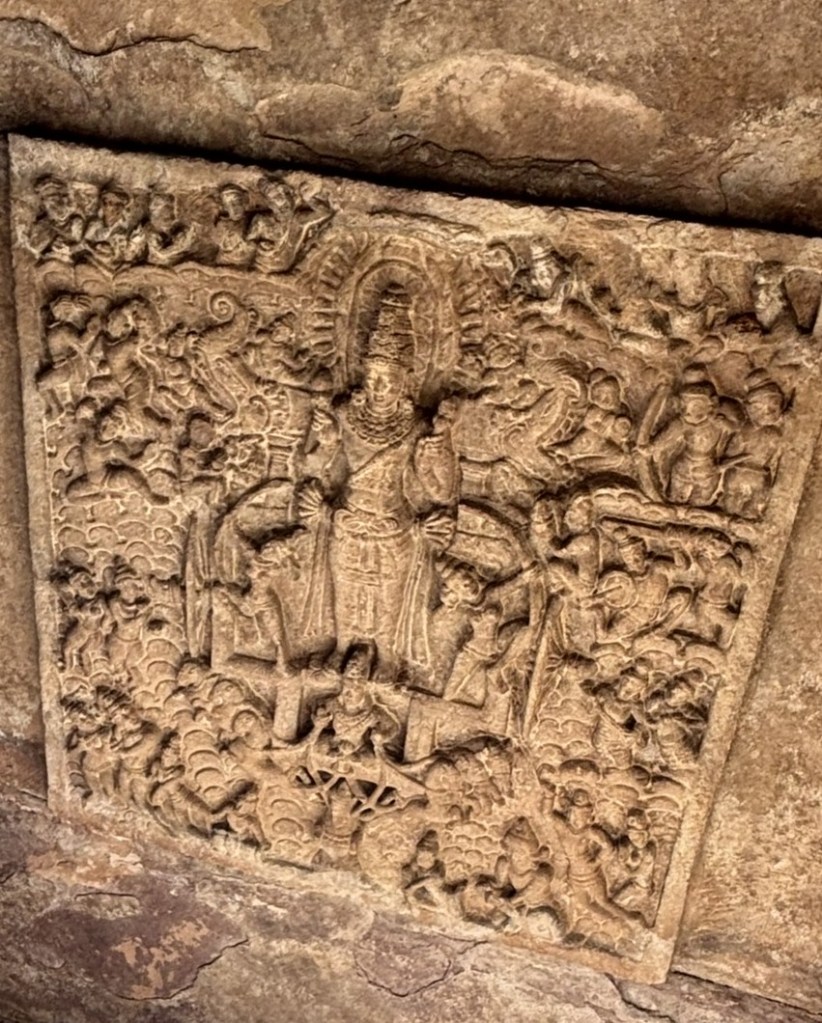
The main highlight is the sculpture of Surya riding a chariot through the clouds. Aruna, his driver, directs the chariot with archers aiming their bows outward to either side. This sculpture is found on the ceiling of the Eastern Mukhamandapa. The details on this intricate carvings are incredible.

Sculptural Narratives and Artistic Edges

Sculptures of various gods and goddesses are prevalent throughout the temple. They include Shiva in different aspects like Nataraja, the dancing Shiva, and Ardhanarishvara, half-Shiva, half-Parvati. There are also Vishnu avatars such as Narasimha and Varaha. Additionally, Durga is depicted slaying the Mahishasura demon. Ganesha and Surya, the Sun god, are also featured.

Puranic themes and Vedic legends include:

Shiva and Parvati with Ravana lifting Mount Kailash.

The churning of the ocean (Samudra Manthan).

Durga slaying the buffalo demon Mahishasura.

Ramayana and Mahabharata: Many scenes from the Ramayana and Mahabharata are carved throughout the halls. The carvings also include stories from the Bhagavata Purana and Panchatantra fables on the exterior walls.

  • Ramayana episodes shown include the golden deer incident, the abduction of Sita by Ravana, the fight between Ravana and the demigod Jatayu, and Lakshmana cutting off Shurpanakha’s nose.
  • Mahabharata narratives are also present. For example, there is the confrontation between Arjuna and Karna. Another instance is Bhishma Pitamah lying on a bed of arrows.

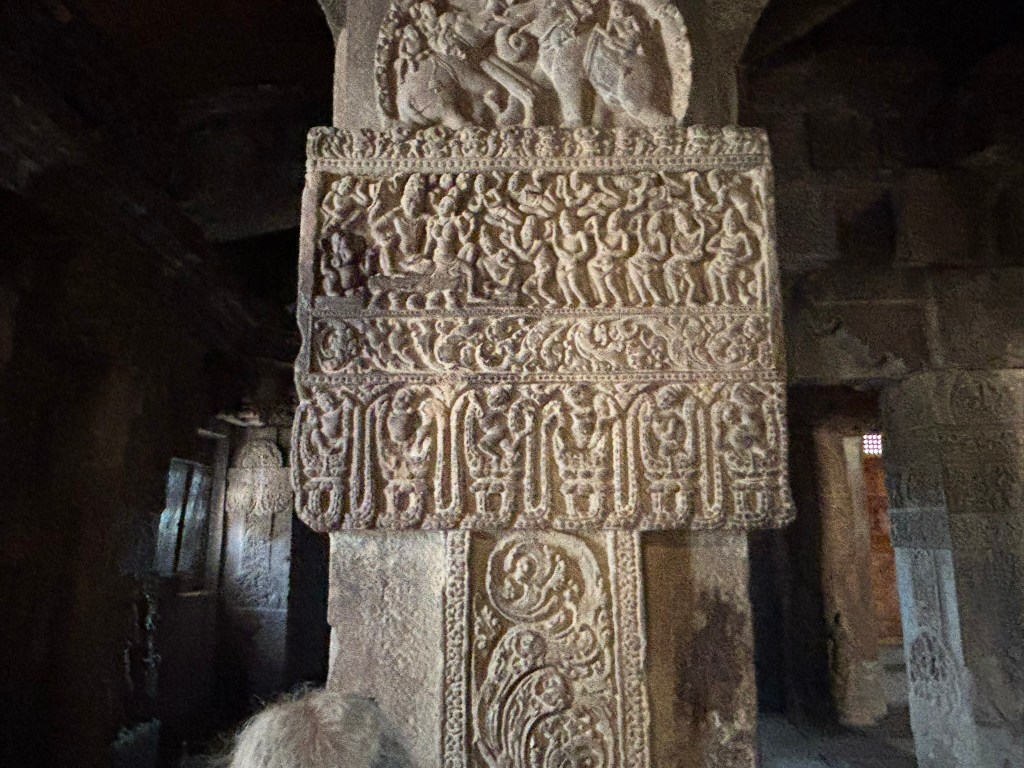
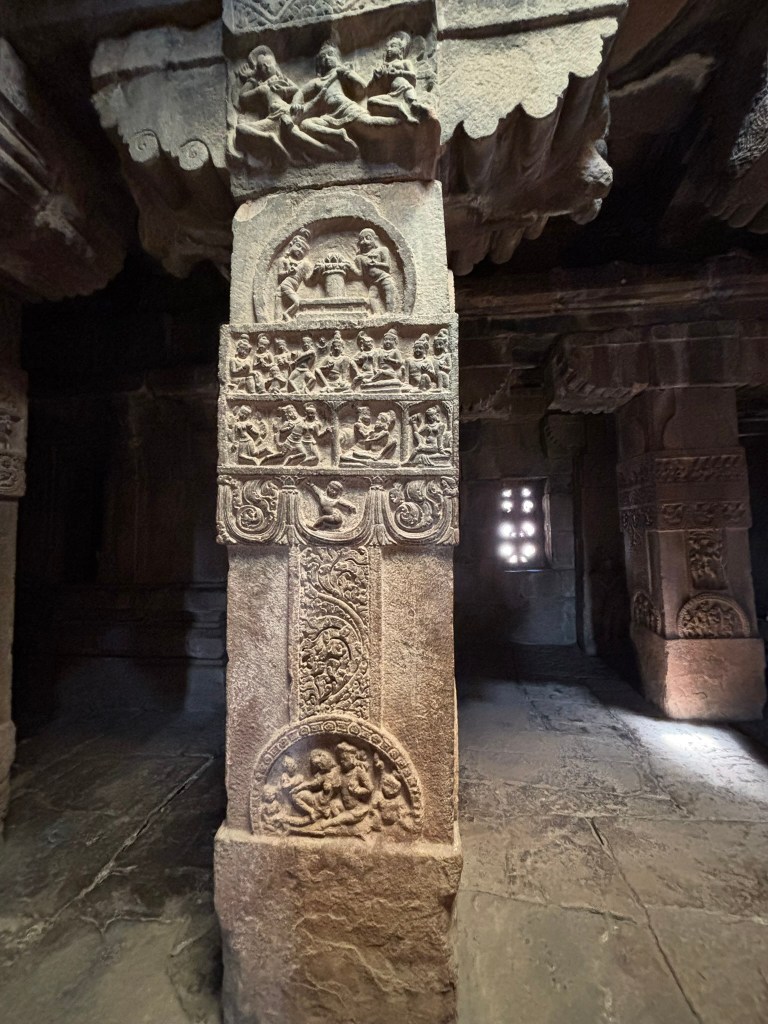
Narrative Friezes: The pillar above illustrates episodes primarily from the Ramayana epic, specifically from the Aranya Khanda section depicting:

  • Shurpanakha confronting Rama and Lakshmana.
  • Lakshmana mutilating Shurpanakha’s nose.
  • Khara and Dushana (demon brothers) fighting Rama and Lakshmana.
  • The demon Maricha in disguise as the golden deer.
  • Ravana approaching Sita’s hut in the disguise of a sage

These highly detailed carvings provide a vivid glimpse into the craftsmanship and religious worldview of the 8th-century Early Chalukyan period.

Having a professional guide is advised, as they can show the key structures and share information about various carvings. Below is one of the scenes in the interior mantapa being explained by our guide. The carvings depict scenes from the Hindu epic, the Mahabharata. The middle panel is believed to show Bhishma lying on a bed of arrows. The bottom panel depicts Bhima fighting Duryodhana. 

Scene from the Mahabharata being explained by the guide

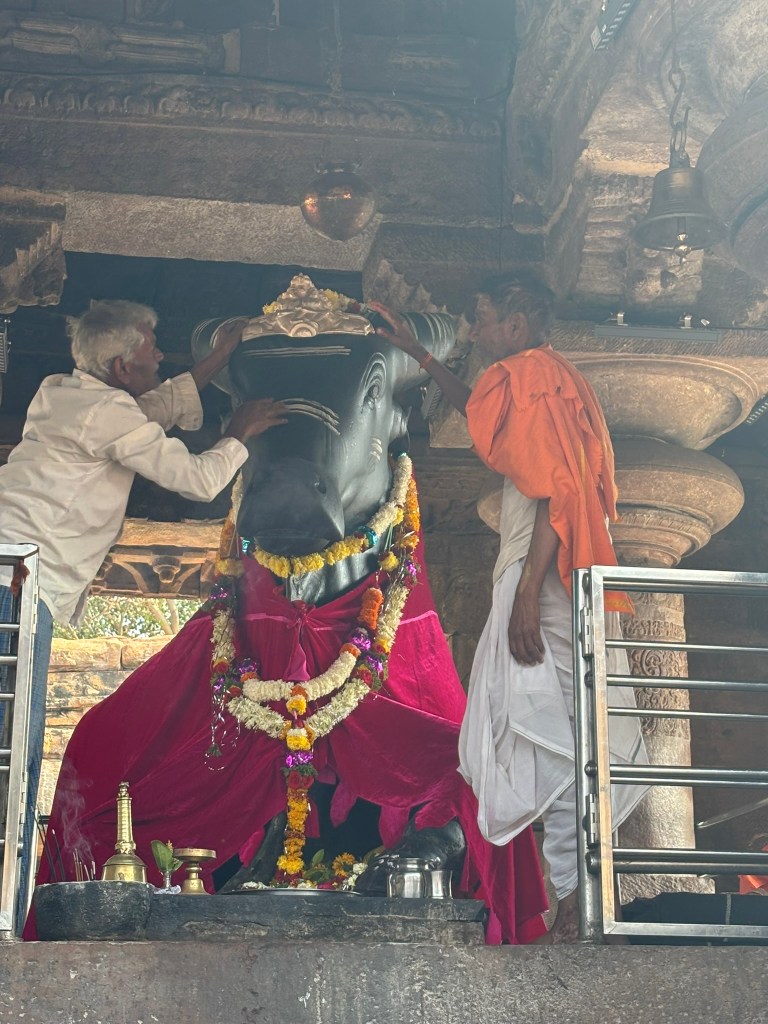
Monolithic Nandi: A large, black stone sculpture of Nandi, the bull vehicle of Lord Shiva. It is housed in a separate mantapa (hall) in front of the Virupaksha temple entrance. Witnessing the craftsmanship and precision needed to carve a single stone into such a detailed form is astonishing.

Mallikarjuna Temple

The Mallikarjuna Temple is also a Shiva temple commissioned by Queen Trailokamahadevi. This temple is similar to the adjacent Virupaksha Temple, but less decorated and weather-worn.

Structural Layout and Composition

  • Plan: The temple follows an axial layout facing east. It consists of a square garbhagriha (sanctum), an antarala (antechamber), and a large pillared sabha-mandapa (community hall).
  • Entrances: It features three mukhamandapas (entrance porches) located on the eastern, northern, and southern sides.
  • Pradakshina Patha: The sanctum is surrounded by a covered circumambulatory path. This was a well-established tradition by the time of its construction.
  • Nandi Mandapa: A separate, four-pillared pavilion for Nandi stands in front of the main temple complex. However, it is now partially collapsed. 

Architectural Elements

  • Superstructure (Vimana): The temple has a four-storeyed vimana. The Mallikarjuna’s tower is distinctive for its hemispherical (circular) roof. It differs from the square roof of the nearby Virupaksha Temple. The dome is another unique feature.
  • Tower Cap: The tower is topped by a circular griva (neck). It also has a hemispherical shikhara (dome). The structure is capped with a stupi or kalasha.
  • Platform (Adhishthana): The structure stands on a high, five-moulded plinth. It is decorated with friezes of animals, including elephants and lions. It also features floral motifs.

Decorative Innovations

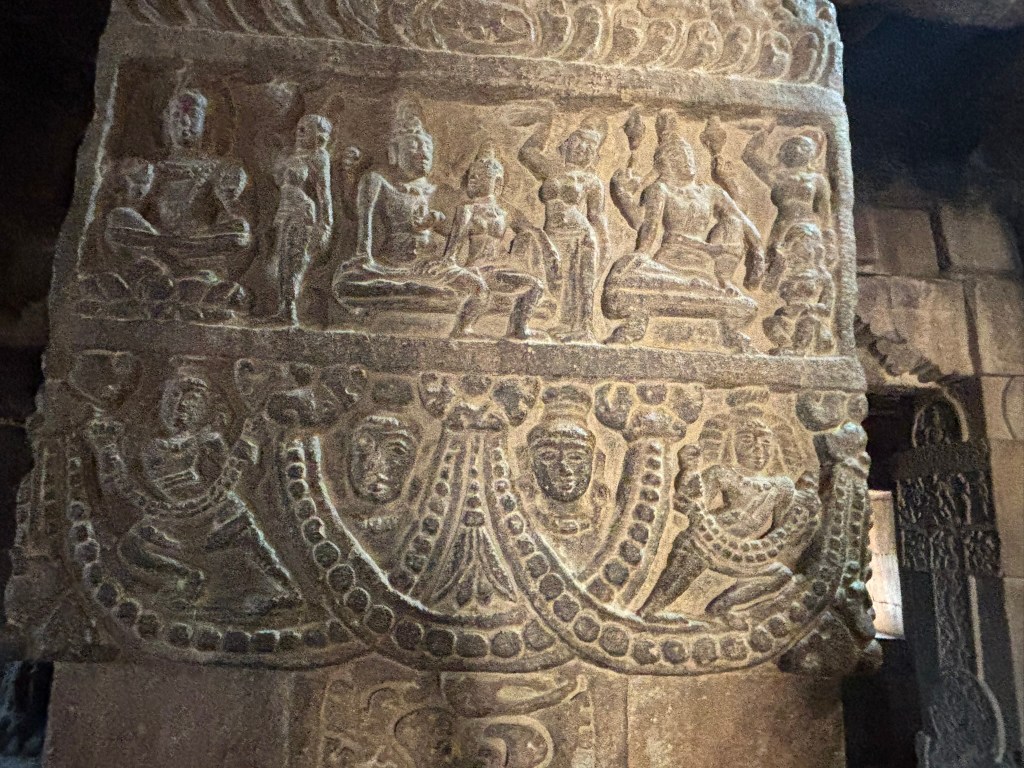
  • Pillars and Ceilings: The 18 pillars of the inner hall are intricately carved. They feature narrative panels depicting scenes from the Ramayana. Some scenes also come from the Mahabharata and Panchatantra. The ceilings are adorned with beautiful figures of Gajalakshmi and Shiva-Parvati with Nandi.
  • Sukanasa: The sukanasa is a prominent arched projection on the front of the tower. It houses a relief of Nataraja (dancing Shiva).
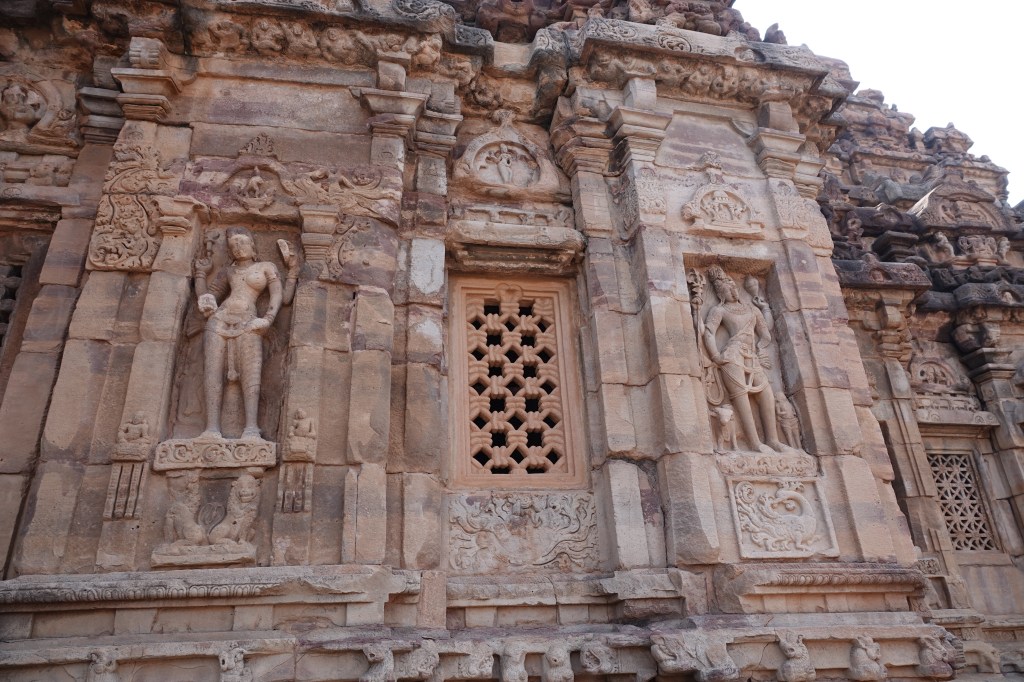
  • External Walls: The exterior walls are divided by pilasters into niches that alternate with perforated windows (pierced stone screens). These niches contain various sculptures of Hindu deities. They also feature detailed friezes of amorous couples (mithuna). Single women are depicted showing diverse emotional expressions. 

Final thoughts

The Virupaksha and Mallikarjuna temples stand as the crowning achievements of this historical ensemble. Often called the “twin temples,” they are more than just stone monuments. They are a testament to the artistic rivalry and devotion of two sister-queens, Lokamahadevi and Trailokyamahadevi. Visiting these temples isn’t just about ticking off a UNESCO site. It’s about experiencing the pinnacle of Chalukyan architectural evolution.

Terminologies used in describing temple architecture

  • Vimana: The pyramidal or stepped-pyramid tower located directly above the main sanctum.
  • Garbhagriha: Literally “womb chamber,” this is the innermost, windowless sanctum housing the primary deity.
  • Gopuram: A monumental, ornate gateway tower providing entry into the temple complex. In later periods, gopurams often became taller than the central vimana.
  • Shikhara: In the Dravida style, this refers specifically to the crowning dome-shaped element at the very top of the vimana. (Note: In North Indian architecture, “Shikhara” refers to the entire tower).
  • Mandapam: Pillared halls or porches used for public rituals, gatherings, or as a transition to the sanctum.
  • Prakaram: The enclosed courtyard or circumambulatory path surrounding the main temple structures.
  • Pushkarini (Kalyani): A ritual bathing tank or reservoir found within the temple complex.
  • Antarala: A vestibular tunnel connecting the mandapa to the garbhagriha. 

Decorative and Vertical Elements

  • Stupi (Kalasha): The final crowning pot or finial placed on top of the shikhara.
  • Dvarapalas: Fierce “door-keepers” or guardian sculptures flanking the entrance to the sanctum.
  • Adhisthana: The highly decorated base or pedestal on which the entire temple structure stands.
  • Prastara: The entablature or horizontal beam that marks the transition between the walls and the spire.
  • Yali (Vyala): A mythical creature, often with the face of a lion, used as a decorative pillar motif.
  • Nasi: A decorative horseshoe-shaped arch motif, often found on the exterior of the vimana.