
Traveling south from the Virupaksha complex, the road leads to Kamalapura. The landscape then opens into Krishnapura, another historic quarter of Hampi’s sacred center. At its heart stands the Krishna Temple. It is a grand monument commissioned in 1515 CE by the Vijayanagara emperor Krishnadevaraya. This was to commemorate his celebrated victory over the Gajapati rulers of Orissa. The temple once housed a granite icon of the infant Krishna. This icon was seized from the fort at Udayagiri during this campaign. It is now preserved at the Government State Museum in Chennai.
A Temple Anchored in its Urban Landscape
Like other major shrines in Hampi, the Krishna Temple is aligned with a broad bazaar street extending eastward. Today, this street sits at a lower level than the temple itself. Its colonnades are partly engulfed by fields of sugarcane and banana plantations. This setting creates a striking contrast between cultivated greenery and monumental stone.
A few metres north of the bazaar lies a rectangular tank. It is framed by additional colonnades and crowned by a small pavilion that rises from the water. This tank is nestled beneath a rocky overhang. It forms one of the most picturesque corners of the complex. If you have time, this is a good place get some nice photos.
The Grand Gopura: A Royal Statement
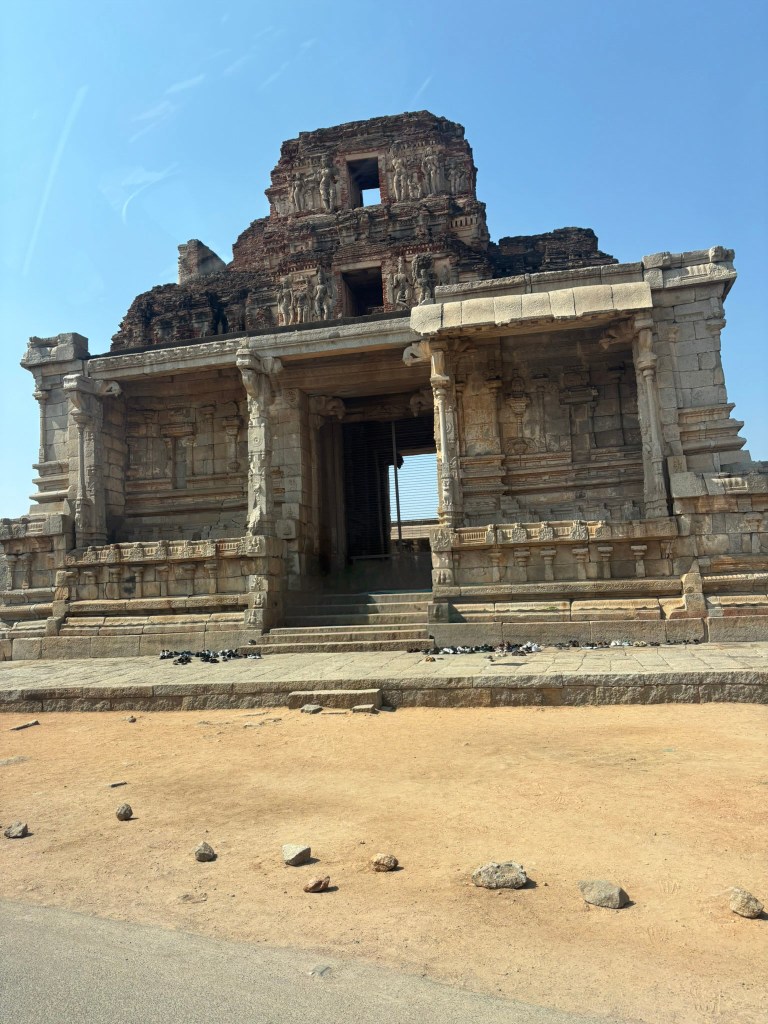
The eastern entrance gopura immediately announces the temple’s royal origins. Though now dilapidated, its frontal portico remains impressive for the sheer height of its granite columns. These columns were recently reset during conservation efforts. Above them rises the brick superstructure, only partially preserved, but still bearing traces of plaster sculptures. Among these are battle scenes on the western face. These scenes possibly depict Krishnadevaraya’s Orissa campaign. Later renovations have simplified many of the original figures.
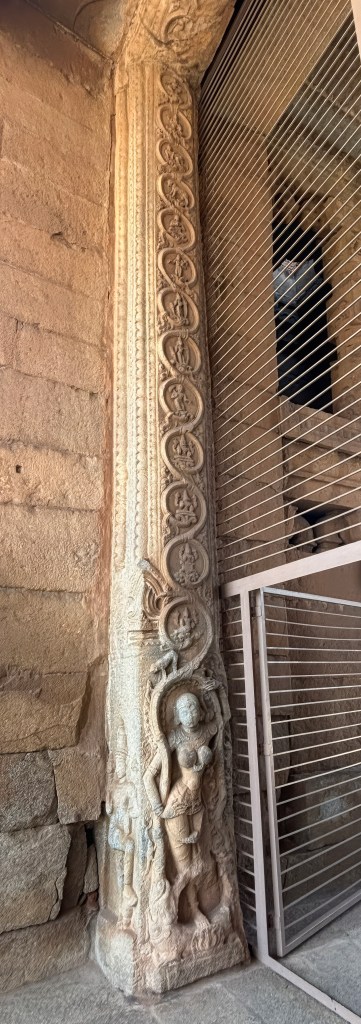
Within the gopura passageway, the doorway jambs are carved with elegant maidens entwined with creepers. A charming hare‑in‑the‑moon motif appears between nagas on the underside of one lintel. This is a delightful detail easily missed by hurried visitors.
Inside the Temple: Mandapas, Shrines, and Royal Inscriptions
A large inscription slab stands at the centre of the walled compound. Krishnadevaraya himself set it up. It records his military exploits and benefactions. The carving is somewhat hastily executed, but the monument remains a valuable historical record of the emperor’s reign.
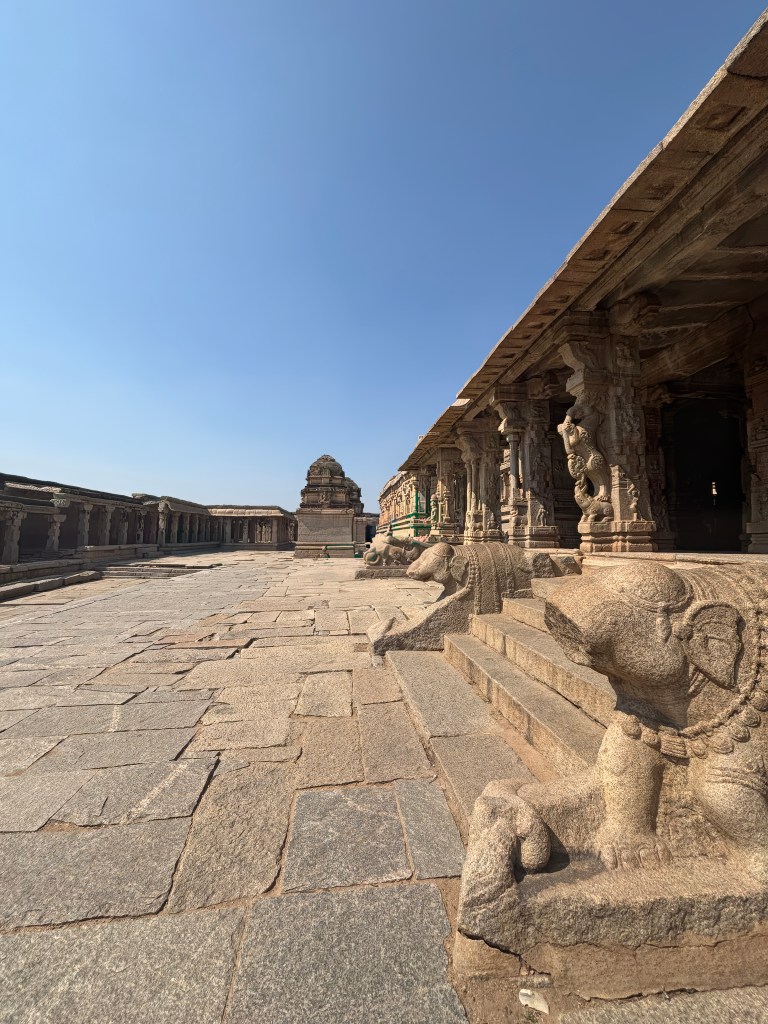
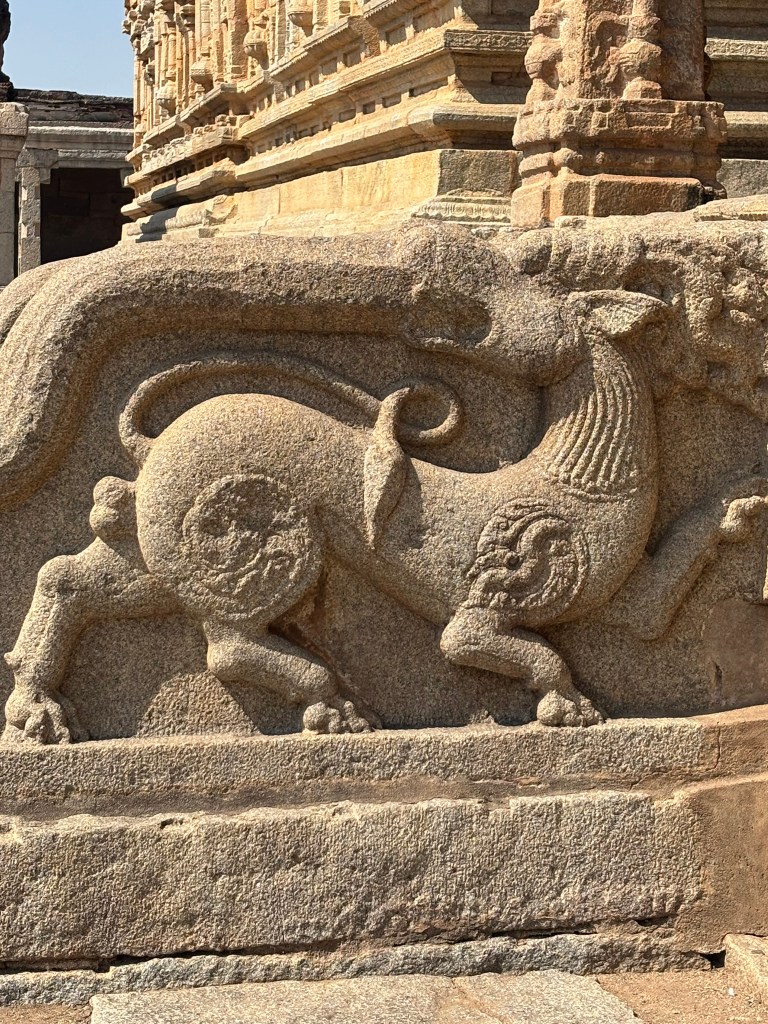
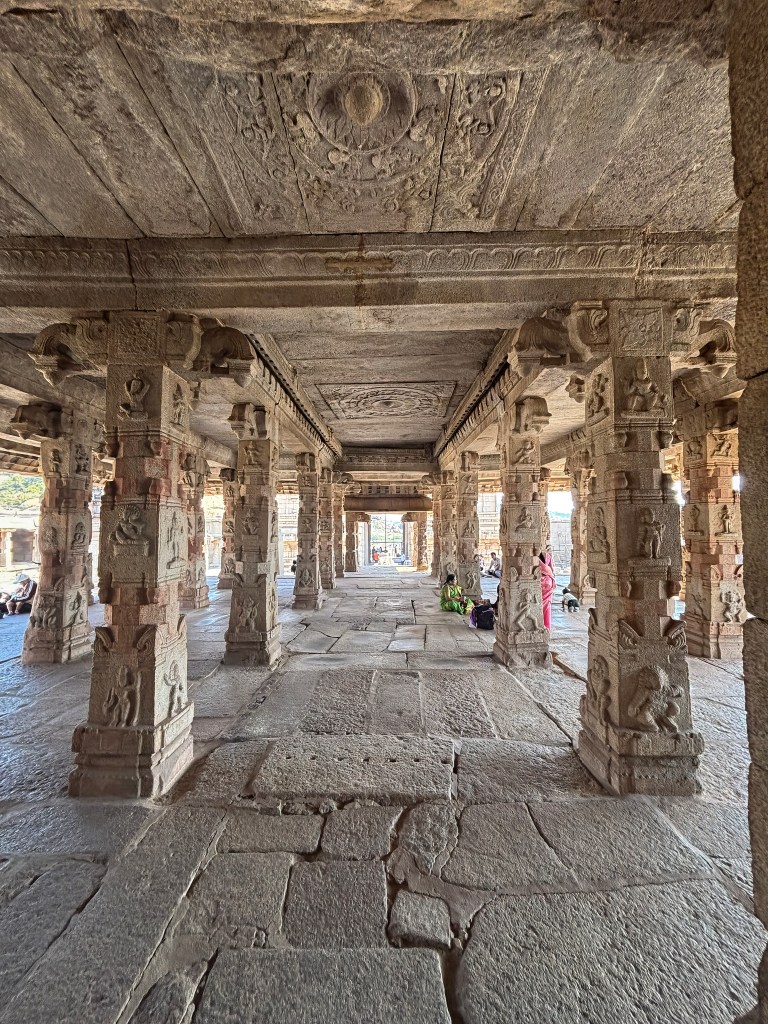
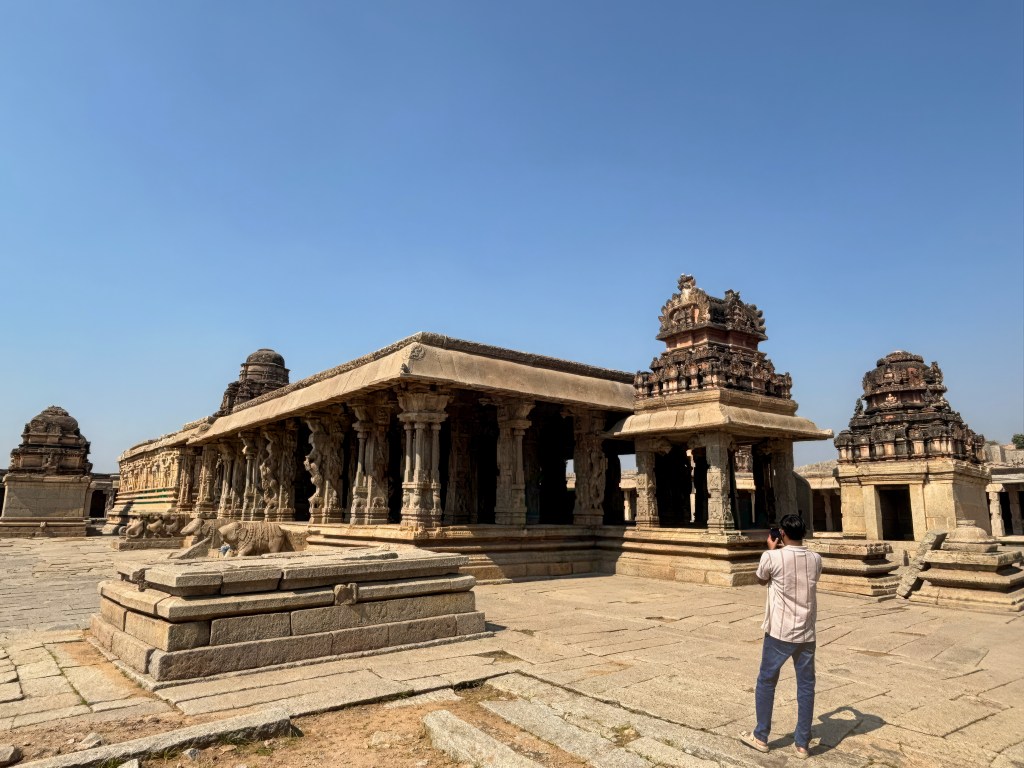
The temple layout follows the classic Vijayanagara sequence:
- a 25‑bay open mandapa,
- an enclosed nine‑bay mandapa with side porches,
- and a towered sanctuary surrounded by an unlit circumambulatory passage.
Minor shrines occupy the outer corners of the enclosure. A double‑sanctuaried goddess temple stands to the north. It adds to the ritual complexity of the site.
Layers of Construction and Adaptation
Along the inner perimeter is a continuous colonnade. It is interrupted on the south side by a passageway. This leads to an earlier pavilion‑like gateway. This older structure became part of the Krishna Temple complex. It was crowned with a brick tower. This illustrates the Vijayanagara habit of integrating pre‑existing buildings into new architectural schemes.
Beyond this lies an outer-walled enclosure, where a curious six‑domed structure stands. The building is built of rubble coated in plaster. It has internal arches and steps leading to the roof. The building features holes in the domes. These are clear evidence that it once served as a granary. Its presence highlights the temple’s significance as a sacred space. It also emphasizes its role as a center of economic and administrative activity.
Final Thoughts on the Krishna Temple
The Krishna Temple is one of those places in Hampi where layers of history feel unusually close to the surface. You sense Krishnadevaraya’s ambition in the soaring gopura. You also feel the devotional pulse that once centered around the now‑empty sanctuary. Even in its ruined state, the complex carries the unmistakable imprint of royal patronage. It is a temple built not only for worship. It commemorates a moment of triumph that shaped the empire’s identity.
 Peaks to Palaces
One Reply to “”