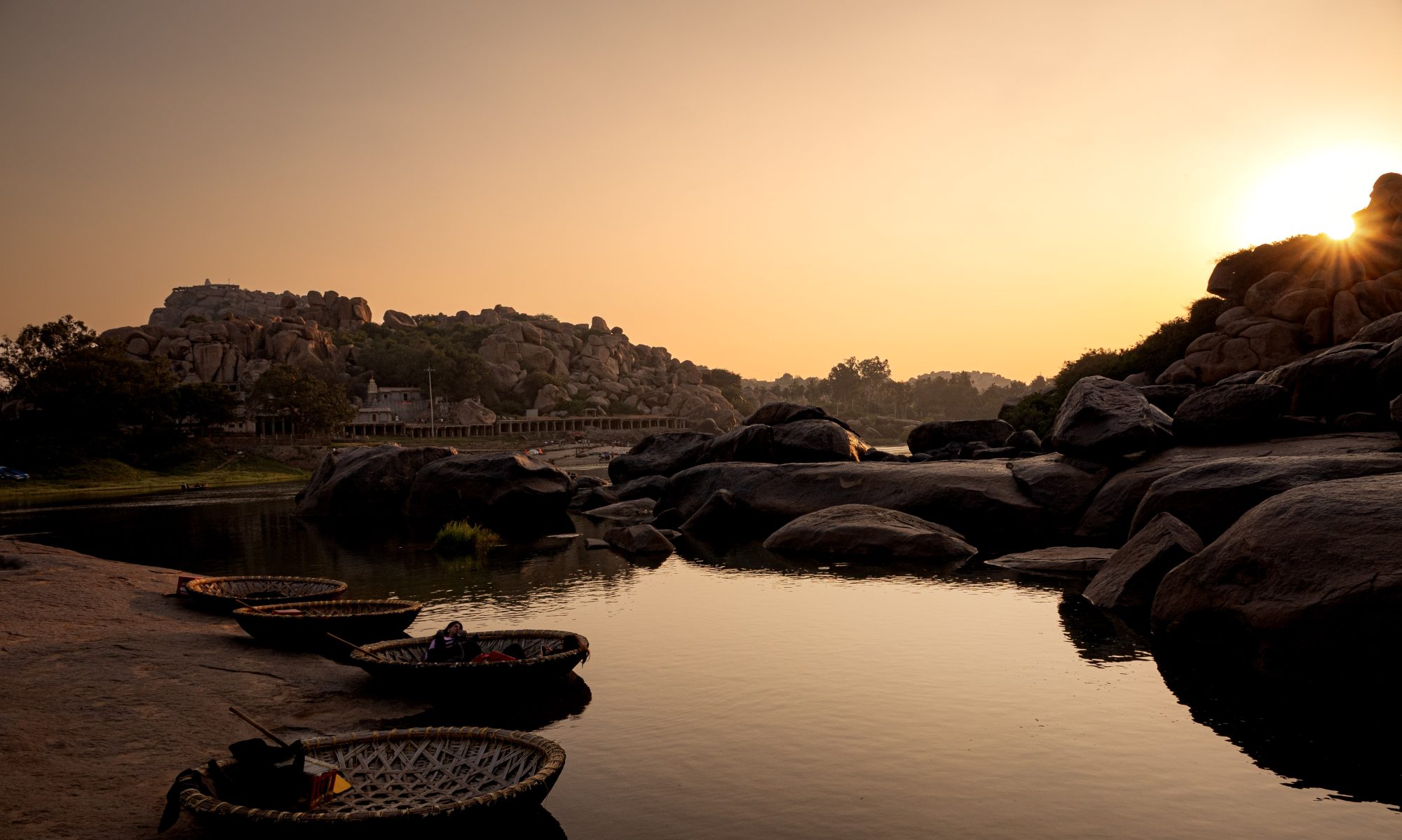
There are places in Hampi where history feels loud—grand mandapas, towering gopuras, bazaars that once echoed with royal processions. And then there are places where history whispers. Chakratirtha is a rare spot. Mythology, river, stone, and silence unite in a way that feels almost otherworldly.
The coracle ride and a visit to the river ruins weren’t part of our itinerary. Nevertheless, they turned out to be among our best experiences. I highly suggest taking a guided tour of the ruins, as there are no markings or directions. Also, we rented the entire theppa, which made it easier to do what we wanted. Sunset is the best time for this visit
- Chakratirtha Where the River Swirls with Legends
- Setting Off on the Coracle: A Journey Into Stillness
- Stopping at the Secret Shrines Along the River
- Other river ruins worth visiting
- Narasimha Temple: A Quiet Shrine Revealed by the River
- The Kampabhupa Pathway: Echoes of Ancient Pilgrims
- Final thoughts
Chakratirtha Where the River Swirls with Legends
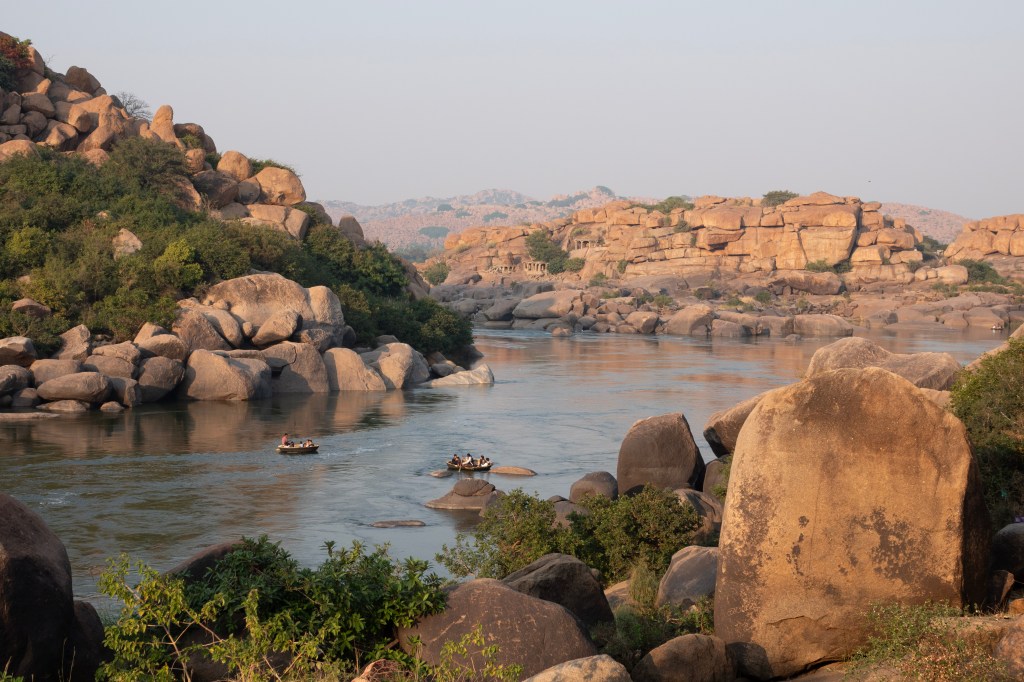
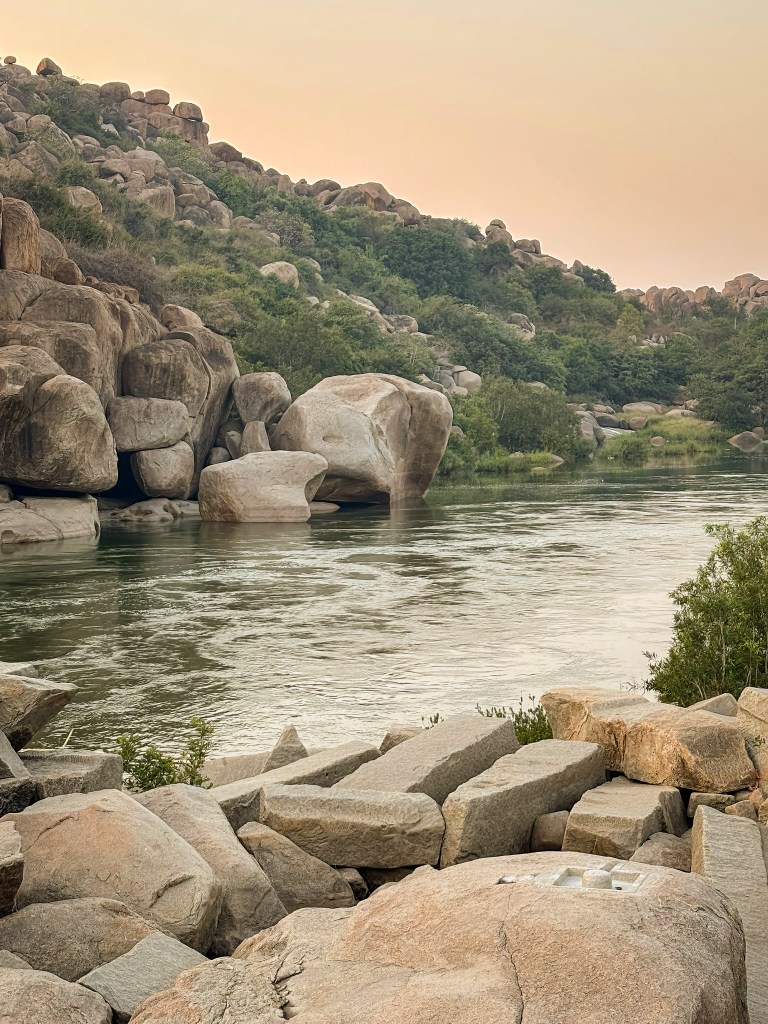
Chakratirtha—literally “the sacred water body that swirls”—sits at the valley point between Matanga Hill and Rishyamukha Hill. Here, the Tungabhadra narrows, bends, and gathers force, creating a natural whirlpool that locals believe carries divine imprints. On auspicious days, pilgrims report seeing the forms of Rama, Sita, and Lakshmana in the swirling waters.
This is also the spot where, according to legend, Lord Shiva handed the Sudarshana Chakra to Lord Vishnu. The river, ever in motion, is said to echo that cosmic exchange.
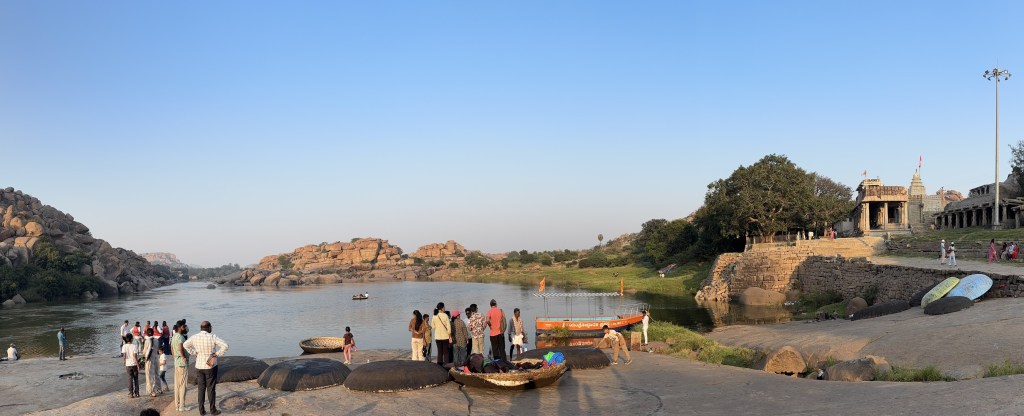
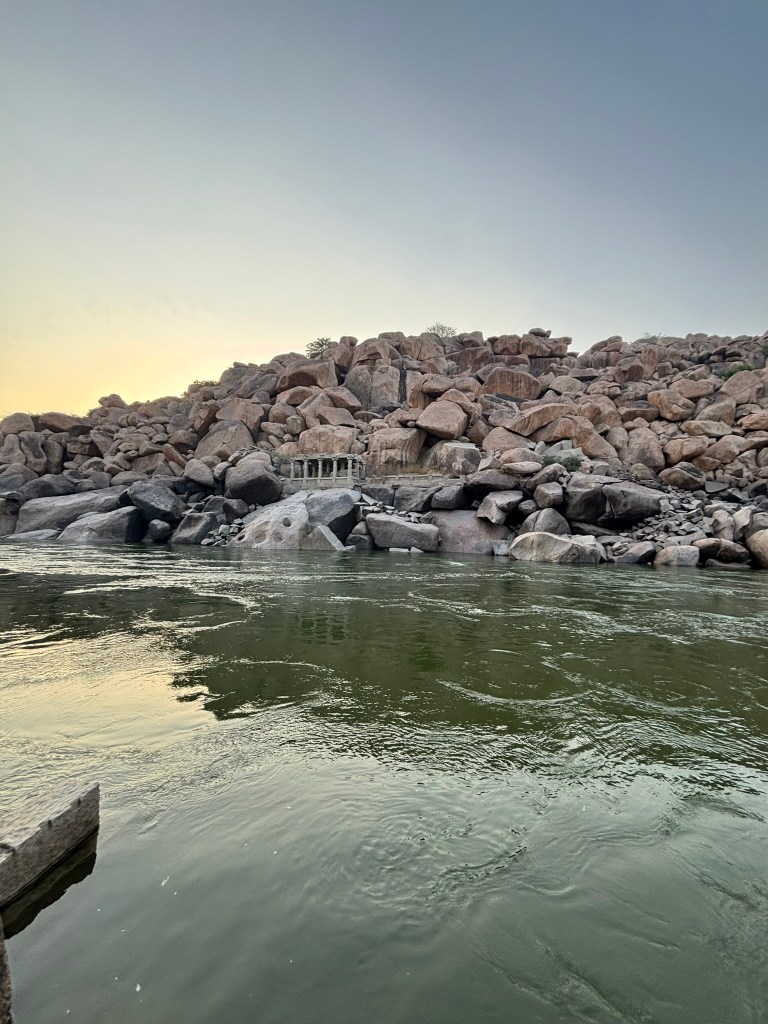
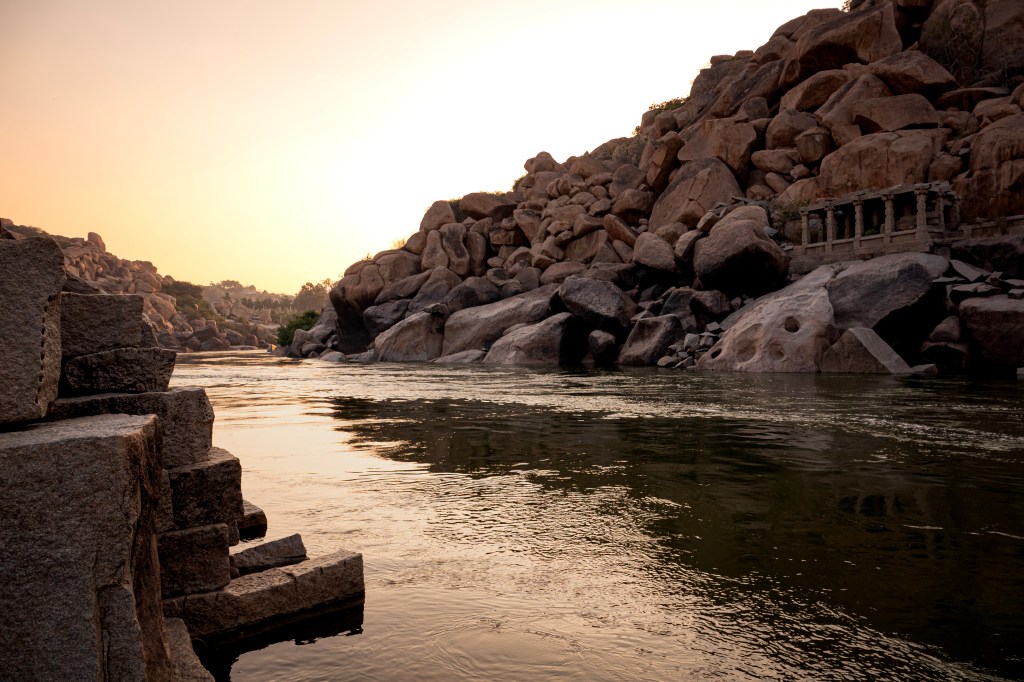
Pilgrims still take a holy dip here before climbing the steps to the Kodandarama Temple—a shrine carved into a massive boulder. At the Kodandarama temple, Rama stands with a bow in hand. Sita is to his left. Lakshmana and Hanuman are by his side. The nearby ancient pavilions are weathered yet dignified. They have sheltered generations of devotees. People have paused here to rest or pray. Others have simply breathed in the place’s sanctity.
Setting Off on the Coracle: A Journey Into Stillness
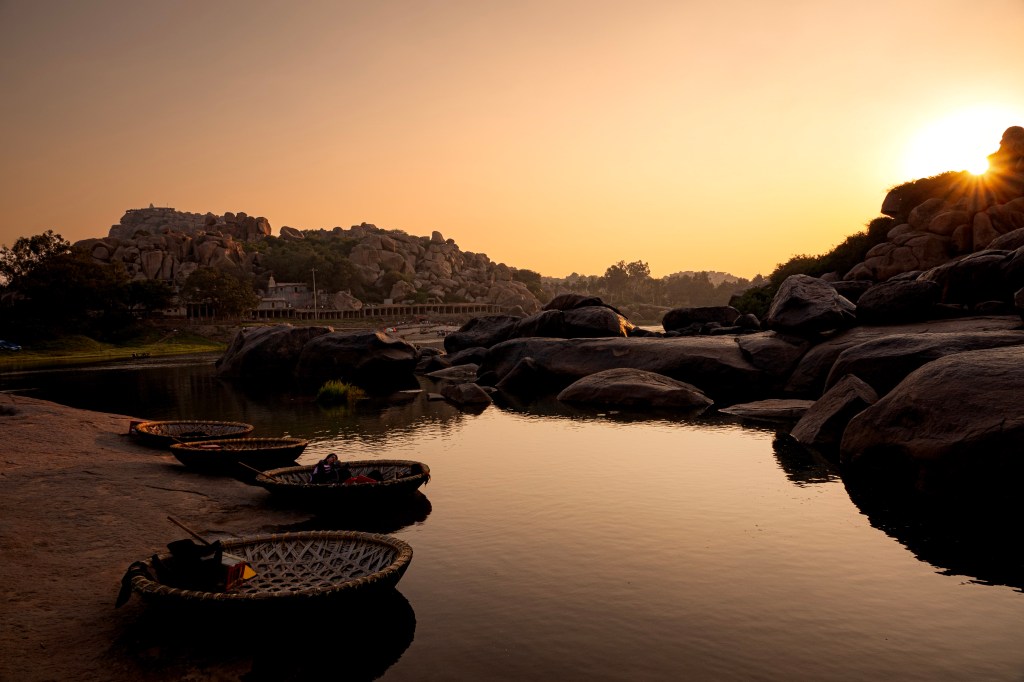
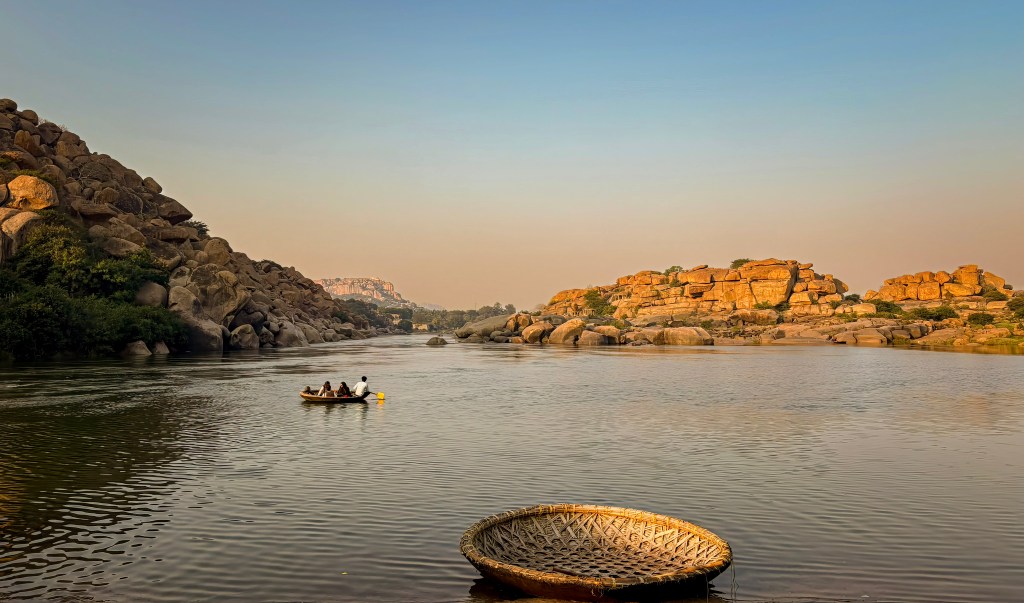
From the flat rocky bank—etched with Shiva lingas, footprints, and devotional carvings—you’ll spot coracles drying in the sun. These round bamboo boats, tar‑coated and impossibly light, are your gateway to one of Hampi’s most serene experiences.
There’s no motor, no rush—just the rhythmic dip of the oar and the soft lap of water against bamboo. It’s the kind of silence that makes you notice everything. You see the shimmer of weeds drifting downstream. You notice the play of light on boulders. You hear the faint echo of temple bells carried by the wind.
A coracle ride at Chakra Tirtha is one of Hampi’s most iconic experiences, blending ancient transportation with spiritual sightseeing. Locally known as Teppa or Dongi, these circular boats have glided across the Tungabhadra River for centuries
The Chakra Tirtha Experience
The ride at Chakra Tirtha is highly scenic. It navigates a narrow, boulder-strewn stretch of the river.
- Key Highlights: Rides typically pass the Anantashayana Vishnu carving. It features a massive reclining Vishnu relief. You will see the Sahasra Linga, comprising 1,008 Shiva Lingas carved into a single rock bed. The rides also showcase diverse riverside ruins.
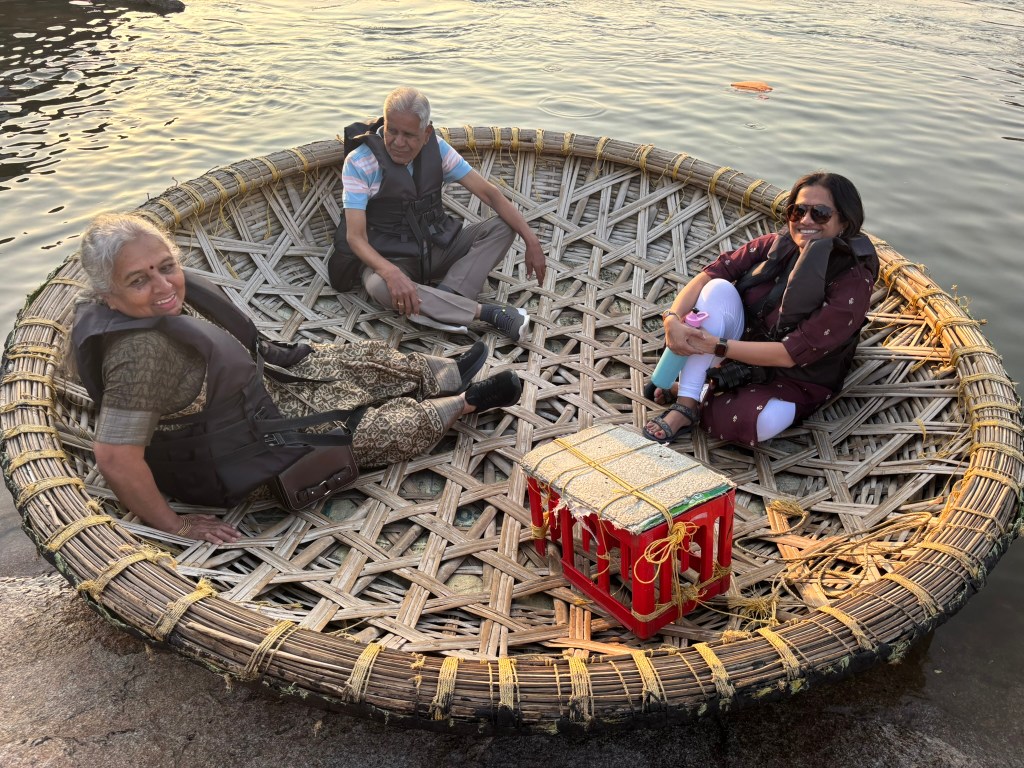
- Cost & Duration: A 30-minute ride typically costs ₹500 per person. A full-hour ride (covering more ruins and islands) costs ₹800 to ₹1,000. We hired the entire coracle for 3 of us. We paid approximately ₹6000 per hour. It was a more intimate guided tour with the boatman. I was pleasantly surprised to see life jackets being provided for this ride.
- The “Spin”: For an adventurous touch, boatmen often give the coracle a high-speed spin in the water upon demand.
History of the Theppa or Coracle
The coracle is one of the world’s oldest boat designs, used for over 2,000 years for fishing
- Ancient Origins: In the 16th century, the Portuguese traveler Domingo Paes marveled at these “round basket-boats.” He noted their ability to carry up to 20 people.
- Strategic Design: The circular, bowl-like shape was perfected for Hampi’s unique environment. It allows the boat to run aground. This prevents capsizing, making it ideal for the river’s strong currents and shallow, rocky beds.
- Traditional Construction:
- Frame: A lattice of split bamboo or willow shoots.
- Skin: Historically made of animal hides (bullock or horse), modern coracles now use heavy-duty plastic or PVC sheets.
- Waterproofing: The exterior is coated with bitumen (tar) or resin to guarantee total water tightness.
- Legacy: During the Vijayanagar Empire, they were vital for transporting grains, construction materials for temples, and ferrying pilgrims to holy sites
Stopping at the Secret Shrines Along the River
The beauty of the Chakratirtha coracle ride is that it doesn’t just take you across the river. It takes you into Hampi’s hidden spiritual landscape.
🕉️ Sahasralinga: A Thousand Lingas in Stone
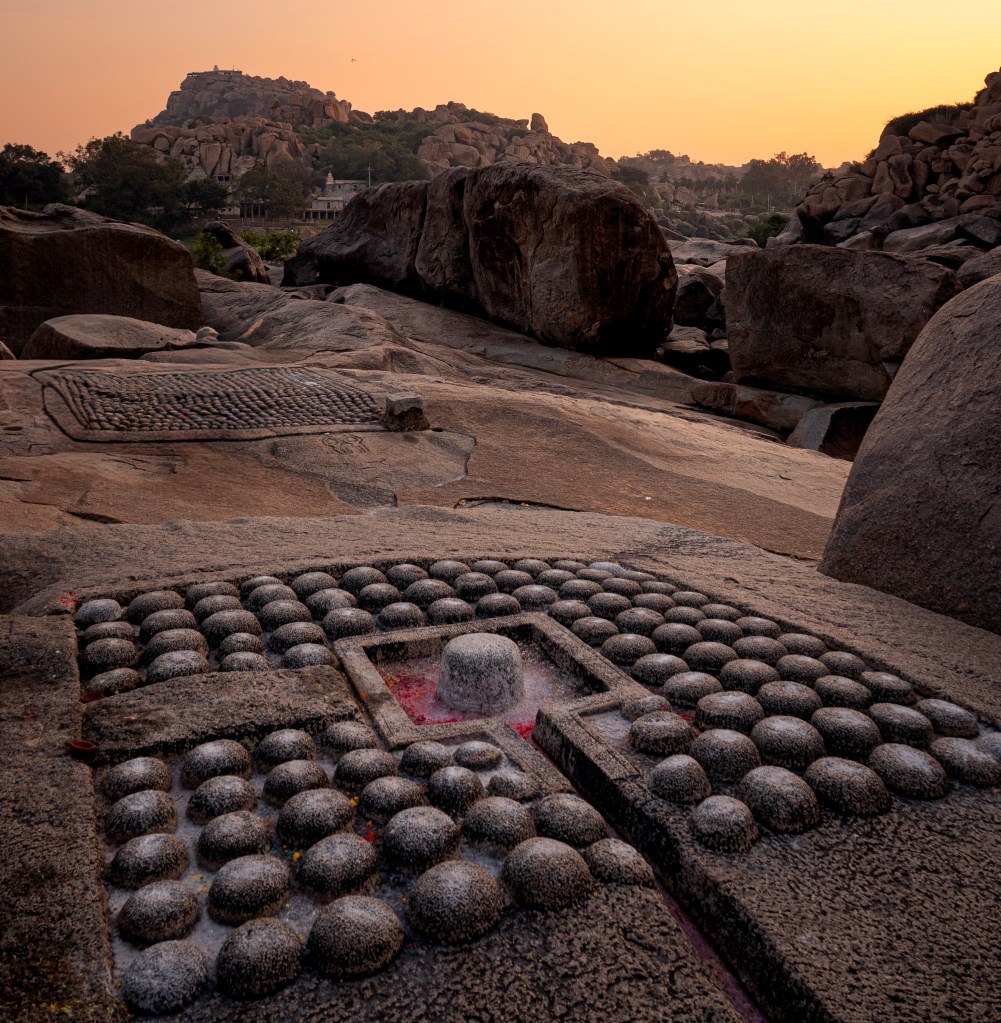
You glide a short distance downstream and come to a quiet stretch of riverbank. Our coracle stopped here. We were guided towards the hidden temples. The first of these is Sahasra Linga or Koti linga. Reaching this location required some boulder-hopping, and there is no clear direction. I don’t think we would have found this place without our boatman leading the way.
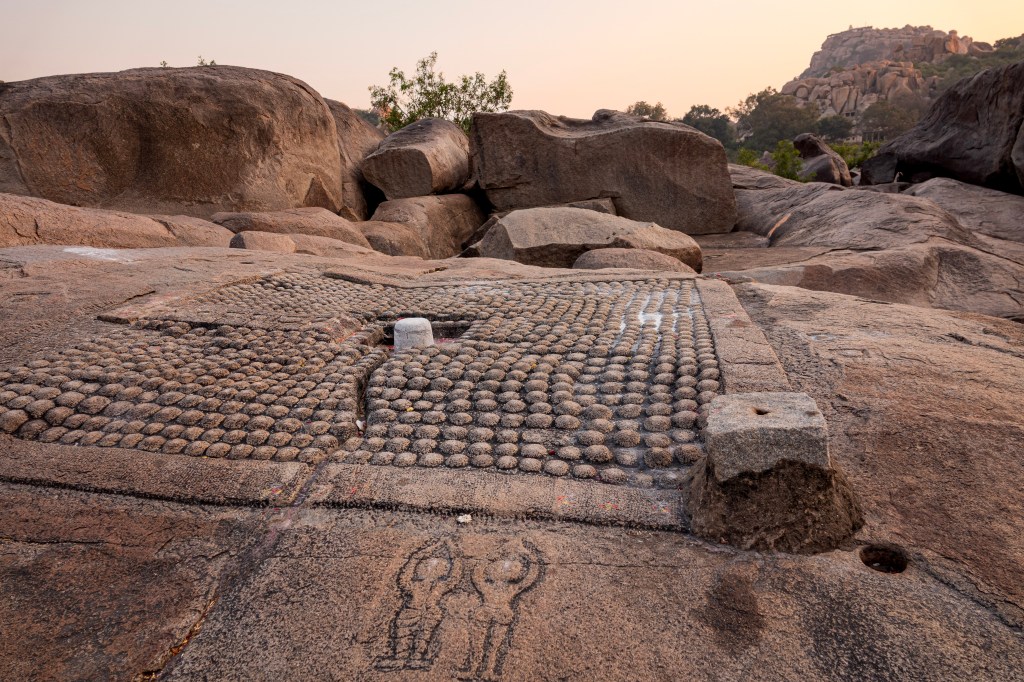
Sahasra Linga is a significant rock-cut site. It features two primary groups of lingas: one set of 108 and a larger, symmetrical grid of 1,008.
Location & Access
- Proximity: It is located a short distance (approx. 400–500 meters) east of the Chakra Tirtha bathing ghat, along the southern bank of the Tungabhadra River.
- Accessibility: Reaching the site by land requires a challenging trek over uneven boulders.
- Visibility: The carvings are best viewed during the dry season (December to May). River levels are low during this time. Many carvings can become submerged during the monsoon.
Why were lingas carved into the rock bed? I wasn’t able to find a clear answer to the origin of these remarkable carvings. Some researchers suggest that the carvings date back to the Vijayanagara Empire. These intricate designs were likely meant for worship and reflection in an open-air sanctuary. The second theory is that these lingas might have been crafted by devotees. They could have created them as a form of devotion and reverence. Additionally, our guide mentioned that a sage created these carvings. He wanted to offer a convenient alternative for worshipers who could not visit the famous Koti Lingas spread across Hampi.
Symbolism: The number 1,008 is spiritually significant, corresponding to the Shiva Sahasranama (the thousand names of Lord Shiva).
🛌 Anantasayana: Vishnu in Eternal Repose
Further along the river, tucked between boulders and half-hidden by the landscape, is one of Hampi’s most peaceful carvings. It is Anantasayana, the reclining Vishnu.
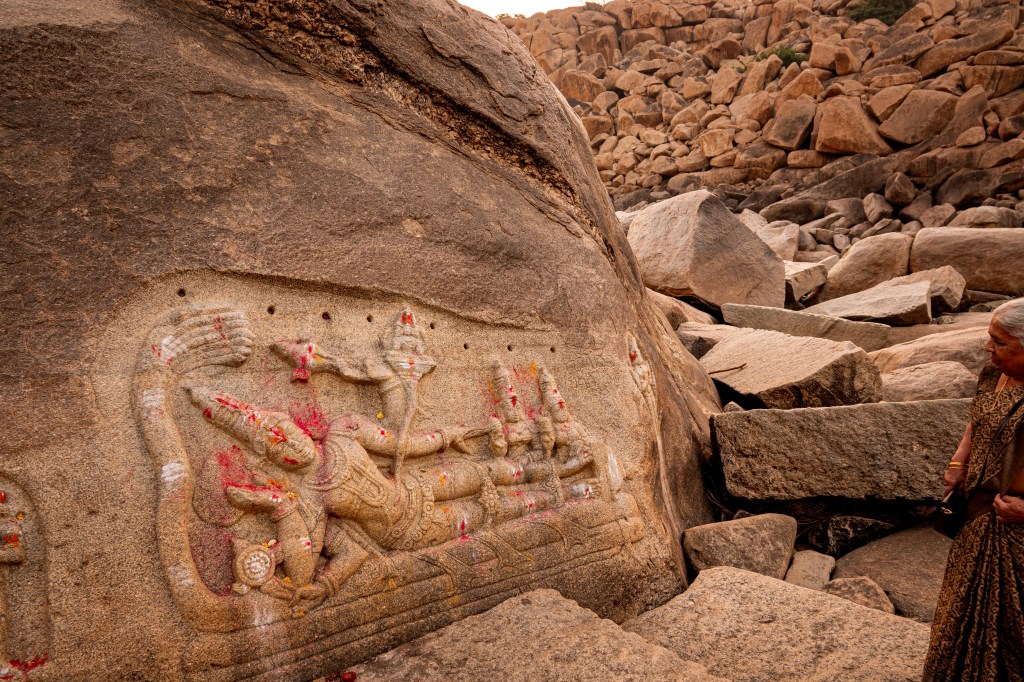
Here, Vishnu rests on the serpent Adishesha, eyes half-closed, the world held in balance by his cosmic sleep. The carving is weathered, softened by centuries of wind and water, but its serenity is unmistakable.
There’s something profoundly calming about arriving here by coracle. You step onto the warm rock. The river flows quietly behind you. Suddenly, the entire scene feels like a meditation.
Other river ruins worth visiting
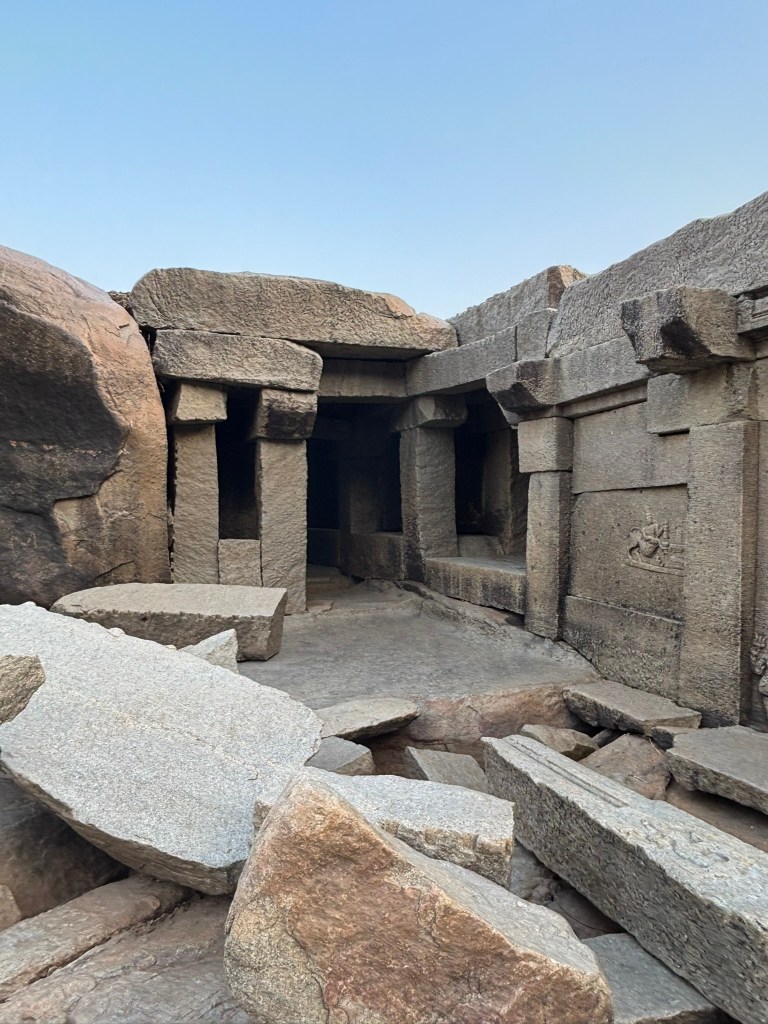
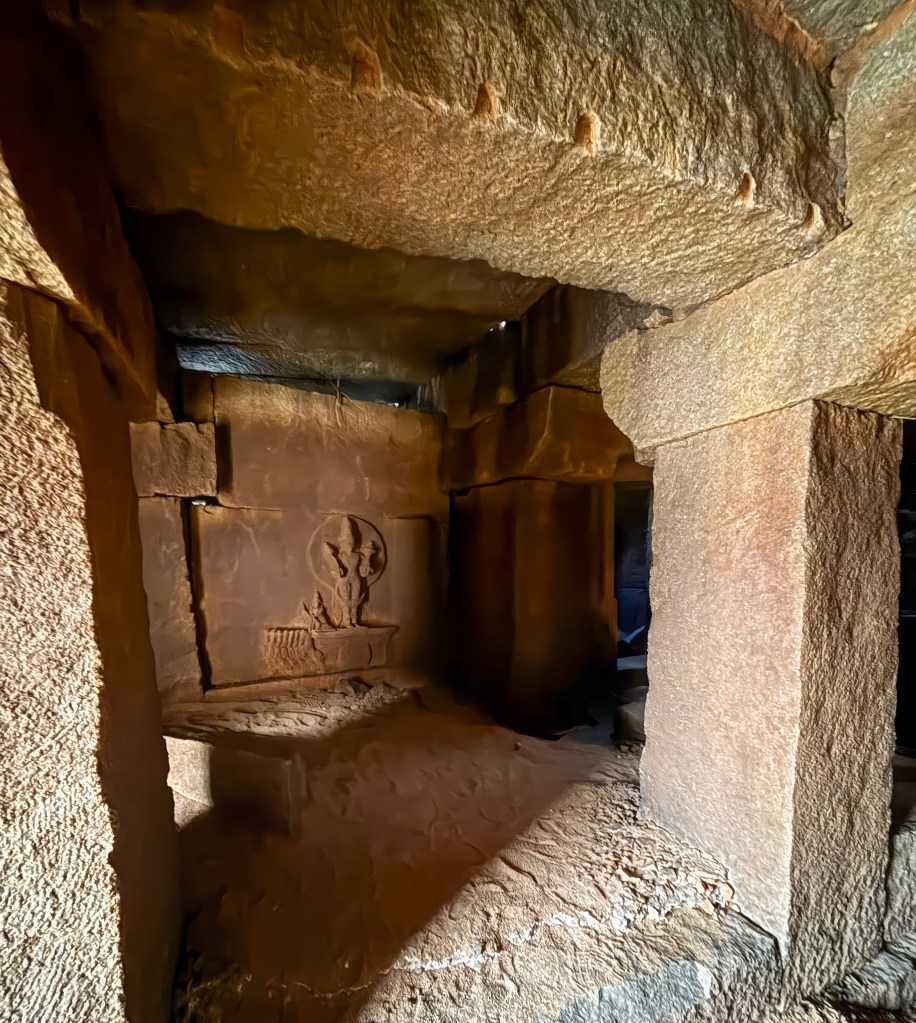
There are also a few other ruins that are worth visiting. One of them is a small sanctuary accessible by crawling under a boulder.
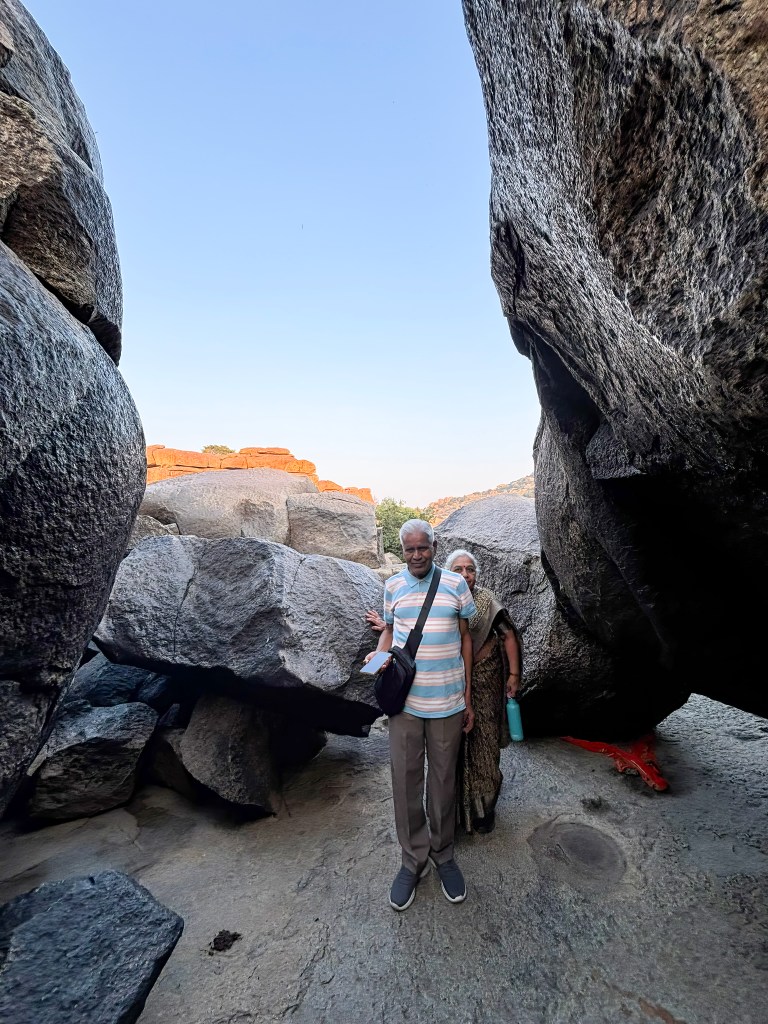
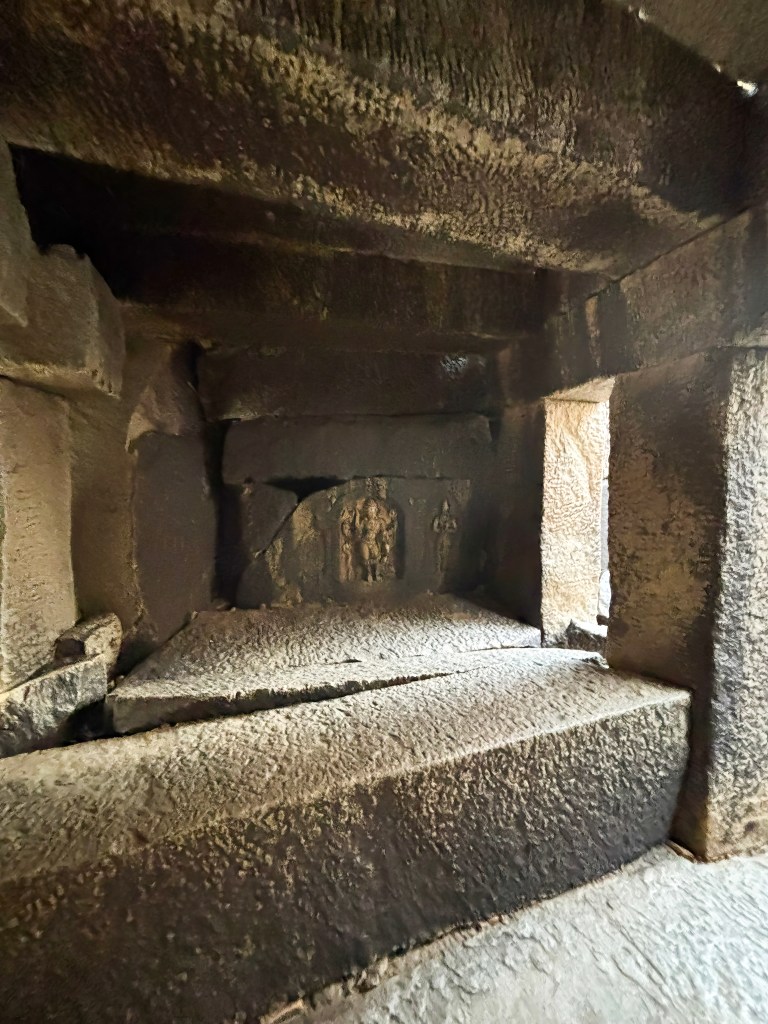
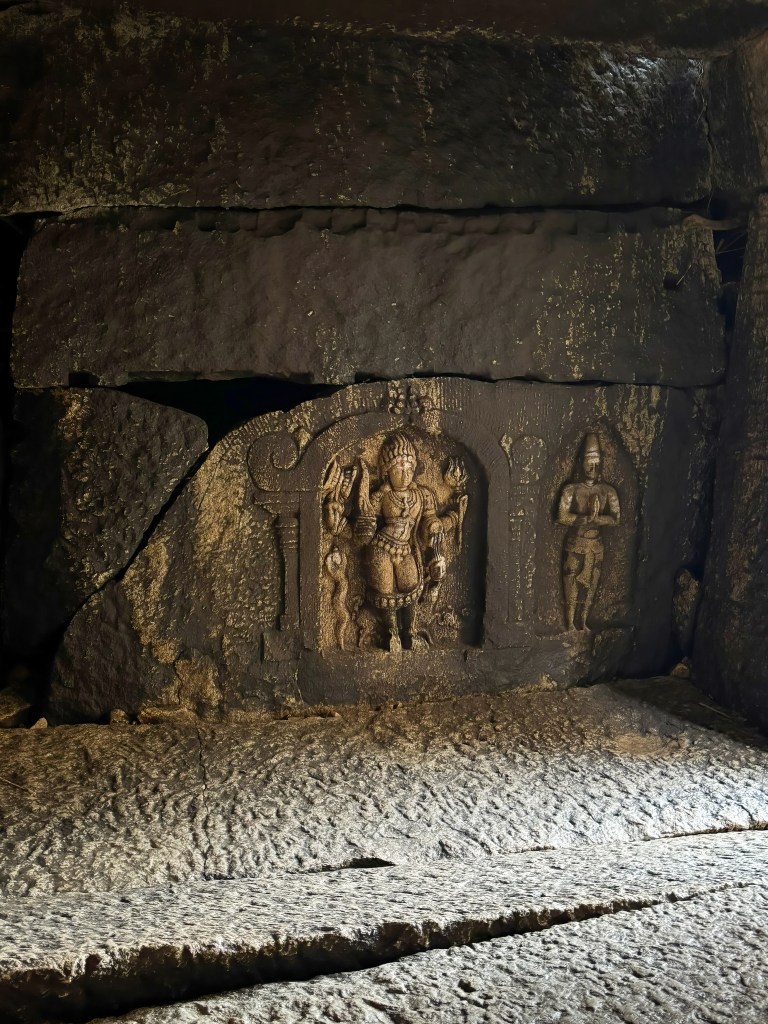
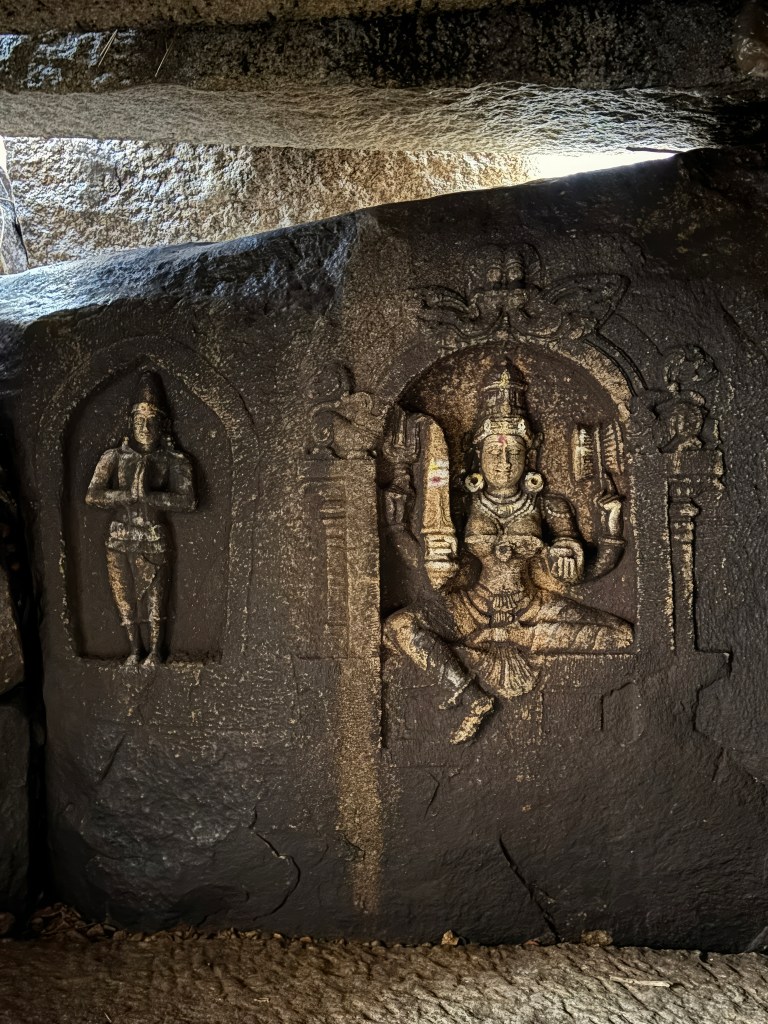
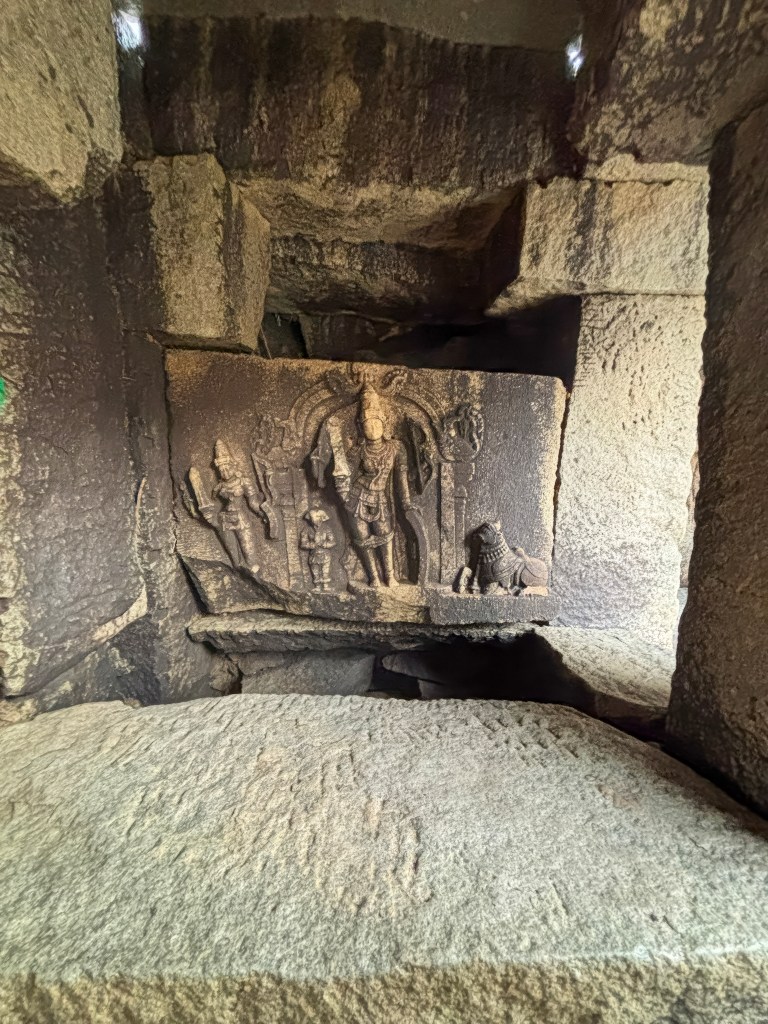
Several gods, including Surya riding on his chariot, are carved into the rock here. You can also see a pavilion built for devotees on the riverbank. Another noteworthy sight is a rock that strikingly resembles an elephant. This natural marvel has captured the imagination of many. Our guide mentioned that the coracle operators, when water levels are low, take passengers under the majestic Elephant Rock. This provides a unique perspective on this ancient marvel. During the monsoon season, though, the temple and its carvings are submerged. It only emerges again with the changing tides and seasons.
Narasimha Temple: A Quiet Shrine Revealed by the River
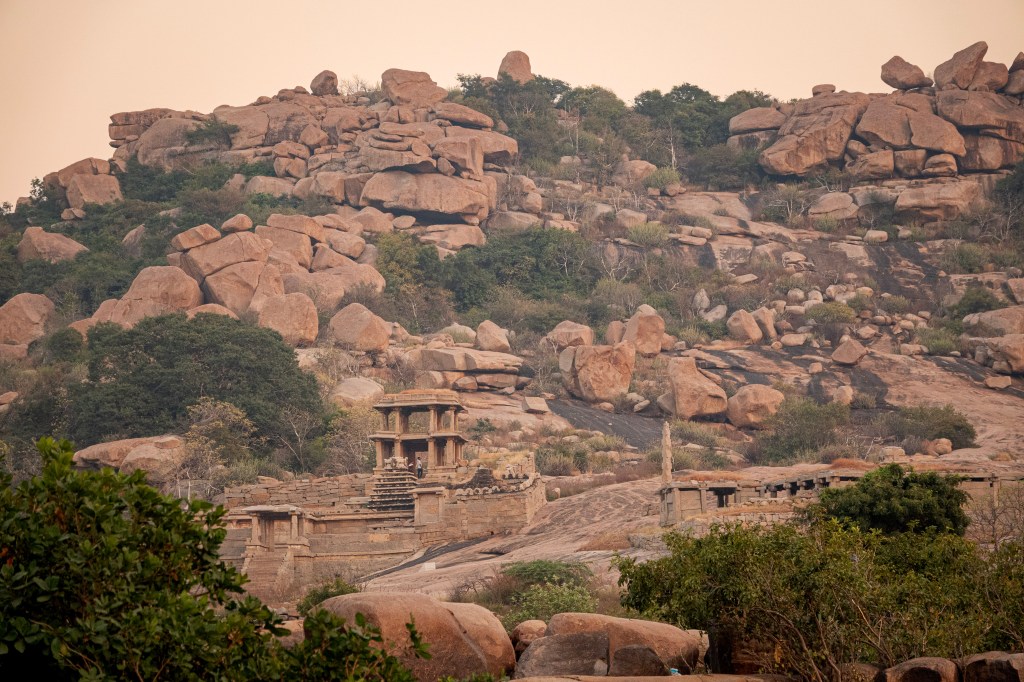
You can also visit the Narashimha temple on the same coracle ride. We ran out of time and couldn’t visit the temple. A short walk takes you through scattered boulders and ancient stone steps. They lead you to the temple. Its weathered facade blends seamlessly into the rocky hillside. The temple is a multi-story structure with characteristic Vijayanagara-style pillars. It has three sanctums originally dedicated to different forms of Vishnu: Venugopala, Lakshminarasimha, and Vishnu-Purushottama.
The Kampabhupa Pathway: Echoes of Ancient Pilgrims
As you return toward Chakratirtha, you may notice the broad stone pathway running along the river—the Kampabhupa Pathway. Built in the 14th century by Kampabhupa, son of Vira Harihara Raya, this ancient route once connected Virupaksha Bazaar to the sacred riverbank and onward to Vittalapura.
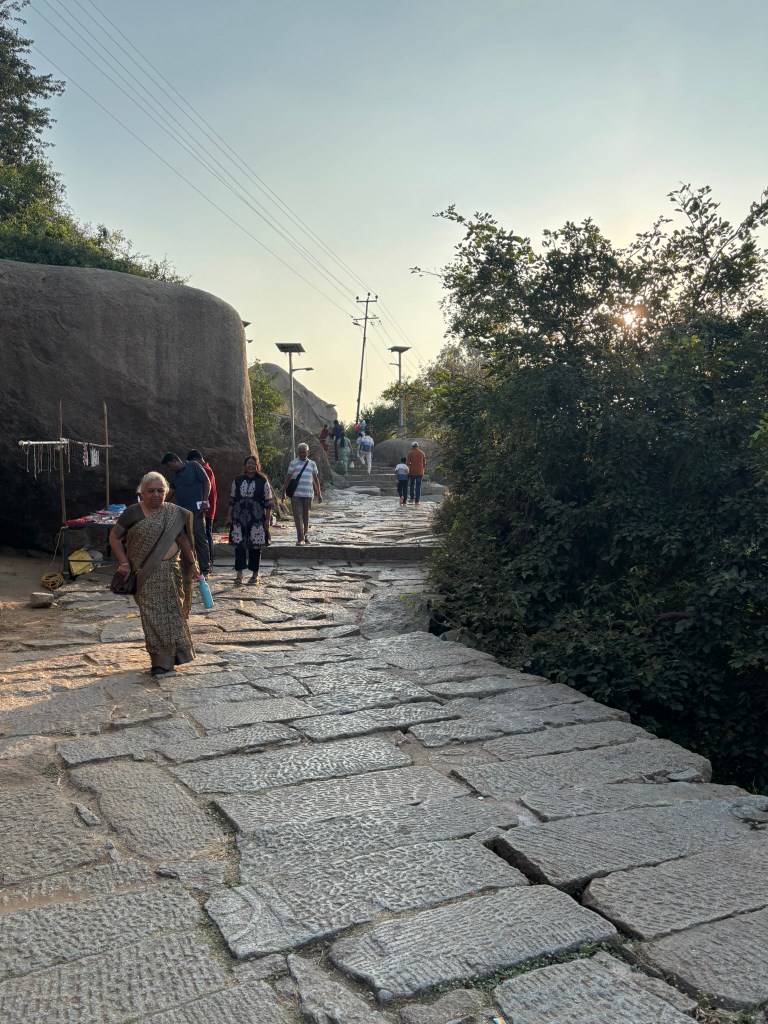
During high waters, the path disappears completely, as if the river reclaims it for a while. But when visible, it’s a beautiful reminder of the pilgrims who walked this very stretch centuries before you floated past in a coracle.
Final thoughts
A coracle ride at Chakratirtha isn’t just a river crossing—it’s a slow unfolding of Hampi’s quieter stories. The sacred whirlpool, the Kodandarama Temple, the secret shrines of Sahasralinga and Anantasayana, the ancient pavilions and pathways… each stop feels like a page from a living epic.
By the time you return to the rocky bank, the sun warm on your shoulders and the river’s rhythm still in your body, you realize this journey has left its own swirl within you—gentle, sacred, unforgettable.
 Peaks to Palaces
One Reply to “”