
Walking into the Royal Centre of Hampi feels like stepping into the private world of the Vijayanagara kings—a world of power, ceremony, elegance, and architectural experimentation. While the temples of Hampi speak of devotion, the royal centre reveals how the empire lived, governed, celebrated, and showcased its grandeur. The Zenana Enclosure, often misunderstood as the women’s quarters, is the perfect starting point for this journey.
- Queen’s Bath: A Royal Spa in Ruins
- Zenana Enclosure: A Royal Retreat, Not a Women’s Quarters
- Lotus Mahal: The Jewel of the Enclosure
- Watchtowers & Hidden Corners
- Elephant Stables: Grandeur for the Empire’s Gentle Giants
- The Parade Ground & Martial Court
- Mahanavami Dibba: The Empire’s Grand Stage
- The Stepped Tank: Geometry, Grace, and the Genius of Vijayanagara Engineering
- A Walk Through Power, Beauty & Imagination
Queen’s Bath: A Royal Spa in Ruins
We started our day’s trip at Queen’s Bath and continued to the royal enclosure and lotus mahal area and ended our journey at Hazara Rama temple (which will be covered in a separate blog). If you’re short on time, then I would suggest visiting Queen’s Bath, Lotus Mahal, and Stepwell from this area.
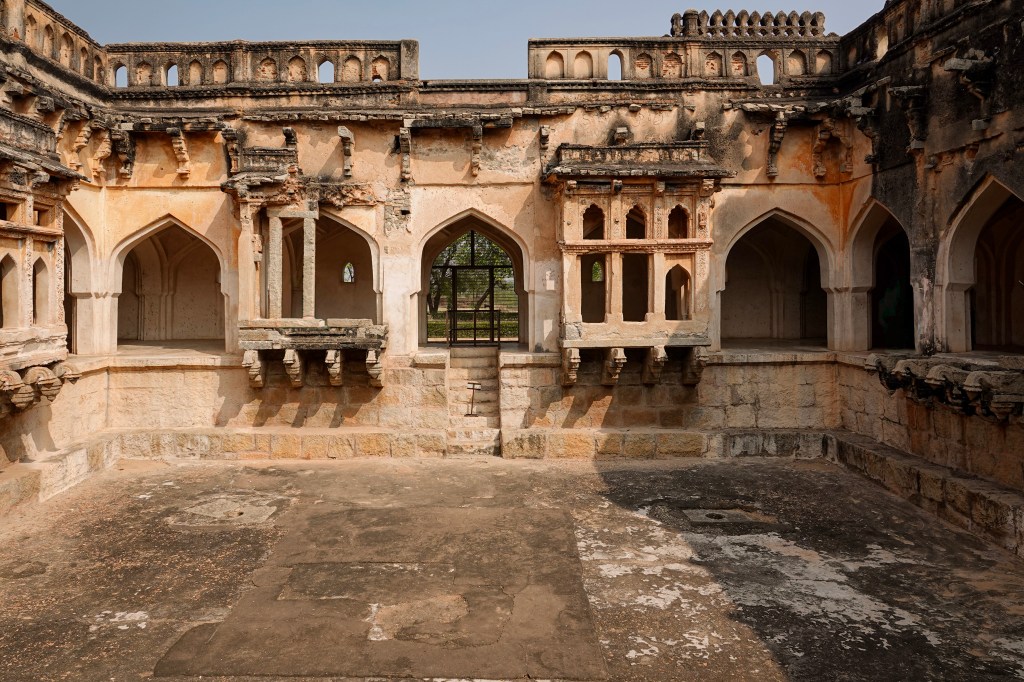
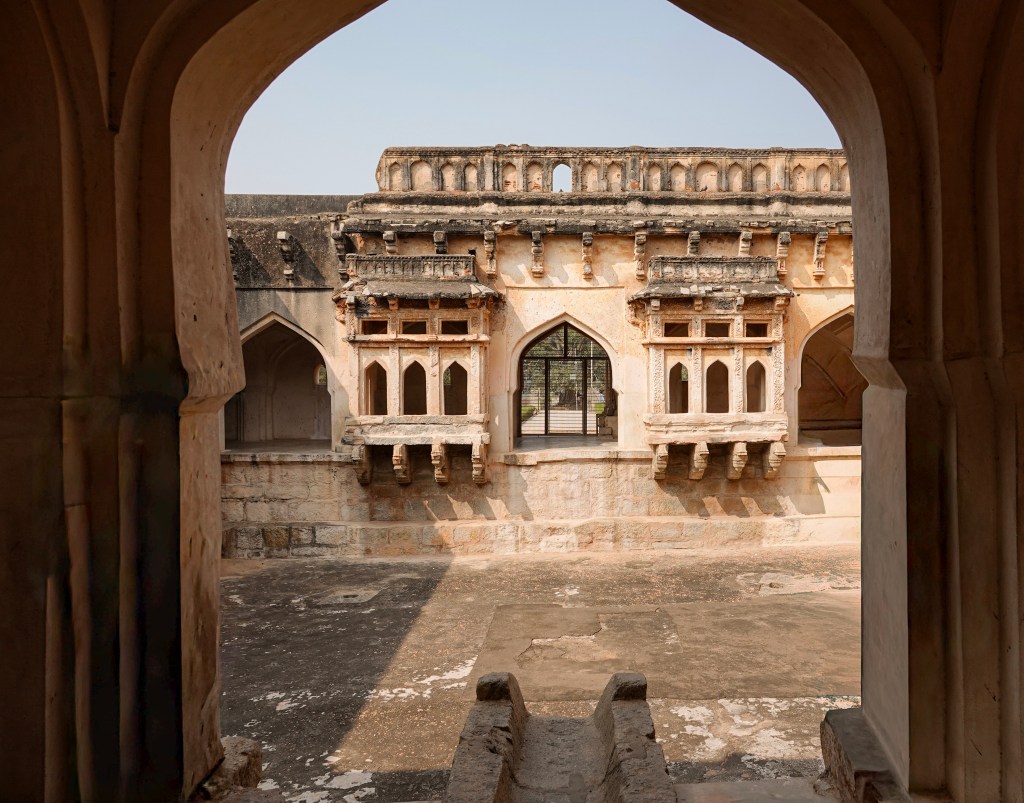
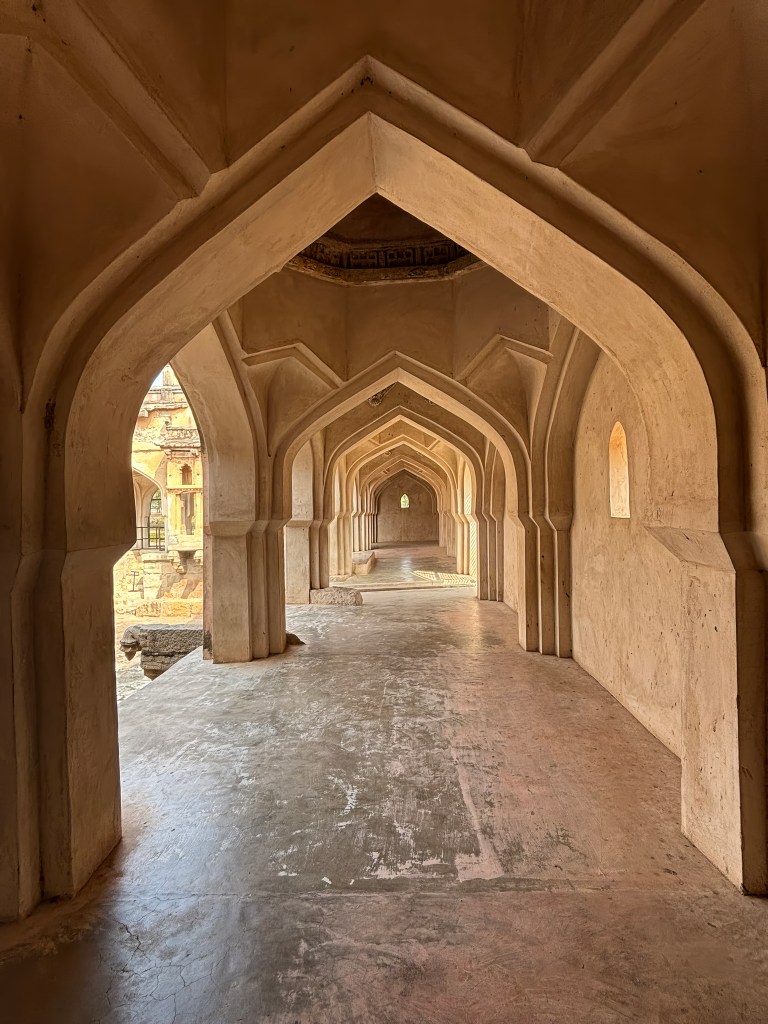
Despite its romantic name, the Queen’s Bath was likely never an exclusive bathing space for royal women. Instead, it functioned as a refined pleasure pavilion for male courtiers and their companions—a social and recreational space rather than a secluded retreat. From the outside, the structure appears almost austere, with plain, unadorned walls that give little hint of the elegance within. Step inside, however, and the atmosphere transforms. A graceful arcaded corridor wraps around a large square pool, its ceilings decorated with ornate vaults of varying designs. Delicate balconies with arched windows once projected over the water, their plasterwork now lost to time but still easy to imagine in their original finery. Historical watercolours show that the bath once had towers rising above the roofline, adding to its architectural drama. Surrounding the pavilion is a water channel that once fed the pool, and not far away lie the remnants of a collapsed aqueduct—part of the sophisticated hydraulic system that supplied the entire royal centre. Even in its ruined state, the Queen’s Bath captures the leisurely grace of courtly life and the Vijayanagara empire’s mastery of water architecture
Zenana Enclosure: A Royal Retreat, Not a Women’s Quarters
Despite its name, the Zenana Enclosure was unlikely to have housed royal women. Its proximity to the elephant stables and the parade grounds suggests a more administrative or ceremonial function—perhaps used by commanders or the king himself. The enclosure is a large, high‑walled quadrangle built with beautifully jointed granite blocks that taper elegantly toward the top. As you walk through its quiet interior, you’ll notice how the space is dotted with structures of different styles, each revealing a different layer of Vijayanagara courtly life.
To the north stands a long, vaulted hall—plain on the outside except for tiny ventilation holes. It may once have been an armoury, treasury, or even a gymnasium where courtiers trained. Its double‑curved eaves, naga‑hood rafters, and perforated parapet show how even utilitarian buildings were crafted with artistic flair.
Nearby are the excavated remains of two palaces. One sits on an ornate triple‑layered basement; the other is set within a rectangular pool, its base carved with charming boating scenes. These ruins hint at the refined lifestyle and architectural experimentation that defined the Vijayanagara court.
Lotus Mahal: The Jewel of the Enclosure
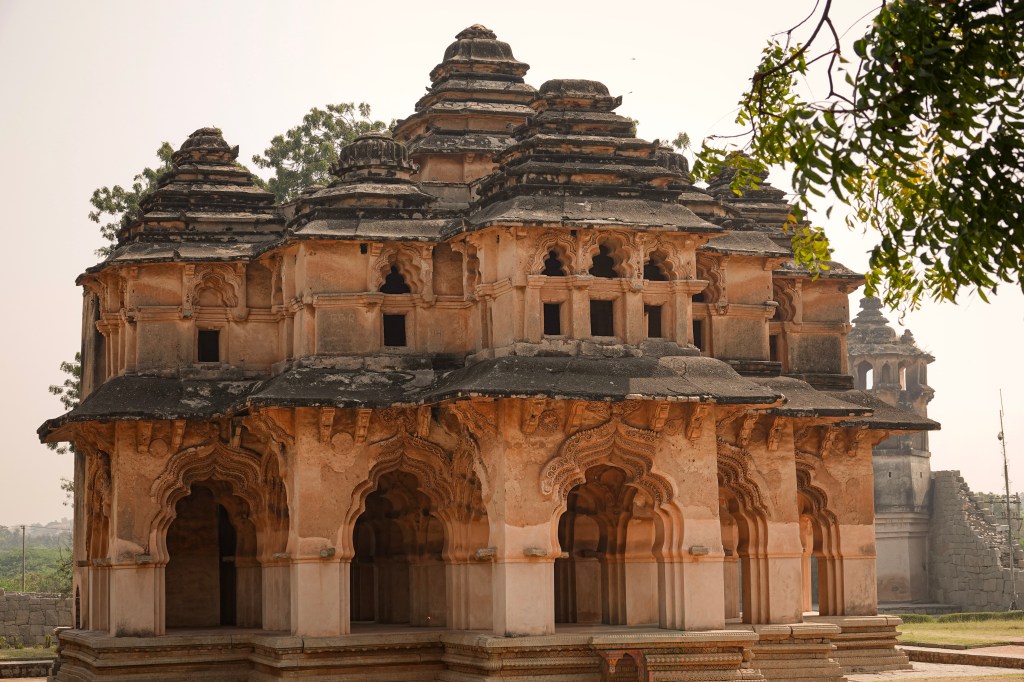
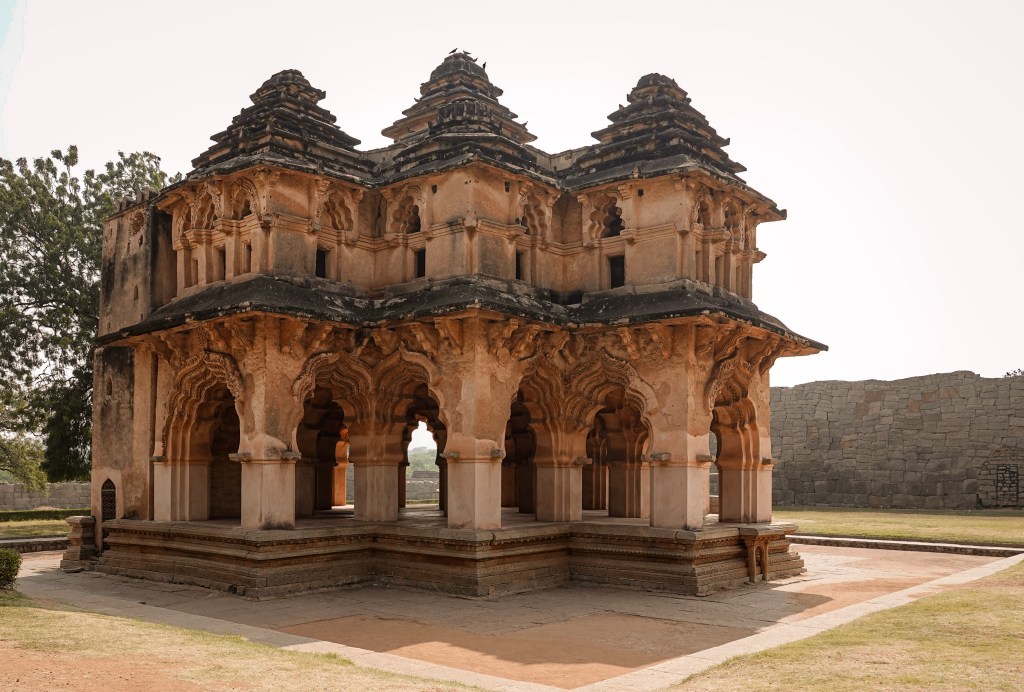
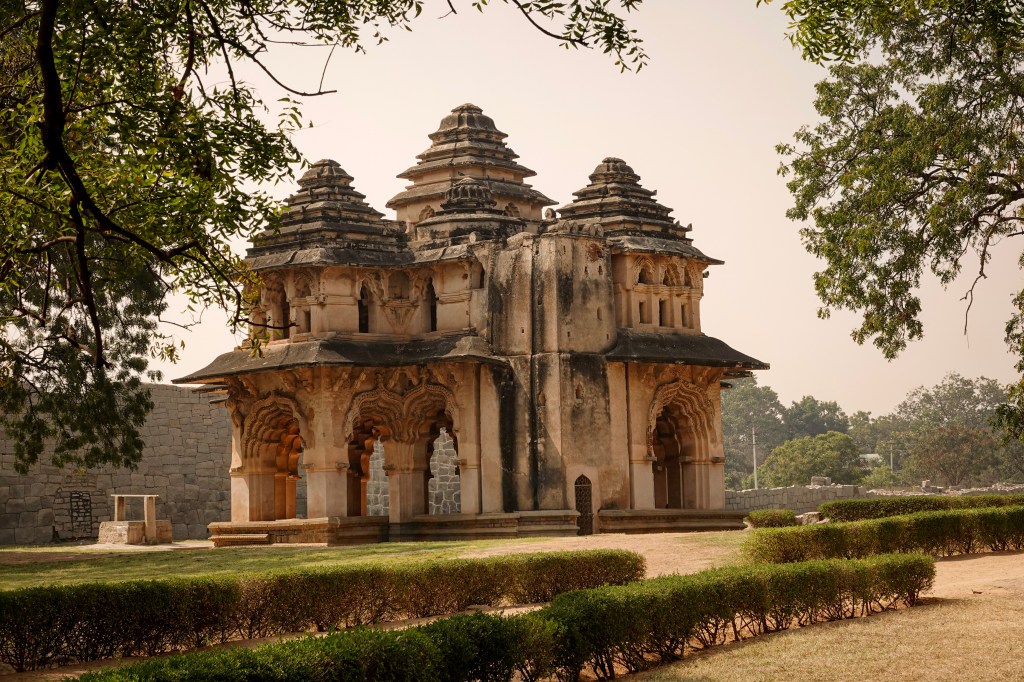
The Lotus Mahal is the star of the Zenana Enclosure—a graceful, airy pavilion that blends temple architecture with Indo‑Islamic design. Its name may be romantic, but its purpose was likely practical: a council chamber or meeting hall, as shown in an 18th‑century map.
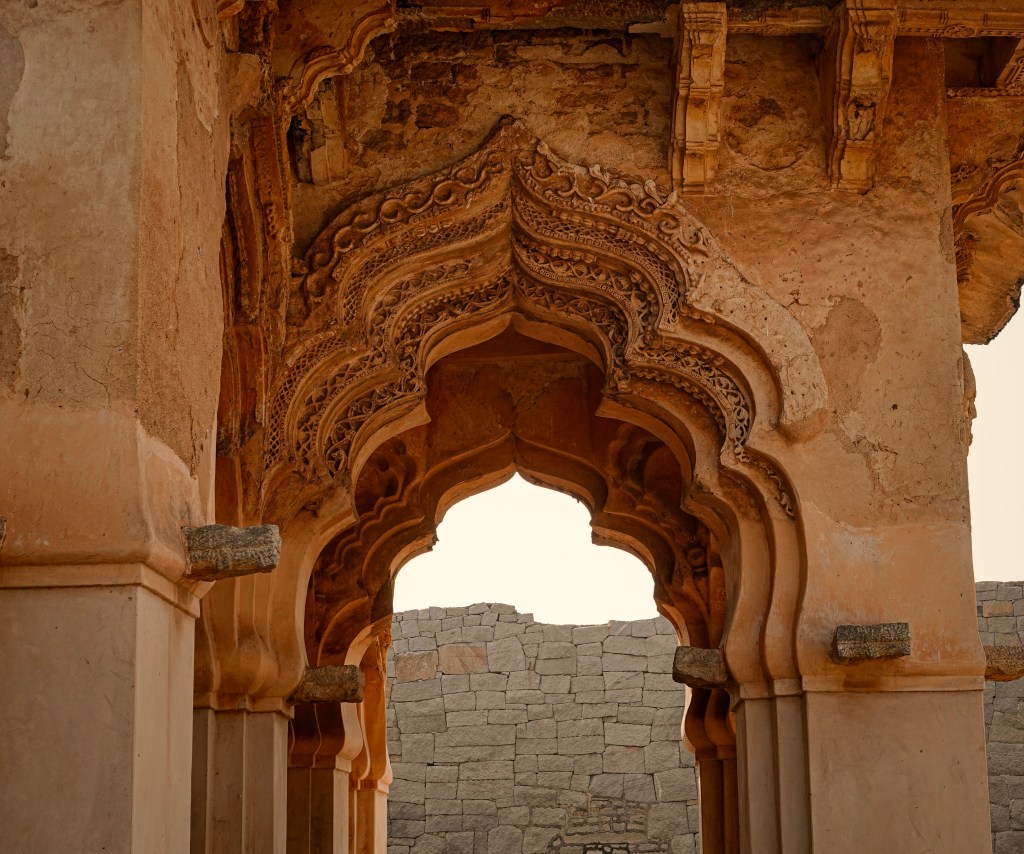
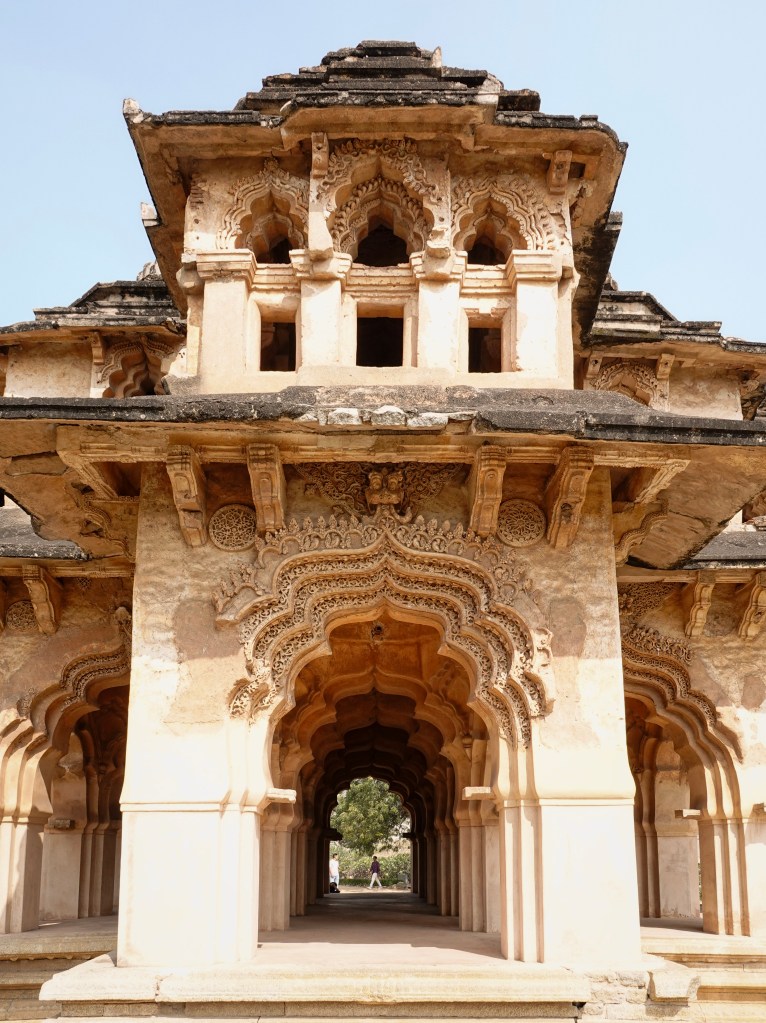
The structure sits on a square, mandala‑like plan with symmetrical projections on all four sides. The stone basement, double‑curved eaves, and pyramidal towers echo Dravidian temple architecture, while the lobed arches, plaster ornamentation, and domed ceilings reflect Sultanate influences. This fusion creates a building that feels both delicate and dignified, a perfect example of Vijayanagara’s inventive courtly style.
Climb the awkward little staircase tower attached to one corner, and you can almost imagine the upper chamber once filled with ministers, scribes, and royal advisors.
Watchtowers & Hidden Corners
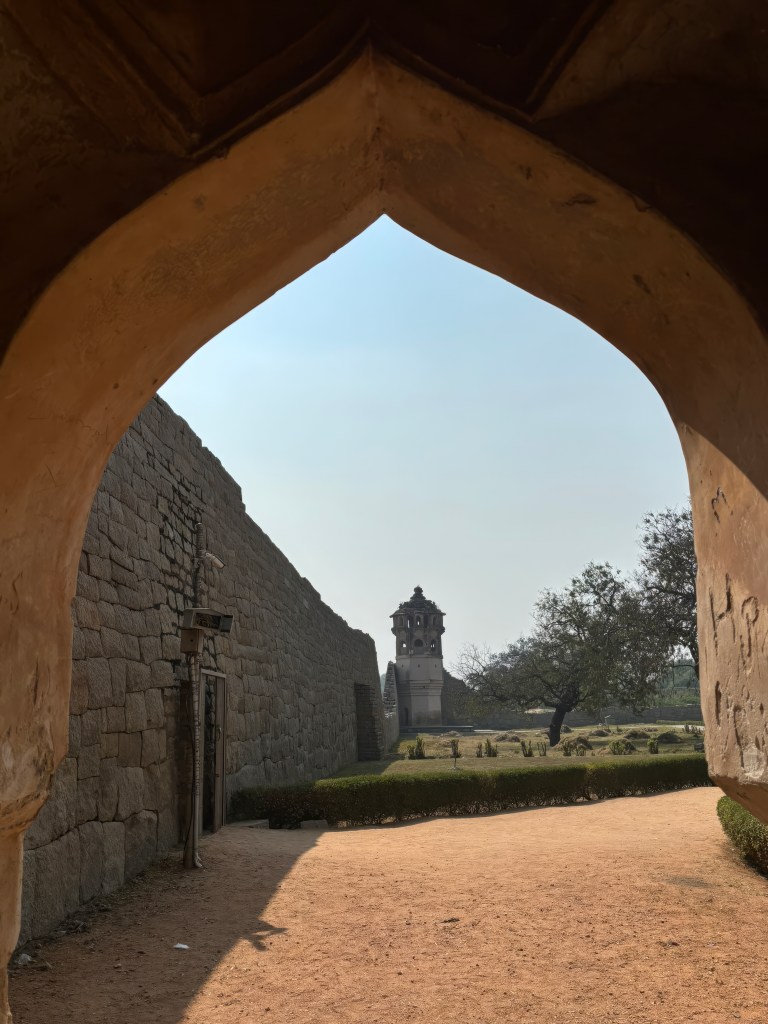
Three watchtowers—two intact, one partly ruined—stand guard along the enclosure walls. Like the Lotus Mahal, they mix temple‑style eaves with Islamic arches and domes. Their presence reinforces the idea that this was a protected administrative zone rather than a secluded women’s space.
Scattered around the enclosure are the remains of a granary, a deep water tank, and foundations of smaller internal compounds. Each fragment adds another brushstroke to the picture of a bustling royal precinct.
Elephant Stables: Grandeur for the Empire’s Gentle Giants
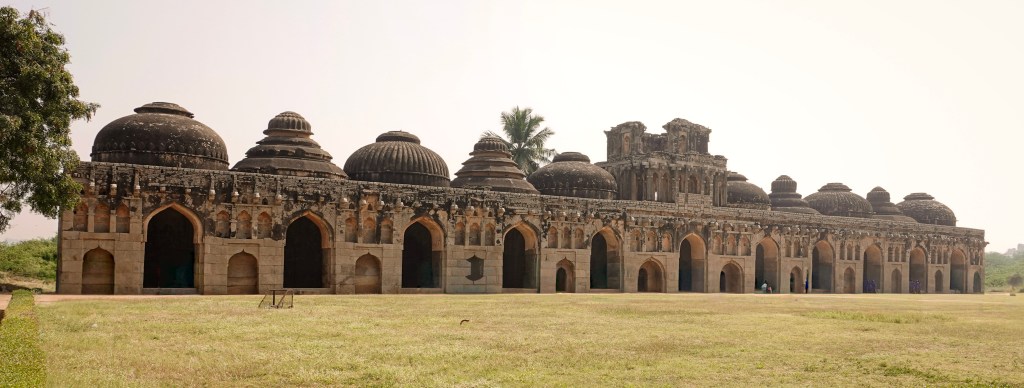
Step out of the Zenana Enclosure through a modest eastern doorway, and the landscape opens into a vast parade ground. On the far side stands one of Hampi’s most iconic structures: the Elephant Stables.
This long, majestic row of eleven chambers once housed the royal elephants—each chamber large enough for two animals. The alternating domes and twelve‑sided vaults create a rhythmic skyline, while the central raised pavilion (now missing its tower) may have been used by musicians during royal processions.
The stables are a masterclass in symmetry, scale, and Indo‑Islamic fusion. Standing before them, it’s easy to imagine the thunder of elephants, the beat of drums, and the spectacle of royal parades.
The Parade Ground & Martial Court
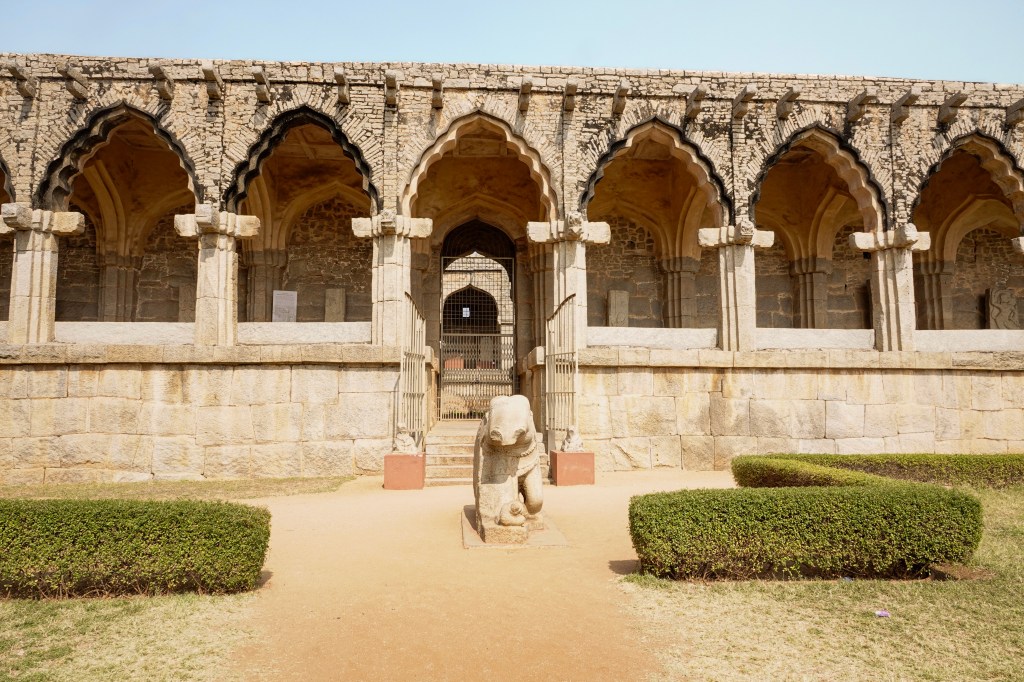
North of the stables is another impressive structure: a long gallery with eleven pointed arches. This elevated platform likely served as a grandstand for watching parades, martial sports, and animal displays. Its interior courtyard—open to the sky and surrounded by arcades—mirrors the vaulted hall inside the Zenana Enclosure, suggesting a shared architectural vocabulary.
The west side of the parade ground holds the ruins of a two‑storey gateway with massive elephant balustrades lying nearby. Rubble on the north and south edges hints at additional service buildings that once supported the royal retinue.
Mahanavami Dibba: The Empire’s Grand Stage
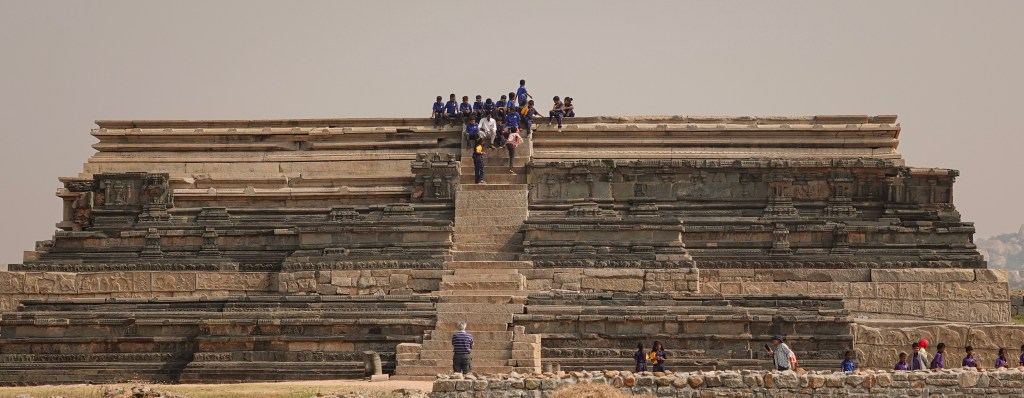
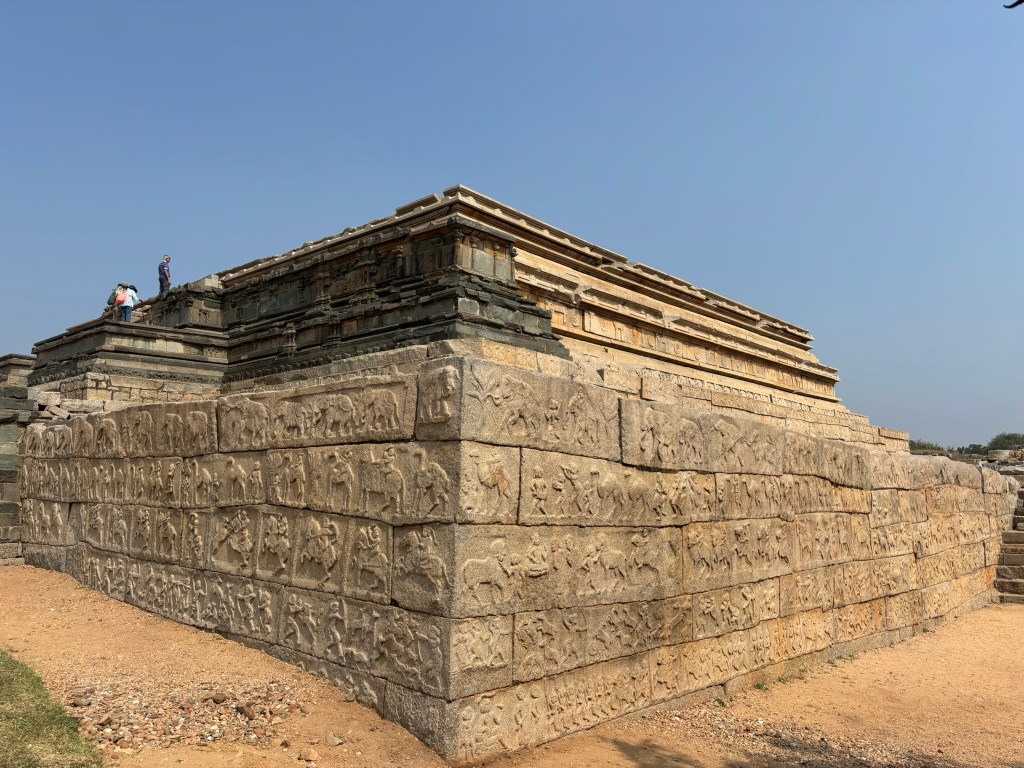
Further south lies the most dramatic structure in the Royal Centre: the Mahanavami Dibba, a massive, multi‑tiered platform used for royal ceremonies, festivals, and public displays of power.
The lower granite tiers date back to the 14th century and are carved with lively scenes—kings receiving visitors, wrestling matches, hunting expeditions, dancers, musicians, and even foreign envoys with pointed hats. Elephants, horses, camels, and mythical creatures parade across the stone, capturing the cosmopolitan energy of the Vijayanagara empire.
Climb the double staircase to the top, and you’ll stand where the king once presided over the grand Mahanavami festival, watching processions, sacrifices, and performances unfold below. The view from the summit offers a sweeping panorama of the royal centre—palaces, tanks, gateways, and the rugged boulder hills beyond.
The Stepped Tank: Geometry, Grace, and the Genius of Vijayanagara Engineering
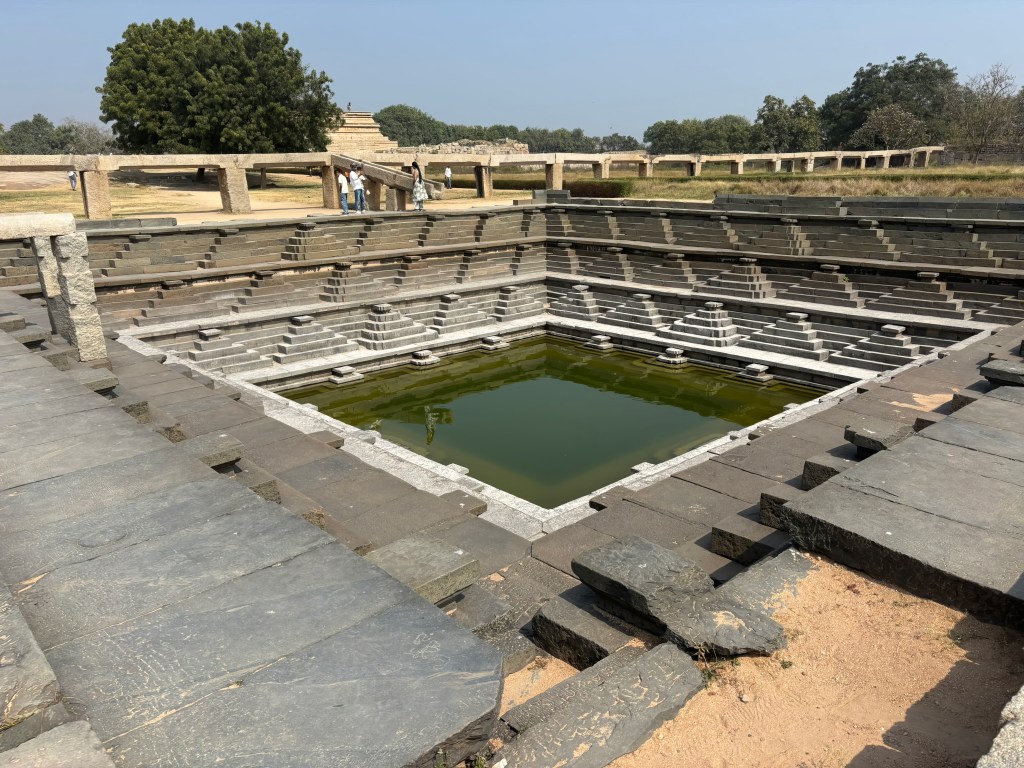
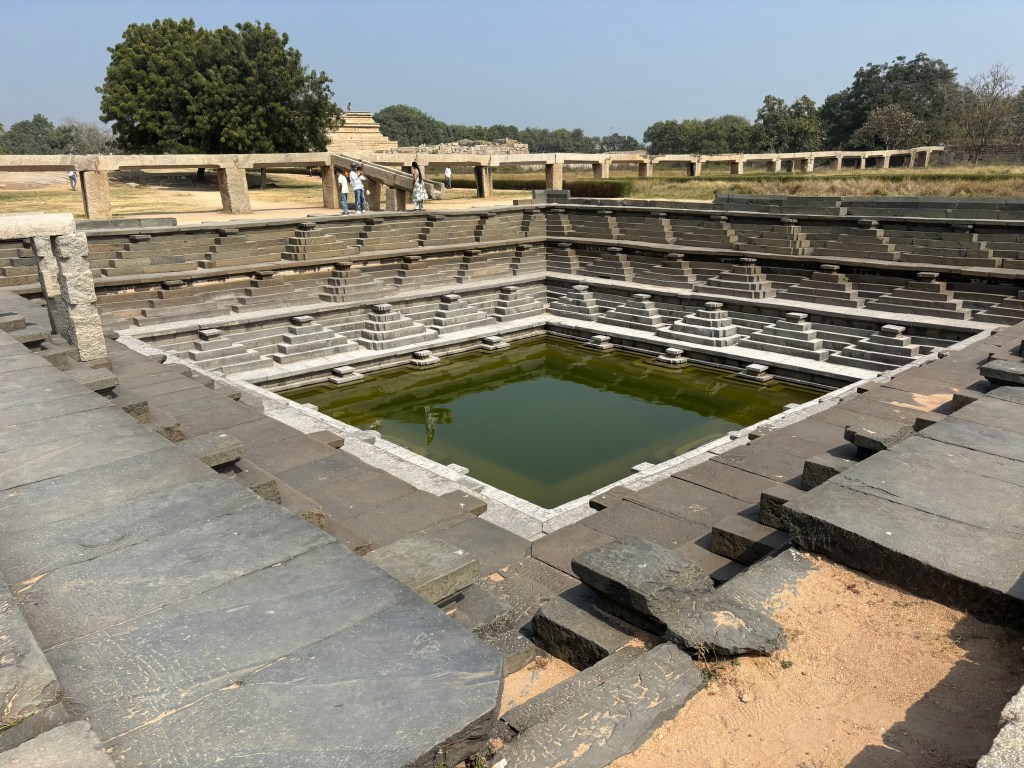
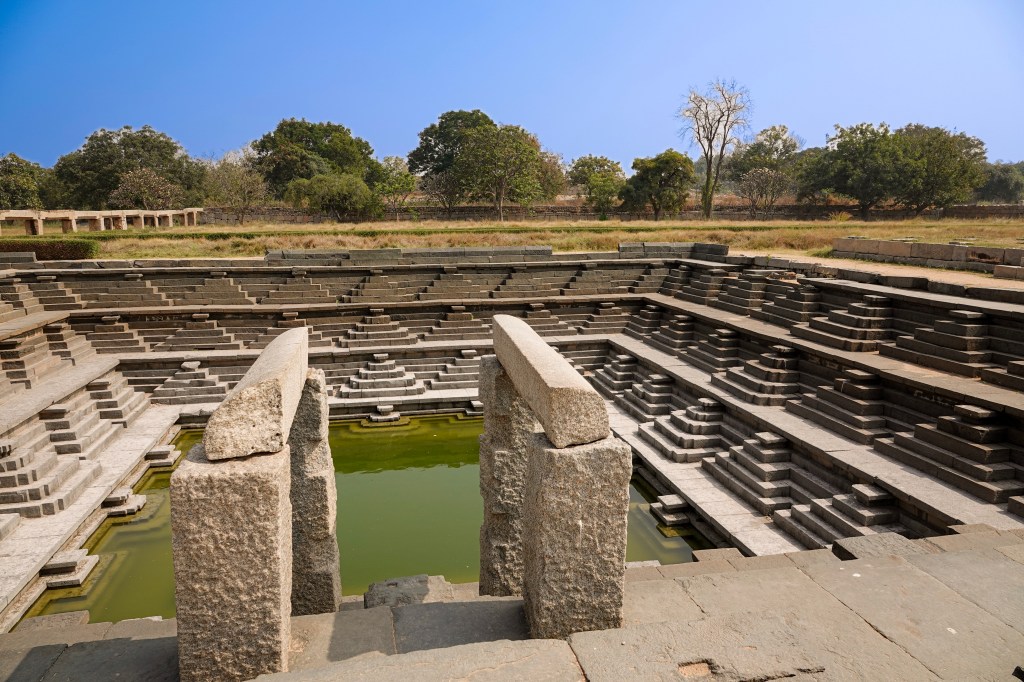
Tucked within the royal quarters is one of Hampi’s most mesmerizing structures—a perfectly proportioned stepped tank that feels like a piece of sacred geometry carved into the earth. Its crisp, symmetrical tiers descend in a rhythmic pattern toward a pool of still green water, creating a play of light and shadow that shifts with every passing hour. Unlike the massive public tanks found elsewhere in the city, this one was clearly meant for the royal household, fed by an intricate network of stone aqueducts that once carried water from distant sources. Standing at its edge, framed by the tall stone pillars that guard its entrance, you can almost imagine the quiet rituals, the ceremonial ablutions, and the everyday rhythms of palace life that once unfolded here. The tank’s precision and elegance reveal not just engineering brilliance but an aesthetic sensibility that valued harmony, balance, and beauty in even the most functional spaces.
A Walk Through Power, Beauty & Imagination
Visiting the Zenana Enclosure and its surrounding monuments is like walking through the architectural imagination of the Vijayanagara empire. Each structure—whether a palace basement, a watchtower, a stable, or a ceremonial platform—reveals a different facet of royal life. Together, they form a vivid portrait of a kingdom that valued beauty, strength, innovation, and spectacle.
 Peaks to Palaces