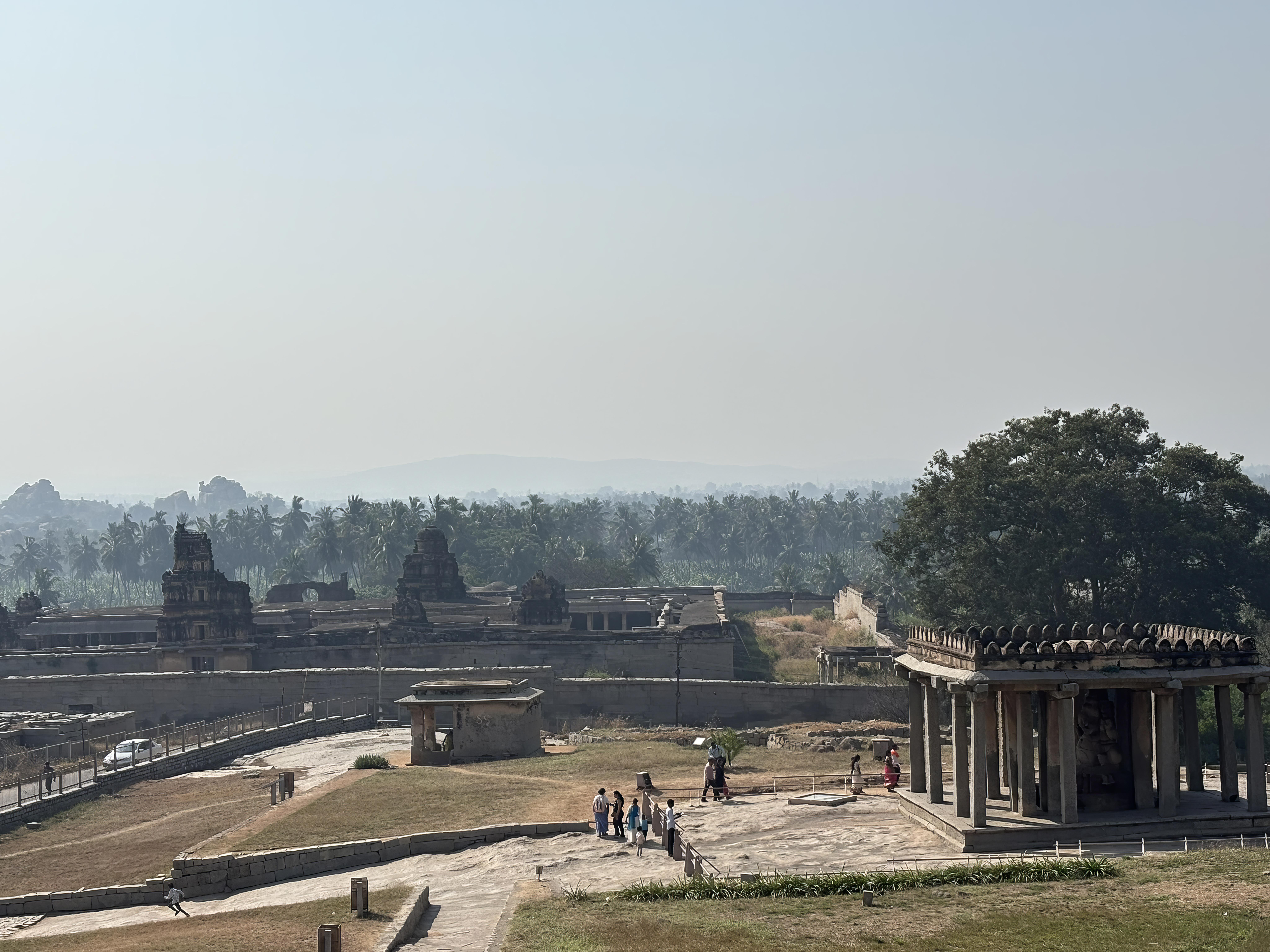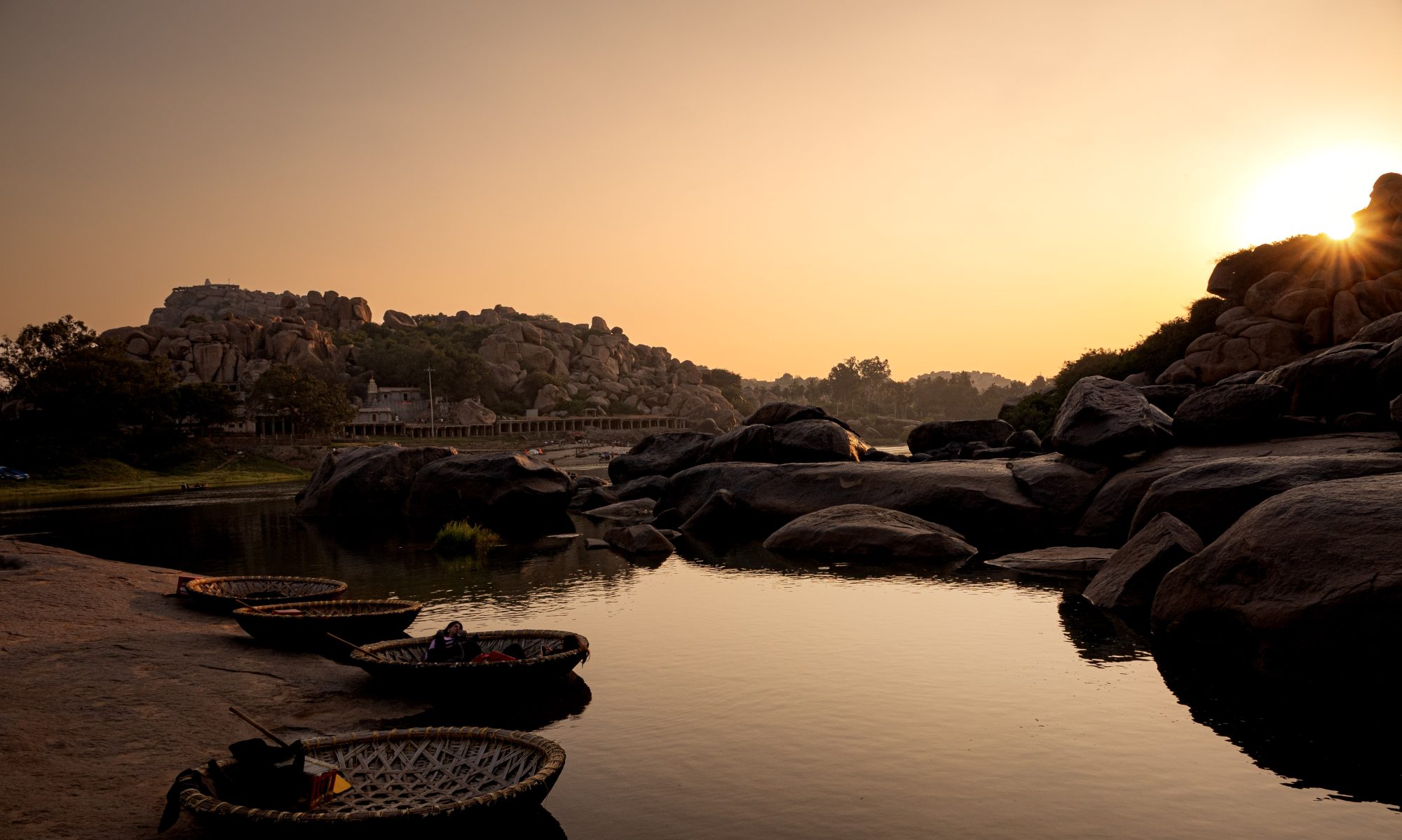
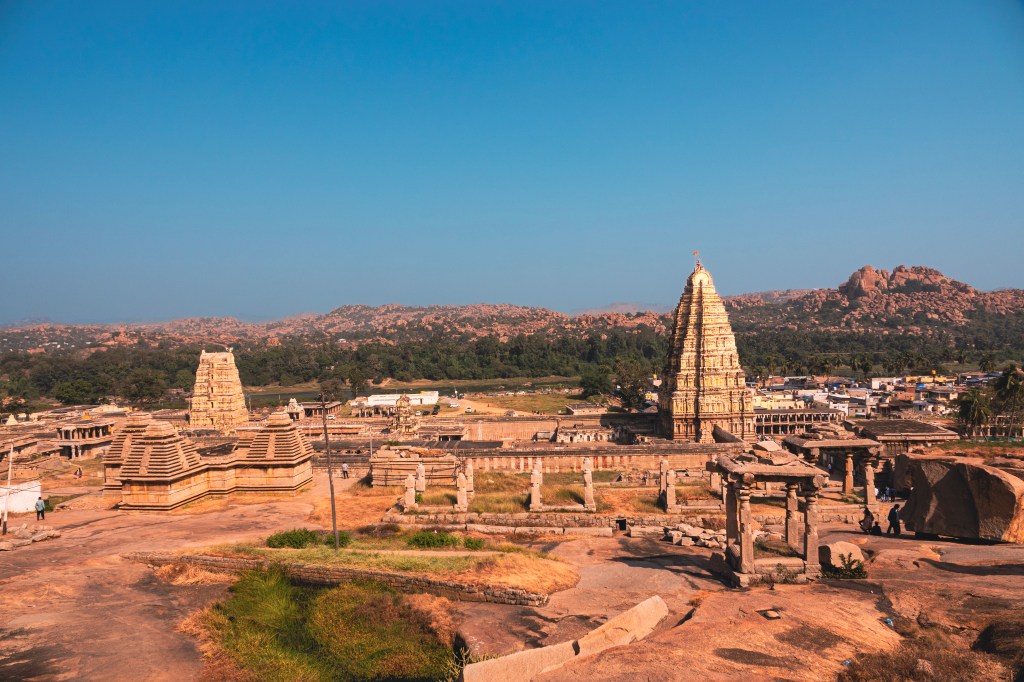
Hampi, a mesmerizing UNESCO World Heritage Site in Karnataka is a blend of surreal boulder-strewn landscapes and ancient history. Once the thriving capital of the 14th-century Vijayanagara Empire, it was one of the world’s largest cities. This was before its devastating fall in 1565. I grew up in this part of the country. I had often heard the ruins somberly called “Halu Hampi” (literally “Ruined Hampi” or “Destroyed Hampi” in the local language). This term shows the city’s tragic transformation. It changed from a “City of Victory” to a sprawling “City of Ruins.” This change followed its six-month pillage by the Deccan Sultanates. Today, you can wander through the remnants of once-grand bazaars. You can witness the iconic Stone Chariot at the Vitthala Temple. You can explore the active Virupaksha Temple. All of these stand as hauntingly beautiful testaments to a lost golden age.
- Quick Architectural Glossary: Vijayanagara Temples
- Our Itinerary
Quick Architectural Glossary: Vijayanagara Temples
Gopura
The monumental gateway tower marking the entrance to a temple complex. Usually built of stone at the base and brick above, often decorated with stucco figures.
Mandapa
A pillared hall used for gatherings, rituals, and processions.
- Open mandapa: airy, columned pavilion.
- Enclosed mandapa: walled hall with doorways and side porches.
Sanctuary / Garbhagriha
The innermost chamber housing the main deity. Usually small, dark, and accessed through a series of mandapas.
Pradakshina Patha
The circumambulatory passage around the sanctuary, sometimes unlit, used for ritual clockwise movement.
Kuta Roof
A square‑to‑domed roof form used in South Indian temple architecture. In Hampi, it appears on smaller shrines and early structures like the Durgadevi shrine.
Shikhara / Vimana
The tower above the sanctuary.
- Dravida vimana: stepped, pyramidal tower typical of the south.
- Brick shikhara: often seen in Vijayanagara temples, decorated with plaster sculptures.
Bazaar Street
A long, colonnaded avenue aligned with major temples, once lined with shops and festival pavilions. Krishna Temple and Virupaksha both have prominent bazaar streets.
Colonnade
A row of stone pillars supporting a roof or canopy. In Hampi, colonnades frame bazaar streets, temple tanks, and enclosure walls.
Tank / Pushkarini
A sacred water reservoir associated with ritual bathing and temple ceremonies. Often surrounded by pillared corridors and pavilions.
Inscribed Slab
A stone record set up by kings or patrons, documenting victories, donations, or temple endowments. The Krishna Temple inscription of Krishnadevaraya is a key example.
Peripheral Shrines
Small subsidiary temples placed along the inner corners or walls of a larger complex, dedicated to attendant deities or guardian figures.
Outer Enclosure
The larger walled compound surrounding the main temple. In the Krishna Temple, this includes a unique six‑domed granary structure.
Stucco Sculpture
Plaster figures applied to brick towers, often depicting deities, dancers, warriors, or mythological scenes. Many Vijayanagara gopuras once had elaborate stucco decoration.
Our Itinerary
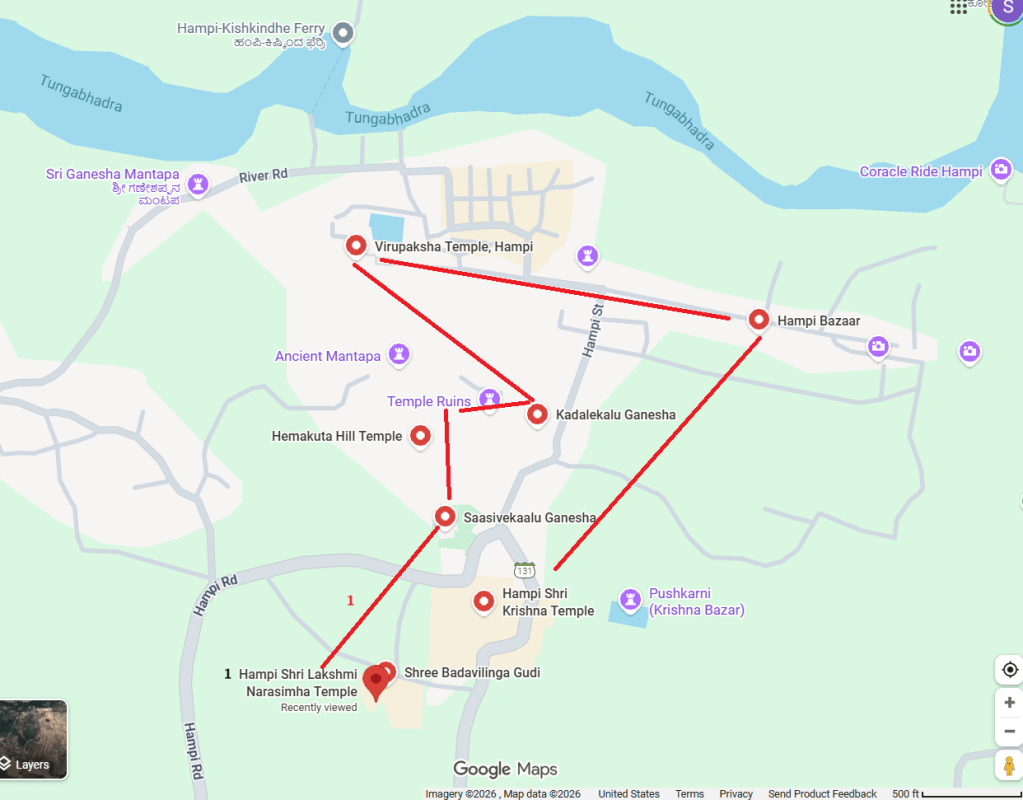
The entire city of Hampi is indeed huge. It’s possible to wander around the suburbs of the city for hours without bumping into anyone else. Seeing everything in Hampi would take several days. However, two to three days are enough to see the major monuments without it being repetitive. We saw Hampi in 4 segments with our guide. I will blog about each segment and its key monuments separately. Here is how we divided our itinerary of Hampi
Virupaksa Trail
This trail includes Virupaksha Temple, Hampi Bazaar, and Manmantha Tank. Other sites are Kampilaraya Temple, Sasivekalu Ganesha, and Kadalekalu Ganesha. The trail also covers the Krishna Temple, Lakshmi Narasimha, and the Badavi Linga. All of these are close together and can be done in 3-4 hours. We started at the Shri Lakshmi Nagashima temple and finished at the Krishna temple.
Here are more details and my commentary on each of these monuments, along with some photographs
Urga Narasimha / Lakshmi Narasimha temple and Badava Linga
Sasivekalu and Kadalekalu Ganesha
Hemakuta hill
Virupaksha Temple
Sri Krishna temple
Thungabhadra Trail
After the morning visit to Virupaksha trail, we took a much-needed break and had lunch. We headed back out around 3.30 PM to start our evening itinerary at Chakra Thirtha. We visited the riverside ruins and took a coracle ride. This was the highlight for me on this trip.
Vittala Trail
Walk through the ancient market and temples of Vithalapura – a Hampi suburb known for the famous Vijaya Vithala temple that houses the renowned
Stone Chariot and musical pillared mantapa.
Monuments Covered: Gejja Mantapa, Kudure Gombe Mantapa, Vithalapura Bazaar, Kalyani, Vijaya Vithala Temple
Raya Trail
This trail takes you back 500 years to the life and times of the Rayas or Kings of the Vijayanagara Empire. Learn about their lifestyle, culture, social and political lives while you gaze upon the royal city’s magnificent architecture.
Monuments Covered: Devaraya’s Palace, Royal Mint, Audience Hall, Secret Chamber, Stepped Tank, Mahanavami Dibba (Great Platform), Hazara Rama Temple, Queen‘s Bath & Palaces, and Elephant Stables
Hazara Rama temple
ANEGUNDI TRAIL
Venture across the Tungabhadra River to where the story of Hampi first began. Discover fortified villages and medieval forts. Explore sacred lakes and ancient temples. Experience a mesmerizing landscape of paddy fields and rock formations dating back 2.5 billion years.
Geology of Hampi: An Ancient Landscape Sculpted by Time
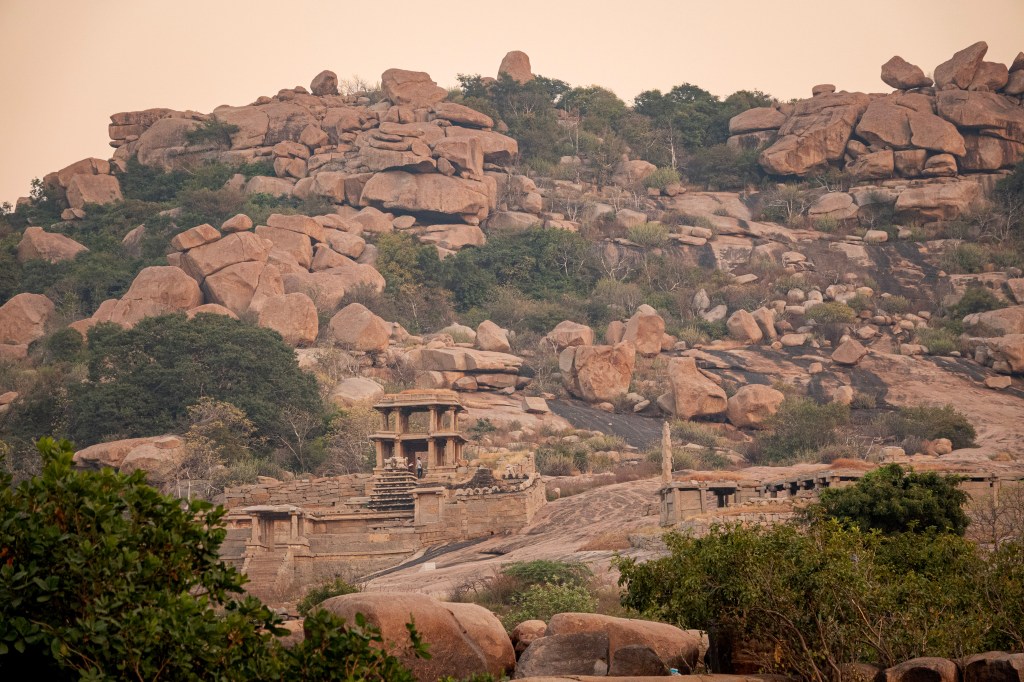
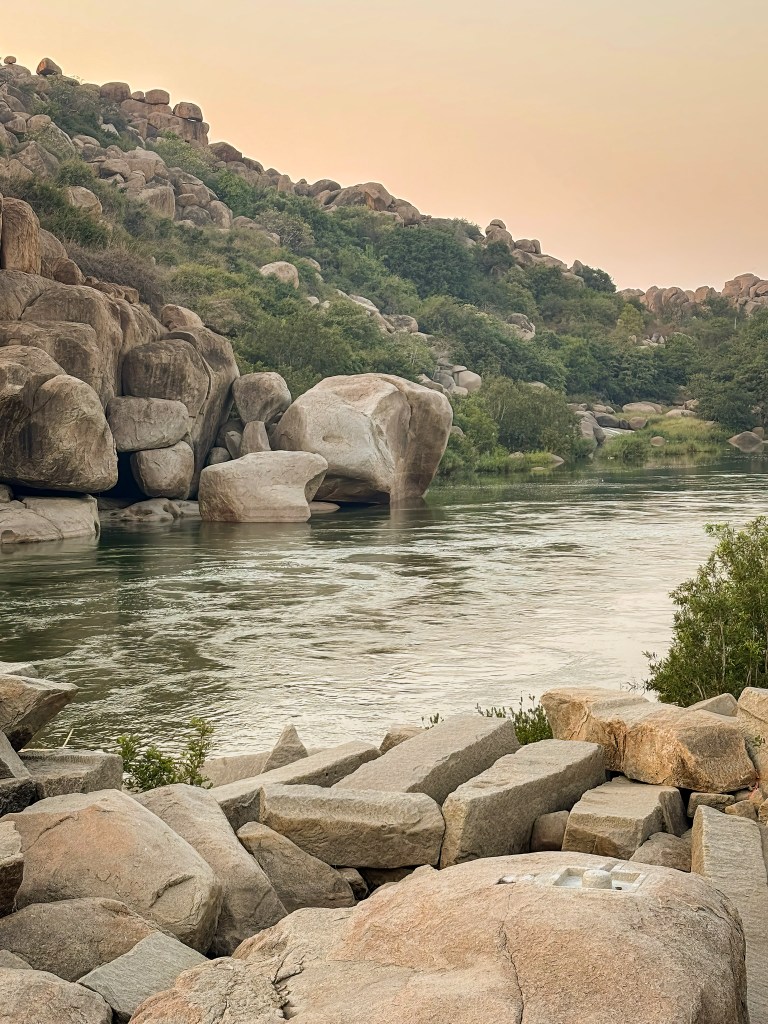
Hampi’s landscape looks almost mythical at first sight. Endless piles of rounded boulders are balanced impossibly on one another. They stretch across farmlands and river valleys like the remnants of a forgotten world. Yet the true story of this terrain is even more astonishing, rooted in billions of years of Earth’s geological history.

A Foundation Older Than Time
Hampi sits atop the Dharwar Craton. It is one of the oldest and most stable pieces of continental crust on the planet. It was formed between 3.6 and 2.5 billion years ago. This ancient foundation underlies parts of Karnataka, Goa, and Andhra Pradesh. It provides the bedrock upon which Hampi’s granite hills stand.
The Deccan Traps Connection
Geographically, the region lies on the broader Deccan Traps, one of the world’s largest volcanic provinces. These traps were created around 66 million years ago. At that time, the Indian Plate drifted over the Réunion hotspot. This movement produced vast layers of basalt that cooled into step‑like formations. The term “traps” itself comes from the Swedish word for “stairs.”
Inselbergs: Hampi’s Signature Land forms
Despite the volcanic origins of the Deccan Traps, Hampi’s dramatic boulder hills are not volcanic cones or remnants of eruptions. Instead, they are inselbergs — “island mountains” formed through deep, prolonged weathering of granite. Over tens of thousands of years, rainwater seeped into cracks in the rock, breaking it down from within.
- Corestones (rounded granite blocks) remained intact.
- Grus (weathered material) eroded away.
- What remained were the surreal piles of rounded boulders we see today.
This slow sculpting created the balancing rocks, tors, koppies, and nubbins that define Hampi’s skyline. These formations look precarious, but they have stood for millennia.
A Landscape Shaped by Nature and Culture
While inselbergs elsewhere are often remote and untouched, Hampi’s have been part of human life for thousands of years.
- Iron Age settlements used the runoff from these hills for farming.
- Pastoral communities grazed animals here, enriching the soil with seed‑rich droppings.
- Temples, shrines, and hill forts were built atop the granite outcrops.
- Vijayanagara architects quarried local stone to build their empire’s monuments.
This interplay of geology and culture makes Hampi unique: a place where natural history and human history are inseparable.
A Geological Backdrop to an Empire
The Vijayanagara Empire chose Hampi as its capital in the 14th century for several reasons. It wasn’t solely for its sacred associations. The fertile river valley was also a factor. The inselbergs provided natural fortification, strategic vantage points, and an endless supply of building material. The same granite that weathered into ancient boulders became the pillars, mandapas, and chariots of Hampi’s architectural wonders.
Hampi’s geology is not just a backdrop. It is the silent architect of the region’s culture, mythology, biodiversity, and imperial legacy.
Final thoughts
Hampi is worth visiting if you love history and architecture. I didn’t expect to fall in love with Hampi, but I walked away with 500+ photographs and memories. I can’t wait to go back and explore more.
 Peaks to Palaces