
The Badami Caves are carved into dramatic cliffs overlooking the emerald Agastya Lake. They are more than just monuments; they are a masterclass in ancient artistry. These four rock-cut temples showcase the cosmic dance of Shiva. They also highlight the serene presence of Jain Tirthankaras and the majestic incarnations of Vishnu. Together, they offer a rare window into a time of profound religious harmony.
The temples are directly carved into the hills. It is astonishing to see the precision and the skill of the artists who carved these sculptures. The intricate details etched into the stone reveal a high level of technical ability. They also show a keen eye for detail. They also demonstrate a deep understanding of the spiritual significance of these structures. Each curve and contour seems to breathe life into the rock, showcasing the artists’ dedication and passion for their craft.
- Cave 1-Key Architectural & Artistic Features
- Cave 2 Key Architectural & Artistic Features
- Cave 3-Key Architectural & Artistic Features
- Cave 4-Key Architectural & Artistic Features
- Final Thoughts
Cave 1–Key Architectural & Artistic Features
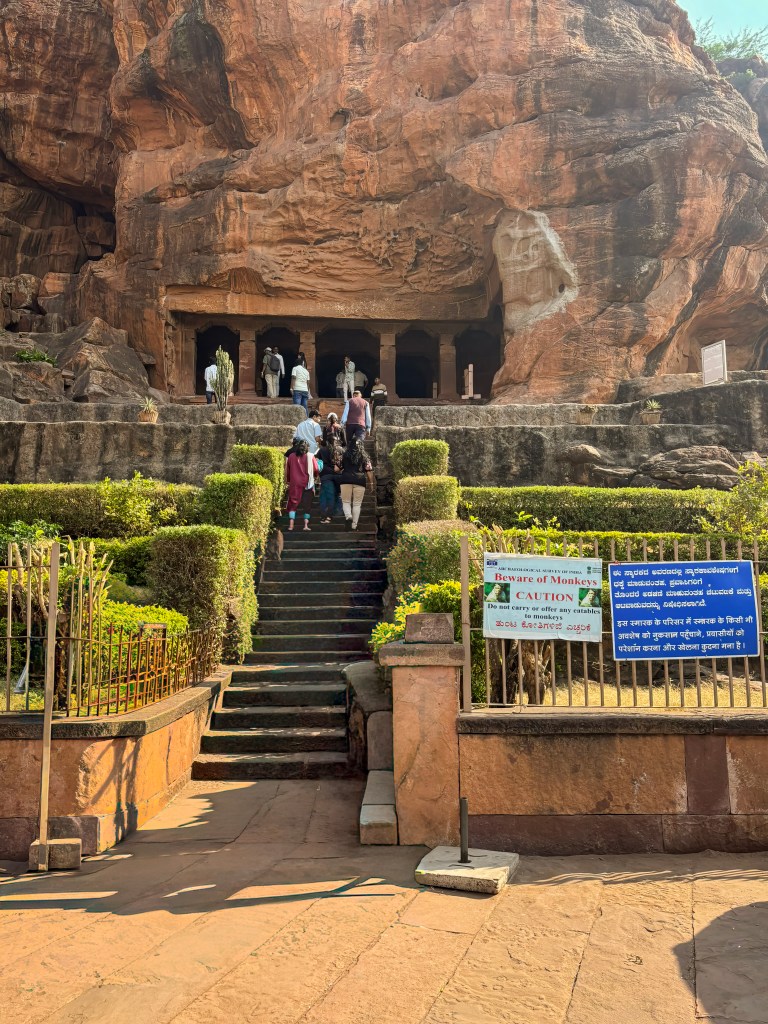
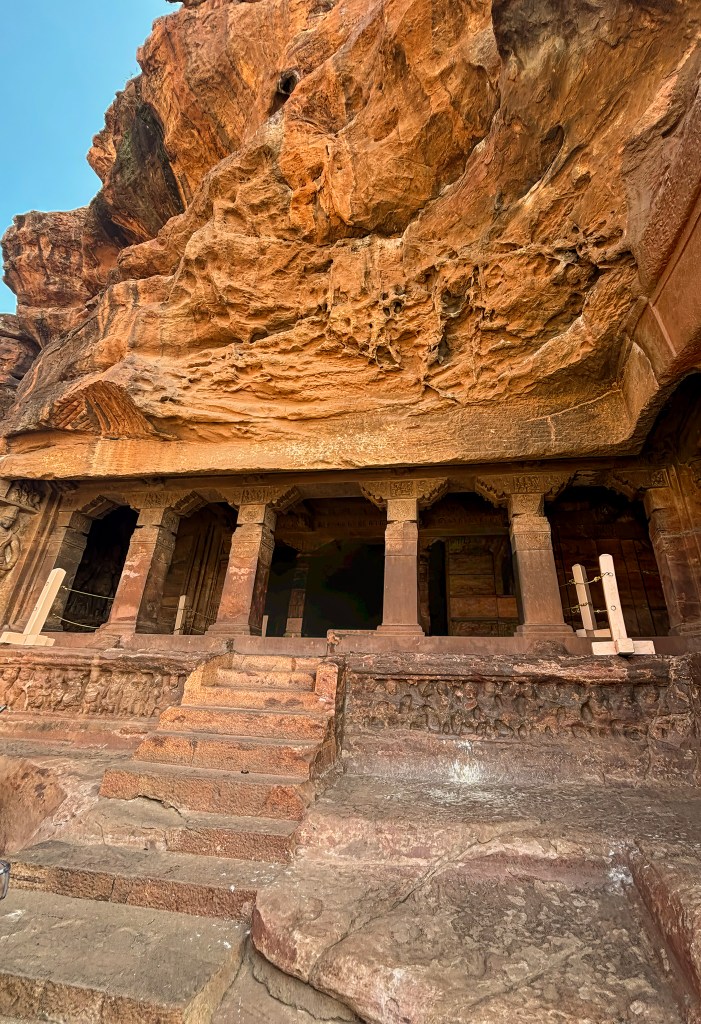
Cave 1 is the first and lowest of the cave temples. Carved from soft red sandstone, it is primarily dedicated to Lord Shiva.
The Nataraja Sculpture
The cave’s most iconic feature is a 5-foot-tall relief of Nataraja, the 18-armed dancing Shiva. This masterpiece is noted for its mathematical precision. It depicts roughly 81 Bharatanatyam dance poses through different arm combinations.
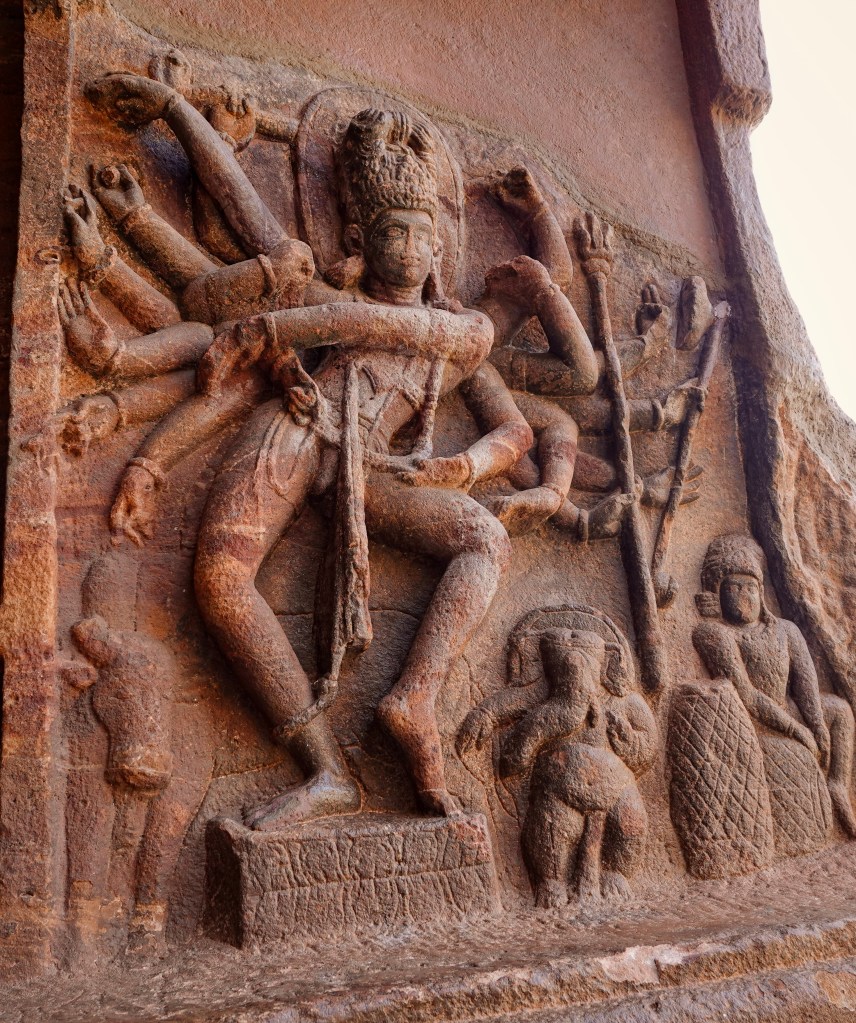
The 81 Poses Explained – The sculpture depicts Shiva performing the Tandava dance. Its most remarkable feature is the arrangement of his 18 arms (9 on each side) in a specific geometric pattern:
- Permutation & Combination: Art historians note that by pairing any of the 9 hands on the left with any of the 9 on the right, a dancer can visually derive 81 distinct Bharatanatyam dance poses (karanas).
- Geometric Precision: The arms are arranged in a pattern that Swiss art historian Alice Boner described as a “cosmic wheel” or time division.
- Symbolic Gestures: Each hand either holds a symbolic object—such as a drum, trident, serpent, or axe—or is formed into a specific Natya mudra (symbolic hand gesture) used in classical Indian dance.
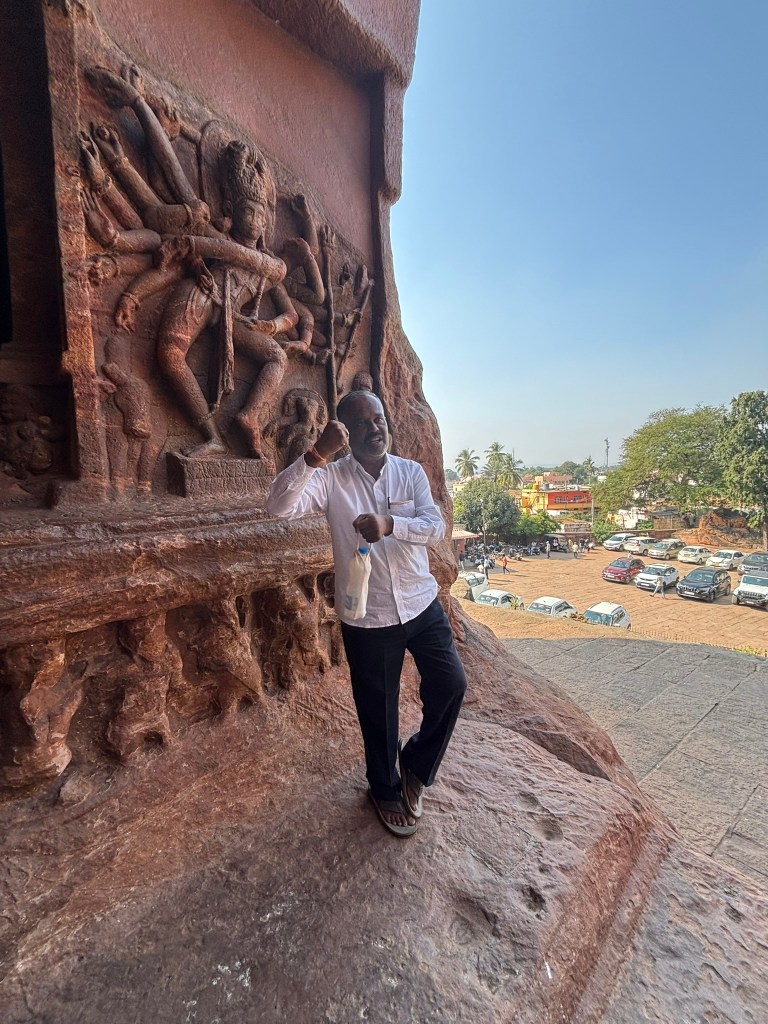
It is advised to have a guide when visiting Badami cave temples. Our guide was able to show us the most important features of each cave, including the Shiva idol and its meaning
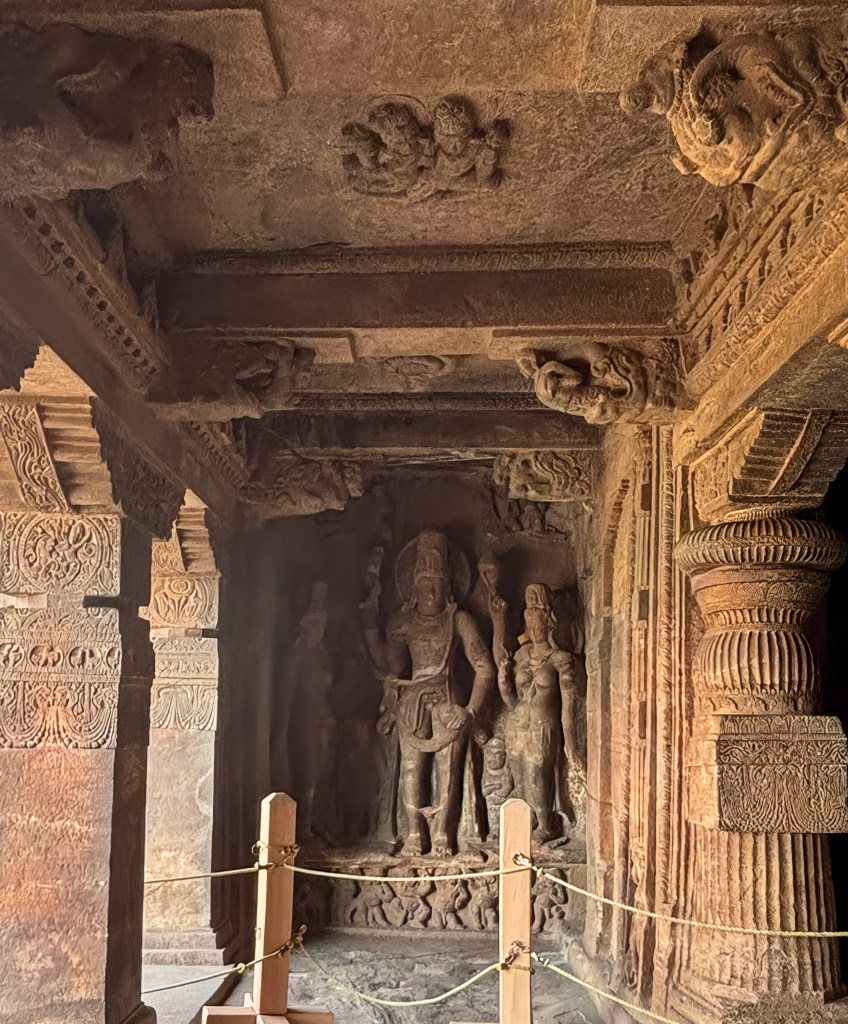
Symbolic Deities
- Harihara: A 7.75-foot fused sculpture representing half-Shiva and half-Vishnu, flanked by their consorts, Parvati and Lakshmi.
- Ardhanarishvara: A relief depicting the composite form of Shiva and Parvati as half-male and half-female.
- Mahishasura Mardini: A striking relief of Goddess Durga slaying the buffalo demon.
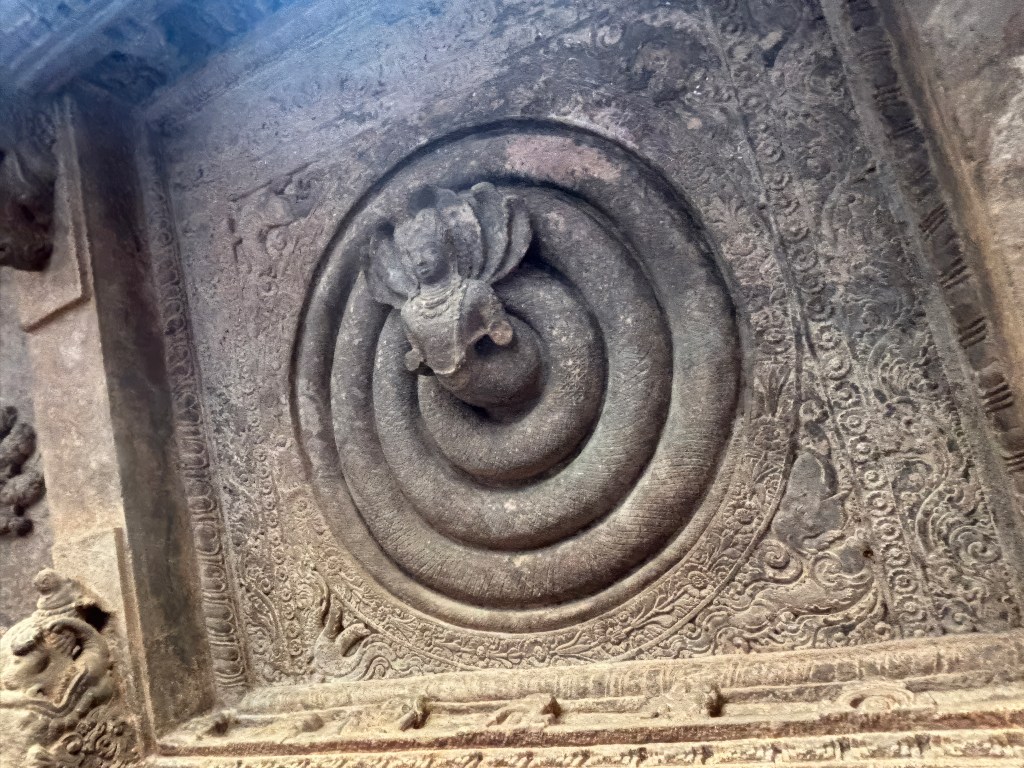
Ceiling Art
The roof features intricate panels, including a prominent Nagaraja (King of Serpents) motif with a coiled body and human torso.
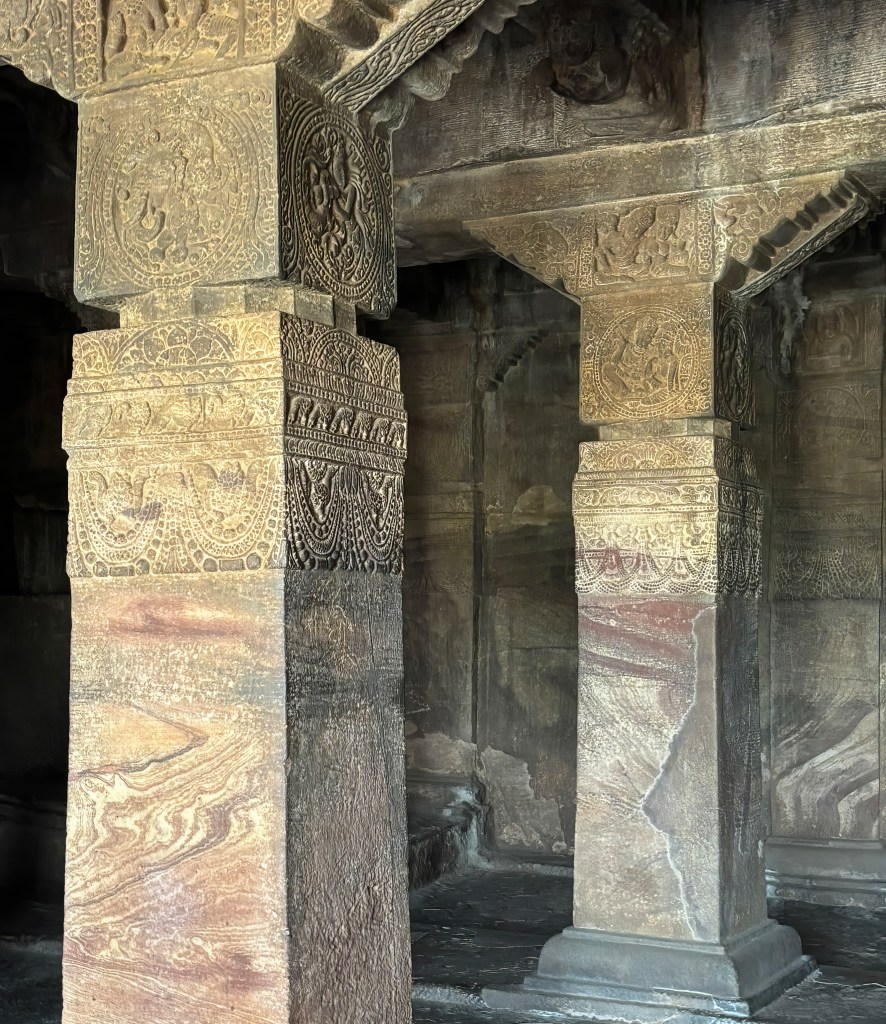
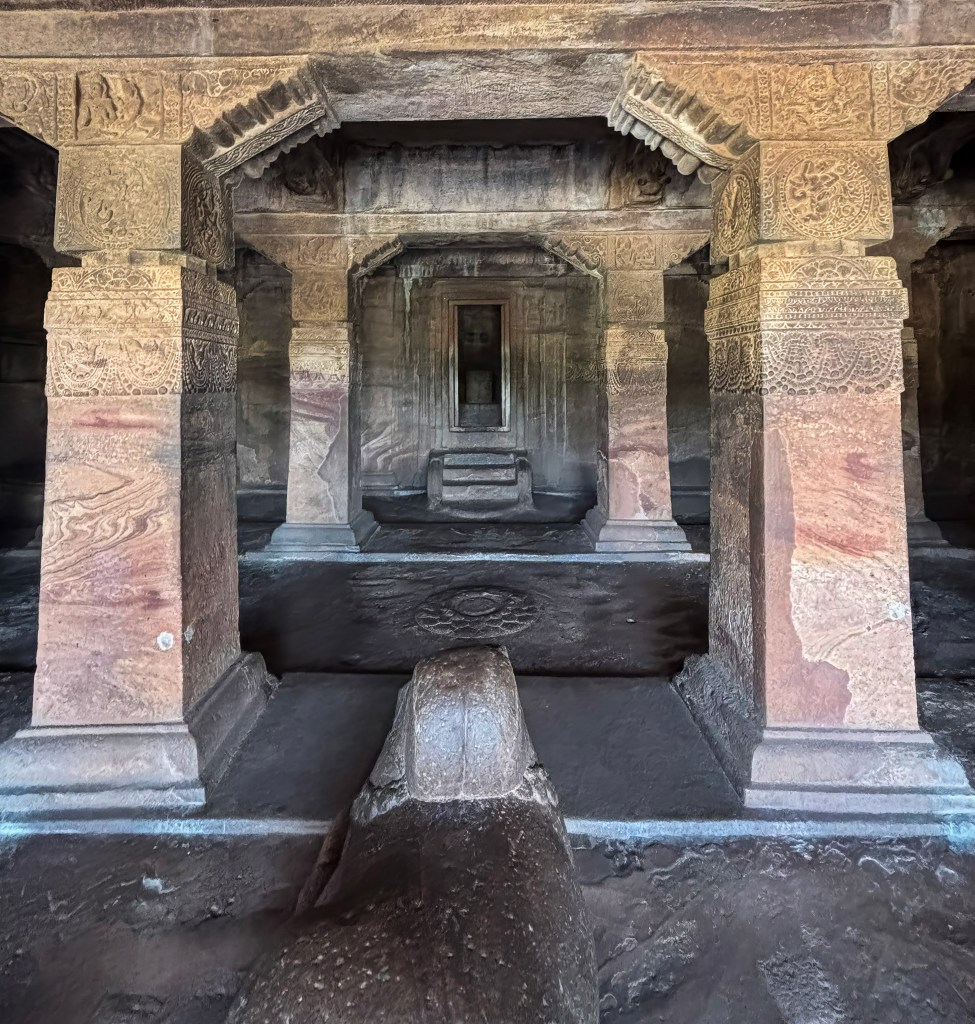
Structure
The temple has a traditional layout. It consists of a pillared verandah (mukha-mandapa), a central pillared hall (maha-mandapa), and a small sanctum (garbhagriha) at the back. The sanctum contains a Shiva Linga.
Cave 2 Key Architectural & Artistic Features
Cave 2 of the Badami cave temples, dating to the late 6th or early 7th century CE. It is primarily dedicated to the Hindu god Vishnu. The temple honors Vishnu and his avatars. It is located above and to the east of Cave 1 and is accessed by climbing approximately 64 steps. Cave 2 is the least refined and resembles a smaller version of Cave 3.
Trivikrama
The largest relief in the cave depicts the legend of Vishnu in his Trivikrama form. In this depiction, he is portrayed as a giant taking one of three massive steps. These steps are meant to master the earth, abyss, and sky.
The sculpture depicts Vishnu as Trivikrama, an eight-armed form. Key features visible in the carving include:
- The Deity: Vishnu is shown with one foot firmly on the ground. His other foot is raised high in the sky. This depicts him measuring the universe. He is holding various attributes, such as a sword and a shield.
- Surrounding Figures: At the bottom left, a figure is believed to be Bali’s son. He is shown holding the lord’s leg in devotion.
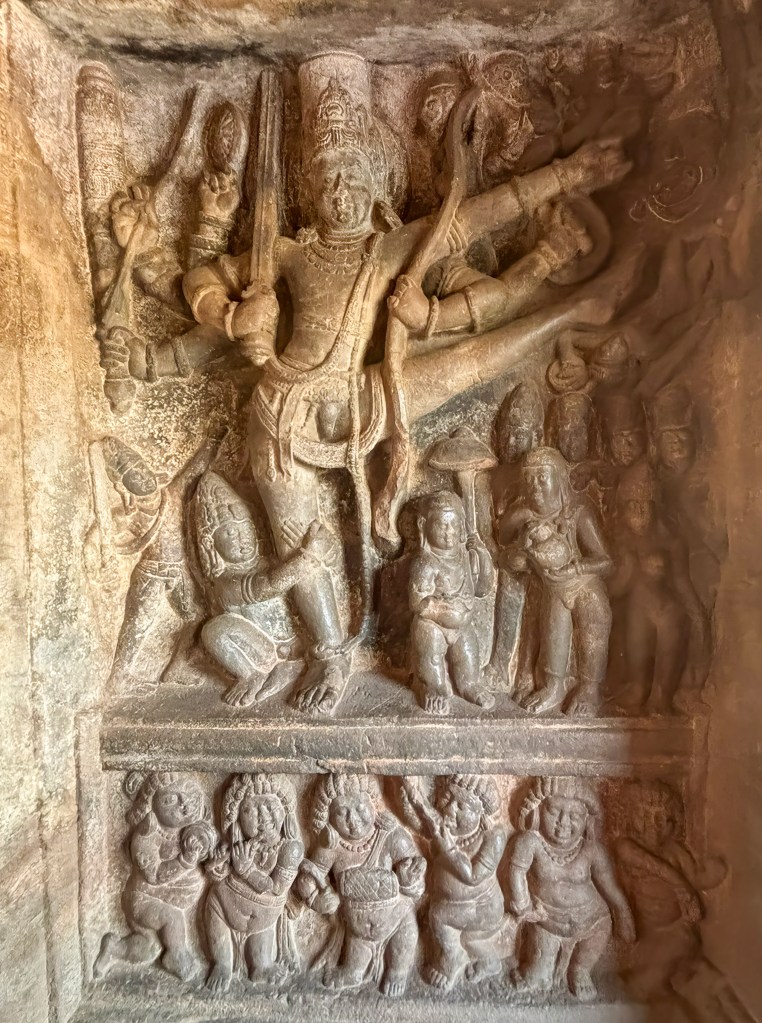
Explanation of the Legend of Trivikrama
- Vamana Avatar: The legend describes the dwarf Brahmin Vamana. He is an avatar of Vishnu. Vamana approached the generous Asura King Mahabali during a grand ritual.
- Three Steps of Land: Vamana requested just three “feet” or steps of land. Mahabali granted this request despite warnings from his preceptor.
- Trivikrama Form: Upon receiving the grant, Vamana transformed into the giant, cosmic form of Trivikrama (meaning “three steps”).
- Measuring the Universe: With his first step, he covered the entire earth and the netherworlds. With his second step, he covered the heavens.
- The Third Step: Overwhelmed, King Mahabali offered his own head for the third step. By doing this, he fulfilled the promise and showed devotion.
- Varaha: Another prominent sculpture shows Vishnu in his Varaha (boar) avatar. He rescues the Earth Goddess, Bhudevi, from the cosmic ocean and the demon Hiranyaksha.
- Other Deities: The cave features sculptures related to the birth of Lord Krishna. It also includes his childhood and other figures from the Bhagavata Purana.
Architectural Details of Cave 2
- Layout: The cave shares a similar layout to Cave 1. It features a pillared verandah (mukha-mandapa). There is also a central pillared hall (maha-mandapa) and a small, square sanctum (garbhagriha) deep inside

- Ceiling: The roof features intricate panels with bas-relief carvings. These include a notable “Matsya Chakra” (wheel with sixteen fish spokes). There is also a variety of swastika patterns. Friezes of flying couples (gandharvas and vidyadharas) and the churning of the ocean (Samudra Manthan) are also present.

- Style: The artwork in Cave 2 is primarily in the northern Deccan style of architecture. Traces of colored paint on the walls and ceiling suggest that the cave was once adorned with fresco paintings. These paintings are similar to those found in Ajanta.
Photo Ops near Cave 2
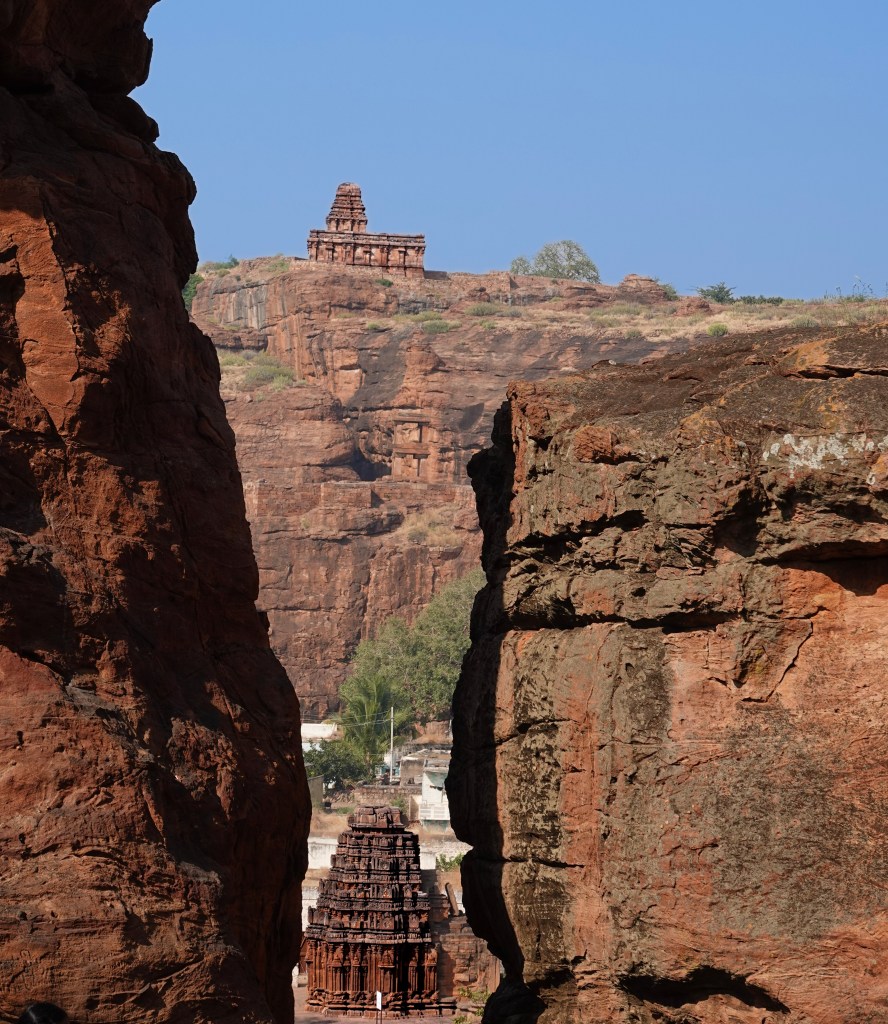
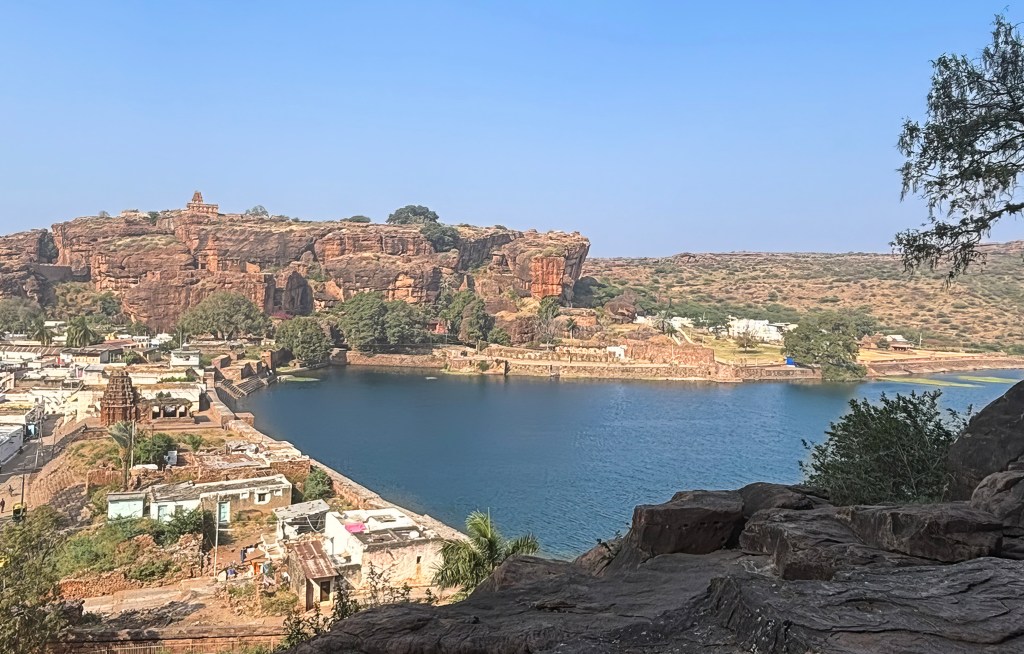
You get a great view of the lake and the town from Cave 2. Also, you can take a photo of the North fort and the Yellamma temple. You will see a lot of people taking this photo, but if you stand outside cave 2, you get a really nice shot like below
Cave 3-Key Architectural & Artistic Features
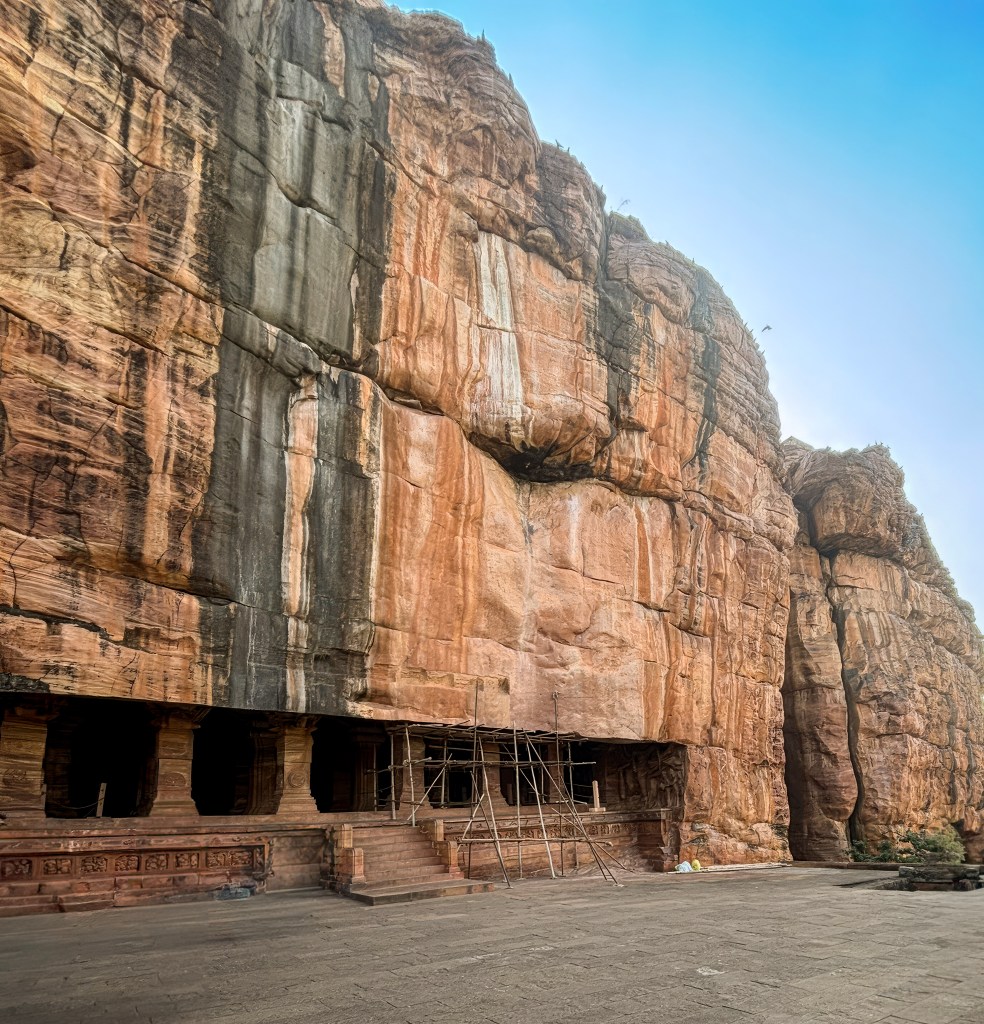
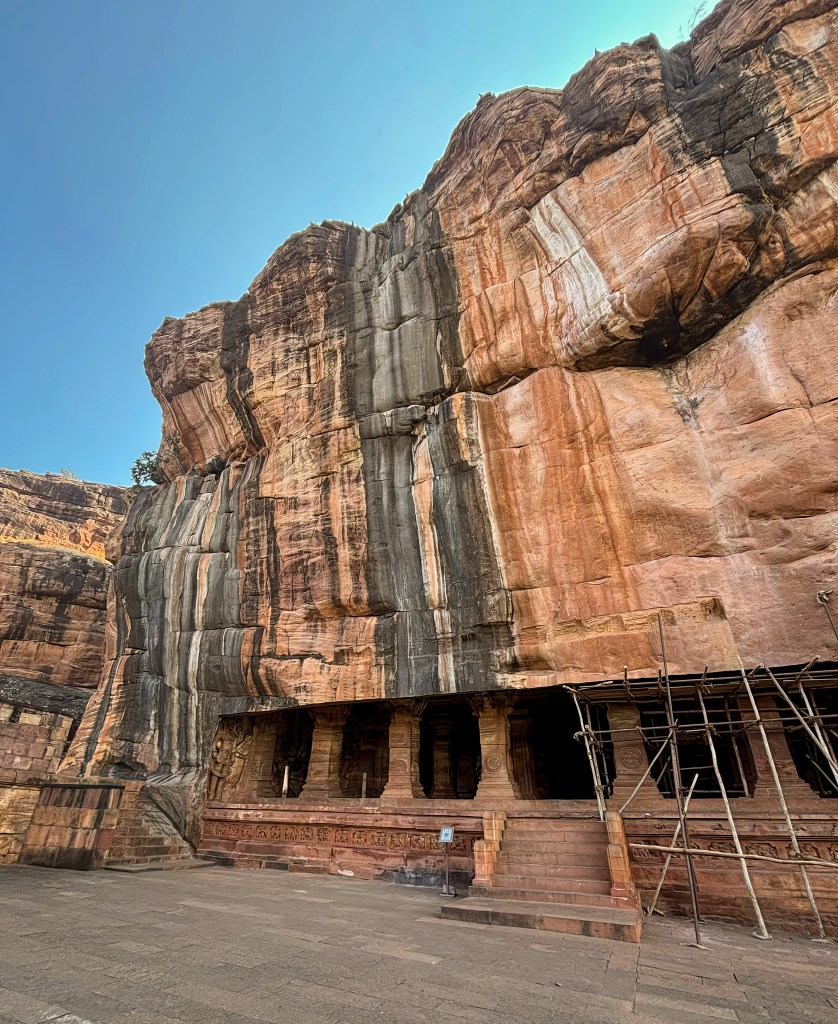
Cave 3 is the largest of the Badami cave temples. It is most intricately carved and dedicated primarily to Lord Vishnu and his various avatars. It is the only cave with a confirmed dedication date of November 1, 578 CE. This date is recorded in an Old Kannada inscription. Thus, it is the oldest firmly dated Hindu cave temple in the Deccan region. The cave showcases a sophisticated blend of northern Nagara and southern Dravida architectural styles. It features a large pillared veranda (mukha-mandapa) and a main hall (maha-mandapa), leading to a small, empty inner sanctum (garbhagriha).
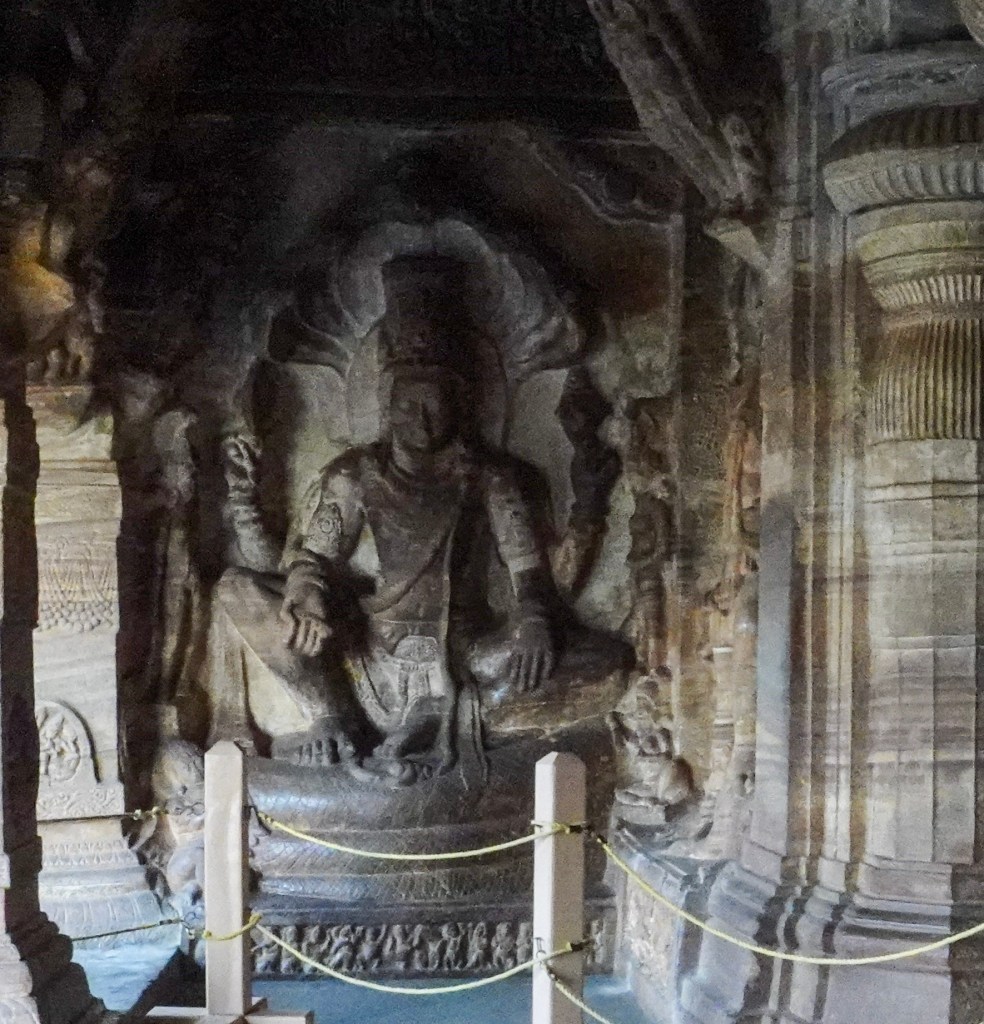
Vishnu as Anantasayana
A unique sculpture of Vishnu shows him in his Anantasayana sitting in a regal posture. The coiled cosmic serpent, Sheshanaga (Ananta), forms the seat and the hood of the canopy. The carving is detailed with other figures; Vishnu’s consorts, Bhudevi and Sridevi, are seen on either side. Garuda (Vishnu’s vehicle) is seated on the floor to the left.
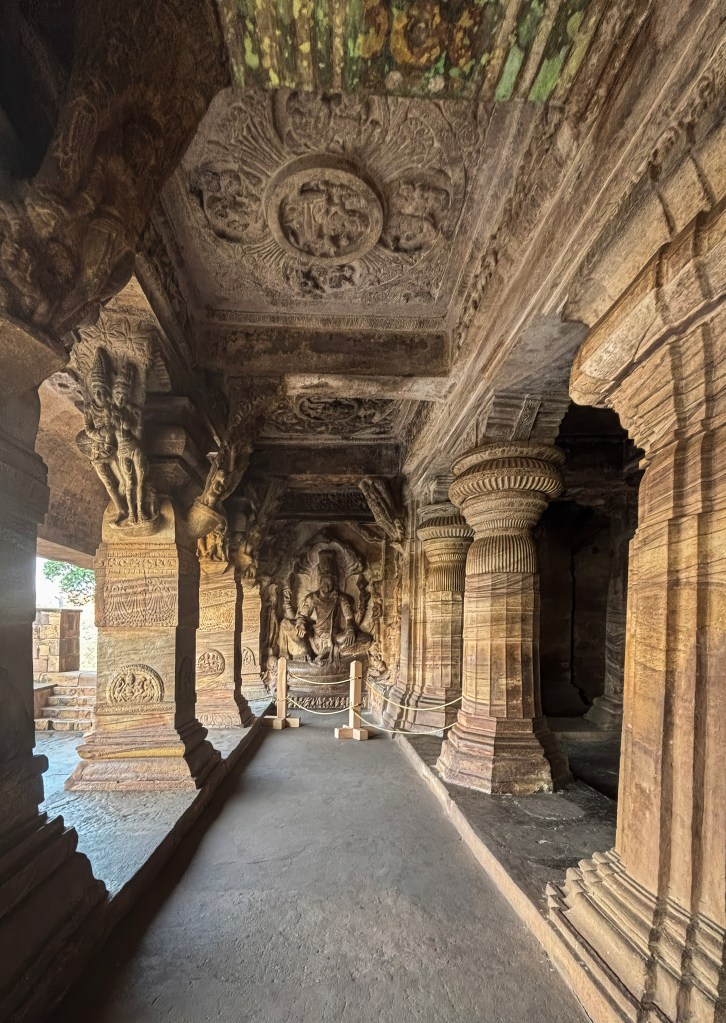
The entire front Veranda is beautiful with great carvings and columns. Don’t forget to look up and appreciate the carvings on the ceiling.
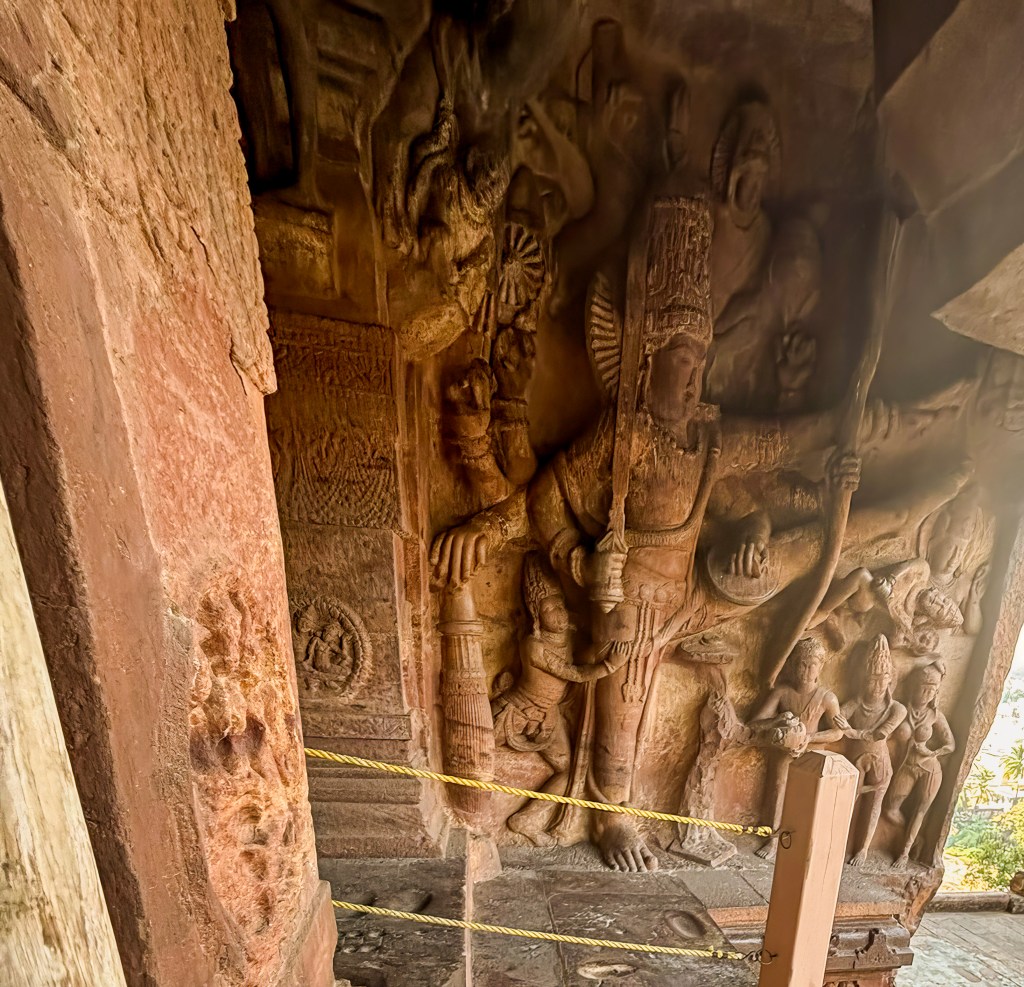
Trivikrama/Vamana
A colossal relief depicting Vishnu in his dwarf avatar, Vamana, transforming into Trivikrama to stride across the universe. This is very similar to the one seen in Cave 2.
Varaha
A massive carving of Vishnu as a boar rescuing the Earth Goddess, Bhudevi can be seen on the opposite wall of the Anantasayana
On the wall column next to Varaha is the inscription giving the name of the royal patrons of the monument. This inscription shows that this cave was consecrated on Nov 1st, 578.
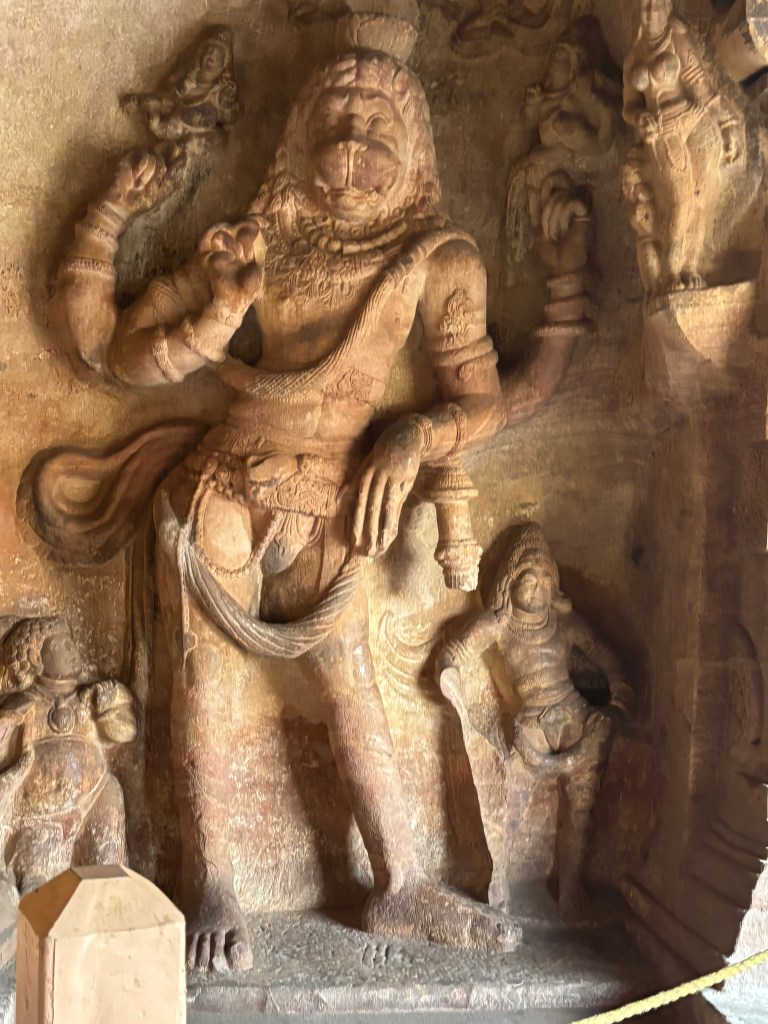
Narasimha
A standing, eight-armed figure of the man-lion avatar, which is depicted in a benevolent form.
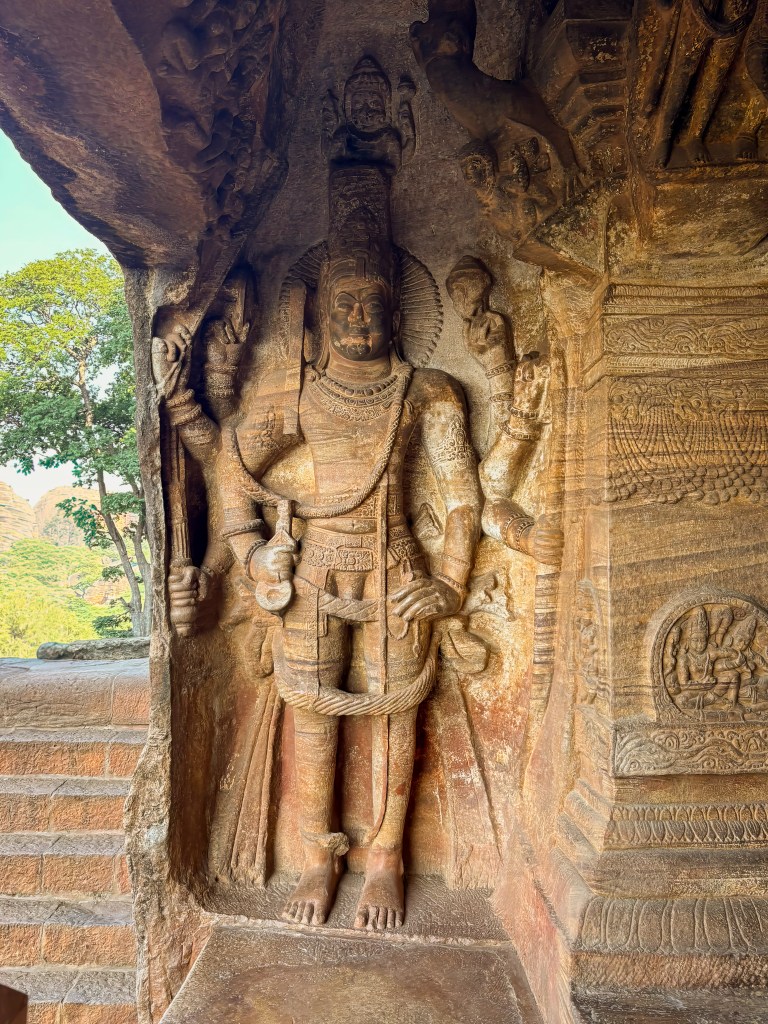
Harihara
A powerful seven-foot-tall sculpture of Harihara can be seen in Cave 3.
Harihara is a composite deity in Hinduism, representing the fused form of Lord Vishnu (Hari) and Lord Shiva (Hara). This specific sculpture portrays the left half as Shiva and the right half as Vishnu. he sculpture is shown with four hands, displaying attributes of both gods. The left side (Shiva’s half) is accompanied by the goddess Parvati, and the right side (Vishnu’s half) is accompanied by the goddess Lakshmi
Unique Features of Cave 3
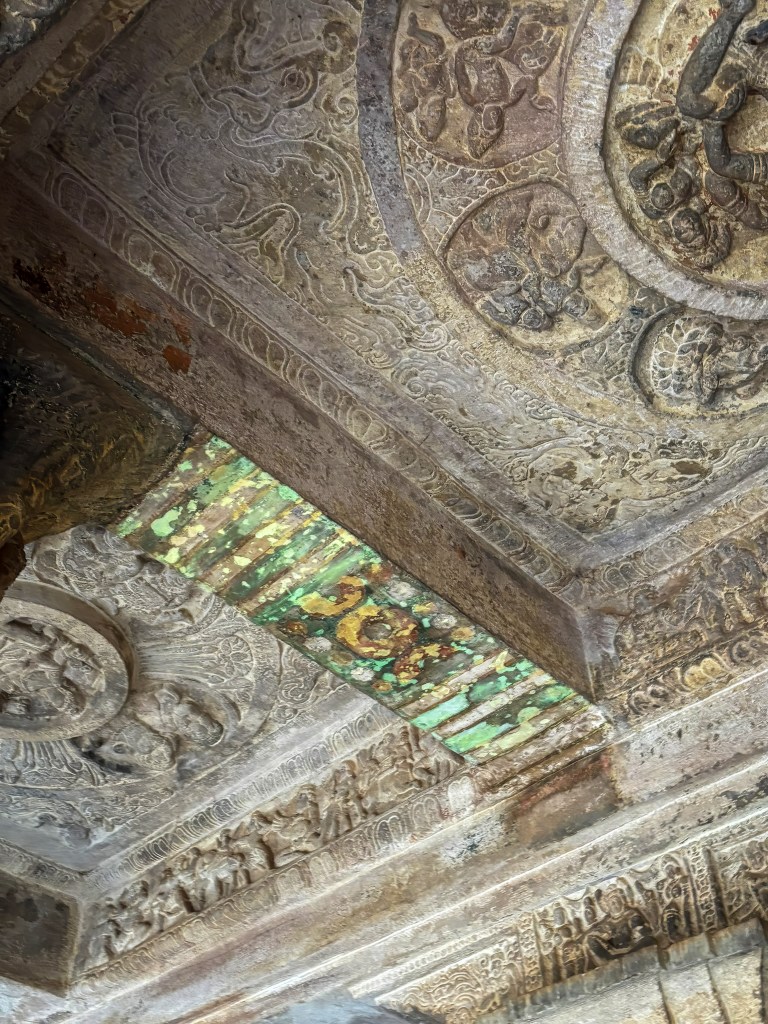
- Fresco Paintings: Traces of ancient fresco paintings, some of the earliest surviving evidence in Indian art, are visible on the ceiling panels, which depict deities like Brahma, Indra, and Varuna.
- Intricate Pillars: The pillars are highly ornate, featuring detailed carvings of human figures, mythological characters, and mithuna (amorous) couples.
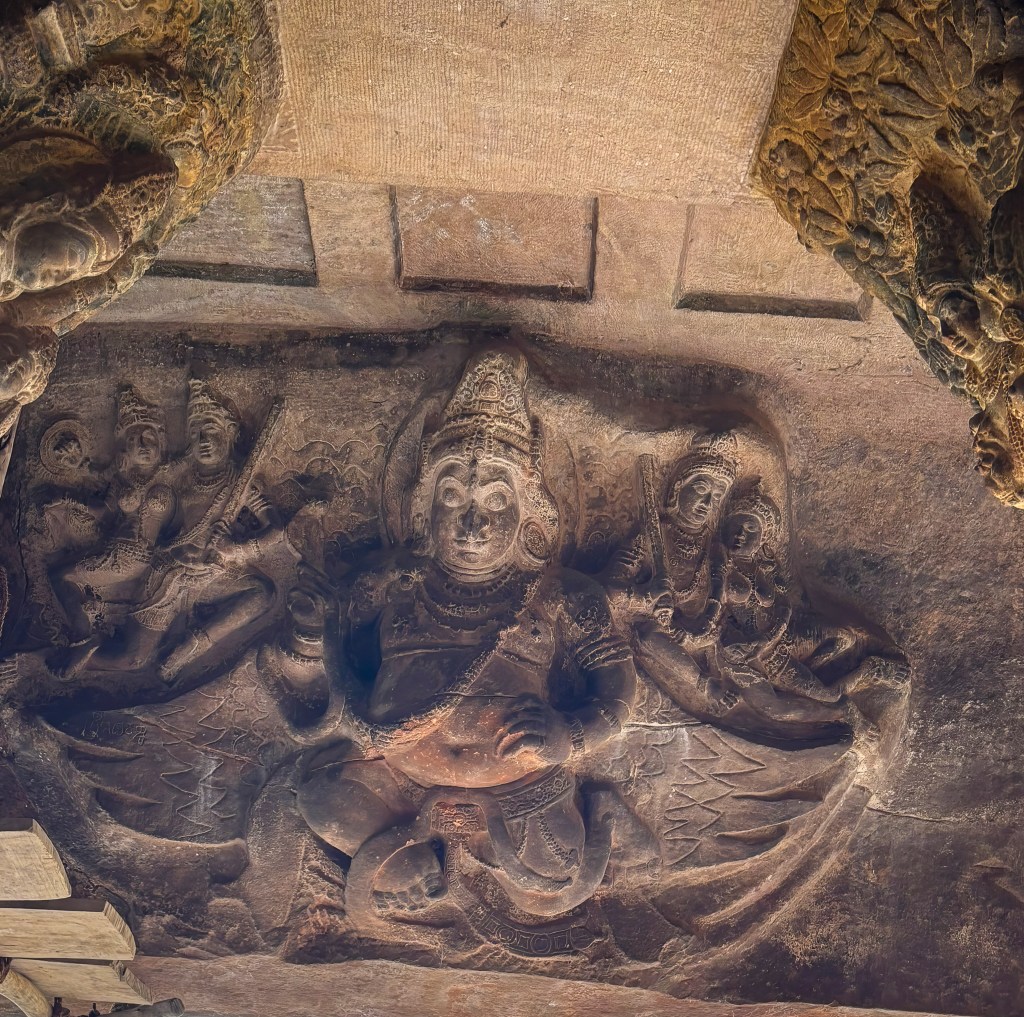
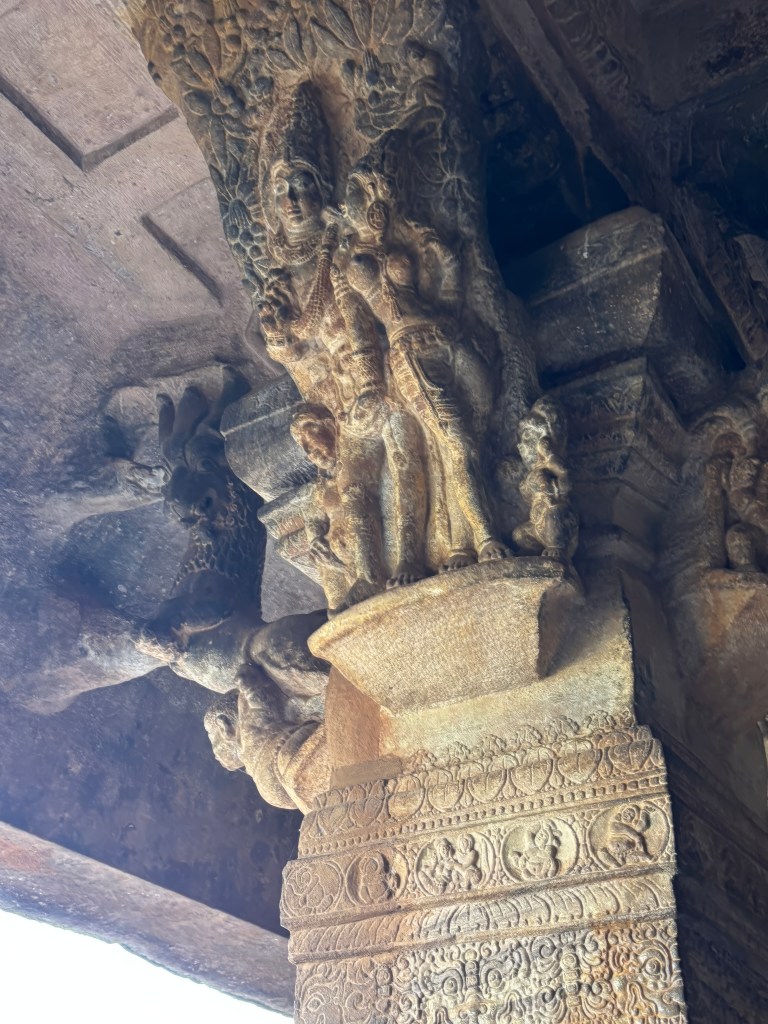
- Ceiling Art: The ceiling has a “Navaranga” (nine-section) design with a central lotus medallion on the floor below it, surrounded by carvings of the Ashta Dikpalas (guardians of the eight directions)
Cave 4-Key Architectural & Artistic Features
Cave 4 is the smallest and highest of the four major rock-cut temples in Badami. Unlike the first three, it is exclusively a Jain temple, illustrating the religious pluralism of the Early Chalukya period. The less intricate drawings and crude carvings suggests that the cave-temple might be the latest of the series
Architectural & Historical Context
- Dating: It was excavated in the late 7th or 8th century CE, significantly later than the Brahmanical caves. Further embellishments were likely added up to the 11th or 12th century.
- Structure: The cave follows a slightly modified layout with an open verandah (mukhamandapa), an oblong antechamber (ardhamandapa), and a main sanctum (garbhagriha).
Major Sculptures
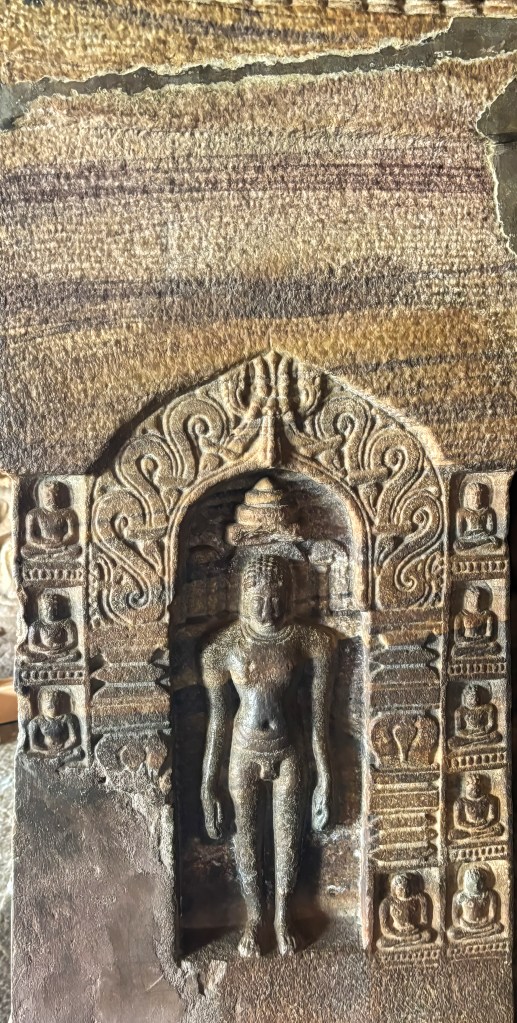
The cave is renowned for its detailed depictions of Jain Tirthankaras and deities in the Digambara (sky-clad) tradition.
Digambara tradition—one of Jainism’s two primary paths. This sect translates to “sky-clad.” It represents the pinnacle of asceticism. Monks renounce all worldly possessions, including clothing. This renunciation demonstrates total detachment from the material self. For travelers, the serene, nude sculptures of Tirthankaras are the most striking evidence of this faith. The legendary Bahubali is depicted in such deep, motionless meditation that vines wind around his limbs. Beyond the stone carvings, the Digambara philosophy emphasizes a life of extreme non-violence (Ahimsa) and spiritual purity, offering a fascinating glimpse into a culture that views the entire universe—the sky itself—as its only garment
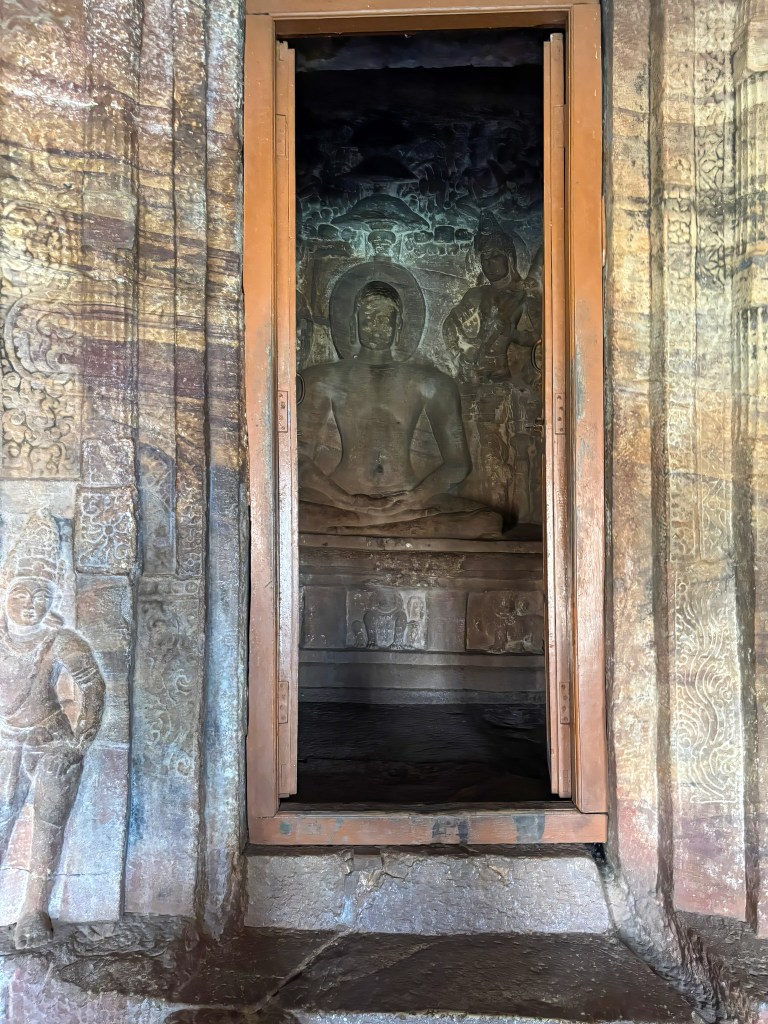
- Lord Mahavira: The central shrine houses the 24th Tirthankara, Mahavira, seated on a lion throne. A 12th-century inscription near this image records the death of a pious woman named Jakkave.
- Parshvanatha: A life-size relief on the right side of the verandah depicts the 23rd Tirthankara in meditation, protected by a five-headed cobra hood.
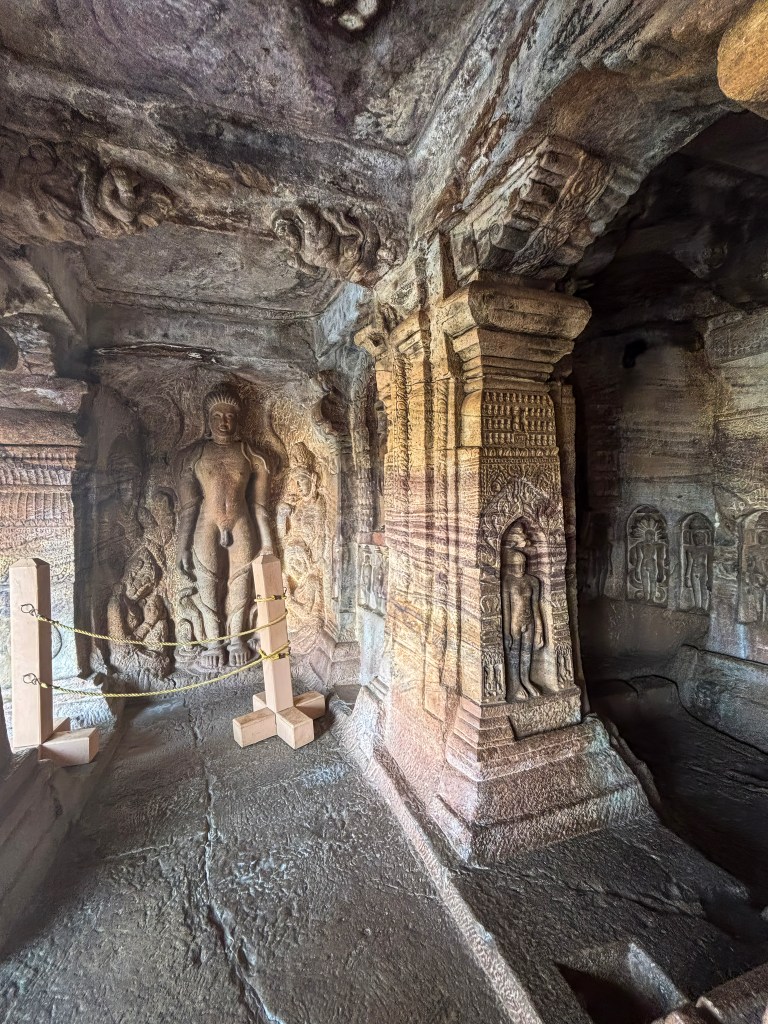
- Bahubali (Gommateshwara): On the left side, Bahubali is shown in the Kayotsarga (standing) posture. This is one of the earliest known representations of Bahubali in South India. It is notable for the vines (madhavi) shown winding around his legs during his long penance.
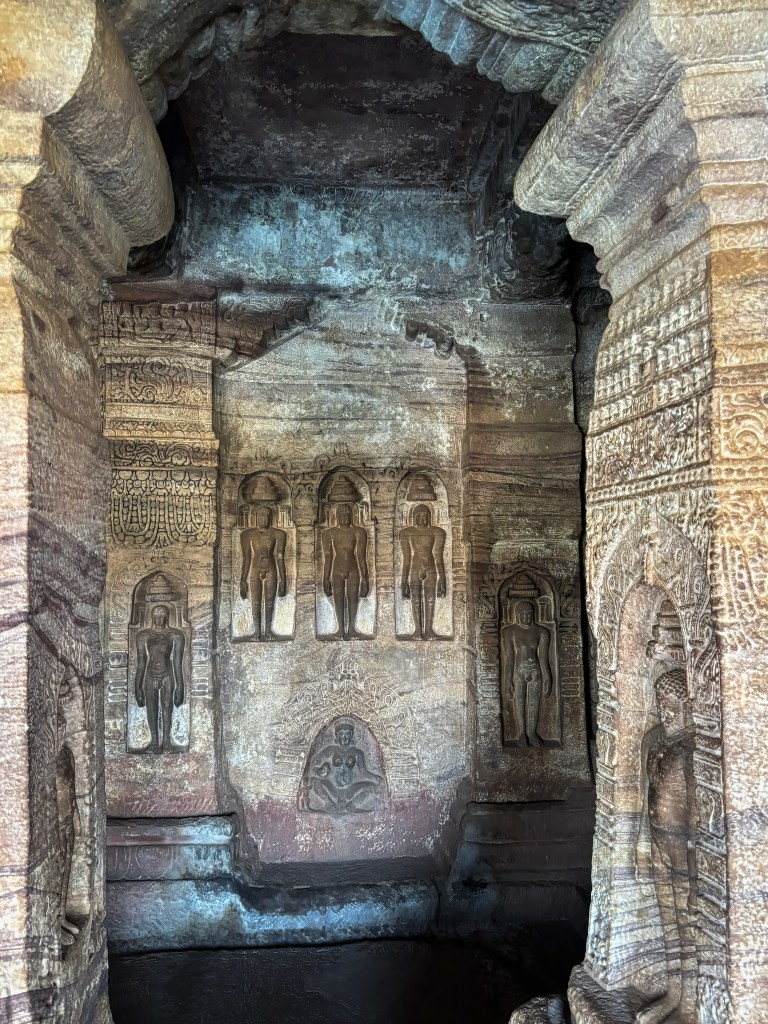
- Other Figures: Smaller carvings of all 24 Tirthankaras, along with Jain deities such as Padmavati, Indrabhuti Gautama, and the female monks Brahmi and Sundari, adorn the pillars and walls
Final Thoughts
A visit to the Badami Cave Temples is a journey into an underrated gem of Indian architectural history. It offers a rare fusion of natural beauty and ancient human ingenuity. It is highly recommended for history lovers and photographers alike, offering stunning views and intricate carvings that will leave you awestruck.
Essential Travel Takeaways
- Plan for a Full Experience: The four main caves can be explored in a couple of hours. However, the area around Badami offers much more. Spend at least a full day in Badami itself. This includes visiting Agastya Lake, the Bhuthanatha Temples, and Badami Fort. Stay for two to three days. Take day trips to the nearby UNESCO World Heritage sites of Aihole and Pattadakal. This will complete the heritage circuit.
- Optimal Timing is Key: The best time to visit is between October and March. During this period, the weather is cooler and more pleasant for outdoor exploration. For the best light, aim for an early morning visit to the caves. To avoid crowds, consider planning your ascent for the late afternoon. This way, you can catch a mesmerizing sunset over the lake and cliffs.
- Physical Preparation: Be ready for a physical climb. The caves are accessed by a series of steep, uneven rock-cut steps. Sturdy, comfortable footwear with good grip is essential. There is no wheelchair access. The climb is manageable for most people but requires careful navigation, especially with children or the elderly.
- Hire a Guide: Hiring a local guide is highly recommended. They can help you truly appreciate the rich history and symbolism. They will also point out the intricate details of the Hindu and Jain carvings.
- Mind the Monkeys: The area is home to many monkeys. Do not carry food or water bottles openly, as they can be quite cheeky and snatch items from your hands

