
Deep in the heart of Karnataka, where the Malaprabha River curves gracefully, lies Pattadakal. It is a UNESCO World Heritage site. This site is the spiritual “cradle of Indian temple architecture”. Travelers exploring the Chalukyan heartland will find the Virupaksha and Mallikarjuna temples as the most magnificent chapter of this stone-carved story.
A Royal Tale of Two Queens
These “twin” temples were not merely religious structures. They were grand political statements commissioned around 745 CE by two sister queens Lokamahadevi and Trailokyamahadevi. These masterpieces were built to celebrate their husband, King Vikramaditya II’s victory over the Pallavas. They represent the pinnacle of Dravidian (Southern) architecture in northern Karnataka.
What to Expect on Your Visit
- The Masterpiece (Virupaksha): This temple is often hailed as the site’s “crown jewel.” The Virupaksha Temple is the only one in the complex that remains an active place of worship today. Its architectural excellence was so profound that it later inspired the world-famous Kailasa Temple at Ellora.
- The Delicate Twin (Mallikarjuna): Standing just beside its neighbor, the Mallikarjuna Temple mirrors Virupaksha’s layout. It offers its own unique charm. The charm includes a distinctive hemispherical tower dome. It also has some of the most delicate narrative carvings in the complex.
- Stone-Carved Epics: Both temples function as stone libraries. As you walk through their pillared halls, you will discover incredibly detailed friezes. These friezes depict scenes from the Ramayana, Mahabharata, and Panchatantra.
Whether you are a history enthusiast or a casual traveler, these two temples offer a rare opportunity. You can see ancient royal devotion perfectly preserved in red sandstone. They also showcase architectural evolution.
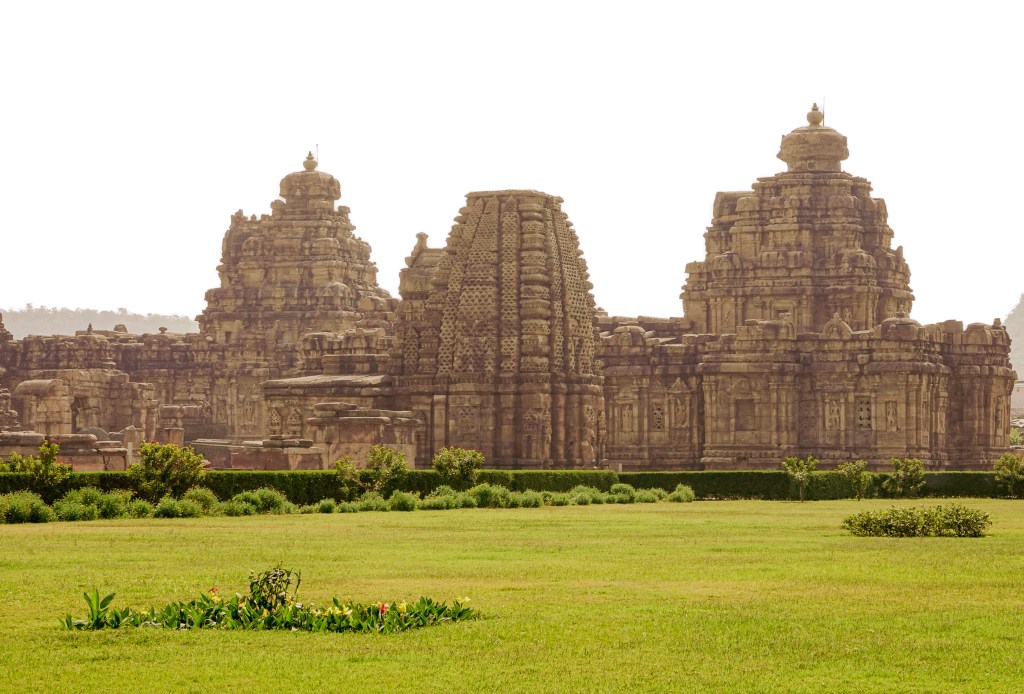
Virupaksha Temple Architecture
- Style: Primarily Dravidian style, described as a fully developed example that served as a model for later grand temples, including the Kailasa temple at Ellora.
- Vimana (Tower): Features a tall, four-story tower with a square top (sikhara). The verticality is emphasized by the structure.
- Plan: It has a large, square plan from the base to the sikhara. The complex is extensive, consisting of a main shrine, a large pillared hall (mandapa) with three porches, a Nandi pavilion, and peripheral sub-shrines enclosed by a compound wall with massive gateways (gopurams).
- Carvings: Known for highly ornate carvings of Hindu deities and detailed narrative panels from the Ramayana, Mahabharata, and Panchatantra.
- Unique Feature: It is the earliest known full temple complex in the Chalukyan series with a fully formed architectural plan.
Mallikarjuna Temple Architecture
- Style: Also built in the Dravidian style, it is a slightly smaller version of the Virupaksha temple.
- Vimana (Tower): It has a four-story tower, but it is crowned with a hemispherical or circular top (griva and sikhara), a key difference from the Virupaksha temple.
- Plan: It shares a similar square plan and layout to its twin, including a large pillared hall and a Nandi mandapa.
- Carvings: The temple features equally rich sculptures and friezes depicting stories from the epics, similar in style to the Virupaksha temple.
Both temples represent the peak of Dravidian architecture under the Chalukyas. However, the primary architectural distinction between them is in the shape of their crowning elements. It is square for Virupaksha. It is circular for Mallikarjuna.
Exploring the Virupaksha Temple
We spent considerable time walking around the Virupaksha temple, which is dedicated to Shiva. It is the only functioning shrine in the temple complex. It is also among the popular places to visit in Pattadakal. The temple was constructed in 745 AD. Queen Lokamahadevi, consort of the Chalukyan ruler Vikramaditya, built it. She did this to commemorate his victory over the Pallavas of Kanchi.
The temple is built in the Dravidian style of architecture. It has three mukhamandapas on three sides. There is a large stone gateway on the East towards Malaprabha River. A large pillared hall is followed by a sanctum with a circular path for pradakshinas. The mukhamandapas and the pillars of the hall have wonderful carvings of gods. They also depict scenes from the Ramayana and the Mahabharata.
Innovative Ceiling Design Solutions
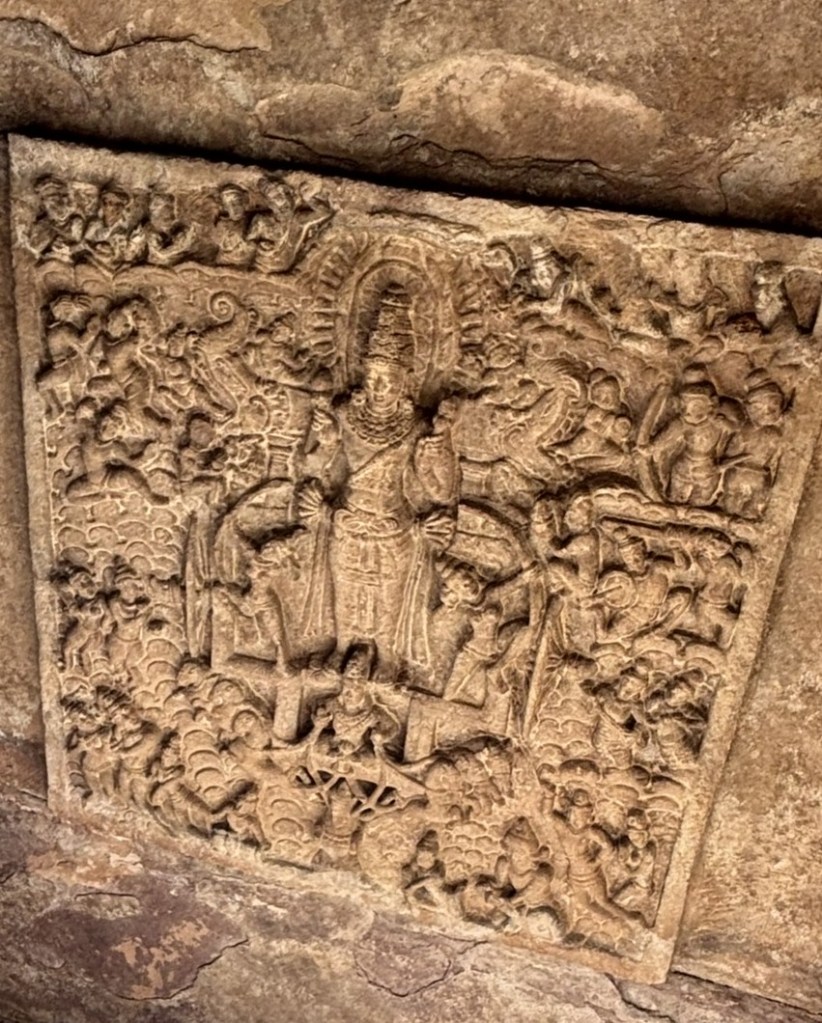
The main highlight is the sculpture of Surya riding a chariot through the clouds. Aruna, his driver, directs the chariot with archers aiming their bows outward to either side. This sculpture is found on the ceiling of the Eastern Mukhamandapa. The details on this intricate carvings are incredible.
Sculptural Narratives and Artistic Edges
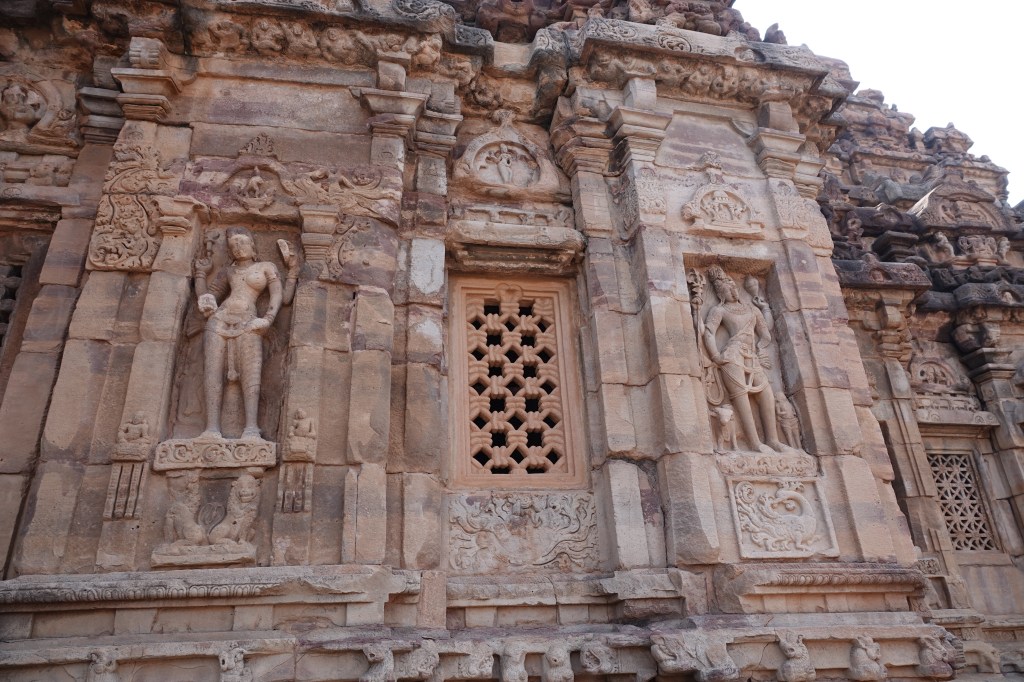
Sculptures of various gods and goddesses are prevalent throughout the temple. They include Shiva in different aspects like Nataraja, the dancing Shiva, and Ardhanarishvara, half-Shiva, half-Parvati. There are also Vishnu avatars such as Narasimha and Varaha. Additionally, Durga is depicted slaying the Mahishasura demon. Ganesha and Surya, the Sun god, are also featured.
Puranic themes and Vedic legends include:
Shiva and Parvati with Ravana lifting Mount Kailash.
The churning of the ocean (Samudra Manthan).
Durga slaying the buffalo demon Mahishasura.
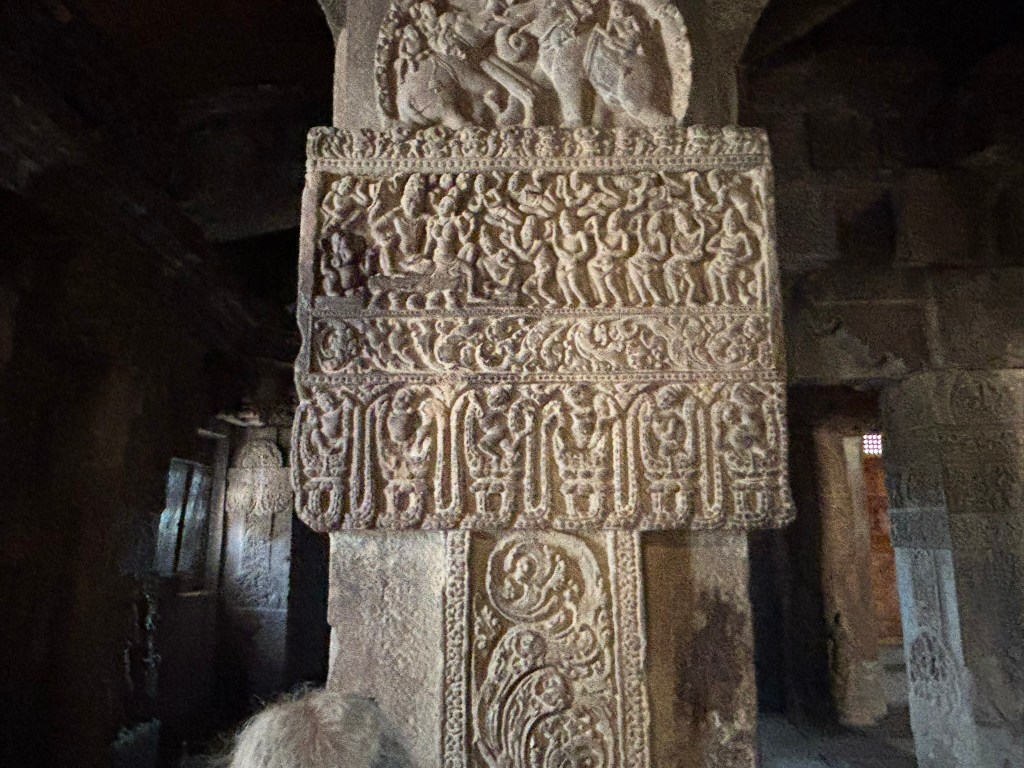
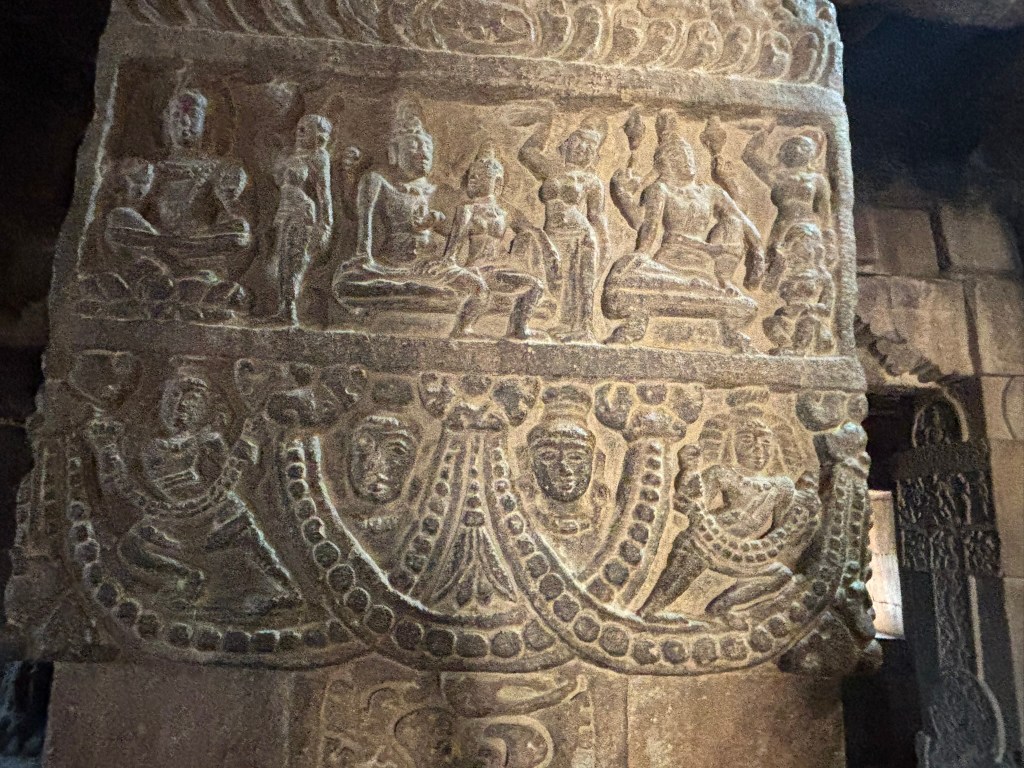
Ramayana and Mahabharata: Many scenes from the Ramayana and Mahabharata are carved throughout the halls. The carvings also include stories from the Bhagavata Purana and Panchatantra fables on the exterior walls.
- Ramayana episodes shown include the golden deer incident, the abduction of Sita by Ravana, the fight between Ravana and the demigod Jatayu, and Lakshmana cutting off Shurpanakha’s nose.
- Mahabharata narratives are also present. For example, there is the confrontation between Arjuna and Karna. Another instance is Bhishma Pitamah lying on a bed of arrows.
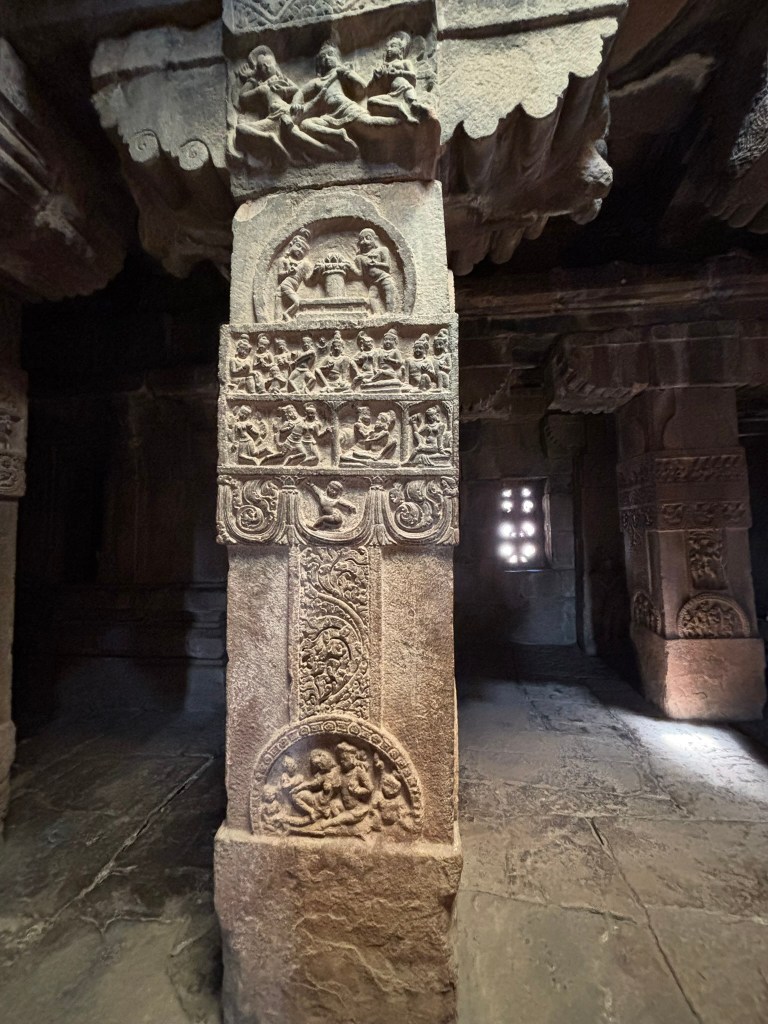
Narrative Friezes: The pillar above illustrates episodes primarily from the Ramayana epic, specifically from the Aranya Khanda section depicting:
- Shurpanakha confronting Rama and Lakshmana.
- Lakshmana mutilating Shurpanakha’s nose.
- Khara and Dushana (demon brothers) fighting Rama and Lakshmana.
- The demon Maricha in disguise as the golden deer.
- Ravana approaching Sita’s hut in the disguise of a sage
These highly detailed carvings provide a vivid glimpse into the craftsmanship and religious worldview of the 8th-century Early Chalukyan period.
Having a professional guide is advised, as they can show the key structures and share information about various carvings. Below is one of the scenes in the interior mantapa being explained by our guide. The carvings depict scenes from the Hindu epic, the Mahabharata. The middle panel is believed to show Bhishma lying on a bed of arrows. The bottom panel depicts Bhima fighting Duryodhana.
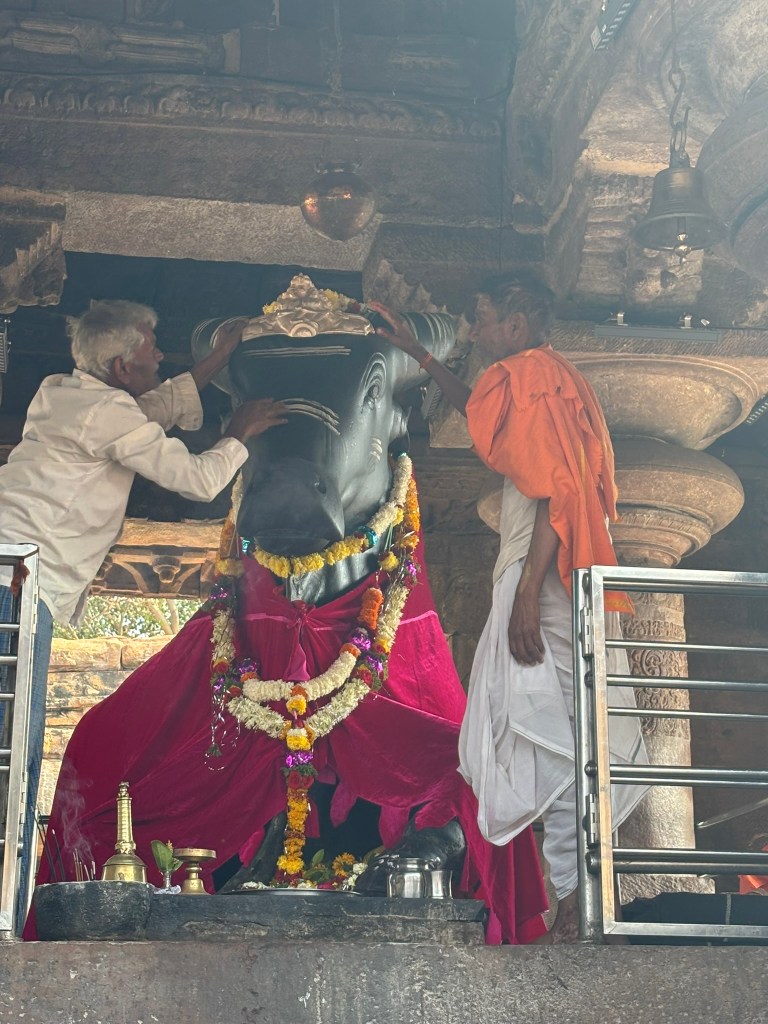
Monolithic Nandi: A large, black stone sculpture of Nandi, the bull vehicle of Lord Shiva. It is housed in a separate mantapa (hall) in front of the Virupaksha temple entrance. Witnessing the craftsmanship and precision needed to carve a single stone into such a detailed form is astonishing.
Mallikarjuna Temple
The Mallikarjuna Temple is also a Shiva temple commissioned by Queen Trailokamahadevi. This temple is similar to the adjacent Virupaksha Temple, but less decorated and weather-worn.
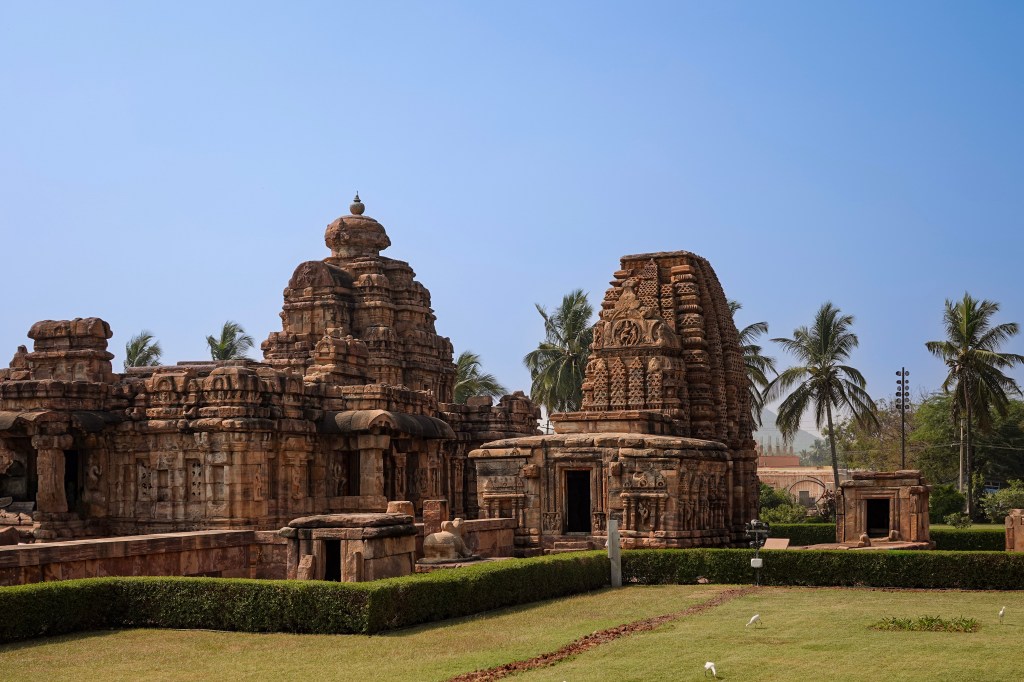
Structural Layout and Composition
- Plan: The temple follows an axial layout facing east. It consists of a square garbhagriha (sanctum), an antarala (antechamber), and a large pillared sabha-mandapa (community hall).
- Entrances: It features three mukhamandapas (entrance porches) located on the eastern, northern, and southern sides.
- Pradakshina Patha: The sanctum is surrounded by a covered circumambulatory path. This was a well-established tradition by the time of its construction.
- Nandi Mandapa: A separate, four-pillared pavilion for Nandi stands in front of the main temple complex. However, it is now partially collapsed.
Architectural Elements
- Superstructure (Vimana): The temple has a four-storeyed vimana. The Mallikarjuna’s tower is distinctive for its hemispherical (circular) roof. It differs from the square roof of the nearby Virupaksha Temple. The dome is another unique feature.
- Tower Cap: The tower is topped by a circular griva (neck). It also has a hemispherical shikhara (dome). The structure is capped with a stupi or kalasha.
- Platform (Adhishthana): The structure stands on a high, five-moulded plinth. It is decorated with friezes of animals, including elephants and lions. It also features floral motifs.
Decorative Innovations
- Pillars and Ceilings: The 18 pillars of the inner hall are intricately carved. They feature narrative panels depicting scenes from the Ramayana. Some scenes also come from the Mahabharata and Panchatantra. The ceilings are adorned with beautiful figures of Gajalakshmi and Shiva-Parvati with Nandi.
- Sukanasa: The sukanasa is a prominent arched projection on the front of the tower. It houses a relief of Nataraja (dancing Shiva).
- External Walls: The exterior walls are divided by pilasters into niches that alternate with perforated windows (pierced stone screens). These niches contain various sculptures of Hindu deities. They also feature detailed friezes of amorous couples (mithuna). Single women are depicted showing diverse emotional expressions.
Final thoughts
The Virupaksha and Mallikarjuna temples stand as the crowning achievements of this historical ensemble. Often called the “twin temples,” they are more than just stone monuments. They are a testament to the artistic rivalry and devotion of two sister-queens, Lokamahadevi and Trailokyamahadevi. Visiting these temples isn’t just about ticking off a UNESCO site. It’s about experiencing the pinnacle of Chalukyan architectural evolution.
Terminologies used in describing temple architecture
- Vimana: The pyramidal or stepped-pyramid tower located directly above the main sanctum.
- Garbhagriha: Literally “womb chamber,” this is the innermost, windowless sanctum housing the primary deity.
- Gopuram: A monumental, ornate gateway tower providing entry into the temple complex. In later periods, gopurams often became taller than the central vimana.
- Shikhara: In the Dravida style, this refers specifically to the crowning dome-shaped element at the very top of the vimana. (Note: In North Indian architecture, “Shikhara” refers to the entire tower).
- Mandapam: Pillared halls or porches used for public rituals, gatherings, or as a transition to the sanctum.
- Prakaram: The enclosed courtyard or circumambulatory path surrounding the main temple structures.
- Pushkarini (Kalyani): A ritual bathing tank or reservoir found within the temple complex.
- Antarala: A vestibular tunnel connecting the mandapa to the garbhagriha.
Decorative and Vertical Elements
- Stupi (Kalasha): The final crowning pot or finial placed on top of the shikhara.
- Dvarapalas: Fierce “door-keepers” or guardian sculptures flanking the entrance to the sanctum.
- Adhisthana: The highly decorated base or pedestal on which the entire temple structure stands.
- Prastara: The entablature or horizontal beam that marks the transition between the walls and the spire.
- Yali (Vyala): A mythical creature, often with the face of a lion, used as a decorative pillar motif.
- Nasi: A decorative horseshoe-shaped arch motif, often found on the exterior of the vimana.
 Peaks to Palaces