Skip the long ticket lines at the National Palace. If you want to experience the raw power of the Mexican Muralism movement without fighting crowds of tourists, you need to head to a functioning government building just blocks from the Zócalo: the Ministry of Public Education (Secretaría de Educación Pública, or SEP).
Here is everything a traveler needs to know to visit this hidden-in-plain-sight masterpiece
- Why This Belongs on Your Mexico City Itinerary
- What to Look For: Navigating the Courtyards
- Essential Travel Logistics
- The Ultimate Monday Travel Hack
- Quick Tips for Your Visit
- Where to find other murals of Diego Rivera
- Final thoughts on Diego Rivera and his art
Why This Belongs on Your Mexico City Itinerary
Most travelers pack into the Palacio de Bellas Artes or wait hours in the sun to see Rivera’s work at the National Palace. The SEP offers something completely different: peace, quiet, and unprecedented access.
Because this is an active government headquarters—not a traditional museum—it remains largely undiscovered by mass tourism. You can stand inches away from 120 original fresco panels painted by Diego Rivera between 1923 and 1928, completely alone, listening only to the faint echo of footsteps across the stone courtyards.
What to Look For: Navigating the Courtyards
The building features two massive, three-story open-air courtyards. Rivera structured them like a physical book of Mexican identity.
The Courtyard of Labor (Patio de los Trabajos)
The Court of Labor murals convey a powerful post-revolutionary narrative that celebrates the dignity, strength, and foundational power of the Mexican working class while critiquing their exploitation under corporate capitalism. By depicting laborers as Christ-like martyrs and anonymous cogs in industrial assembly lines, Diego Rivera exposed the brutal physical toll of foreign-owned mining and agro-industries. Concurrently, he elevated traditional Indigenous crafts and agricultural practices into monumental high art, framing native knowledge and communal labor as inseparable from the Mexican soil. Strategically placed on the building’s ground floor, these panels visually argue that the raw sweat and manual labor of the common worker form the literal structural foundation supporting the entire nation’s intellectual, cultural, and political progress.
Some of the murals that caught my eyes were
Tehuantepec Women (Mujeres tehuantepecas)
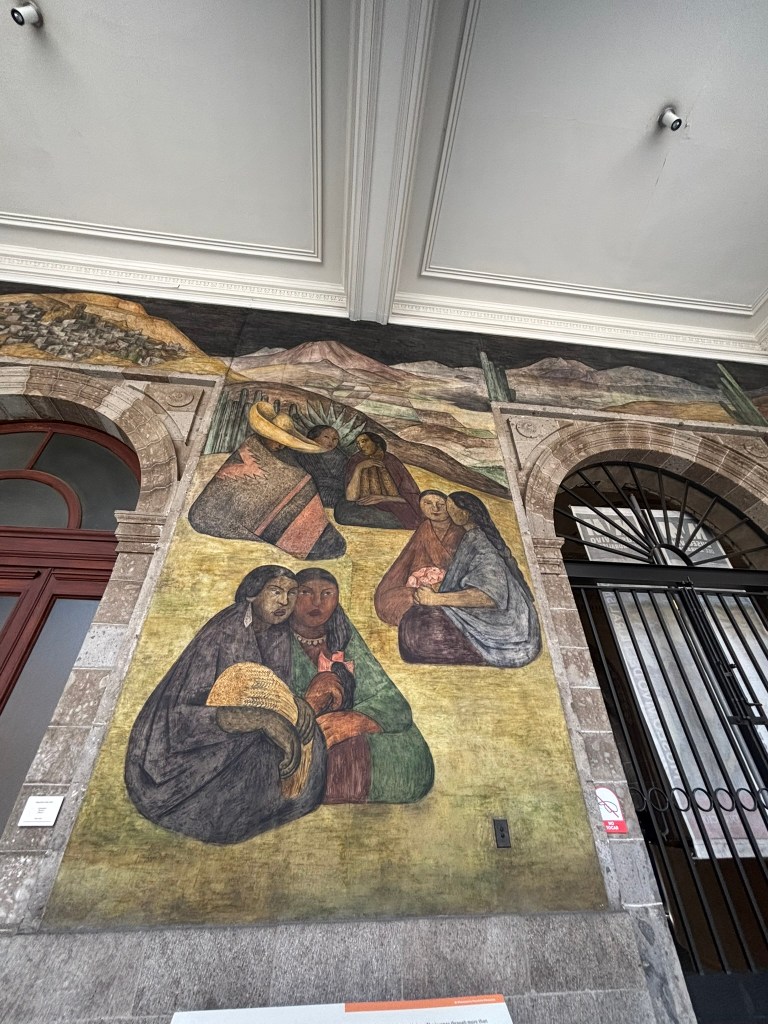
- Where to Find It: On the ground floor of the Court of Labor corridor, along the south wall.
- What It Shows: This panel honors the Indigenous Zapotec women (Tehuanas) from the Isthmus of Tehuantepec in Oaxaca, Mexico. Two women sit prominently in the foreground; one cradles a woven straw basket, while the other holds a bright flower. Behind them, other community members sit against a backdrop of rolling, arid hills and tall cacti. Diego Rivera used this composition to celebrate the dignity, strength, and traditional clothing of Mexico’s southern Indigenous cultures, turning everyday regional life into monumental public art. We can also see the influence of Pablo Picasso’s cubism in this mural
Leaving the Mine (Salida de la mina)
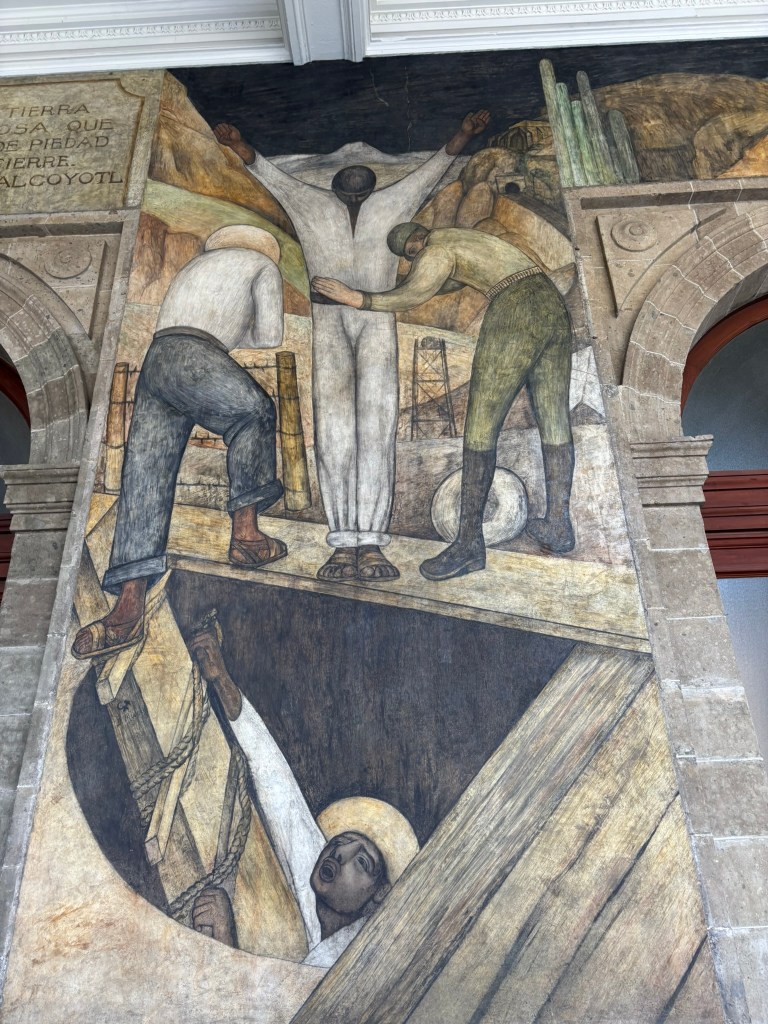
- Where to Find It: On the ground floor of the Court of Labor, sitting directly adjacent to the Entrada a la mina (Entry into the Mine) panel.
- What It Shows: This powerful fresco exposes the harsh exploitation of the Mexican working class by foreign corporate interests. It depicts a miner standing on a wooden platform at the end of his grueling shift, holding his hands out to be searched by an armed guard to ensure no silver ore is being stolen. Rivera intentionally painted the miner in an open, Christ-like crucifixion pose to frame the laborer as a tragic martyr sacrificing his body for industrial greed, while the dark mine opening below resembles a gaping maw demanding human sacrifice. Pablo Picaso’s cubism in this mural.
Tehuana Women with Fruit (Mujeres tehuantepecas)
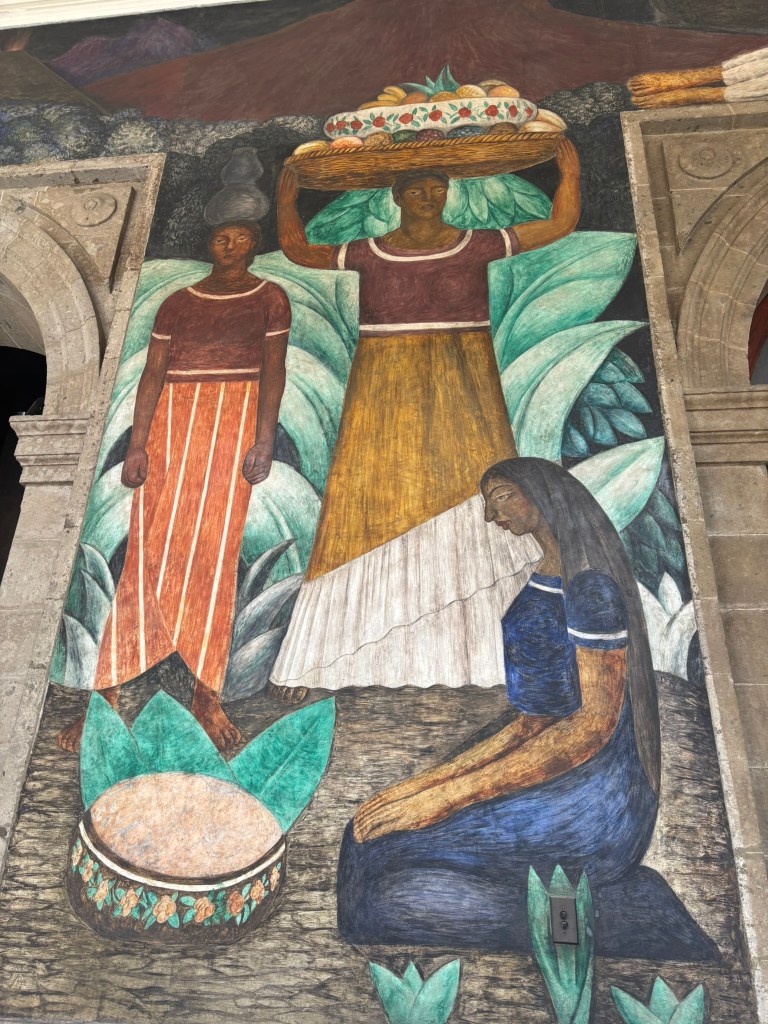
Where to Find It: On the ground floor of the Court of Labor, forming a thematic pair with the first Oaxacan-themed mural.
What It Shows: This panel focuses on the agricultural abundance and physical grace of the women of Tehuantepec. A central woman stands tall and proud, balancing a massive woven basket overflowing with tropical fruits—including pineapples, melons, and bananas—directly on her head. To her left, another woman balances a clay water jug on her shoulder, while a third woman kneels in the foreground beside a traditional painted gourd vessel resting on vibrant green banana leaves, illustrating the rich bounty of Mexico’s tropical south.
The Sugar Mill (El trapiche)
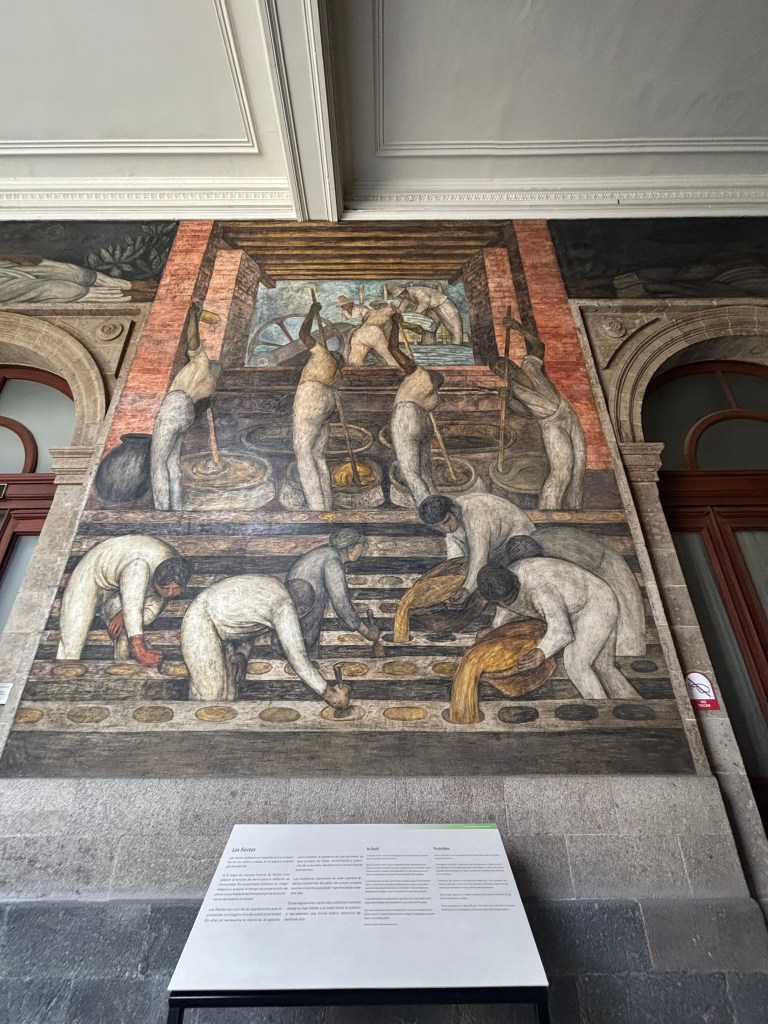
Where to Find It: On the ground floor of the Court of Labor along the north wall of the building.
What It Means: This stark, geometric mural critiques the physical toll of agro-industrial processing by documenting the grueling, repetitive grind of workers refining sugarcane. The composition is divided into two rhythmic rows: the top tier shows four laborers using long poles to stir boiling vats of raw cane juice beneath a heavy wooden milling wheel, while the bottom tier depicts five workers hunched completely in half to pour molten golden syrup into small, circular floor molds to solidify into piloncillo. Rivera deliberately rendered the figures as anonymous, uniform cogs dressed in identical white cotton garments to illustrate how modern corporate machinery transforms individual human beings into a collective production line, functioning as a powerful visual twin to his nearby silver mining panels
The Dyers (Los tintoreros)
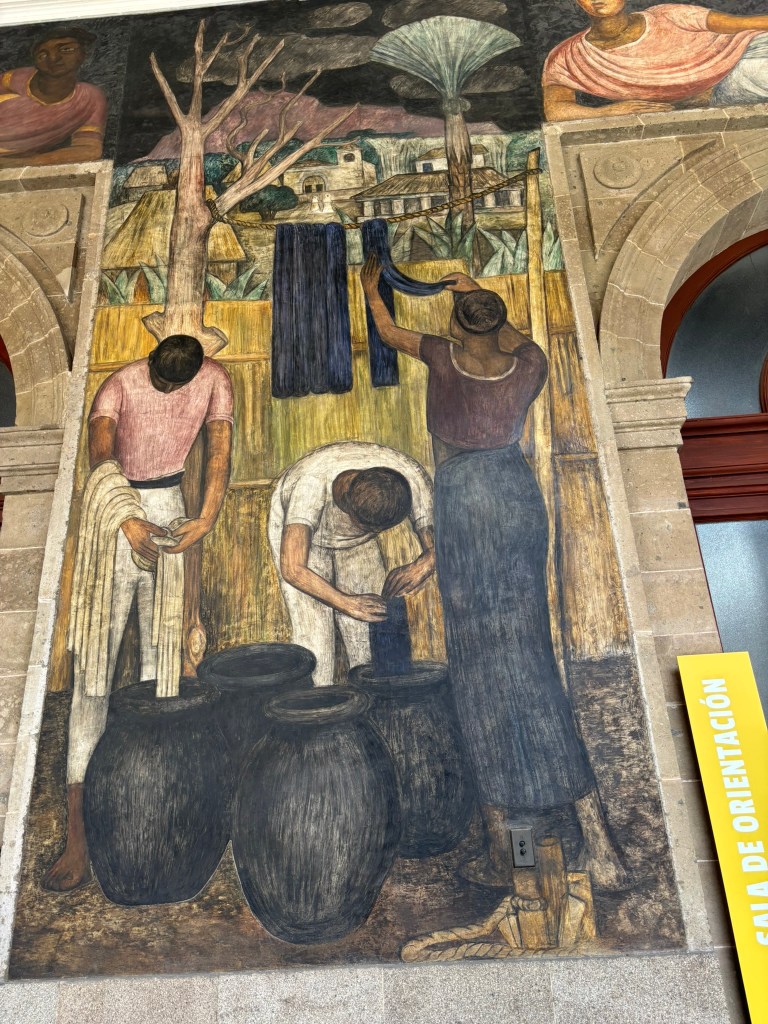
What It Means: This vibrant fresco honors pre-industrial, Indigenous economic traditions by detailing three textile artisans processing fabrics with natural pigments in the tropical, southern region of Tehuantepec, Oaxaca. In the foreground, two men bend deeply over massive, dark ceramic boiling vats to saturate fabrics in rich indigo dyes, while a woman to the right carefully hangs a wet, dark blue textile to dry on a clothesline strung between trees against a background of rolling hills and thatched-roof huts. Diego Rivera purposely placed these historic artisan trades on the same monumental scale as heavy industrial mining to send a clear political message: the masterful craftsmanship of rural Indigenous communities is just as vital and heroic to the foundation of modern Mexico as modern factory labor.
Where to Find It: On the ground floor of the Court of Labor along the south wall of the main headquarters.
The Courtyard of Fiestas (Patio de las Fiestas)
The Courtyard of Fiestas (Patio de las Fiestas) contrasts the hardships of labor by celebrating the vibrant spiritual, seasonal, and communal traditions that bind the Mexican identity together. Through crowded, dynamic scenes like The Day of the Dead and The Maize Festival, the murals capture the chaotic energy, music, and colorful pageantry of traditional street celebrations. Diego Rivera and his contemporaries modeled these festivalgoers after monumental pre-Columbian sculptures, visually anchoring the idea that indigenous rituals and community joy are deeply rooted in the nation’s history.
La Zandunga
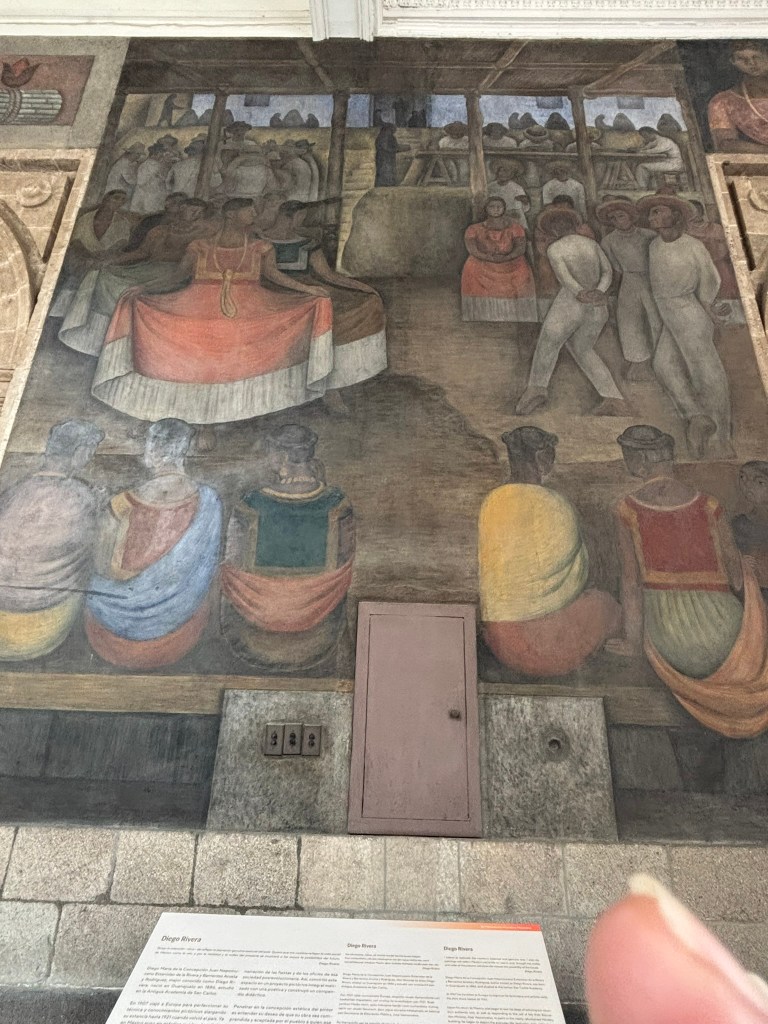
Where to Find It: On the ground floor of the Court of Fiesta along the south wall of the building.
What It Means: This vibrant, culturally rich mural celebrates the resilient regional traditions and indigenous pride of southern Mexico by documenting the lively festive spirit of the Isthmus of Tehuantepec. The composition is divided into a deep, tiered gathering space: the central focus highlights a group of elegant Tehuana women in their iconic flowing, wide-brimmed skirts performing alongside male partners in traditional white garments, while the foreground depicts a row of seated onlookers watching the scene from below with reverent attention. Rivera deliberately organized this section of the courtyard geographically to honor rural culture, rendering the collective celebration as an assertion of communal solidarity and a powerful visual testament to post-revolutionary Mexican identity.
The Market (El mercado)
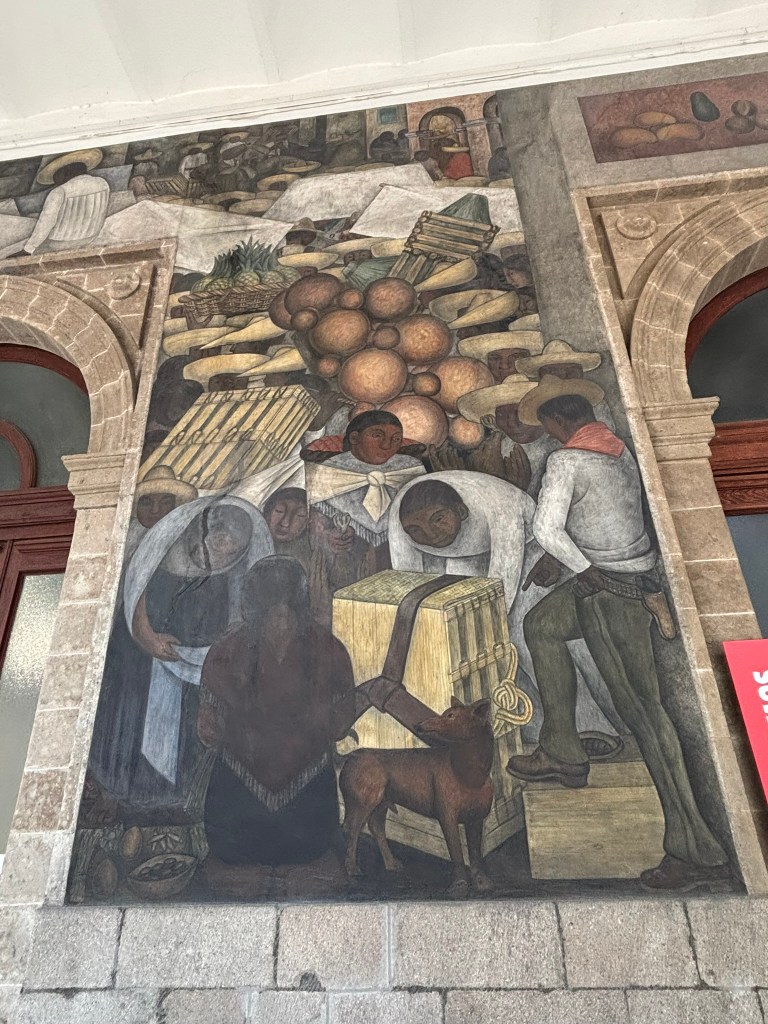
Where to Find It: On the ground floor of the Court of Fiestas along the north wall of the building.
What It Means: This bustling, dense mural celebrates the foundational role of indigenous commerce and agrarian production by documenting a traditional open-air tianguis market. The composition is built on a heavily crowded, layered vertical arrangement: the upper sections feature baskets overflowing with pineapples, maize, and stacks of regional produce beneath rows of broad-brimmed straw hats, while the central foreground zooms in on a family arranging a large wooden slat crate secured with woven straps, alongside a loyal hairless Xoloitzcuintli dog. Rivera deliberately used this space to pivot away from industrialized, foreign-owned factories, rendering this sensory marketplace as an alternative center of economic autonomy, communal unity, and authentic pre-Hispanic mexicanidad that sustained rural Mexican societies across generations
The Little Bull (El torito) by Amado de la Cueva
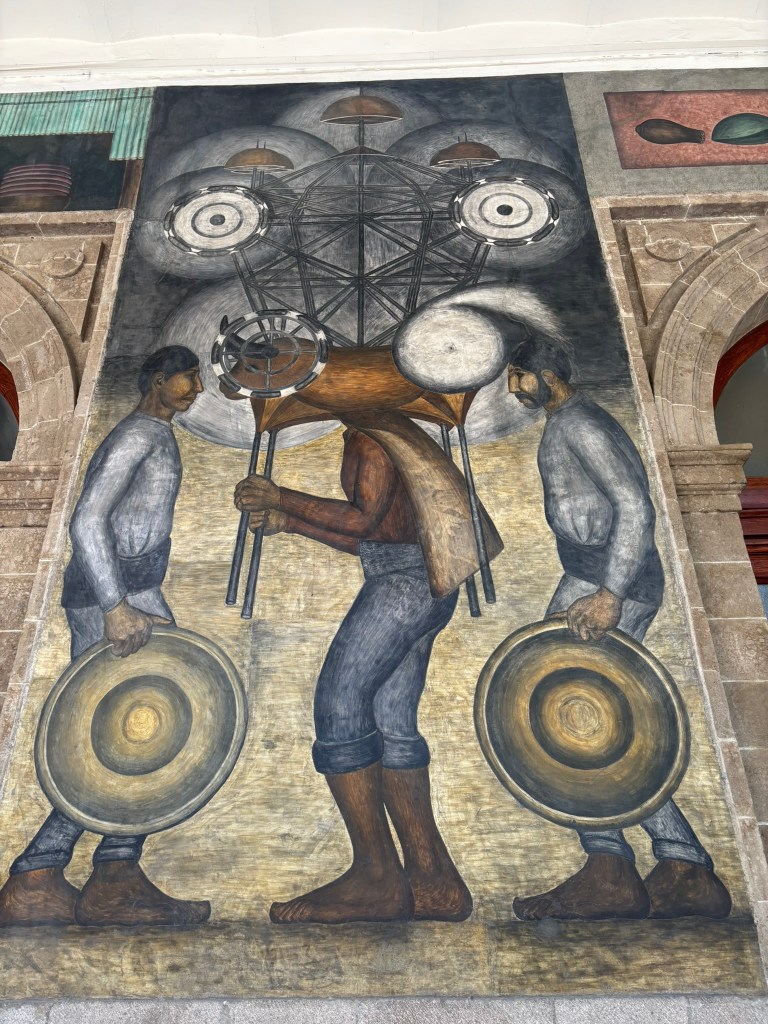
Where to Find It: On the ground floor of the Court of Fiestas along the north wall of the building.
What It Means: This hypnotic, dynamically geometric mural celebrates the vibrant ephemerality of Mexican festive folklore by documenting the traditional pyrotechnic custom of el torito (the little bull). The composition is constructed around a towering, symmetric mechanical armature: the upper background features an intricate network of metal frameworks holding sparking Catherine wheels and exploding firework pinwheels against a dark night sky, while the central focal point highlights a brave bearer lifting the heavy, bull-shaped wicker framing over his head as two flanking figures shield themselves with large circular wooden targets. Amado de la Cueva—one of the few early muralists commissioned to contribute alongside Rivera’s vast project—deliberately focused on the raw, explosive energy of communal celebrations, rendering this dangerous folk performance as an assertion of ancestral memory, popular ingenuity, and the fiery spirit of post-revolutionary community bonding.
Ribbon Dance (La danza de los listones)
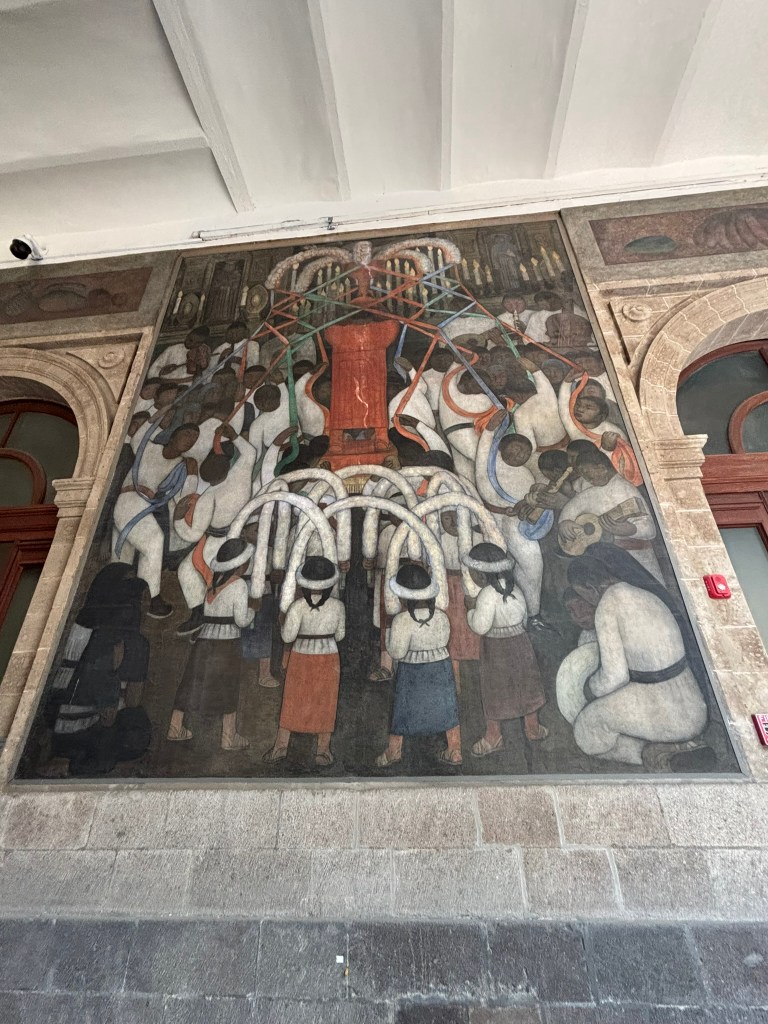
Where to Find It: On the ground floor of the Court of Fiestas along the north wall of the building.
What It Means: This vibrant, ritualistic mural celebrates agricultural fertility and communal harmony by documenting the festive symbiosis of nature and traditional folklore. The composition is constructed around a soaring, layered ceremonial arrangement: the upper section centers on a tall, radiant orange Maypole radiating colorful ribbons like solar rays, held aloft by dynamic lines of workers weaving beneath it, while the foreground showcases young dancers holding curved, floral-wrapped archways aloft in perfect rhythmic unison. Rivera deliberately fused two distinct regional traditions—the dance of the ribbons (listones) and the dance of the arches (arcos)—to represent humanity’s ancestral desire to integrate with natural cycles, rendering this synchronized performance as a profound statement of social unity, mutual respect, and post-revolutionary collective pride.
The Day of the Dead – The Street (El Día de Muertos – La calle)
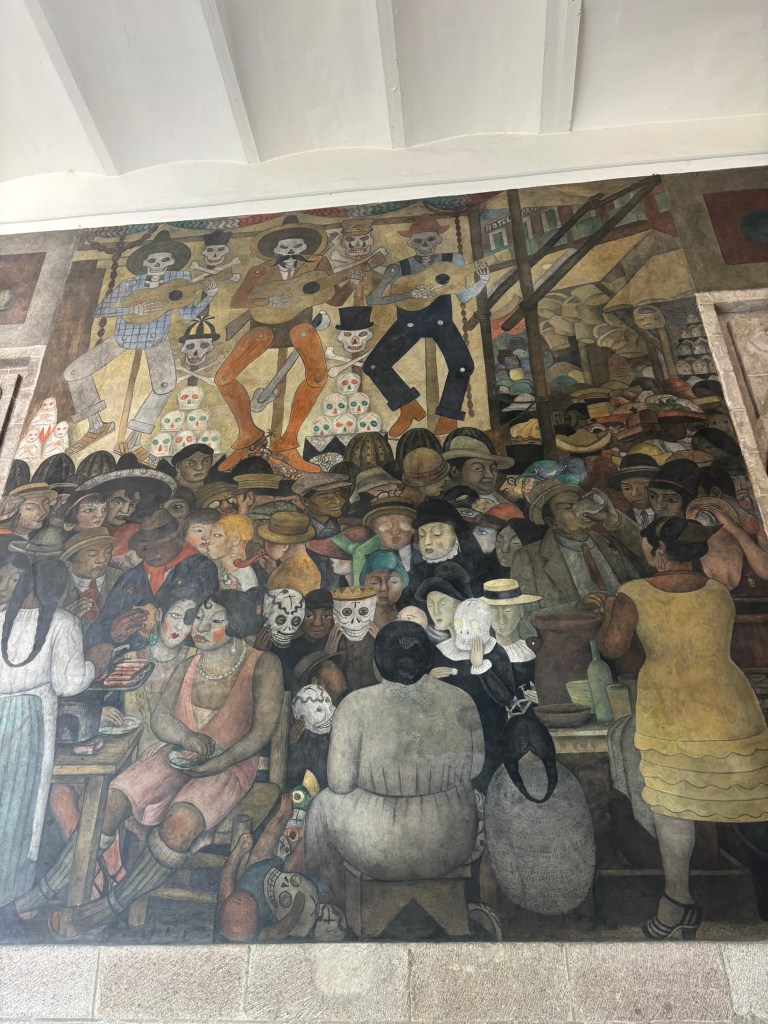
Where to Find It: On the ground floor of the Court of Fiestas along the east wall of the building.
What It Means: This complex, deeply satirical mural explores the socio-political undercurrents of Mexican society by documenting the public celebrations of the Day of the Dead. The composition is built on a layered, contrasting arrangement: the upper register features a mariachi band of skeletal calaveras playing guitars beneath crossbones, while the dense, claustrophobic foreground gathers a cross-section of Mexican society including working-class laborers, indigenous children wearing skull masks, and wealthy, caricatured bourgeoisie figures indulging in food and drink. Rivera deliberately used this iconic festival as a great equalizer, weaving a sharp critique of post-revolutionary class divisions to show how death unites all strata of society, rendering this popular urban gathering as a profound statement on social justice, cultural resilience, and the unique Mexican philosophy toward mortality.
The Top Floor (The Political Manifesto)
Walk up the stone staircases to the highest level. Here, Rivera illustrated revolutionary folk songs. Look closely at the faces—Rivera painted his famous wife, Frida Kahlo, into the mural The Insurrection, depicting her as a fierce revolutionary handing out weapons to soldiers. I didn’t get a chance to go upstairs on this trip, but I’m hoping to go back and see more on my next trip to Mexico City.
Essential Travel Logistics
Where Is It?
The building is located at República de Argentina 28 in the Historic Center (Centro Histórico). It is a quick 5-minute walk northeast of the Zócalo or the Metropolitan Cathedral.
How to Get In (The Security Process)
Because it is a working government office, getting in requires a minor security check:
- Bring a physical ID: You must present a valid passport or driver’s license to the armed guards at the gate. Digital copies on your phone will not work.
- The Exchange: Security will keep your ID at the front desk and give you a plastic visitor’s badge. You will swap the badge back for your ID when you leave.
- Cost: Entrance is completely free.
The Ultimate Monday Travel Hack
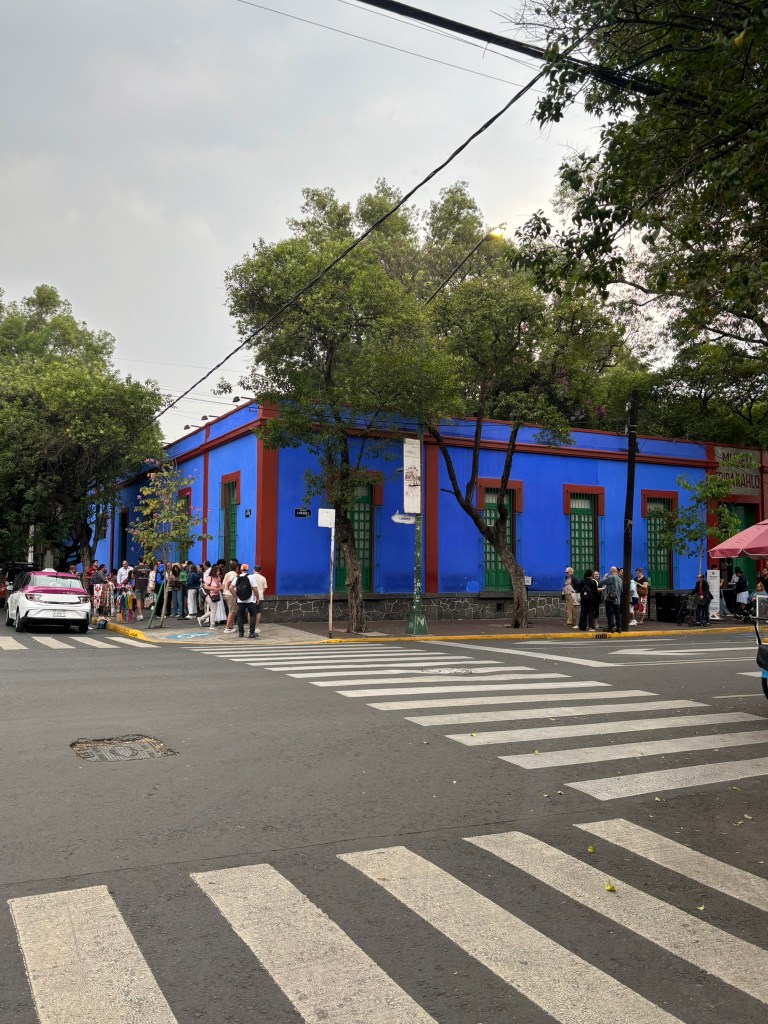
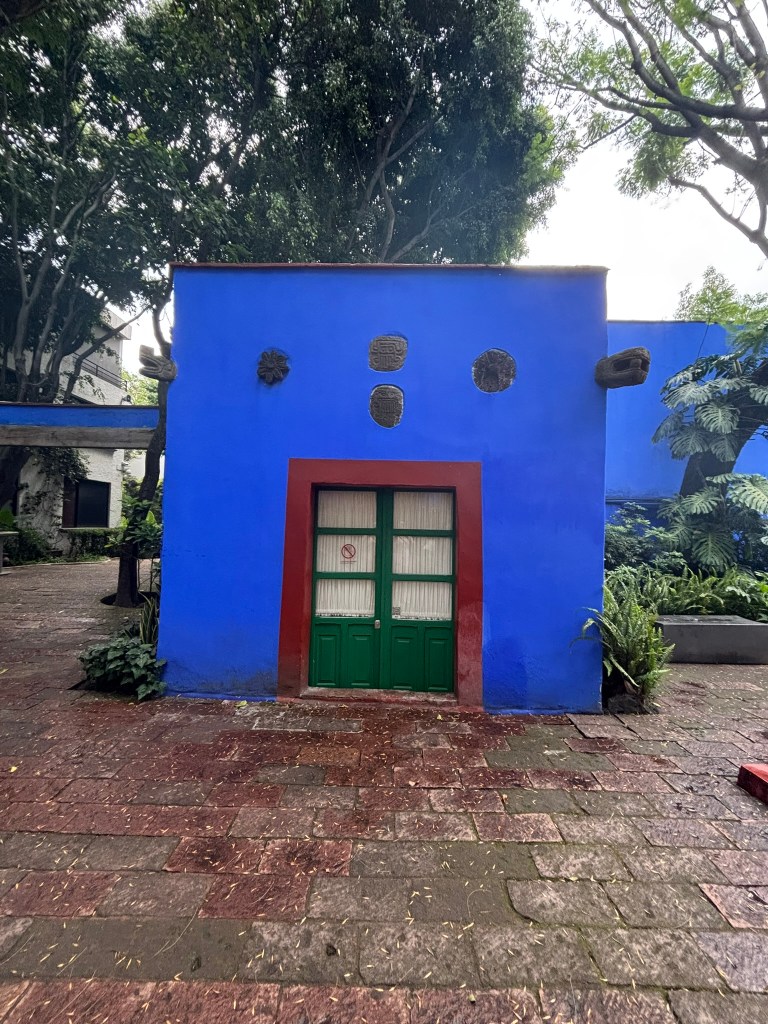
Almost every major museum in Mexico City—including the Anthropology Museum, Frida Kahlo’s Blue House, and Bellas Artes—is closed on Mondays. The SEP murals are open on Mondays.
- Hours: Monday, and Wednesday through Sunday from 10:00 AM to 5:30 PM.
- Weekly Closure: The building is closed on Tuesdays.
Quick Tips for Your Visit
- Look up at the stairwells: Rivera didn’t just paint the courtyard walls; the main stairwell features sweeping landscapes of Mexico’s tropical regions.
- Accessibility note: The ground floor courtyards are flat and easy to navigate, but the historic elevators to the upper floors are often restricted for official use only.
- Guide: It is good to have a guide with you to explain the different murals. I went with City Unscripted, booked through Viator as a private tour
Where to find other murals of Diego Rivera
To truly grasp the complex, layered soul of Mexican history, traveling through Diego Rivera’s monumental murals is an absolute necessity. Across his massive frescoes, Rivera transformed public walls into living history books, weaving together thousands of years of indigenous resilience, the trauma of the Conquest, and the fiery triumphs of the Revolution into a singular, breathtaking narrative. I didn’t get to see all of his murals on this trip, but hoping the cover more next time I am in Mexico
Downtown (Centro Histórico)
- Palacio Nacional (National Palace): Located on the main Zócalo plaza, the grand stairwell houses his masterpiece, “The History of Mexico” (Epopeya del pueblo mexicano). Spanning three massive walls, it chronicles thousands of years of Mexican history from pre-Hispanic Mesoamerica through the Conquest and Revolution.
- Note: Entry usually requires booking a free guided tour and presenting an official government ID/passport. You need to stand in line early to get the tickets to enter the parliament building
- Palacio de Bellas Artes (Palace of Fine Arts): Located on the edge of Alameda Central, the top floors host “Man, Controller of the Universe” (El hombre controlador del universo). This is Rivera’s meticulous recreation of the infamous Man at the Crossroads fresco, commissioned by the Rockefeller family in New York and subsequently destroyed for its inclusion of Vladimir Lenin.
- Museo Mural Diego Rivera: This dedicated museum was built specifically to house just one breathtaking masterpiece: “Dream of a Sunday Afternoon in the Alameda Central” (Sueño de una tarde dominical en la Alameda Central). The 15-meter fresco acts as a surreal timeline of Mexican history featuring iconic historical figures, a self-portrait of Rivera as a child, Frida Kahlo, and the elegant skeleton La Catrina.
- Antiguo Colegio de San Ildefonso: Considered the cradle of the Mexican Muralism movement, the Amphitheater Simón Bolívar inside this former college houses Rivera’s very first mural, “Creation” (La creación, 1922). It features a unique blend of religious symbolism and Greek muses painted before he fully adopted his signature revolutionary, indigenous style.
- Mercado Abelardo L. Rodríguez: A bustling public market where Rivera’s students painted expansive social-realist scenes under his direct supervision.
- Cárcamo de Dolores (Dolores Waterworks): Located in the second section of Chapultepec Park, this unique indoor-outdoor installation features the mural “Water, the Source of Life” (Agua, el origen de la vida). Painted entirely inside a deep-water basin, it is paired with a massive outdoor tiled mosaic fountain of the Aztec rain god, Tlaloc.
- Teatro de los Insurgentes: Located along Avenida de los Insurgentes Sur, the entire facade of this mid-century theater features a massive, 46-meter long glass mosaic mural designed by Rivera. It chronicles the History of Theater in Mexico and centers around a prominent portrait of the iconic Mexican comic actor, Cantinflas.
- Estadio Olímpico Universitario (UNAM): The main exterior wall of the university’s Olympic stadium features a relief mural made from colorful natural stones titled “The University, the Family and Sport in Mexico”.
- Anahuacalli Museum: Designed by Rivera himself out of dark volcanic stone to hold his massive collection of pre-Columbian artifacts, the museum also showcases several of his early sketches, drafts, and layout designs for his most famous murals.
Final thoughts on Diego Rivera and his art
Standing before the monumental murals of Mexico City, it is incredibly easy to experience a sharp tug-of-war between loving the art and disliking the man behind the brush. It is a well-documented sentiment that my tour guide settled perfectly: like any monumental artist, Diego Rivera had layers. While it is easy to condemn his tumultuous personal life and legendary infidelity, digging into his history reveals an artist deeply shaped by early psychological fracturing. Being raised by his indigenous Tarascan nanny, Antonia, after experiencing emotional abandonment by his mother, instilled in him a profound reverence for native women that radiates from his vibrant canvases, even as it manifested as a deep-seated resentment and disrespect toward white women later in life. This stark emotional contrast breathes an uncomfortable, human reality into his masterpieces. You don’t have to excuse Rivera’s personal flaws to be deeply moved by his work; instead, understanding the childhood traumas that molded his brushstrokes allows you to appreciate how a deeply broken man could still elevate Mexico’s indigenous working class to an unrivaled peak of artistic dignity.