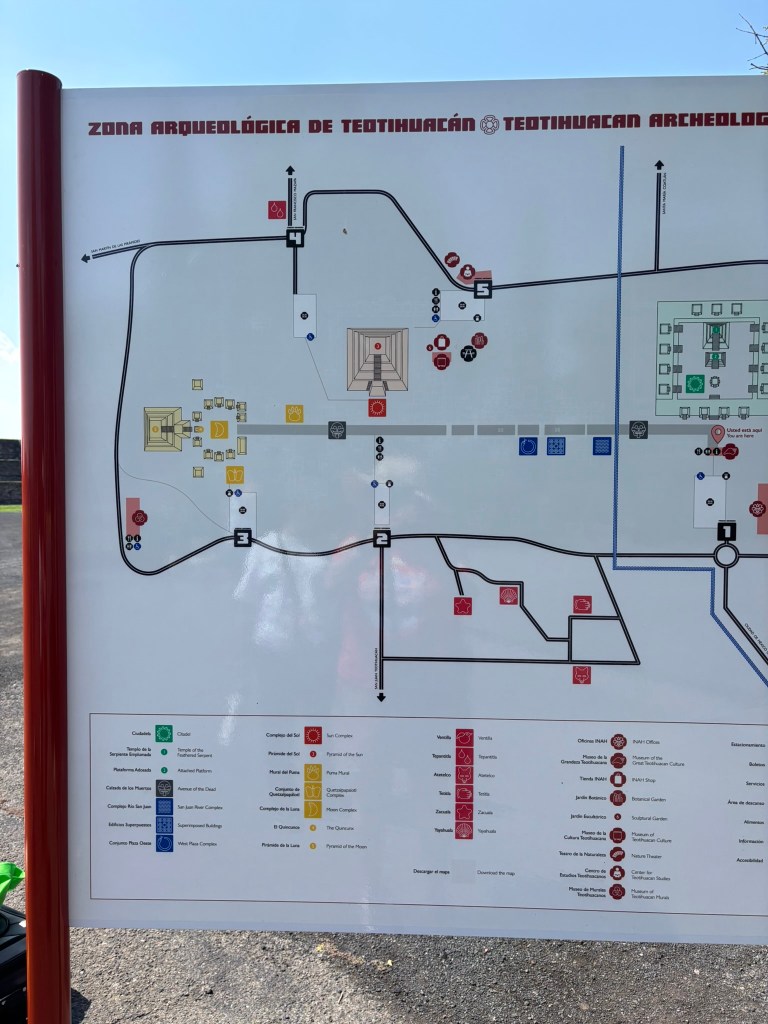
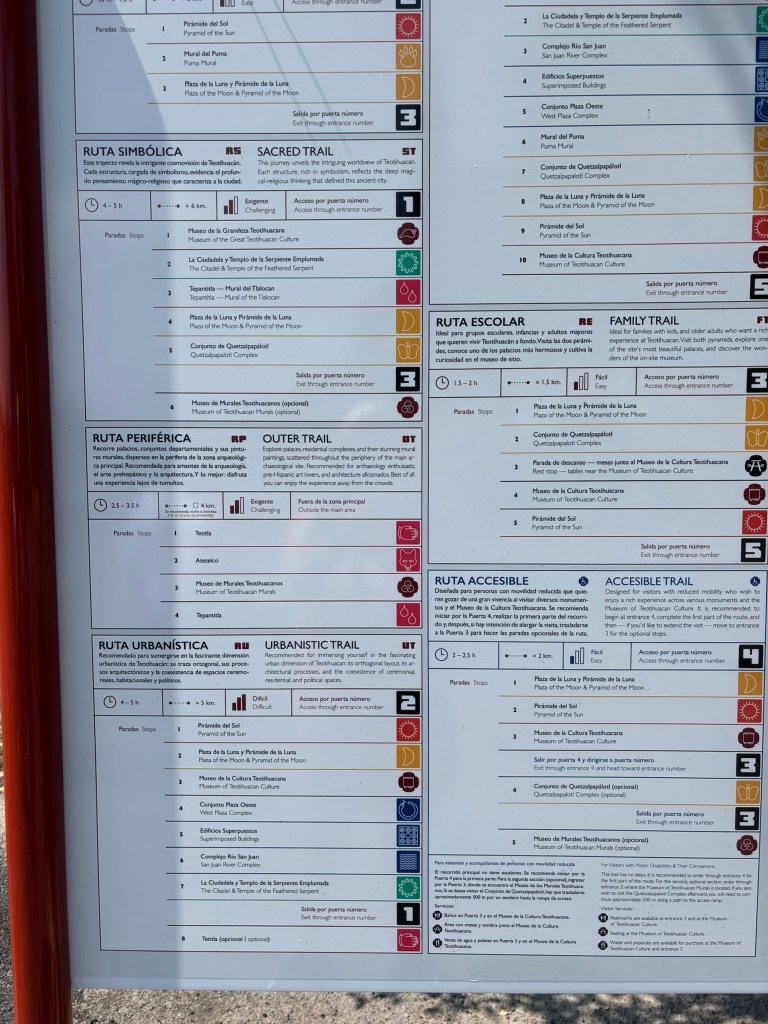
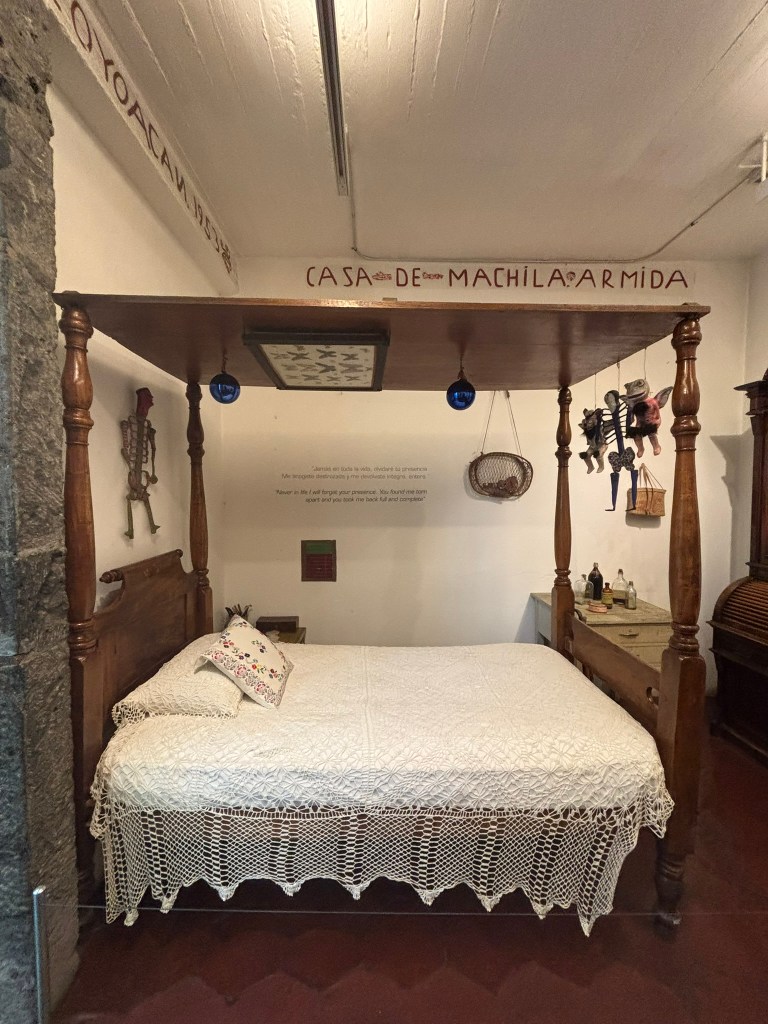
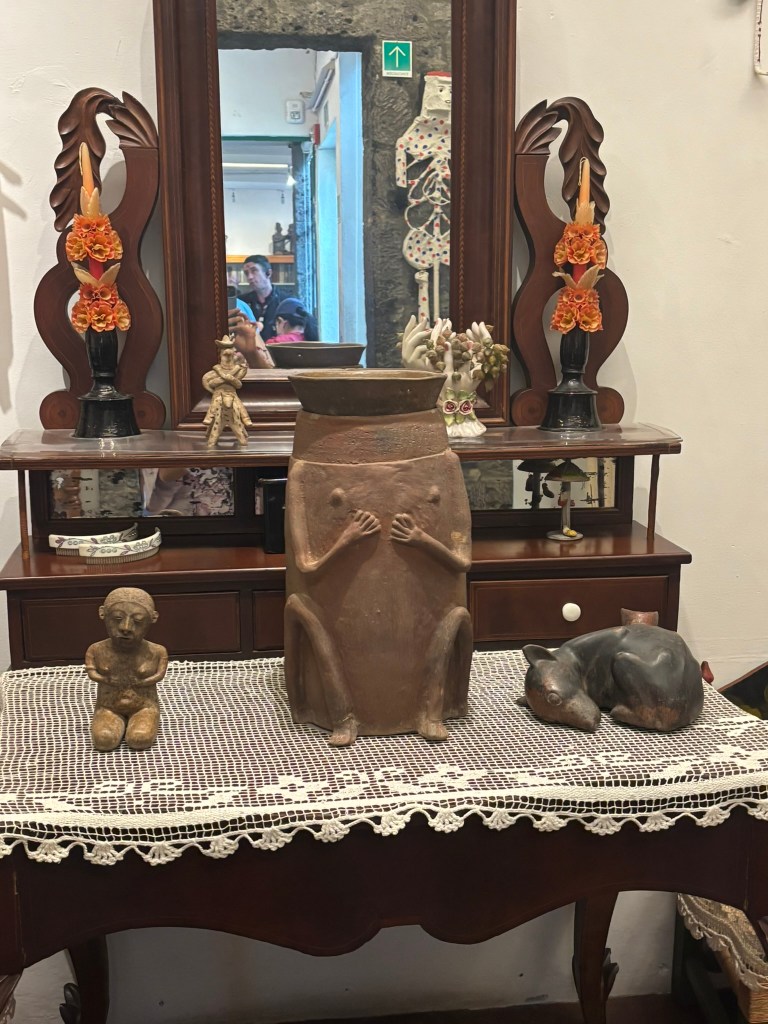
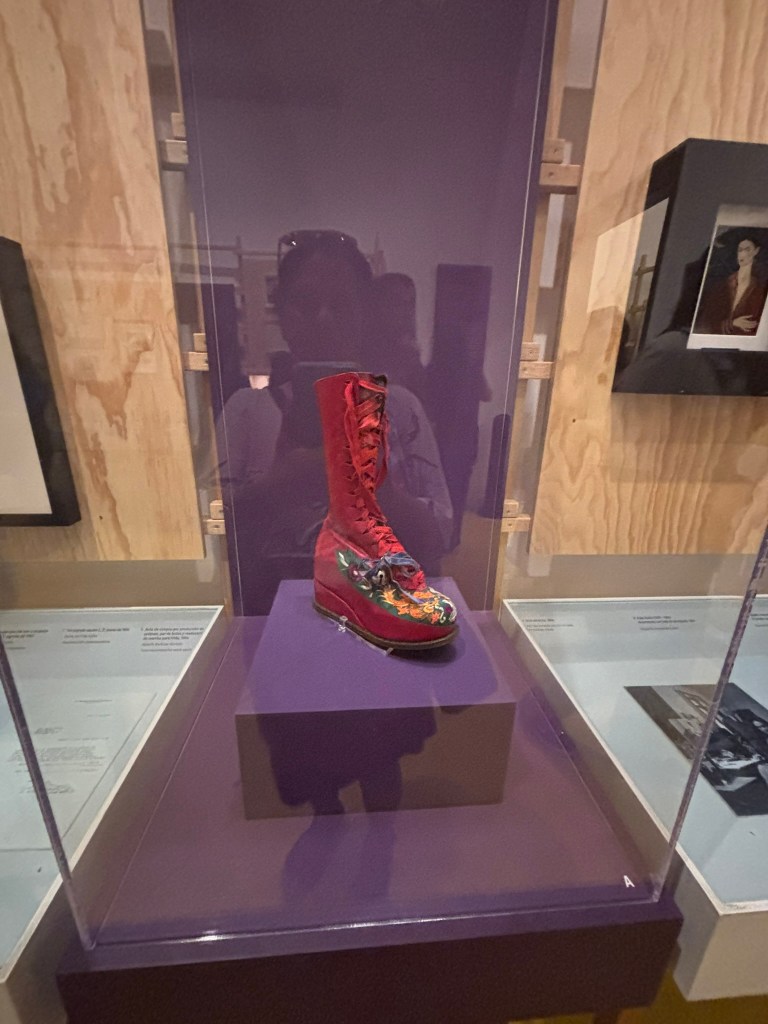
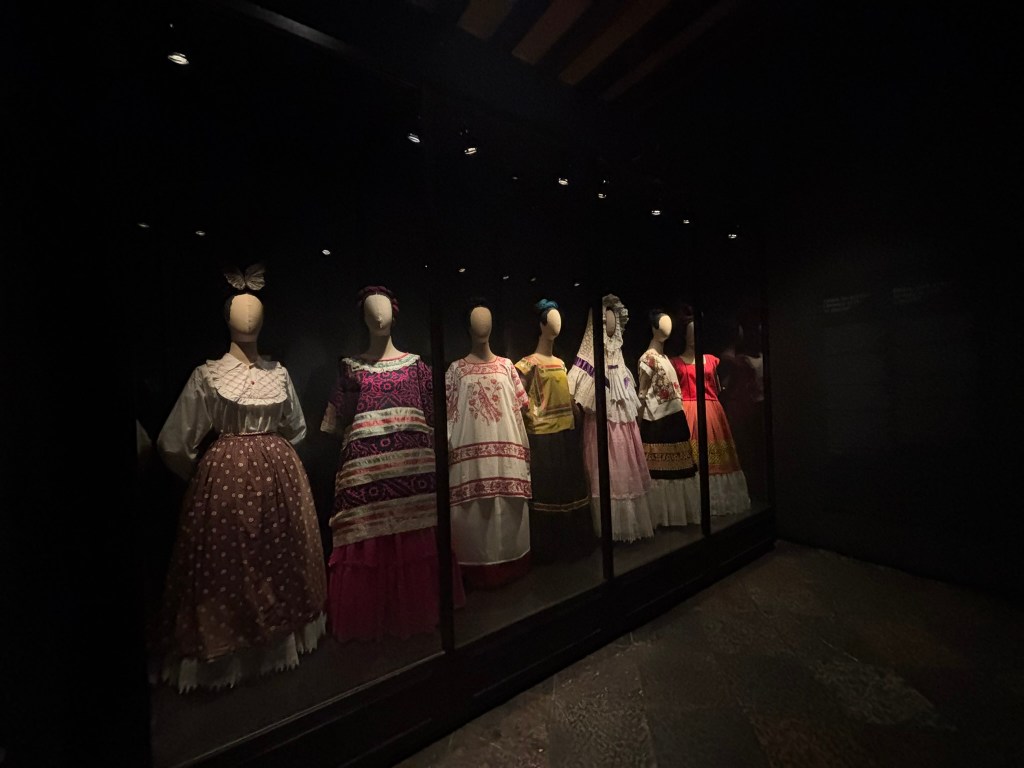
Planning a day trip to the ancient pyramids of Teotihuacán can feel overwhelming, especially when you realize this massive UNESCO World Heritage site stretches over two miles. Most travelers don’t realize that the complex has five distinct gated entrances (puertas). Picking the wrong gate means adding miles of walking under an intense, shade-free Mexican sun. Whether you are arriving by car, taking a public bus from Mexico City, or chasing the morning hot-air balloons, choosing the right starting point will save your feet and maximize your time. My overall pick would be Gate 5, which lets you enter near the middle of the complex and puts you close to La Gruta restaurant for lunch after the visit.
What is at each of the 5 Gates?
Gate
Key Nearby Landmarks & Attractions
Best Used For
Gate 1
La Ciudadela (The Citadel), Temple of the Feathered Serpent (Quetzalcóatl), and the main site museum.
Public bus arrivals and starting the classic, linear chronological walk.
Gate 2
The lower section of the Avenue of the Dead, centered directly in front of the colossal Pyramid of the Sun.
A direct approach to the main pyramid
Gate 3
The northern end of the complex, immediate access to the Pyramid of the Moon and the Quetzalpapálotl Palace.
Drivers looking for quick parking near the northern plaza and avoiding the crowd bottleneck.
Gate 4
The rear of the Pyramid of the Moon, the Jaguar Palace, and the spectacular Teotihuacán Mural Museum.
Independent art lovers or specialized tours focusing heavily on the preserved paint fragments and ancient palaces.
Gate 5
The eastern side of the complex, offering a direct pathway leading right up to the Pyramid of the Sun.
Early risers watching the hot air balloons or anyone staying overnight in the neighboring town. This entrance is also close to the famous nearby cave restaurant, La Gruta, where you can grab lunch.
The Verdict: Which Entrance is the Best?
The “best” gate depends completely on your travel style and how you plan to navigate the ancient city.
My choice, even though we took Gate 1 on this trip, would be Gate 5
The Overall Best Choice for Backpackers & Public Transit Users: Gate 1 If you take the public bus from Mexico City’s Autobuses del Norte terminal, this is where you will naturally be dropped off. It forces a long walk, but starting here allows you to experience the site as the ancients did—walking linearly down the Avenue of the Dead from the Temple of Quetzalcóatl straight toward the great northern pyramids. We did follow this path for our visit. The only drawback is the long walk back to the parking lot in the hot sun after visiting the Pyramid of the Moon
The Best Choice for Photographers & Early Birds: Gate 5 If you manage to arrive right at the 9:00 AM opening time, entering through Gate 5 puts you in prime position. It provides the shortest path to the Pyramid of the Sun, letting you experience its massive scale in peace before the massive tour bus crowds pour in from the city. As a bonus, it aligns perfectly with the path of early-morning hot air balloons floating over the landscape. This entrance is also close to La Gruta, the famous cave restaurant.
Practical information for visiting
Admission to the Teotihuacán pyramids is completely free on Sundays for all Mexican nationals and legal foreign residents.
To claim free entry on Sunday, you must present a valid official ID (such as an INE card, passport, or official residency card) at the ticket booth.
General Entrance Fees (Non-Sundays)
If visiting Monday through Saturday, the National Institute of Anthropology and History (INAH) enforces the following standard ticket prices:
Mexican Nationals & Legal Residents: $105 MXN
Foreign Visitors: $210 MXN
Everyday Free Admission Categories
Regardless of the day of the week, entry remains entirely free for the following individuals (proof of status required):
Children under 13 years old
Mexican students and teachers with a valid institutional ID
Senior Mexican citizens holding an INAPAM card
Persons with disabilities
A Warning for Sunday Travelers
While Sunday free admission saves money, it also means Sunday is consistently the most crowded and hectic day of the week. Long lines form quickly at all five gates, and the paths fill up with local families and large tour groups. If you plan to go on a Sunday, it is highly recommended to arrive exactly at the 8:00 AM opening time to beat both the massive crowds and the intense midday su
Skip the long ticket lines at the National Palace. If you want to experience the raw power of the Mexican Muralism movement without fighting crowds of tourists, you need to head to a functioning government building just blocks from the Zócalo: the Ministry of Public Education (Secretaría de Educación Pública, or SEP).
Here is everything a traveler needs to know to visit this hidden-in-plain-sight masterpiece
Most travelers pack into the Palacio de Bellas Artes or wait hours in the sun to see Rivera’s work at the National Palace. The SEP offers something completely different: peace, quiet, and unprecedented access.
Because this is an active government headquarters—not a traditional museum—it remains largely undiscovered by mass tourism. You can stand inches away from 120 original fresco panels painted by Diego Rivera between 1923 and 1928, completely alone, listening only to the faint echo of footsteps across the stone courtyards.
What to Look For: Navigating the Courtyards
The building features two massive, three-story open-air courtyards. Rivera structured them like a physical book of Mexican identity.
The Courtyard of Labor (Patio de los Trabajos)
The Court of Labor murals convey a powerful post-revolutionary narrative that celebrates the dignity, strength, and foundational power of the Mexican working class while critiquing their exploitation under corporate capitalism. By depicting laborers as Christ-like martyrs and anonymous cogs in industrial assembly lines, Diego Rivera exposed the brutal physical toll of foreign-owned mining and agro-industries. Concurrently, he elevated traditional Indigenous crafts and agricultural practices into monumental high art, framing native knowledge and communal labor as inseparable from the Mexican soil. Strategically placed on the building’s ground floor, these panels visually argue that the raw sweat and manual labor of the common worker form the literal structural foundation supporting the entire nation’s intellectual, cultural, and political progress.
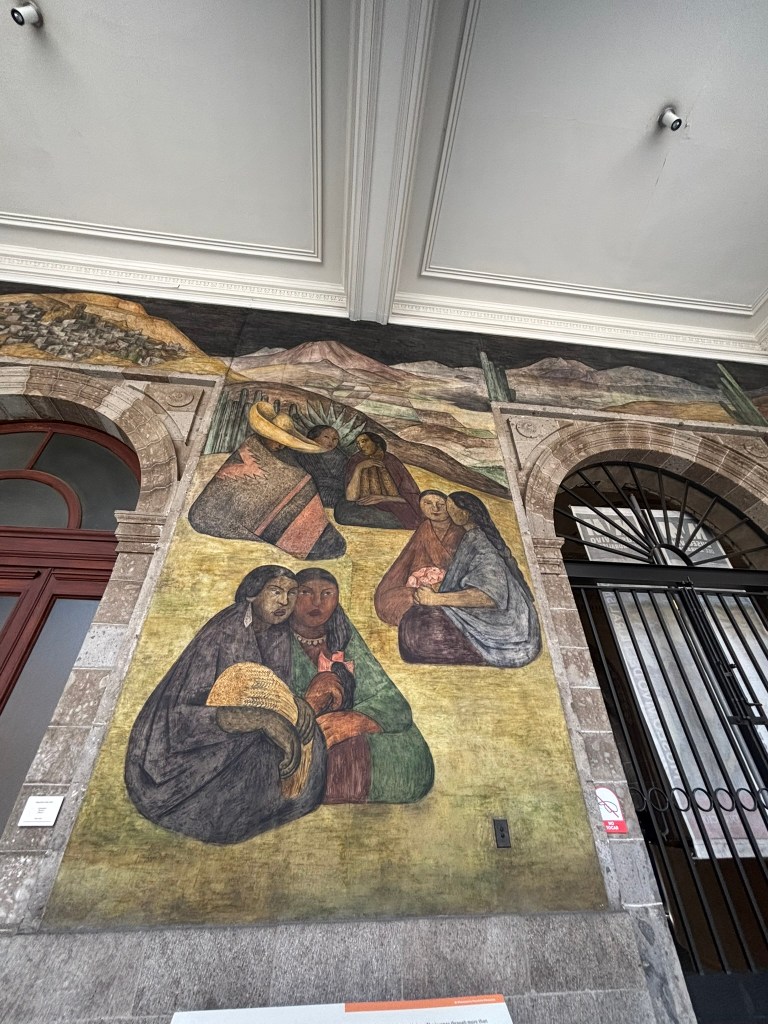
Some of the murals that caught my eyes were
Tehuantepec Women (Mujeres tehuantepecas)
Where to Find It: On the ground floor of the Court of Labor corridor, along the south wall.
What It Shows: This panel honors the Indigenous Zapotec women (Tehuanas) from the Isthmus of Tehuantepec in Oaxaca, Mexico. Two women sit prominently in the foreground; one cradles a woven straw basket, while the other holds a bright flower. Behind them, other community members sit against a backdrop of rolling, arid hills and tall cacti. Diego Rivera used this composition to celebrate the dignity, strength, and traditional clothing of Mexico’s southern Indigenous cultures, turning everyday regional life into monumental public art. We can also see the influence of Pablo Picasso’s cubism in this mural
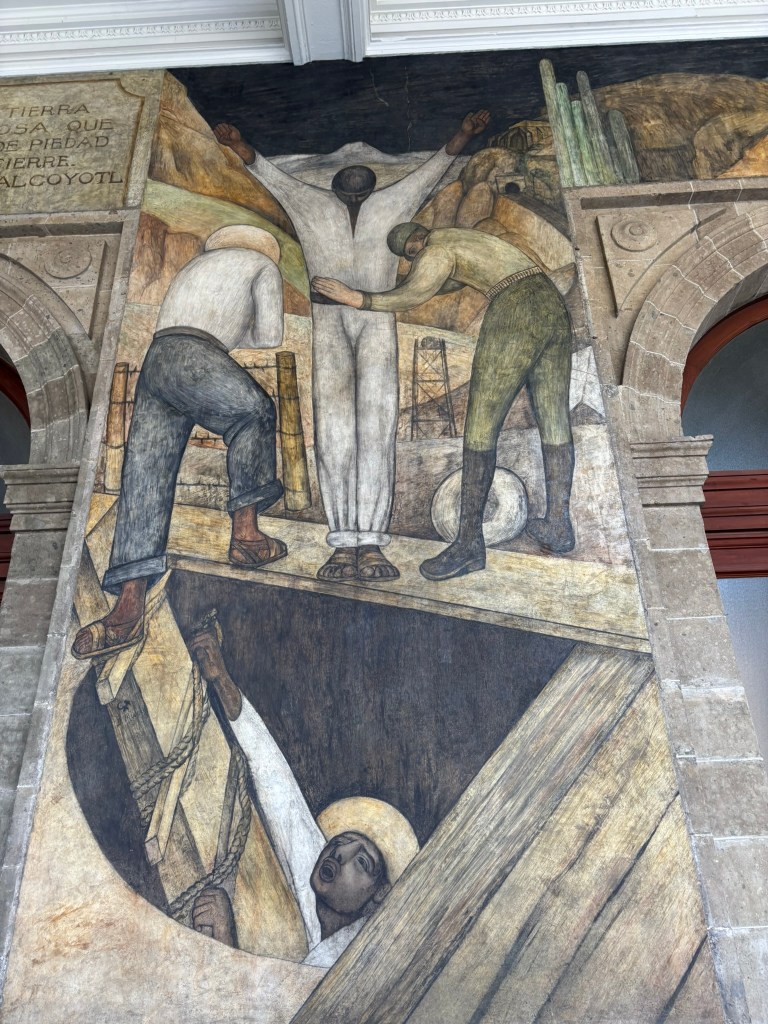
Leaving the Mine (Salida de la mina)
Where to Find It: On the ground floor of the Court of Labor, sitting directly adjacent to the Entrada a la mina (Entry into the Mine) panel.
What It Shows: This powerful fresco exposes the harsh exploitation of the Mexican working class by foreign corporate interests. It depicts a miner standing on a wooden platform at the end of his grueling shift, holding his hands out to be searched by an armed guard to ensure no silver ore is being stolen. Rivera intentionally painted the miner in an open, Christ-like crucifixion pose to frame the laborer as a tragic martyr sacrificing his body for industrial greed, while the dark mine opening below resembles a gaping maw demanding human sacrifice. Pablo Picaso’s cubism in this mural.
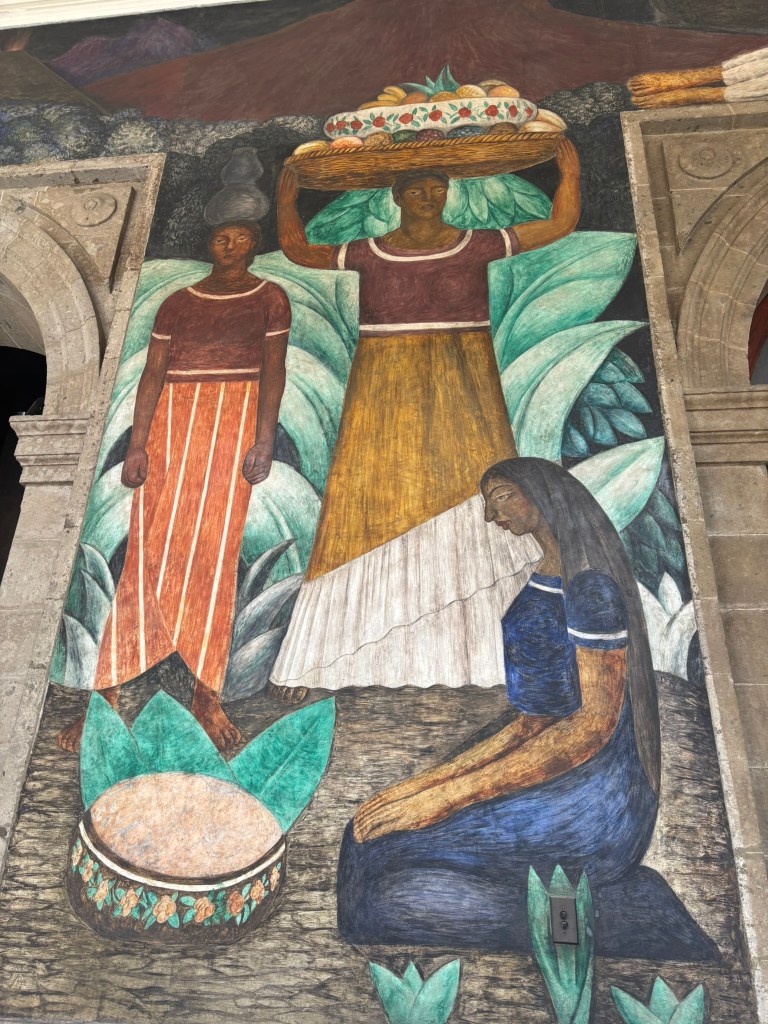
Tehuana Women with Fruit (Mujeres tehuantepecas)
Where to Find It: On the ground floor of the Court of Labor, forming a thematic pair with the first Oaxacan-themed mural. What It Shows: This panel focuses on the agricultural abundance and physical grace of the women of Tehuantepec. A central woman stands tall and proud, balancing a massive woven basket overflowing with tropical fruits—including pineapples, melons, and bananas—directly on her head. To her left, another woman balances a clay water jug on her shoulder, while a third woman kneels in the foreground beside a traditional painted gourd vessel resting on vibrant green banana leaves, illustrating the rich bounty of Mexico’s tropical south.
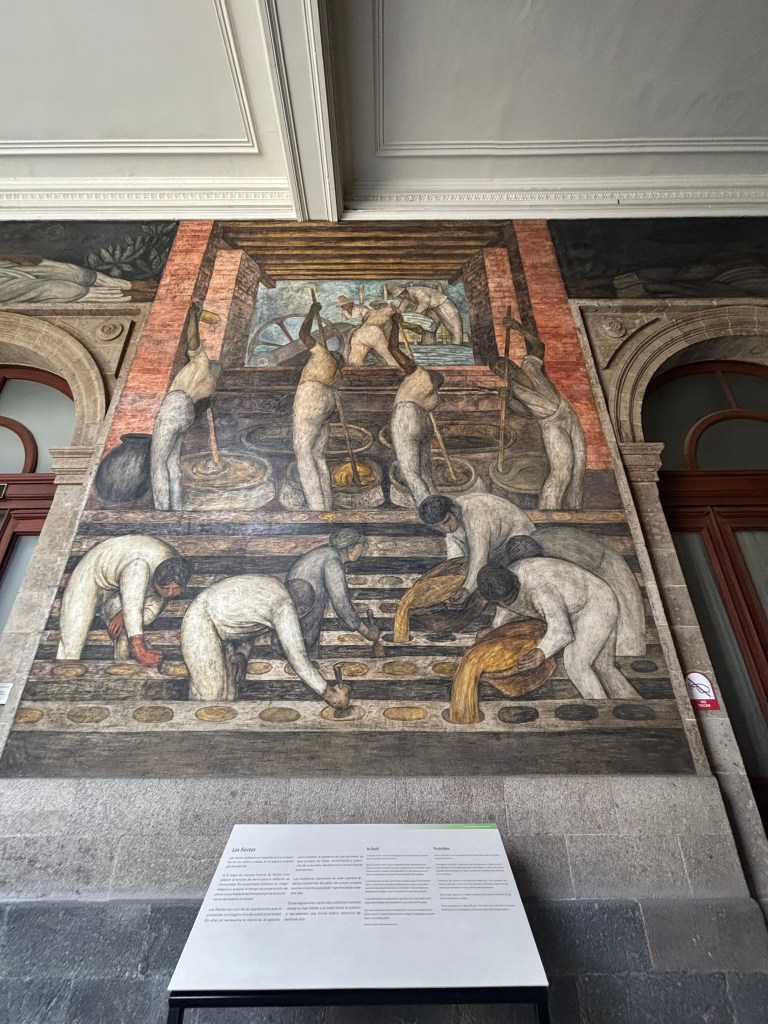
The Sugar Mill (El trapiche)
Where to Find It: On the ground floor of the Court of Labor along the north wall of the building. What It Means: This stark, geometric mural critiques the physical toll of agro-industrial processing by documenting the grueling, repetitive grind of workers refining sugarcane. The composition is divided into two rhythmic rows: the top tier shows four laborers using long poles to stir boiling vats of raw cane juice beneath a heavy wooden milling wheel, while the bottom tier depicts five workers hunched completely in half to pour molten golden syrup into small, circular floor molds to solidify into piloncillo. Rivera deliberately rendered the figures as anonymous, uniform cogs dressed in identical white cotton garments to illustrate how modern corporate machinery transforms individual human beings into a collective production line, functioning as a powerful visual twin to his nearby silver mining panels
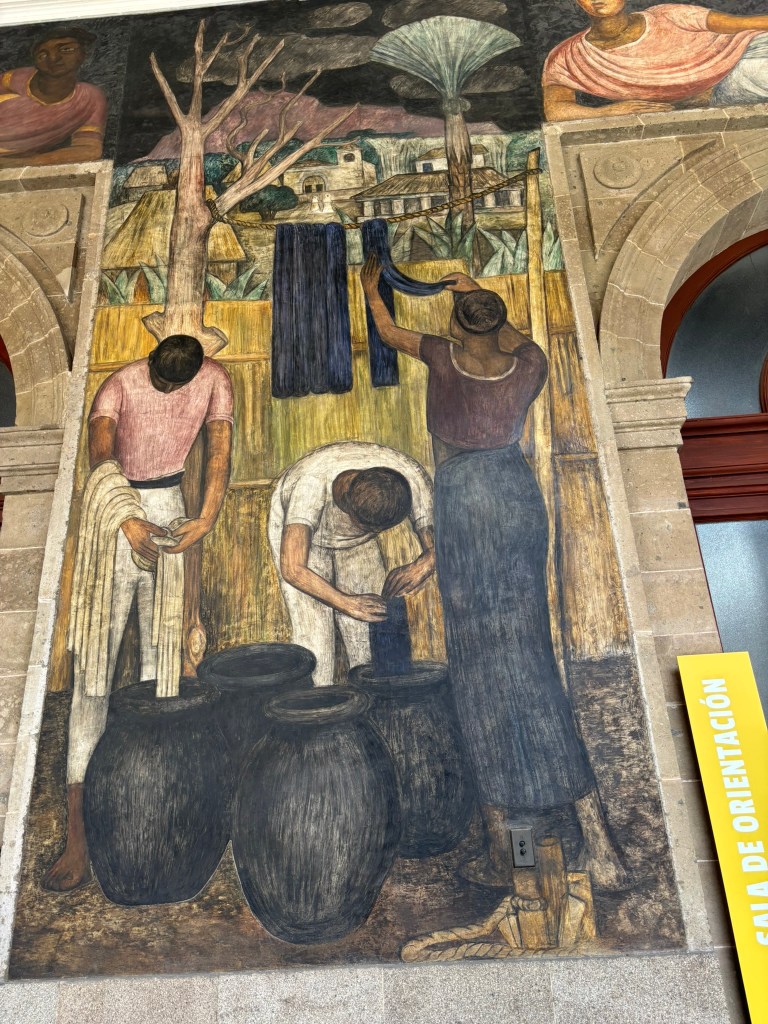
The Dyers (Los tintoreros)
What It Means: This vibrant fresco honors pre-industrial, Indigenous economic traditions by detailing three textile artisans processing fabrics with natural pigments in the tropical, southern region of Tehuantepec, Oaxaca. In the foreground, two men bend deeply over massive, dark ceramic boiling vats to saturate fabrics in rich indigo dyes, while a woman to the right carefully hangs a wet, dark blue textile to dry on a clothesline strung between trees against a background of rolling hills and thatched-roof huts. Diego Rivera purposely placed these historic artisan trades on the same monumental scale as heavy industrial mining to send a clear political message: the masterful craftsmanship of rural Indigenous communities is just as vital and heroic to the foundation of modern Mexico as modern factory labor.
Where to Find It: On the ground floor of the Court of Labor along the south wall of the main headquarters.
The Courtyard of Fiestas (Patio de las Fiestas)
The Courtyard of Fiestas (Patio de las Fiestas) contrasts the hardships of labor by celebrating the vibrant spiritual, seasonal, and communal traditions that bind the Mexican identity together. Through crowded, dynamic scenes like The Day of the Dead and The Maize Festival, the murals capture the chaotic energy, music, and colorful pageantry of traditional street celebrations. Diego Rivera and his contemporaries modeled these festivalgoers after monumental pre-Columbian sculptures, visually anchoring the idea that indigenous rituals and community joy are deeply rooted in the nation’s history.
La Zandunga
Where to Find It: On the ground floor of the Court of Fiesta along the south wall of the building.
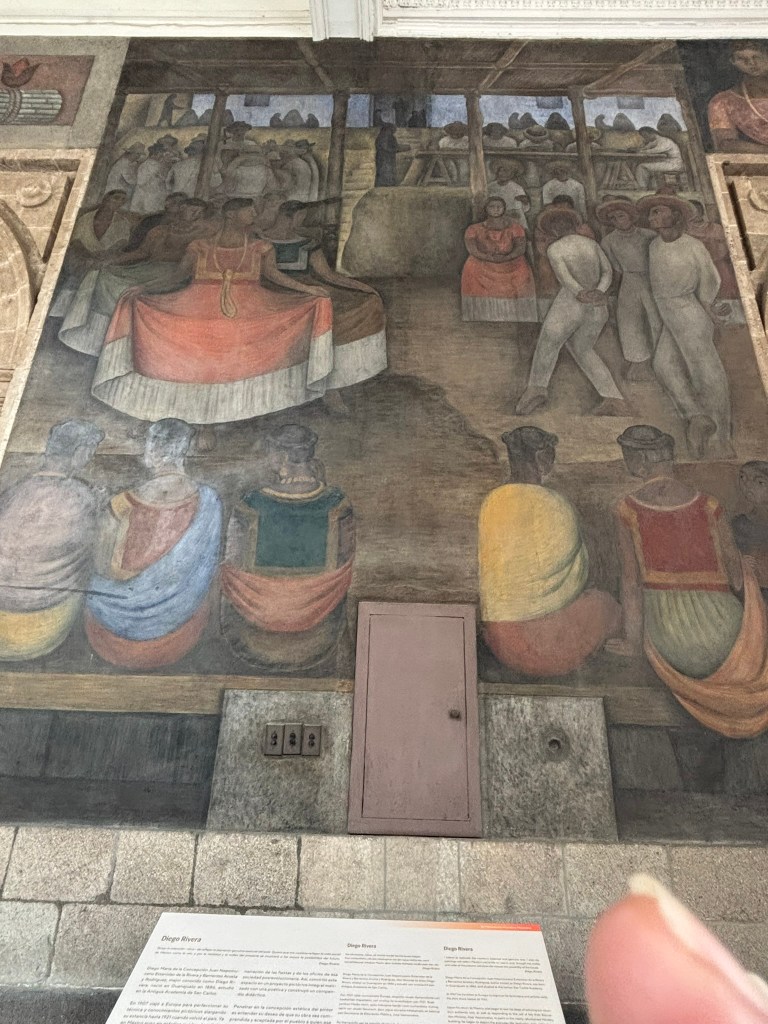
What It Means: This vibrant, culturally rich mural celebrates the resilient regional traditions and indigenous pride of southern Mexico by documenting the lively festive spirit of the Isthmus of Tehuantepec. The composition is divided into a deep, tiered gathering space: the central focus highlights a group of elegant Tehuana women in their iconic flowing, wide-brimmed skirts performing alongside male partners in traditional white garments, while the foreground depicts a row of seated onlookers watching the scene from below with reverent attention. Rivera deliberately organized this section of the courtyard geographically to honor rural culture, rendering the collective celebration as an assertion of communal solidarity and a powerful visual testament to post-revolutionary Mexican identity.
The Market (El mercado)
Where to Find It: On the ground floor of the Court of Fiestas along the north wall of the building.
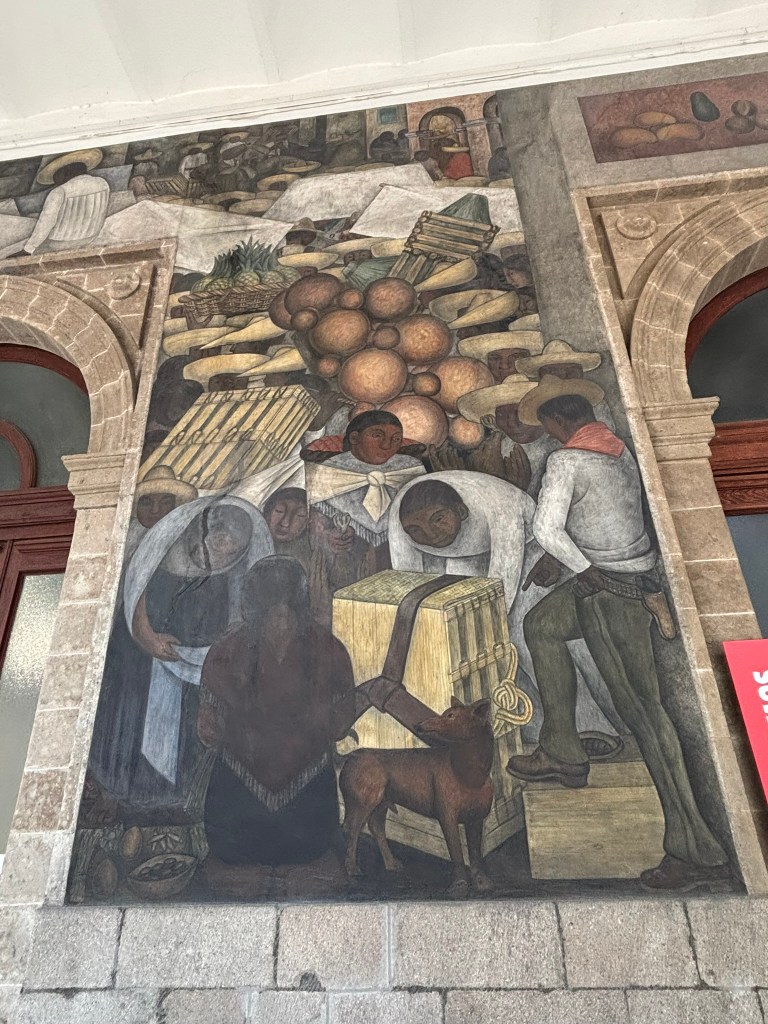
What It Means: This bustling, dense mural celebrates the foundational role of indigenous commerce and agrarian production by documenting a traditional open-air tianguis market. The composition is built on a heavily crowded, layered vertical arrangement: the upper sections feature baskets overflowing with pineapples, maize, and stacks of regional produce beneath rows of broad-brimmed straw hats, while the central foreground zooms in on a family arranging a large wooden slat crate secured with woven straps, alongside a loyal hairless Xoloitzcuintli dog. Rivera deliberately used this space to pivot away from industrialized, foreign-owned factories, rendering this sensory marketplace as an alternative center of economic autonomy, communal unity, and authentic pre-Hispanic mexicanidad that sustained rural Mexican societies across generations
The Little Bull (El torito) by Amado de la Cueva
Where to Find It: On the ground floor of the Court of Fiestas along the north wall of the building.
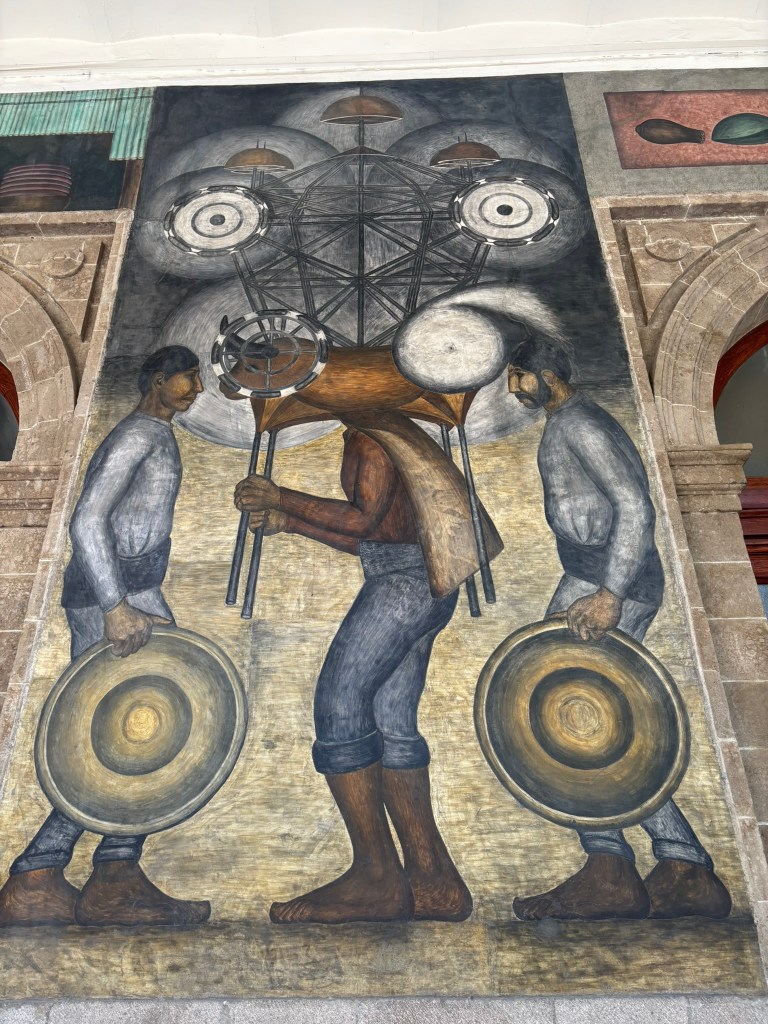
What It Means: This hypnotic, dynamically geometric mural celebrates the vibrant ephemerality of Mexican festive folklore by documenting the traditional pyrotechnic custom of el torito (the little bull). The composition is constructed around a towering, symmetric mechanical armature: the upper background features an intricate network of metal frameworks holding sparking Catherine wheels and exploding firework pinwheels against a dark night sky, while the central focal point highlights a brave bearer lifting the heavy, bull-shaped wicker framing over his head as two flanking figures shield themselves with large circular wooden targets. Amado de la Cueva—one of the few early muralists commissioned to contribute alongside Rivera’s vast project—deliberately focused on the raw, explosive energy of communal celebrations, rendering this dangerous folk performance as an assertion of ancestral memory, popular ingenuity, and the fiery spirit of post-revolutionary community bonding.
Ribbon Dance (La danza de los listones)
Where to Find It: On the ground floor of the Court of Fiestas along the north wall of the building.
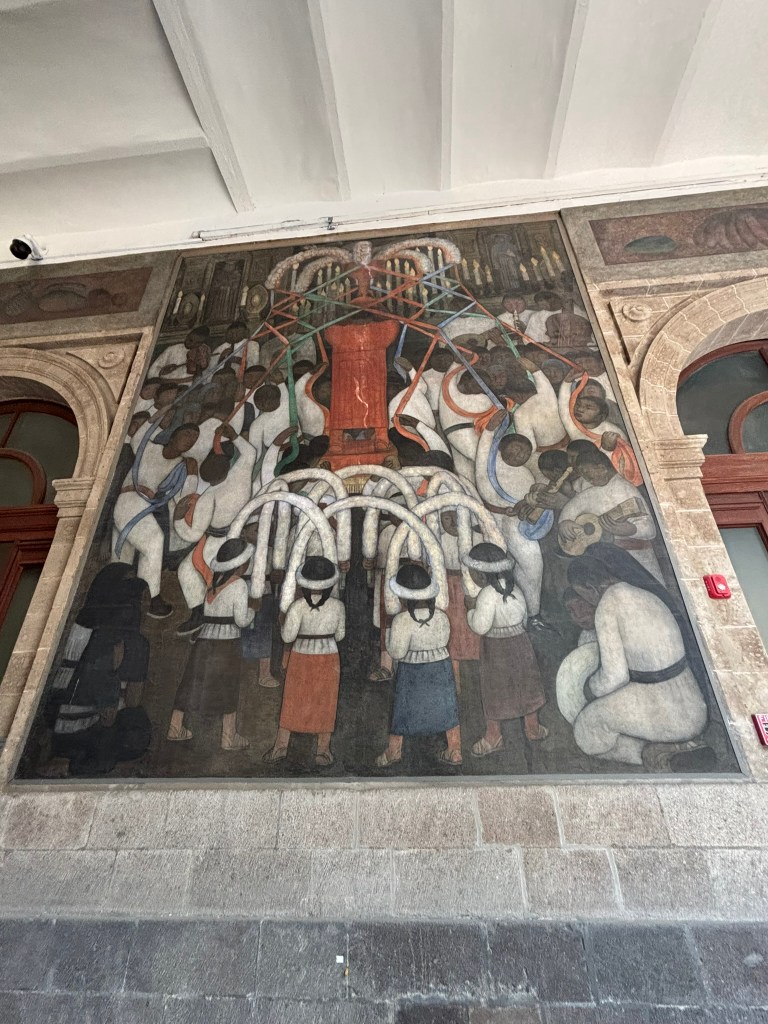
What It Means: This vibrant, ritualistic mural celebrates agricultural fertility and communal harmony by documenting the festive symbiosis of nature and traditional folklore. The composition is constructed around a soaring, layered ceremonial arrangement: the upper section centers on a tall, radiant orange Maypole radiating colorful ribbons like solar rays, held aloft by dynamic lines of workers weaving beneath it, while the foreground showcases young dancers holding curved, floral-wrapped archways aloft in perfect rhythmic unison. Rivera deliberately fused two distinct regional traditions—the dance of the ribbons (listones) and the dance of the arches (arcos)—to represent humanity’s ancestral desire to integrate with natural cycles, rendering this synchronized performance as a profound statement of social unity, mutual respect, and post-revolutionary collective pride.
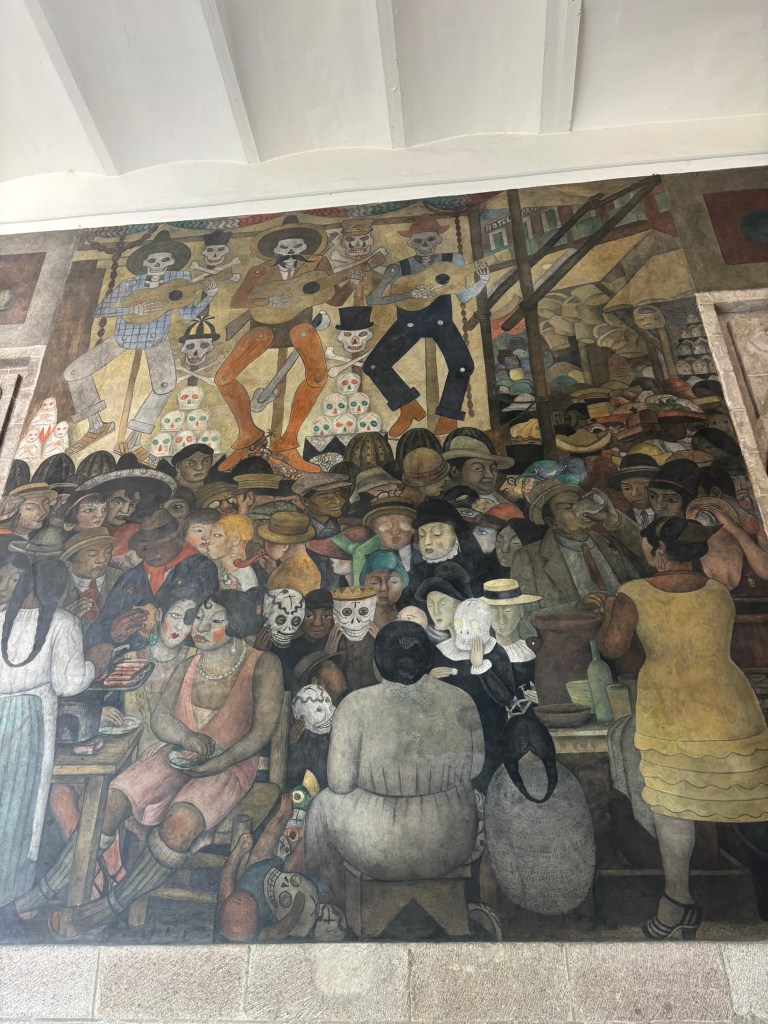
The Day of the Dead – The Street (El Día de Muertos – La calle)
Where to Find It: On the ground floor of the Court of Fiestas along the east wall of the building.
What It Means: This complex, deeply satirical mural explores the socio-political undercurrents of Mexican society by documenting the public celebrations of the Day of the Dead. The composition is built on a layered, contrasting arrangement: the upper register features a mariachi band of skeletal calaveras playing guitars beneath crossbones, while the dense, claustrophobic foreground gathers a cross-section of Mexican society including working-class laborers, indigenous children wearing skull masks, and wealthy, caricatured bourgeoisie figures indulging in food and drink. Rivera deliberately used this iconic festival as a great equalizer, weaving a sharp critique of post-revolutionary class divisions to show how death unites all strata of society, rendering this popular urban gathering as a profound statement on social justice, cultural resilience, and the unique Mexican philosophy toward mortality.
The Top Floor (The Political Manifesto)
Walk up the stone staircases to the highest level. Here, Rivera illustrated revolutionary folk songs. Look closely at the faces—Rivera painted his famous wife, Frida Kahlo, into the mural The Insurrection, depicting her as a fierce revolutionary handing out weapons to soldiers. I didn’t get a chance to go upstairs on this trip, but I’m hoping to go back and see more on my next trip to Mexico City.
Essential Travel Logistics
Where Is It?
The building is located at República de Argentina 28 in the Historic Center (Centro Histórico). It is a quick 5-minute walk northeast of the Zócalo or the Metropolitan Cathedral.
How to Get In (The Security Process)
Because it is a working government office, getting in requires a minor security check:
Bring a physical ID: You must present a valid passport or driver’s license to the armed guards at the gate. Digital copies on your phone will not work.
The Exchange: Security will keep your ID at the front desk and give you a plastic visitor’s badge. You will swap the badge back for your ID when you leave.
Cost: Entrance is completely free.
The Ultimate Monday Travel Hack
Almost every major museum in Mexico City—including the Anthropology Museum, Frida Kahlo’s Blue House, and Bellas Artes—is closed on Mondays. The SEP murals are open on Mondays.
Hours: Monday, and Wednesday through Sunday from 10:00 AM to 5:30 PM.
Weekly Closure: The building is closed on Tuesdays.
Quick Tips for Your Visit
Look up at the stairwells: Rivera didn’t just paint the courtyard walls; the main stairwell features sweeping landscapes of Mexico’s tropical regions.
Accessibility note: The ground floor courtyards are flat and easy to navigate, but the historic elevators to the upper floors are often restricted for official use only.
Guide: It is good to have a guide with you to explain the different murals. I went with City Unscripted, booked through Viator as a private tour
Where to find other murals of Diego Rivera
To truly grasp the complex, layered soul of Mexican history, traveling through Diego Rivera’s monumental murals is an absolute necessity. Across his massive frescoes, Rivera transformed public walls into living history books, weaving together thousands of years of indigenous resilience, the trauma of the Conquest, and the fiery triumphs of the Revolution into a singular, breathtaking narrative. I didn’t get to see all of his murals on this trip, but hoping the cover more next time I am in Mexico
Downtown (Centro Histórico)
Palacio Nacional (National Palace): Located on the main Zócalo plaza, the grand stairwell houses his masterpiece, “The History of Mexico” (Epopeya del pueblo mexicano). Spanning three massive walls, it chronicles thousands of years of Mexican history from pre-Hispanic Mesoamerica through the Conquest and Revolution.
Note: Entry usually requires booking a free guided tour and presenting an official government ID/passport. You need to stand in line early to get the tickets to enter the parliament building
Palacio de Bellas Artes (Palace of Fine Arts): Located on the edge of Alameda Central, the top floors host “Man, Controller of the Universe” (El hombre controlador del universo). This is Rivera’s meticulous recreation of the infamous Man at the Crossroads fresco, commissioned by the Rockefeller family in New York and subsequently destroyed for its inclusion of Vladimir Lenin.
Museo Mural Diego Rivera: This dedicated museum was built specifically to house just one breathtaking masterpiece: “Dream of a Sunday Afternoon in the Alameda Central” (Sueño de una tarde dominical en la Alameda Central). The 15-meter fresco acts as a surreal timeline of Mexican history featuring iconic historical figures, a self-portrait of Rivera as a child, Frida Kahlo, and the elegant skeleton La Catrina.
Antiguo Colegio de San Ildefonso: Considered the cradle of the Mexican Muralism movement, the Amphitheater Simón Bolívar inside this former college houses Rivera’s very first mural, “Creation” (La creación, 1922). It features a unique blend of religious symbolism and Greek muses painted before he fully adopted his signature revolutionary, indigenous style.
Mercado Abelardo L. Rodríguez: A bustling public market where Rivera’s students painted expansive social-realist scenes under his direct supervision.
Cárcamo de Dolores (Dolores Waterworks): Located in the second section of Chapultepec Park, this unique indoor-outdoor installation features the mural “Water, the Source of Life” (Agua, el origen de la vida). Painted entirely inside a deep-water basin, it is paired with a massive outdoor tiled mosaic fountain of the Aztec rain god, Tlaloc.
Teatro de los Insurgentes: Located along Avenida de los Insurgentes Sur, the entire facade of this mid-century theater features a massive, 46-meter long glass mosaic mural designed by Rivera. It chronicles the History of Theater in Mexico and centers around a prominent portrait of the iconic Mexican comic actor, Cantinflas.
Estadio Olímpico Universitario (UNAM): The main exterior wall of the university’s Olympic stadium features a relief mural made from colorful natural stones titled “The University, the Family and Sport in Mexico”.
Anahuacalli Museum: Designed by Rivera himself out of dark volcanic stone to hold his massive collection of pre-Columbian artifacts, the museum also showcases several of his early sketches, drafts, and layout designs for his most famous murals.
Final thoughts on Diego Rivera and his art
Standing before the monumental murals of Mexico City, it is incredibly easy to experience a sharp tug-of-war between loving the art and disliking the man behind the brush. It is a well-documented sentiment that my tour guide settled perfectly: like any monumental artist, Diego Rivera had layers. While it is easy to condemn his tumultuous personal life and legendary infidelity, digging into his history reveals an artist deeply shaped by early psychological fracturing. Being raised by his indigenous Tarascan nanny, Antonia, after experiencing emotional abandonment by his mother, instilled in him a profound reverence for native women that radiates from his vibrant canvases, even as it manifested as a deep-seated resentment and disrespect toward white women later in life. This stark emotional contrast breathes an uncomfortable, human reality into his masterpieces. You don’t have to excuse Rivera’s personal flaws to be deeply moved by his work; instead, understanding the childhood traumas that molded his brushstrokes allows you to appreciate how a deeply broken man could still elevate Mexico’s indigenous working class to an unrivaled peak of artistic dignity.
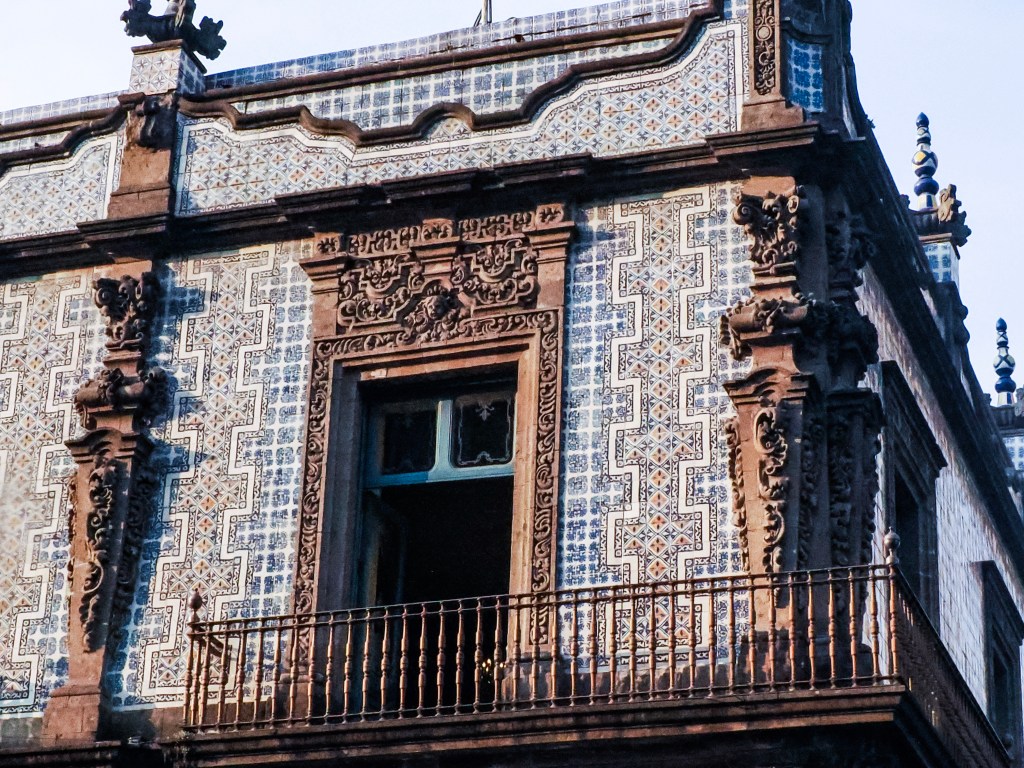
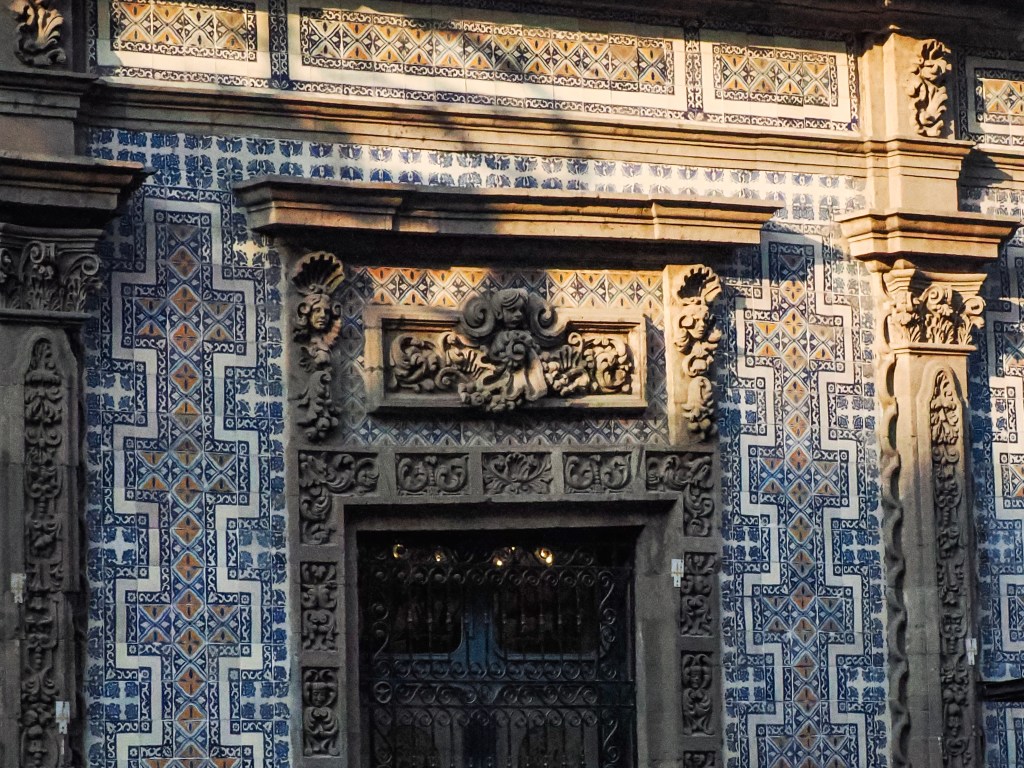
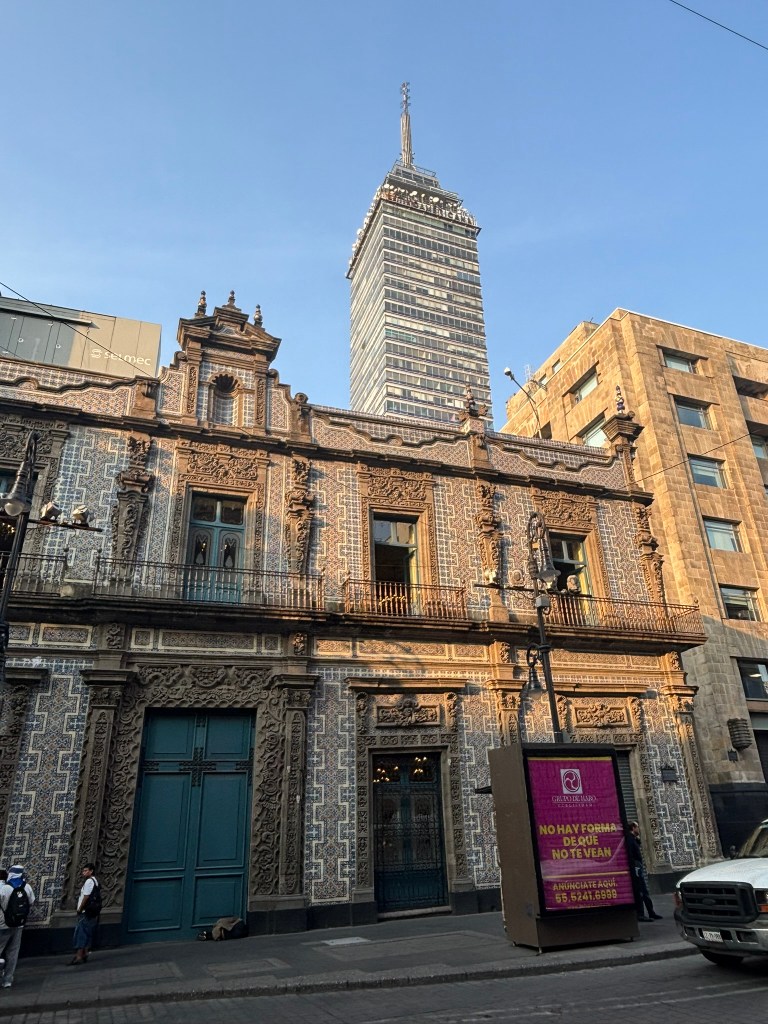
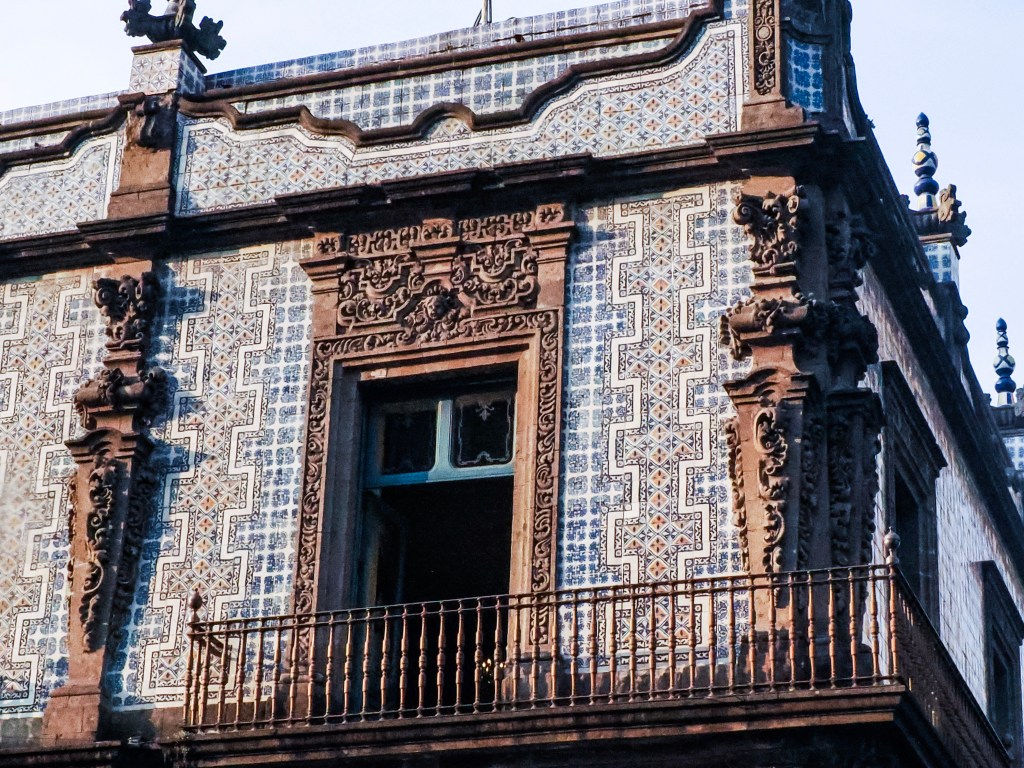
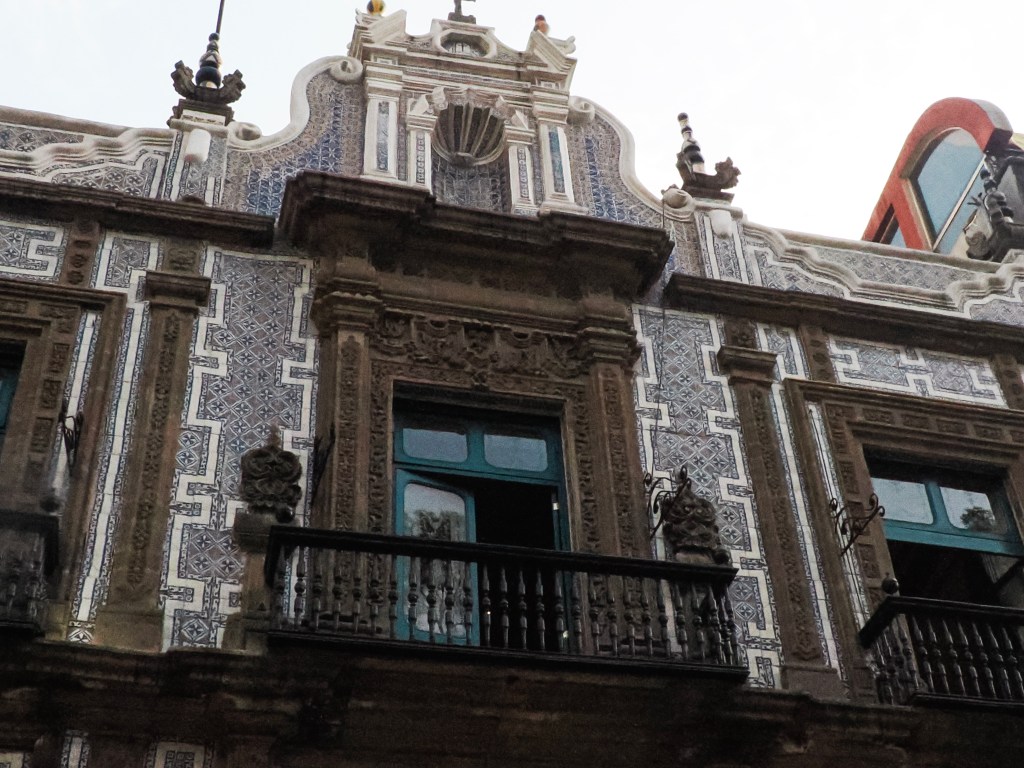
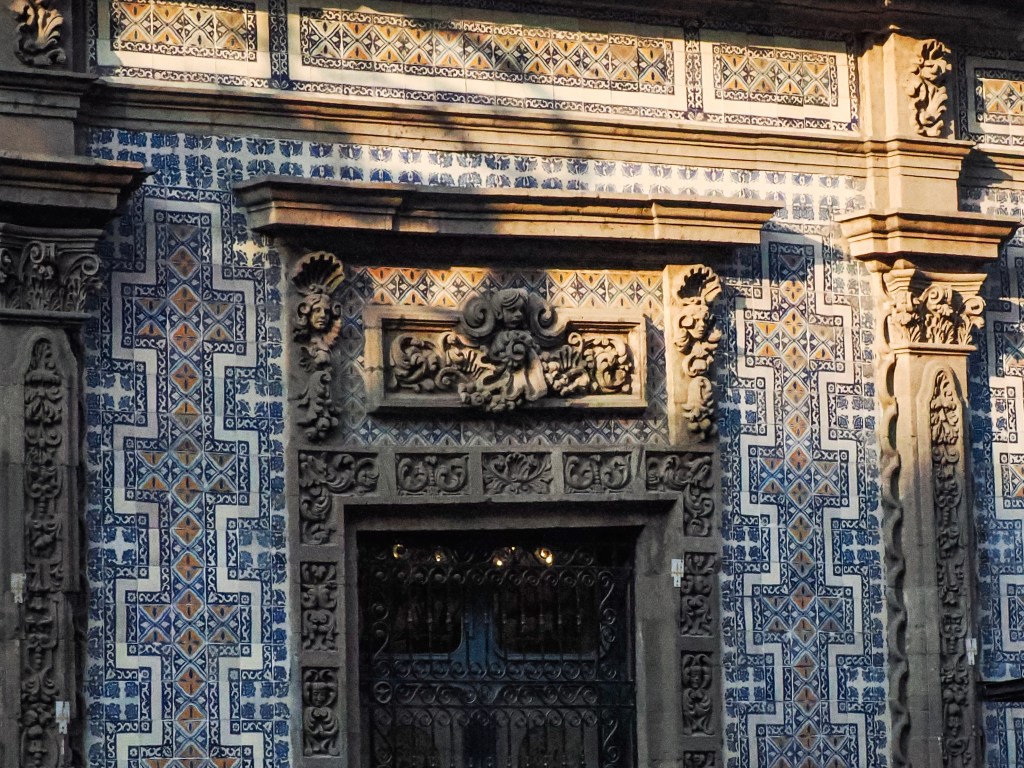
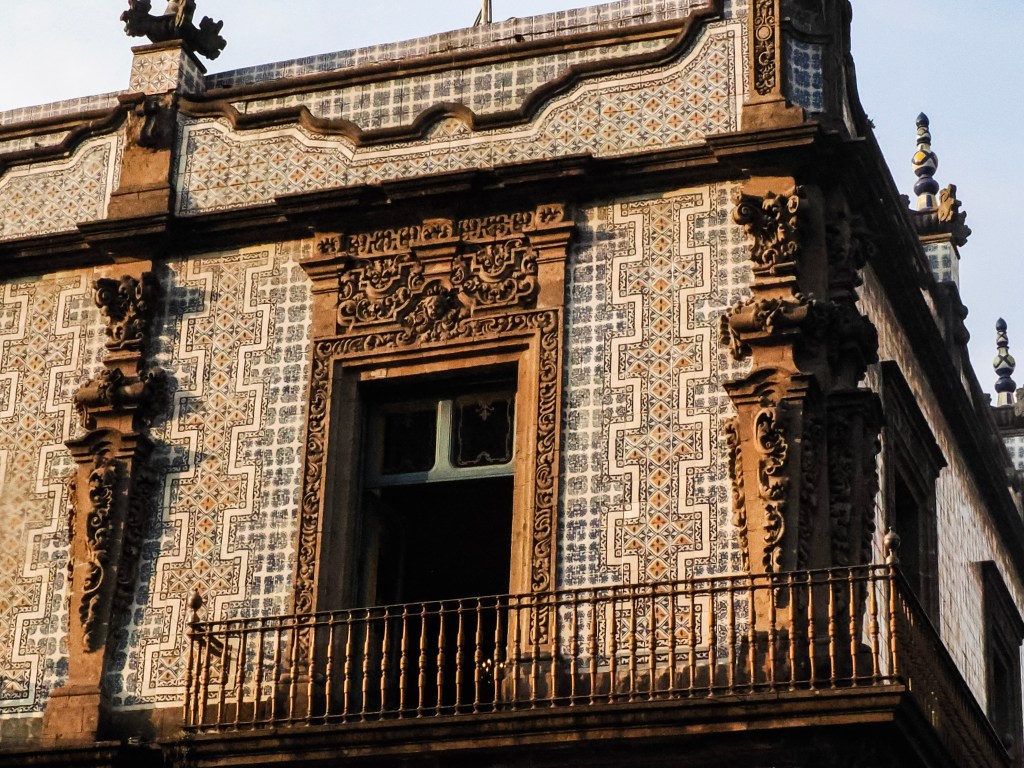
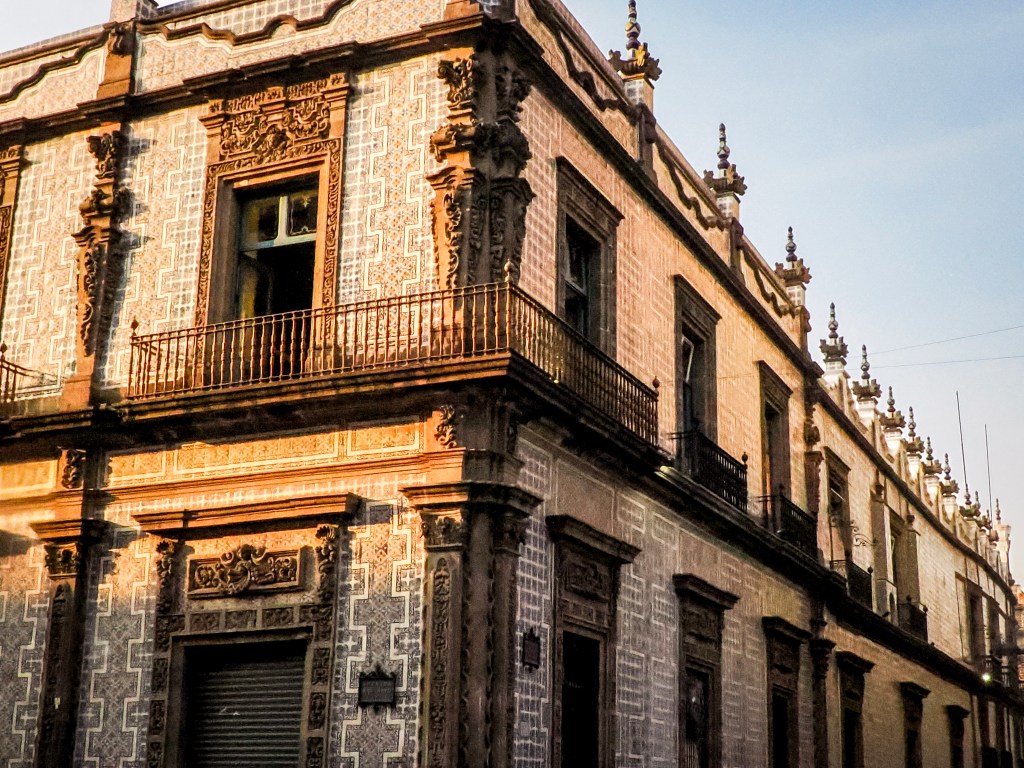
Tucked away along the bustling, stone-paved corridor of Avenida Francisco I. Madero in Mexico City’s Centro Histórico sits one of the world’s most spectacular historic buildings: La Casa de los Azulejos (The House of Blue Tiles).
While millions of travelers walk past its shimmering, iridescent facade every year, few realize that stepping through its doors is like entering a living time capsule of Mexican history, world-class art, and culinary tradition. Here is everything you need to know to photograph, explore, and experience this architectural wonder.
The building’s origins date back to the late 16th century when it served as a grand residence for the Counts of the Valley of Orizaba. However, it wasn’t until 1737 that the mansion received its iconic, head-turning transformation.
According to local folklore, the son of the count was quite a reckless youth. Frustrated by his son’s lack of ambition, the count famously declared, “My son, you will never build a house of tiles,”—a colonial-era idiom meaning he would never amount to anything. Taking the insult as a challenge, the young heir turned his life around, inherited the property, and covered the entire outer facade in thousands of hand-painted, blue-and-white glazed Talavera tiles imported from Puebla.
The resulting design is an exquisite example of New Spanish Baroque architecture, where the cool, geometric repetition of the glazed tiles contrasts beautifully with the heavily carved, dark volcanic stone frame around the windows and balconies
🗼 The French Influence and Porfirian Elegance
In the late 19th and early 20th centuries, Mexico underwent a profound cultural shift during the regime of President Porfirio Díaz. Díaz was famously obsessed with French architecture, fashion, and cuisine, sparking a nationwide movement to “Europeanize” the capital.
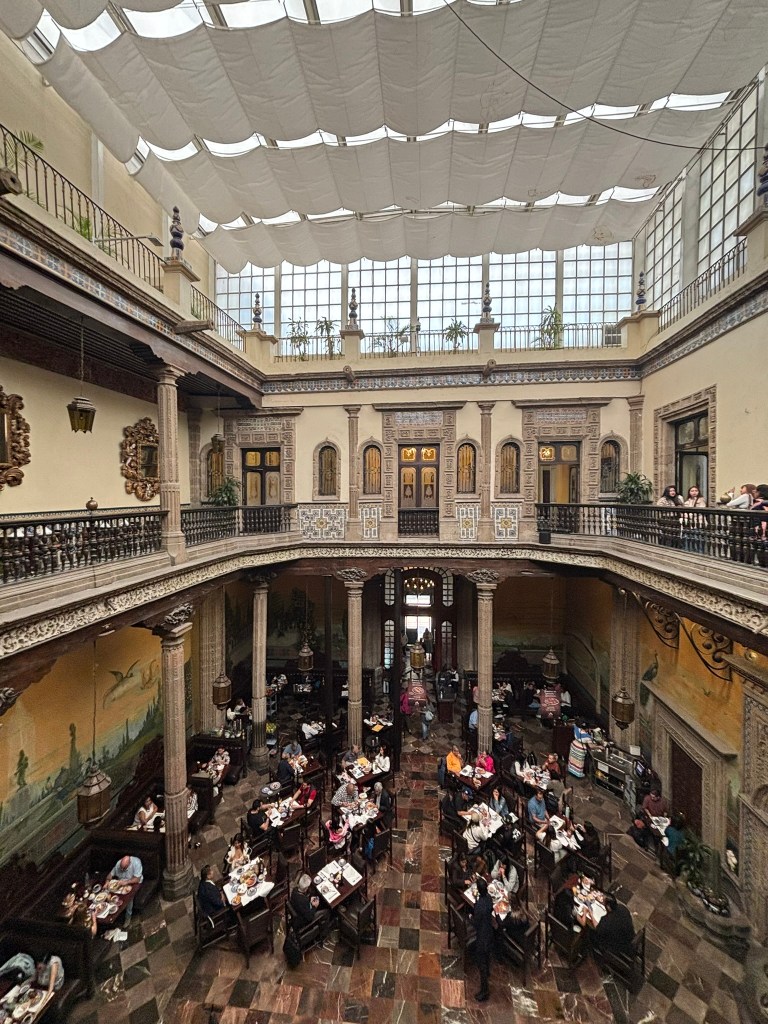
The House of Blue Tiles quickly became a central hub for this Francophile transformation. The building was leased to the elite Jockey Club, an ultra-exclusive playground for Mexico City’s wealthy, French-educated aristocracy. During this era, the central open-air patio was enclosed with a magnificent Art Nouveau stained-glass and iron canopy overhead, mirroring the grand shopping arcades of Paris.
Walking into the space today, that unmistakable Belle Époque flair remains intact. Crystal chandeliers hang from the high ceilings, classical French-style columns support the upper loggias, and an air of old-world European elegance seamlessly blends with the building’s original Mexican structure.
🦚 The Elegant Courtyard and the Lost Peacock Mural
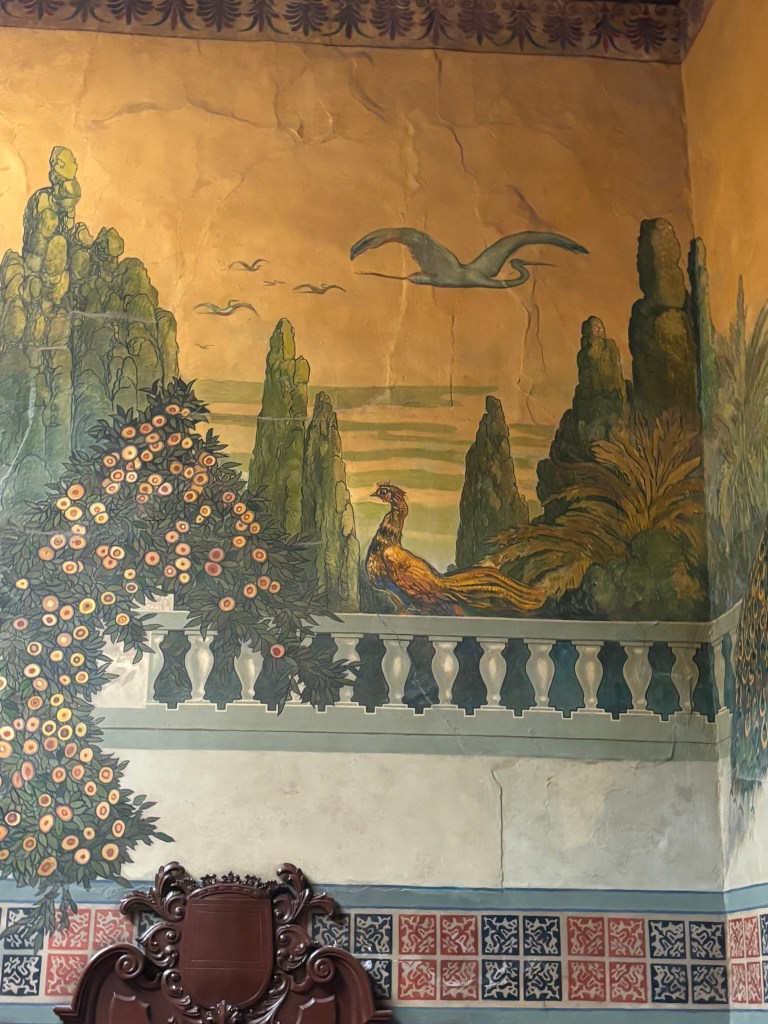
Before you even reach the upper stairs, your eyes will be drawn to the perimeter walls surrounding the central dining patio. Covering these high panels is a beautiful, expansive mural featuring lush, stylized foliage and towering peacocks.
Often overshadowed by the heavier political art of the post-revolutionary era, this decorative mural is a rare, preserved example of early 20th-century European romanticism in Mexico City. The soft pastel tones and whimsical layout mimic classical French and art nouveau wall tapestries. It was specifically commissioned during the building’s transition into a luxury social club to add a sense of serene, palatial garden opulence to the enclosed indoor dining space.
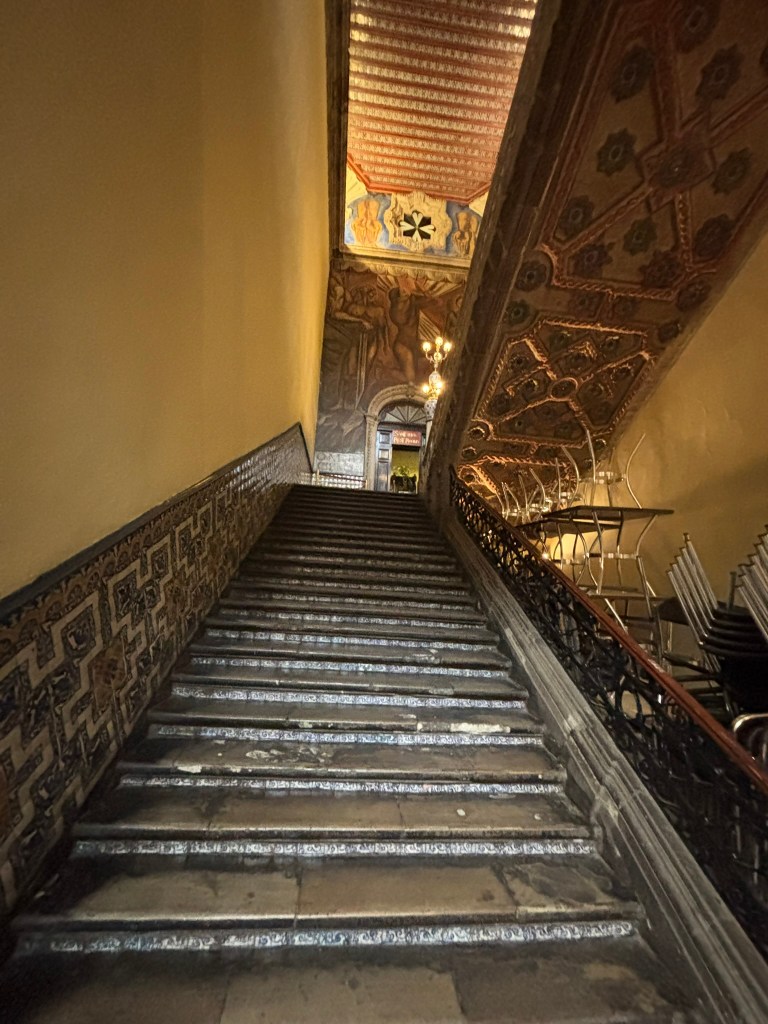
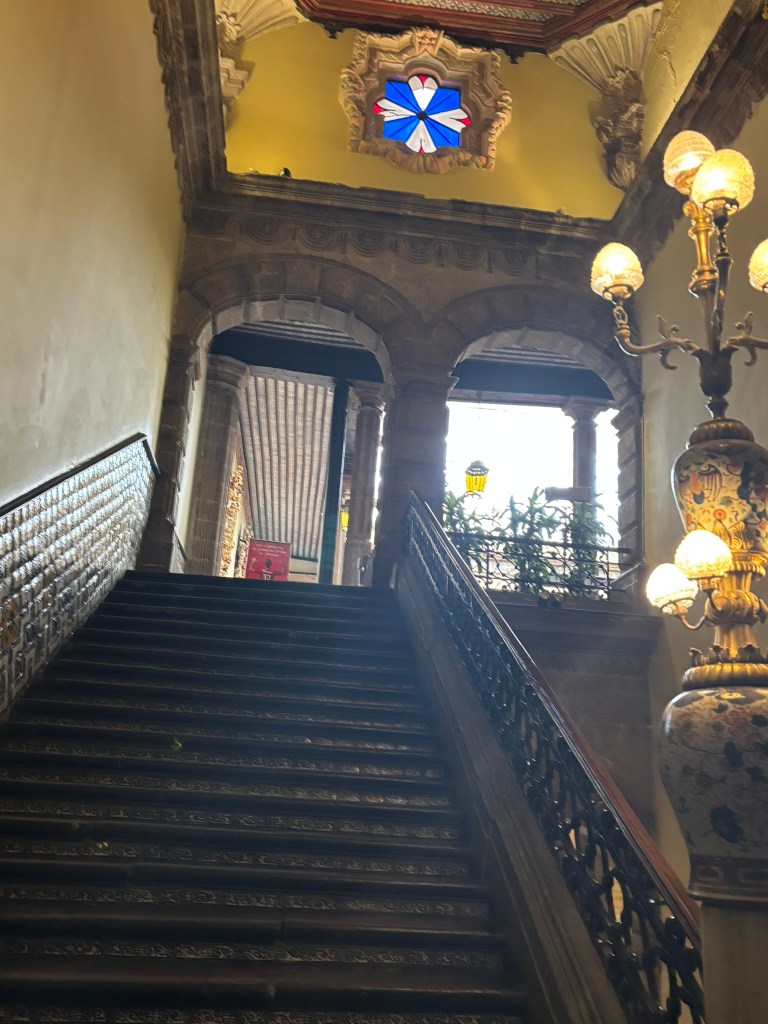
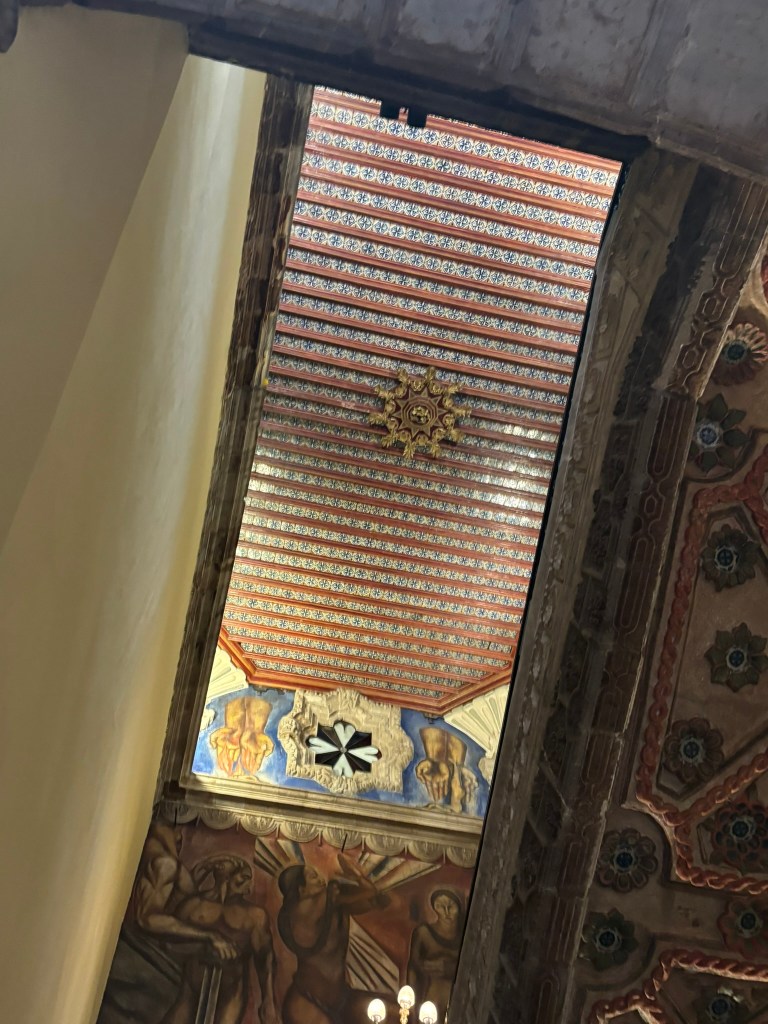
🎨 The Hidden Staircase Mural: José Clemente Orozco
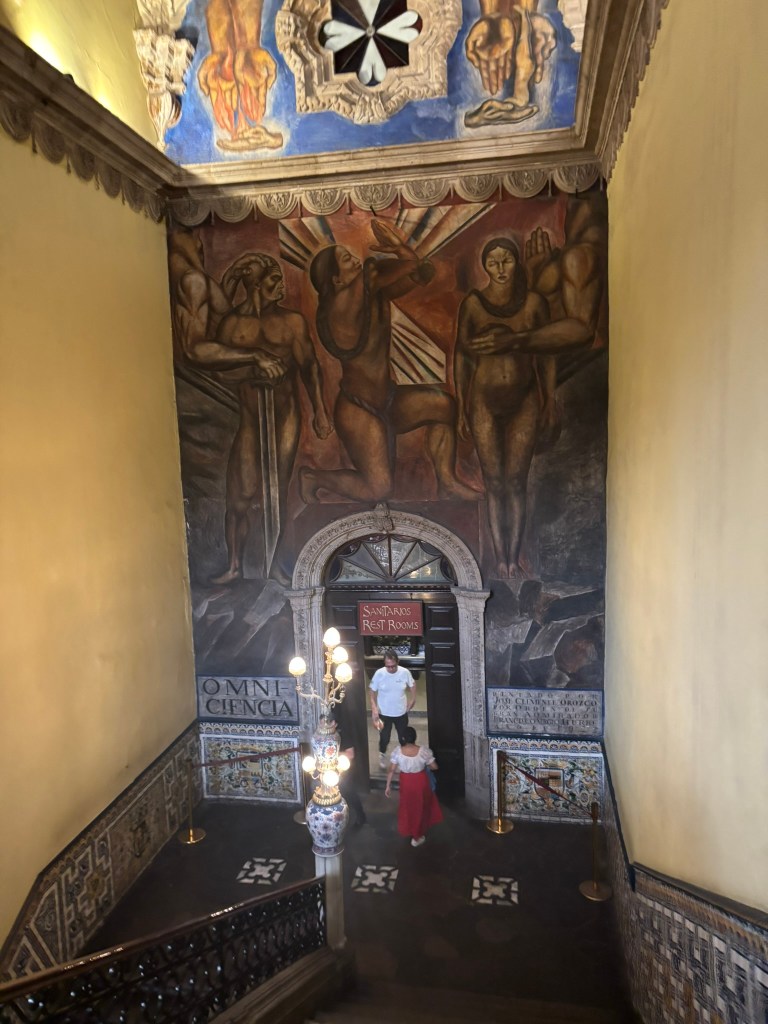
While the courtyard celebrates decorative elegance, the interior staircase holds a monumental piece of Mexico’s post-revolutionary identity.
In 1925, the owner of the property commissioned legendary Mexican muralist José Clemente Orozco to paint the towering walls of the main stairwell. The result is “Omnisciencia” (Omniscience), a powerful, dramatic artwork rendered in Orozco’s characteristically bold, expressionistic style. The mural depicts allegorical figures exploring themes of human knowledge, spiritual awakening, and the feminine creative force.
📸 Pro Photo Tip for the Mural:
Walk up to the mid-landing of the staircase to capture a straight-on shot .
Look up to frame the contrast between Orozco’s heavy, emotional modern strokes and the surrounding, delicate 18th-century stone archways.
🍳 Dining in History: The Sanborns Restaurant
Today, the building is famously occupied by Sanborns, a classic Mexican department store and diner chain that has preserved the property since 1919.
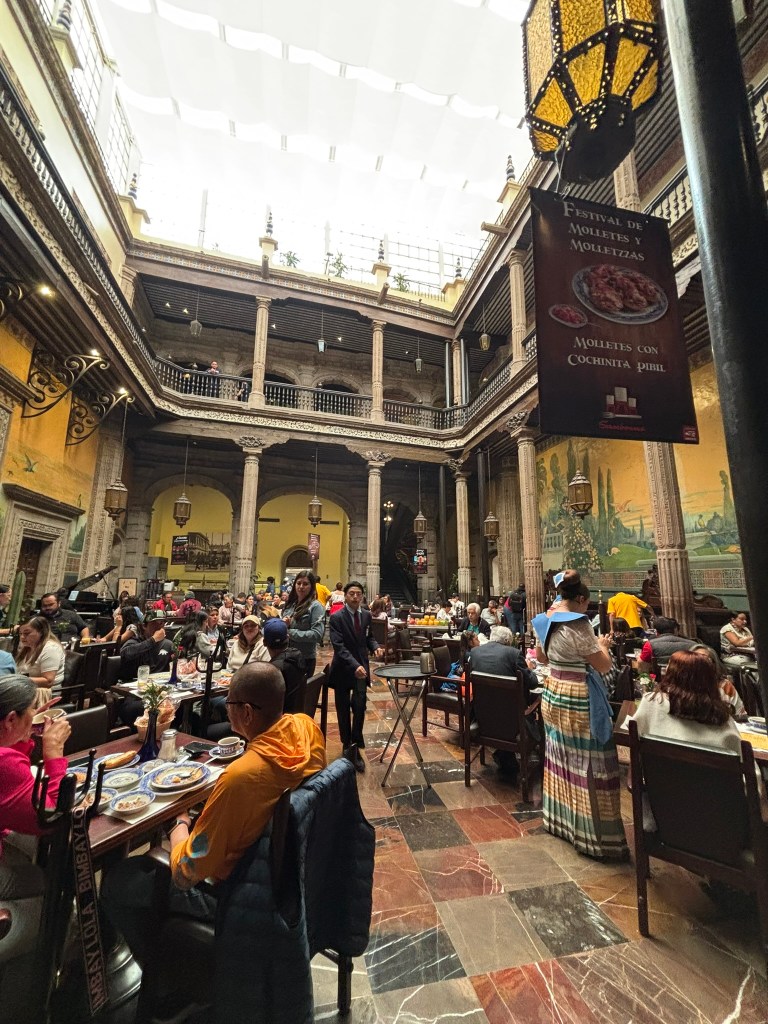
The main dining room sits directly under the spectacular, glass-roofed Moorish patio, surrounded by the stone fountain and the peacock murals. Sitting here for a meal is an absolute must-do itinerary item for any visitor to the historic center. It is a bustling, uniquely Mexican experience where waitresses dressed in traditional folk attire serve comforting local dishes to a mix of reading locals, business executives, and international travelers.
📍 Visitor Information
Address: Av. Francisco I. Madero 4, Centro Histórico, Mexico City .
Best Time to Photograph the Facade: Visit at 7:00 AM during our recommended [Sunrise Walking Itinerary]. The soft morning light avoids casting harsh, distracting shadows from the overhead wires, and the lack of crowds lets you stand back across the street to capture the full length of the tiled exterior
Admission: Completely free to walk inside, view the murals, and browse the architecture.
There is a fleeting, magical window of time when the chaotic, pulsing heart of Mexico City completely stands still. At 6:00 AM, before the street vendors set up their stalls and millions of commuters flood the metro, the historic center belongs entirely to the early risers, the dreamers, and the photographers.
If you are willing to beat the sun, you will be rewarded with an unforgettable spectacle: the first golden light clipping the towers of a massive Baroque cathedral, long dramatic shadows stretching down empty colonial alleys, and the crisp morning air carrying the irresistible scent of freshly baked cinnamon and sugar.
This isn’t just a sightseeing route—it is a carefully timed, multi-sensory sprint through the very best architectural icons, legendary 100-year-old bakeries, and secret rooftop views in the Centro Histórico. From catching the perfect sunrise on Moneda Street to navigating the towering pastry pyramids of Pastelería Ideal, this step-by-step itinerary maps out exactly how to beat the crowds, capture postcard-perfect shots, and reward your early morning hustle with the ultimate rooftop breakfast overlooking the grand Zócalo.
Grab your camera, lace up your walking shoes, and let’s dive into the ultimate morning loop in Mexico City.
[1] Zócalo ── [2] Moneda St. ── [3] Cathedral ── [4] Café El Popular │ [7] Pastelería Ideal ── [6] House of Tiles ── [5] Madero Pedestrian St. │ [8] Palacio Postal ── [9] Finca Don Porfirio ── [10] Bellas Artes │ [13] Museo Bimbo ── [12] Café de Tacuba ── [11] Alameda Central & El Moro │ [14] ROOFTOP BREAKFAST FINISH (Balcón del Zócalo)
🌅 Phase 1: Chasing the Golden Hour (6:00 AM – 7:30 AM)
Zócalo (Plaza de la Constitución) — 6:00 AM
The Shot: Capture the massive, empty central plaza in the blue hour. Look for the military guards raising the monumental Mexican flag.
Directions: Walk to the far right (northeast) corner of the plaza, behind the Cathedral.
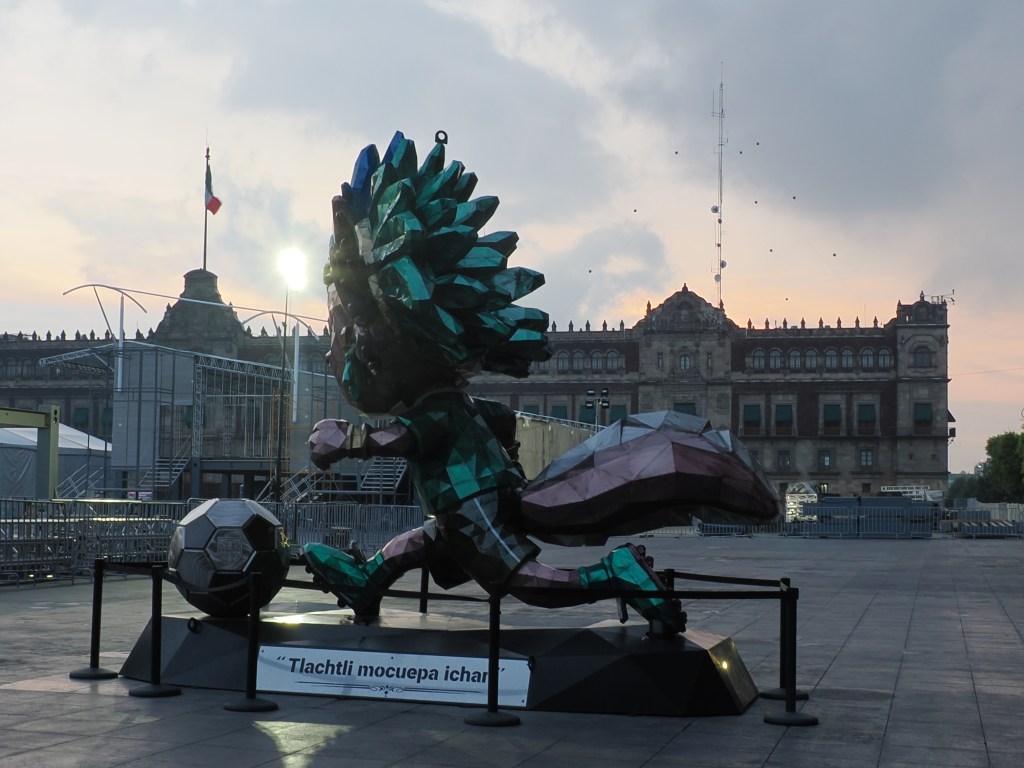
Since I visited in May of 2026, Zocalo was being prepared for the FIFA fan fest, and the entire Zocalo was under construction. I couldn’t get empty Zocalo as I had anticipated
2. Moneda Street — 6:20 AM
The Shot: Look directly east down this narrow, historic colonial street. Photograph the sun the exact moment it crests the horizon, casting dramatic, elongated shadows.
Directions: Turn around and walk right up to the massive stone facade of the Cathedral.
3. Mexico City Metropolitan Cathedral — 6:40 AM
The Shot: Frame the towering Baroque bell towers from a low angle as they catch the very first direct, golden rays of sunlight.
Directions: Walk straight into the wide, stone-paved pedestrian avenue cutting west.
4. Café El Popular — 7:00 AM
The Treat & The Shot: Step briefly into this beloved, retro 24/7 diner. Photograph the bustling morning energy and grab a quick espresso and a hot concha straight from the baker’s heavy metal tray.
Directions: Walk one block north back onto Madero Street.
🥐 Phase 2: Tiles, Towers, and Pastry Pyramids (7:30 AM – 9:00 AM)
5. Madero Pedestrian Street — 7:15 AM
The Shot: Walk west down this famous thoroughfare. Because it is early, you can shoot down the center of the avenue completely devoid of crowds, using the architecture as leading lines.
Directions: Walk two blocks west until you see the shimmering blue facade on your left.
For the life of me I couldn’t find this street. I walked down Cinco de Mayo Street until I reached the house of blue tiles and then realized the Madero Street runs parallel to Cinco de Mayo Street. I didn’t get any sunrise photos as it was already 7.30 by the time I made it here.
6. House of Blue Tiles (Casa de los Azulejos) — 7:30 AM
The Shot: Photograph the striking 18th-century palace facade, completely covered in hand-painted blue-and-white Puebla tiles. Early morning light avoids harsh glare on the glazed ceramic.
Directions: Walk one block south onto Av. 16 de Septiembre.
Go inside and check out the beautiful architecture and murals. This is good place to eat breakfast or grab traditional lunch.
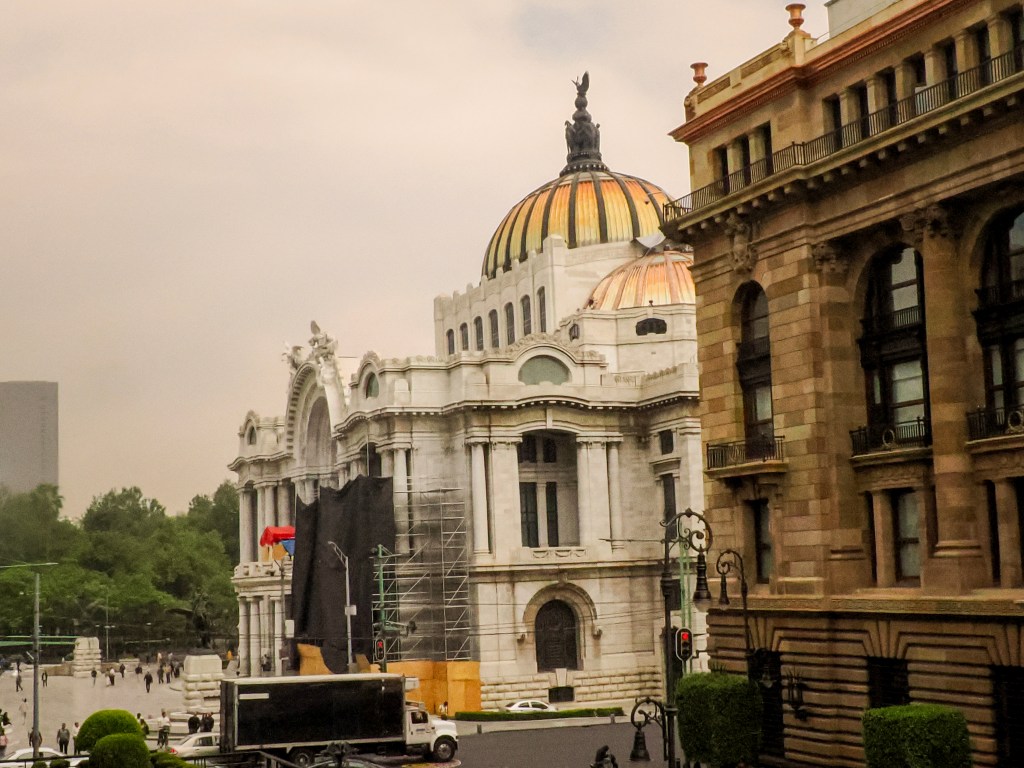
You get great view of Palacio de Bellas Artes from the balcony on Cinco De Mayo Street.
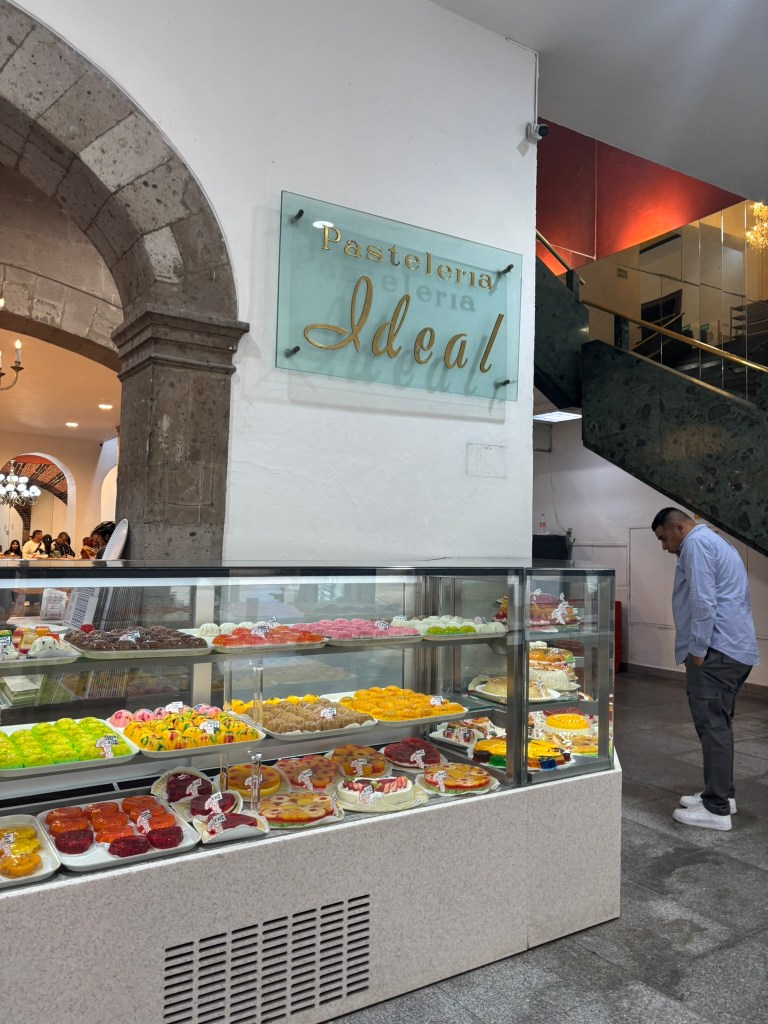
7. Pastelería Ideal — 7:45 AM
The Treat & The Shot: This cavernous pastry kingdom opens at 6:30 AM. Grab a giant metal tray and tongs, and photograph the towering pyramids of freshly baked orejas and bísquets. Check out the surreal wedding cake museum upstairs!
Directions: Walk back north to Tacuba Street, heading toward the main cross-street (Eje Central).
To reach about my experience on visiting this bakery, click here
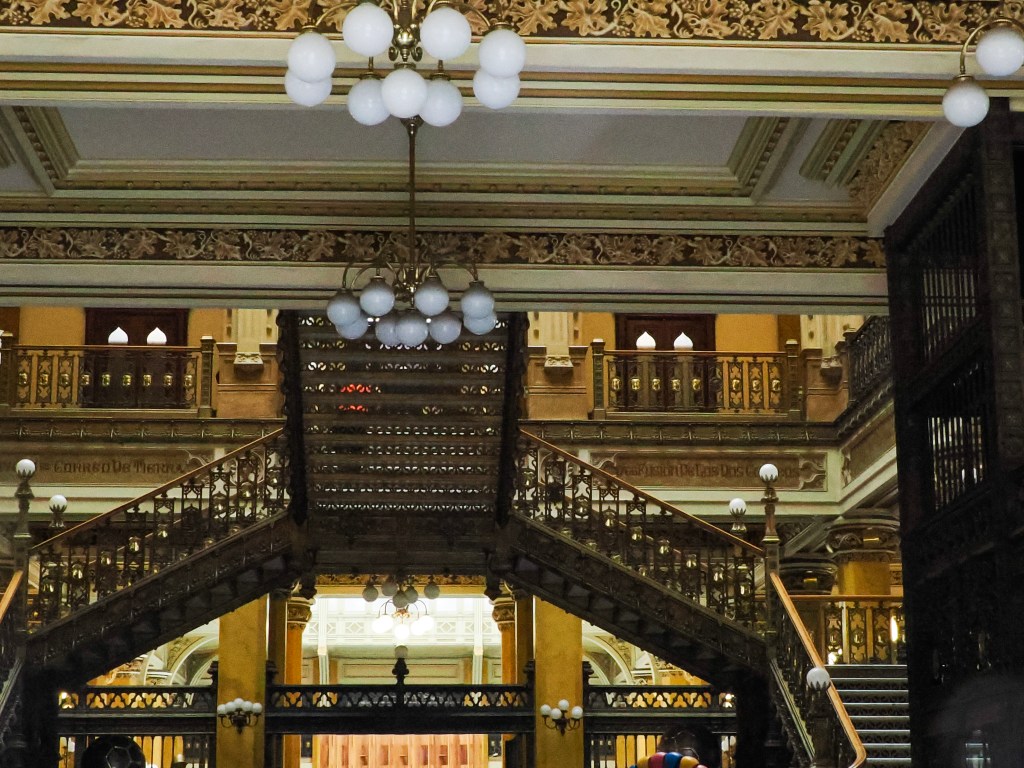
8. Palacio Postal (The Golden Post Office) — 8:15 AM
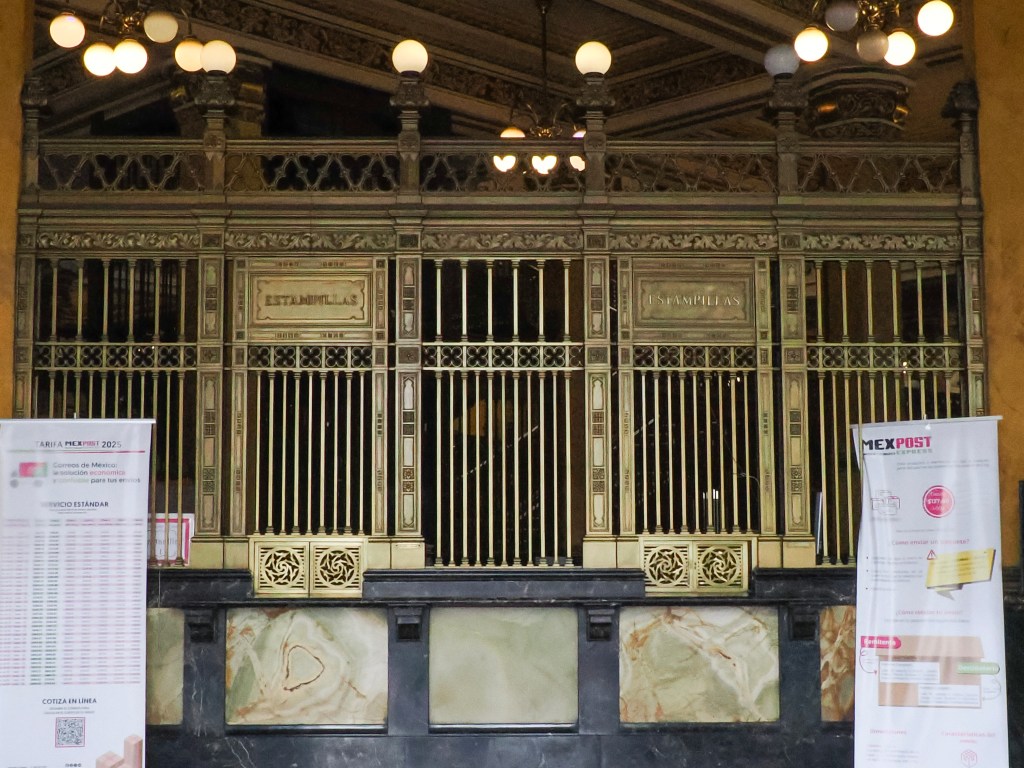
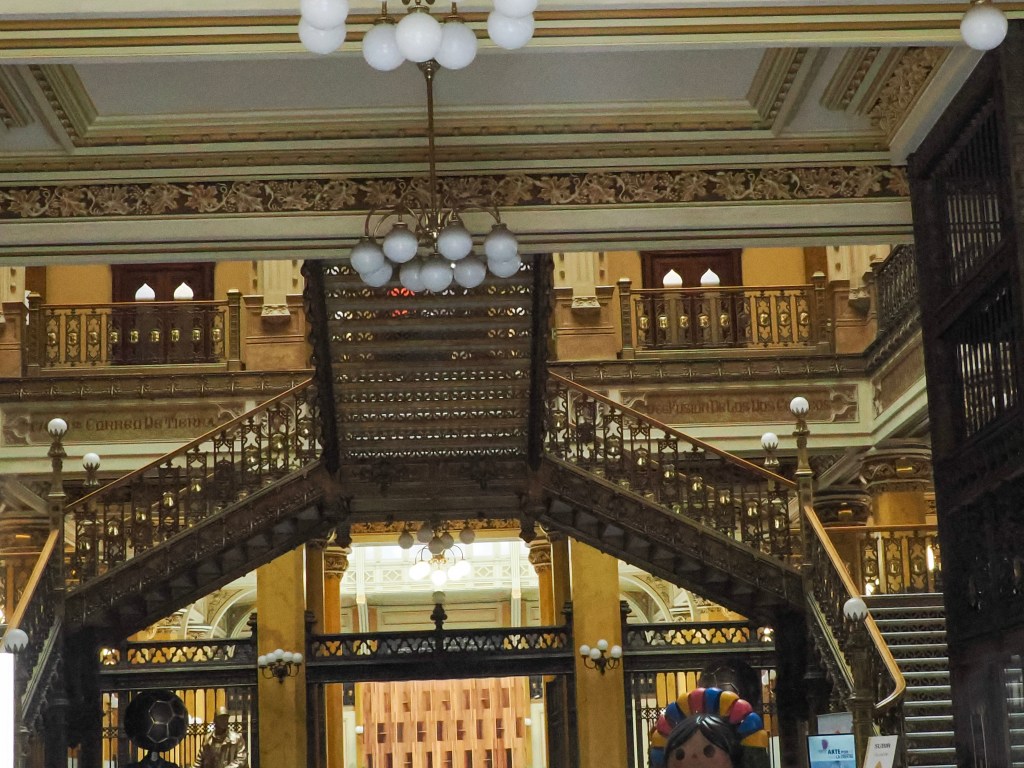
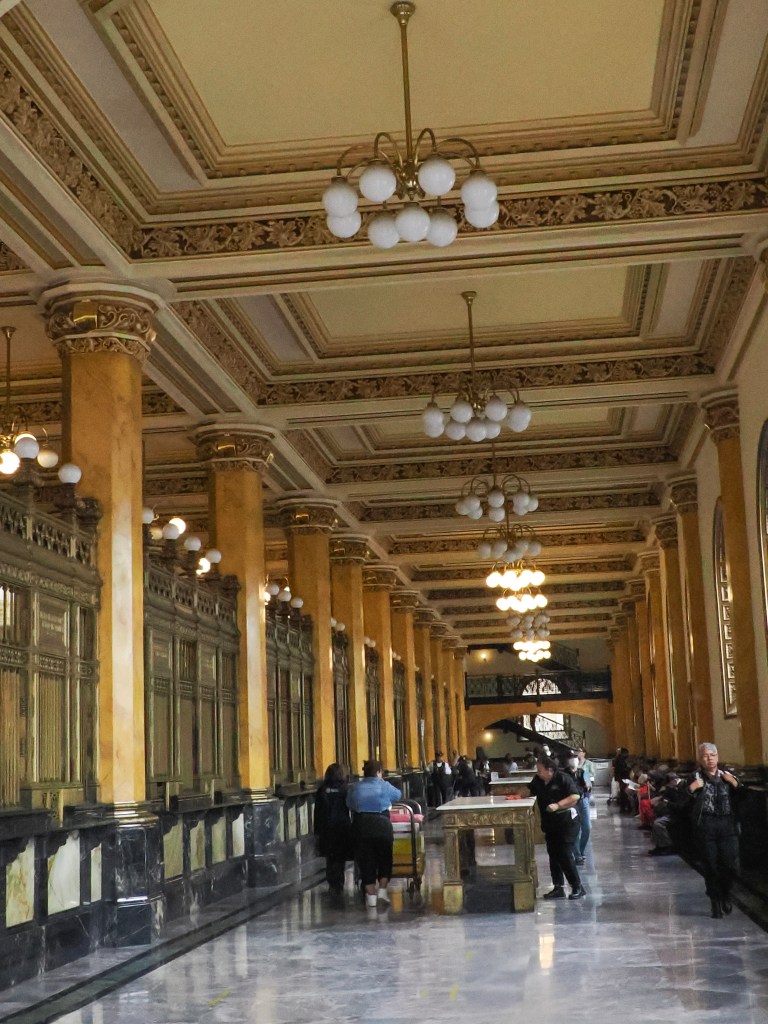
The Shot: Enter right when the doors open. Photograph the breathtaking Italianate-Gothic interior, featuring sweeping golden-brass staircases and an intricate iron-and-glass dome ceiling.
Directions: Step outside and cross the marble plaza immediately next door.
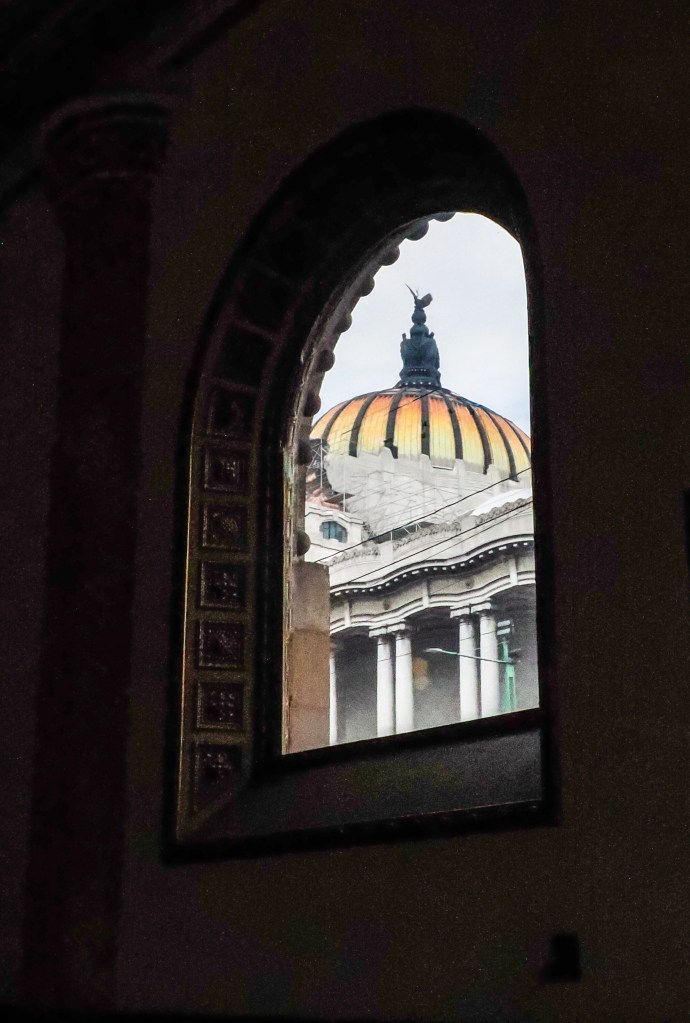
One of my favorite photos from the post office is actually the dome of Palacio de Bellas Artes taken through the window.
🌳 Phase 3: Palaces & Parks (9:00 AM – 10:30 AM)
. Finca Don Porfirio (Sears Building Balcony) — 8:45 AM
The Treat & The Shot: Go into the Sears department store directly across from Bellas Artes. Take the elevator to the 8th floor café. Order a traditional Café de Olla (spiced coffee) and shoot the absolute best elevated, postcard view of the palace domes.
Directions: Take the elevator back down and cross the street to the marble plaza.
10. Palacio de Bellas Artes — 9:15 AM
The Shot: Photograph the iconic Art Nouveau and Art Deco white-marble cultural palace cleanly from ground level before daytime vendors pitch their tents.
Directions: Walk past the west side of the palace straight into the lush tree line.
Unfortunately, they were doing some construction work on the front of the building, and I decided not to take any photos. This will on my to-do list for next visit
11. Alameda Central & Churrería El Moro — 9:45 AM
The Treat & The Shot: Stroll through the oldest public park in the Americas, shooting the marble fountains backlit by the rising sun. Stop at the park’s edge for a bag of legendary, crispy churros dusted in cinnamon sugar from El Moro (operating since 1935).
Directions: Walk east back toward the Zócalo along Calle de Tacuba.
12. Café de Tacuba — 10:15 AM
The Shot: Peer into this century-old institution (opened 1912). Document the brilliant classic Puebla tiles, massive oil paintings, and historic dining rooms that make it look like a living museum.
Directions: Keep walking east for two blocks.
13. El Globo (Museo Bimbo) — 10:35 AM
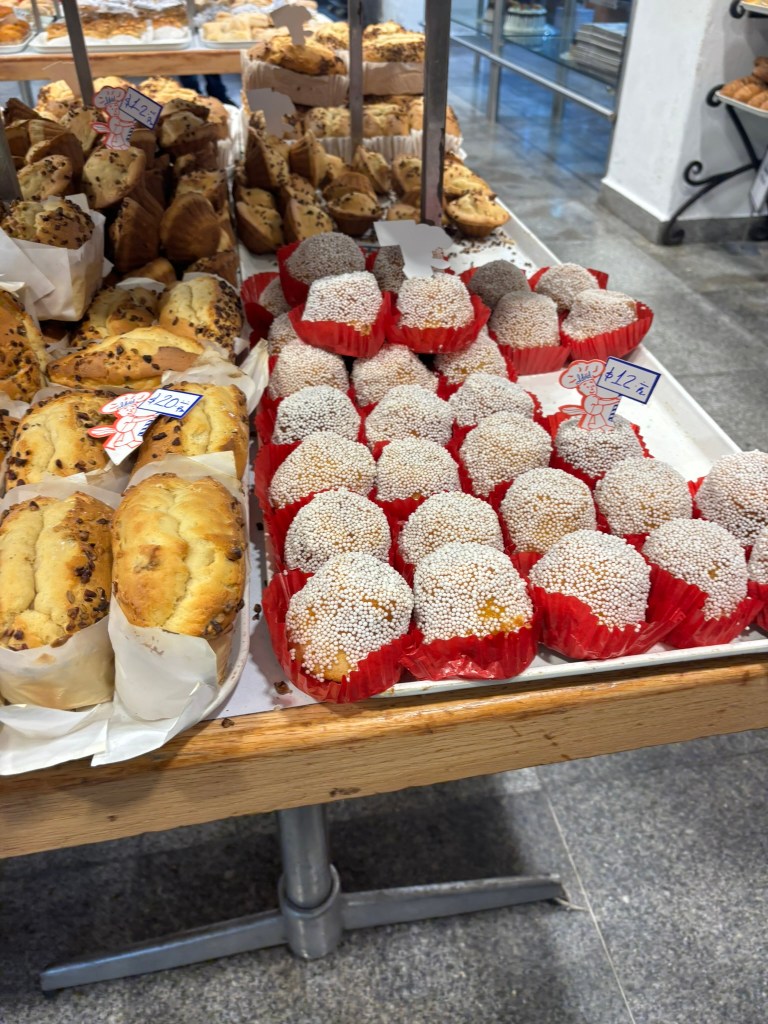
The Treat & The Shot: Stop at this unique bakery location owned by Grupo Bimbo. Grab their signature Garibaldi pastry (an apricot-glazed pound cake completely coated in white sprinkles) and photograph the vintage baking exhibits detailing Mexican culinary history.
Directions: Walk two final blocks east to arrive back at the main square.
🍳 Phase 4: The Grand Finale Rooftop Breakfast (11:00 AM)
14. Balcón del Zócalo — 11:00 AM Finish Line
Reward yourself by taking the elevator up to the 6th floor of the Zócalo Central Hotel.
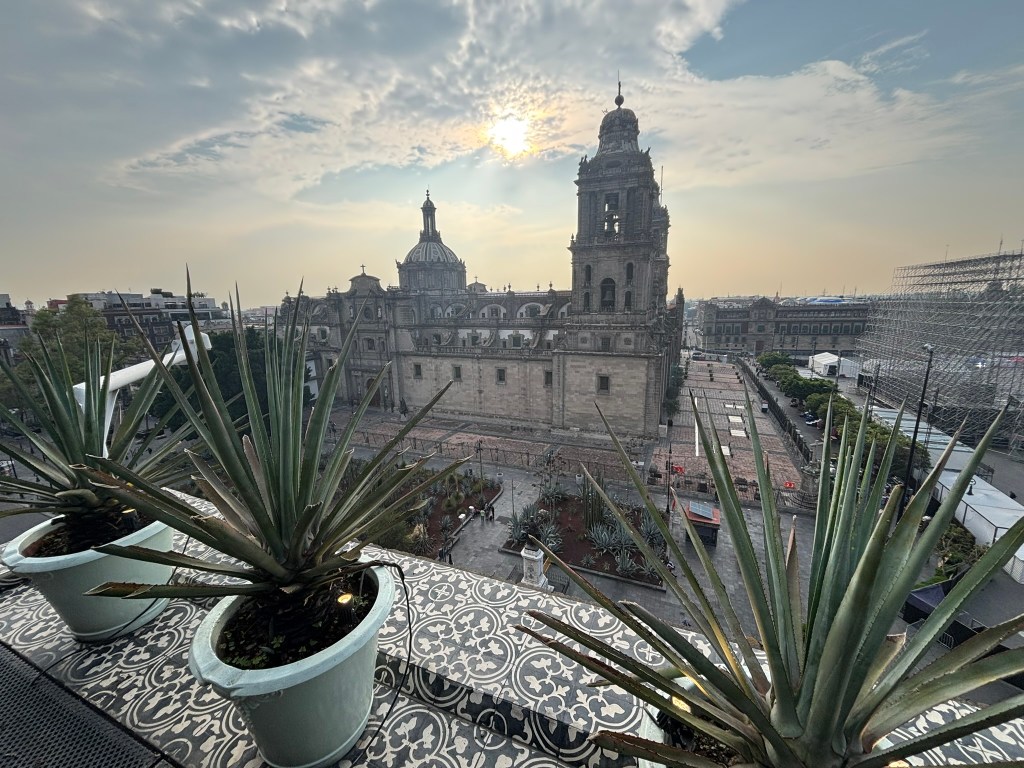
The Reward: Sit right at the terrace edge to enjoy gourmet, modern chilaquiles and artisan sweet breads while reviewing your photos. Use your telephoto lens to capture stunning, compressed close-ups of the Cathedral towers and the sprawling plaza below you. (Advanced reservations are highly recommended to secure a table right against the glass balcony).
Taken from roof top cafe at Zocalo central
Alternative View: If you prefer an expansive, open-air breakfast buffet, the Terraza Gran Hotel Ciudad de México sits just across the square, offering a sweeping view of the National Palace.
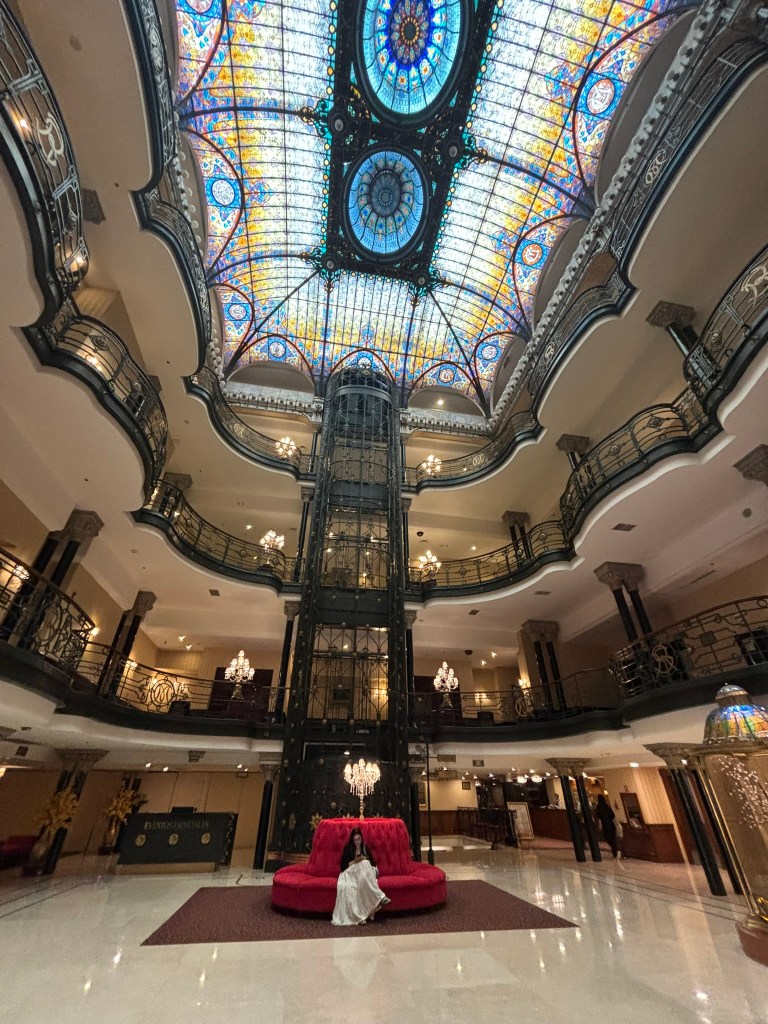
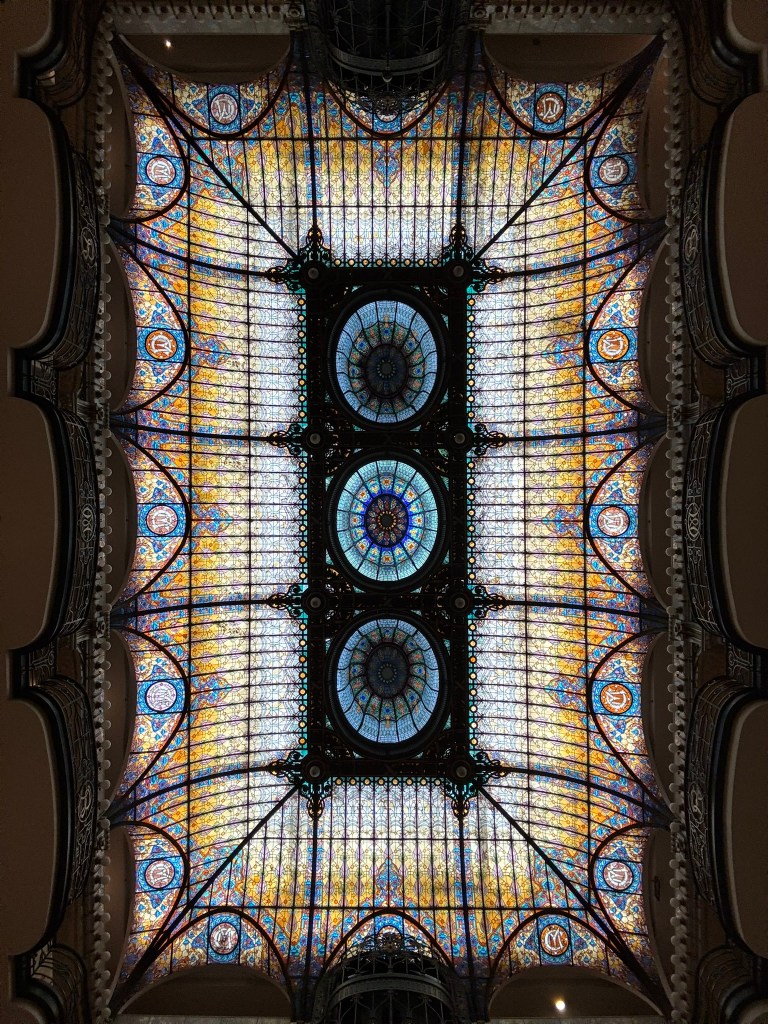
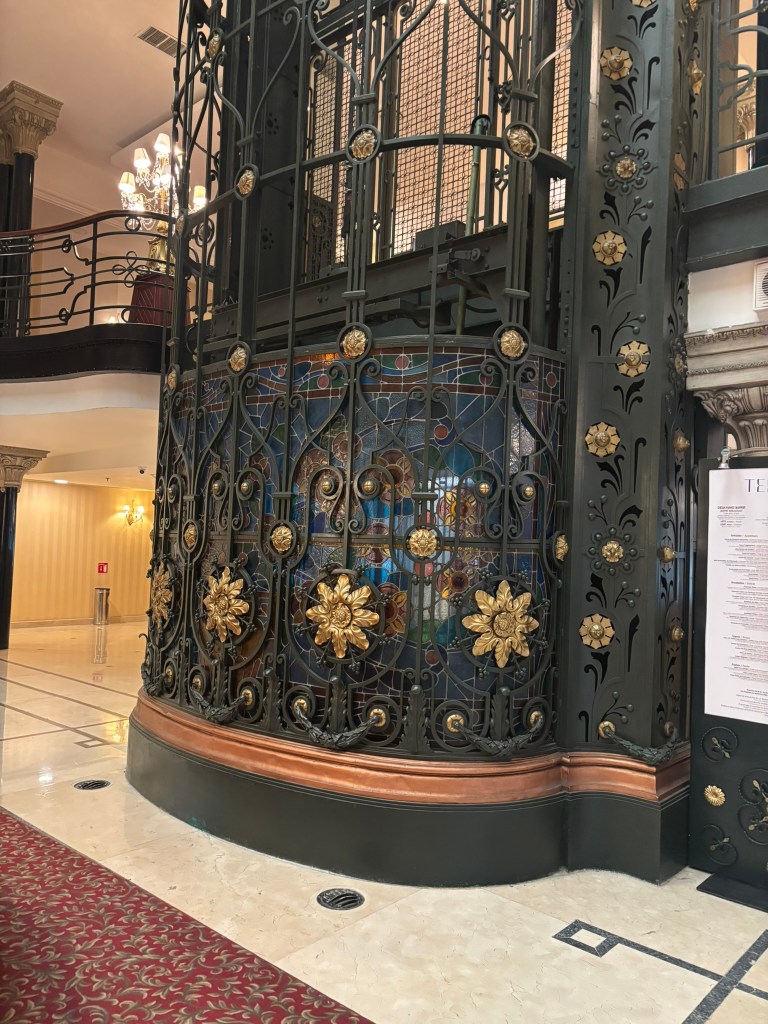
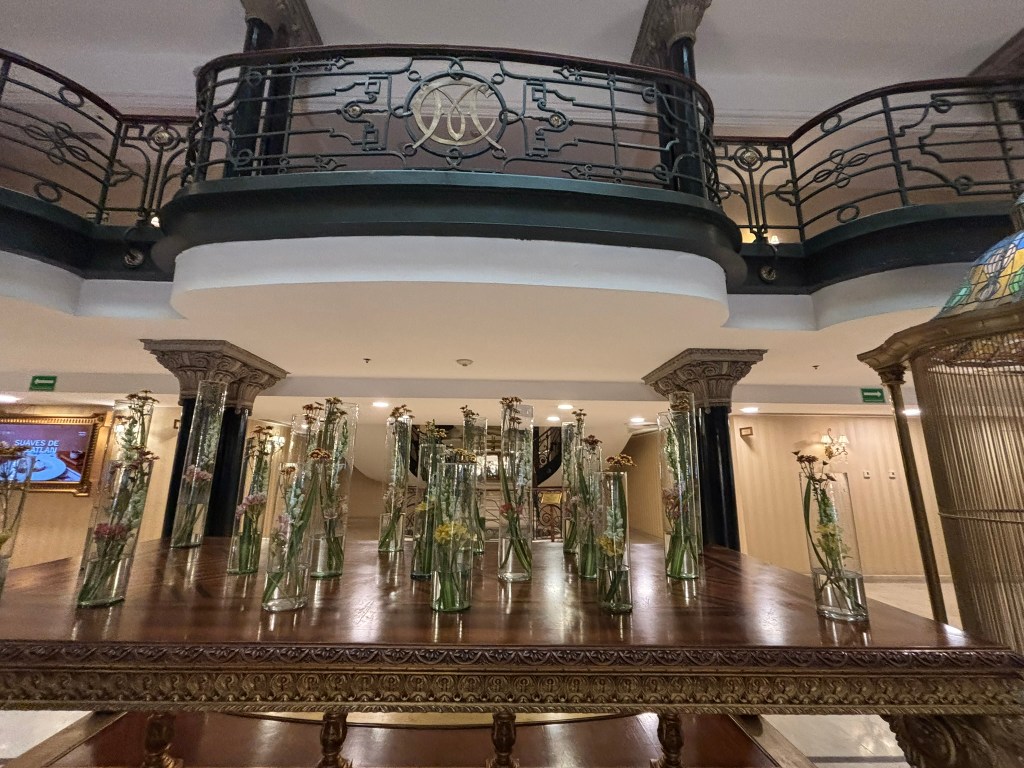
I had visited Hotel Gran on my Phase 1 but this is great option for breakfast or lunch. The lobby of the Gran Hotel Ciudad de México is an Art Nouveau masterpiece originally built in 1899 as the premier department store El Centro Mercantil. It is widely celebrated as one of the most architecturally stunning hotel lobbies in the world.
Key Features to Photograph
Wrought-Iron Balustrades: Elegant, curving Art Nouveau balconies wrap seamlessly around the first three floors of the central atrium
The Tiffany Stained-Glass Ceiling: Designed by French artisan Jacques Gruber and imported in 1908, it features over 20,000 pieces of vibrant, colored glass arranged in dramatic arches and domes. It is one of the largest stained-glass installations in the world.
Gilded Open Elevators: The historic, openwork steel elevator shafts are meticulously decorated with intricate golden metal flowers. These function as original 19th-century Otis lifts.
Pip: Peaks to Palaces has been to Mexico City, and apparently the city does not let you leave without feeding you something ancient, showing you something sinking, and handing you an obsession you didn't ask for.
Mara: Sandy covers a lot of ground here — the culinary landscape for a vegetarian navigating a meat-heavy capital, the layered history inside the Metropolitan Cathedral, and the enduring artistic collision between Frida Kahlo and Diego Rivera.
Pip: Three themes, one city, and somehow all of them connect back to things built on top of other things.
Mara: That's actually a fair summary of Mexico City's entire identity. Let's start with the food.
Eating Well in a Meat-Heavy Capital
Pip: The premise here is genuinely interesting — Mexico City has a reputation as a carnivore's paradise, but there's a case to be made that its deepest culinary traditions are anything but.
Mara: The post makes exactly that case. The setup for local colleagues as guides is key — the writing puts it this way: "Having native speakers clearly explain your ovo-lacto-vegetarian preferences to the restaurant staff gives you complete peace of mind, so you can relax and fully enjoy your meal without worrying about hidden meat broth or unexpected lard."
Pip: So the real travel hack isn't a restaurant app — it's knowing someone who can say "no lard" with authority.
Mara: And that local access unlocks places like Restaurante El Cardenal, where the vegetarian path runs through a huauzontle omelet — an ancient Aztec herb the Spanish actually banned under penalty of physical punishment, secretly preserved by indigenous farmers for centuries.
Pip: That's a remarkable thing to order for breakfast without knowing the backstory.
Mara: The bakery post, "Crumb Trails Through Time," adds another layer — the historic panaderías of the Zócalo aren't just charming stops, they're built on colonial-era ruins, and one of them, Pastelería El Molino, turns out to be the exact birthplace of Grupo Bimbo, now the largest commercial baking company on Earth.
Pip: From a neighborhood pastry counter to thirty-five countries. The conchas were apparently load-bearing.
Mara: And Cantina La Ribera rounds out the restaurant coverage — high-energy, live Lucha Libre mariachi, and a kitchen that built a bespoke vegetarian menu on the spot, including a spicy carrot tostada that wasn't on the menu at all.
Pip: From ancient grains to tableside Crepes Suzette on a fire cart — that's a full arc. Speaking of things built on top of other things, the cathedral is next.
The Cathedral That Refused to Sink
Pip: The Metropolitan Cathedral is framed not just as a landmark but as a physical record of conquest — stone pulled from Aztec temples, repurposed to build the church that replaced them.
Mara: The post puts it plainly: "If you look closely at some of the older exterior walls today, you are looking at the very stones that once formed the temples of Aztec gods."
Pip: Architecture as a receipts archive.
Mara: And the building kept accumulating history. Construction ran from 1573 to 1813 — nearly two hundred fifty years — which is why the structure moves through Gothic foundations, Baroque facades, and a Neoclassical dome in a single visit.
Mara: What's striking is that the cathedral is still actively fighting gravity. Built on the soft clay lakebed of ancient Lake Texcoco, different sections sank at different rates, and a massive 1990s engineering rescue involved threading high-tensile steel cables through the stone columns to pull the leaning walls back inward.
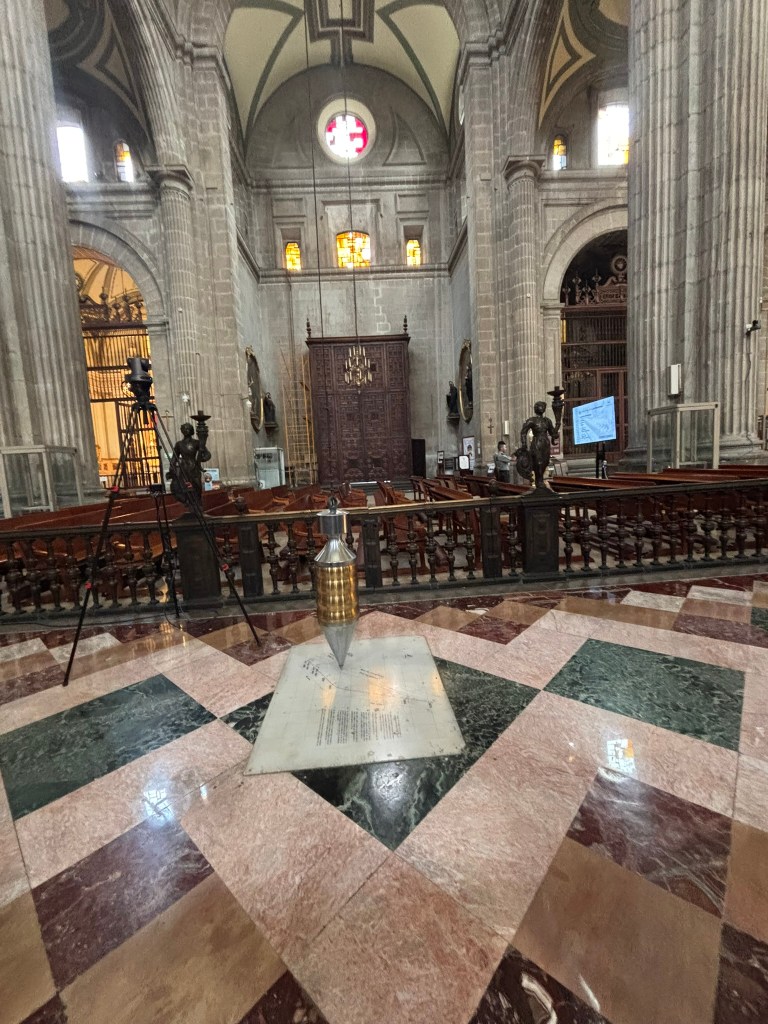
Pip: A five-hundred-year-old building in a structural corset. The interior adds the Altar of the Kings in Churrigueresque gold leaf, fourteen guild-sponsored side chapels, and a brass pendulum on the nave floor that tracks the building's ongoing tilt in real time.
Mara: The pendulum is a genuinely strange and wonderful detail — a live instrument measuring centuries of slow collapse, right there on the floor where visitors walk. From stones pulled from Aztec temples to steel cables holding the arches together, the cathedral earns the post's description of it as a monument that mirrors the city's own endurance.
Pip: That endurance theme carries directly into Coyoacán.
Frida's Universe, Diego's Shadow
Pip: The Frida and Diego coverage asks a pointed question — how does a woman history treated as a footnote end up completely eclipsing the man who was supposed to be the giant?
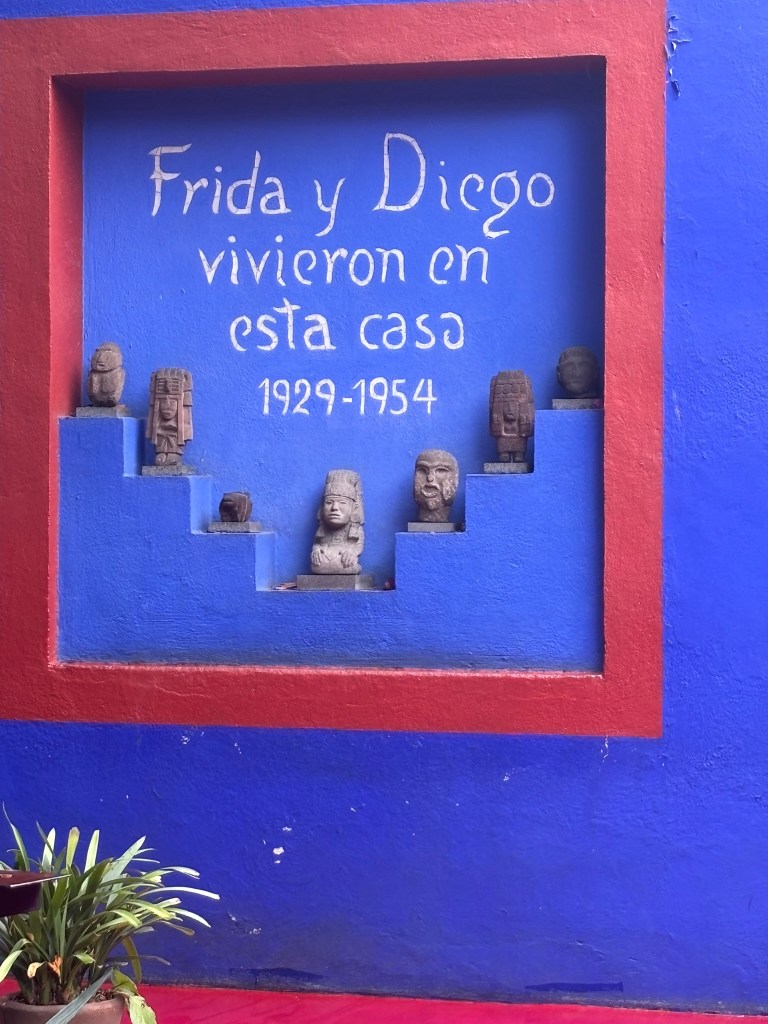
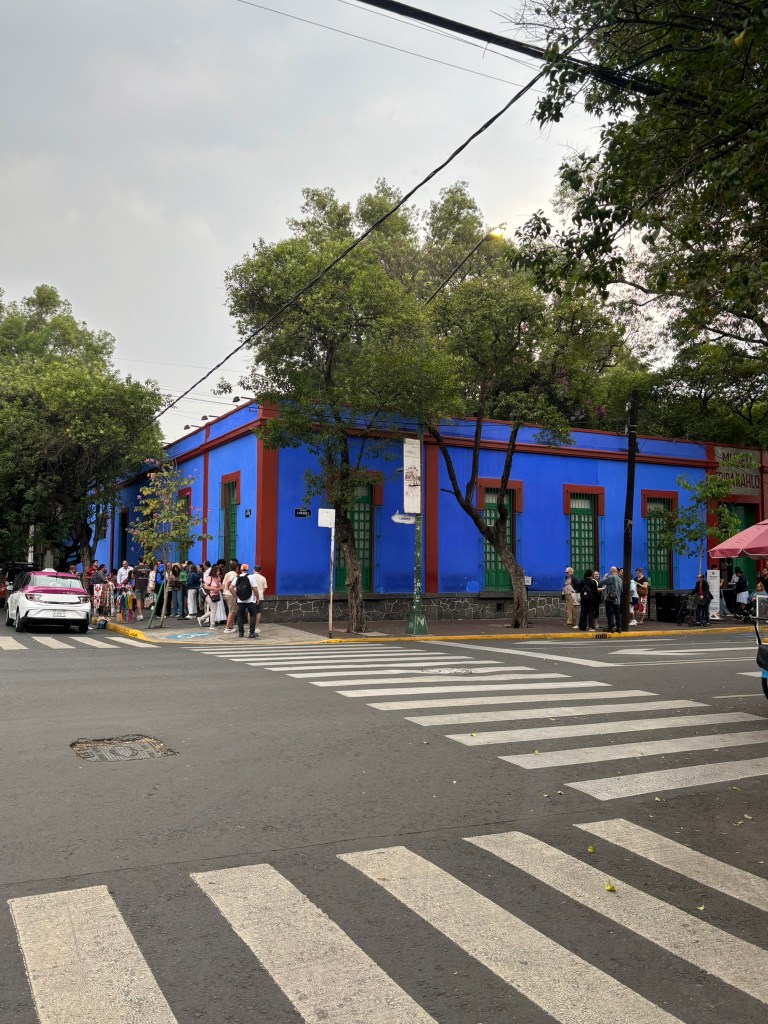
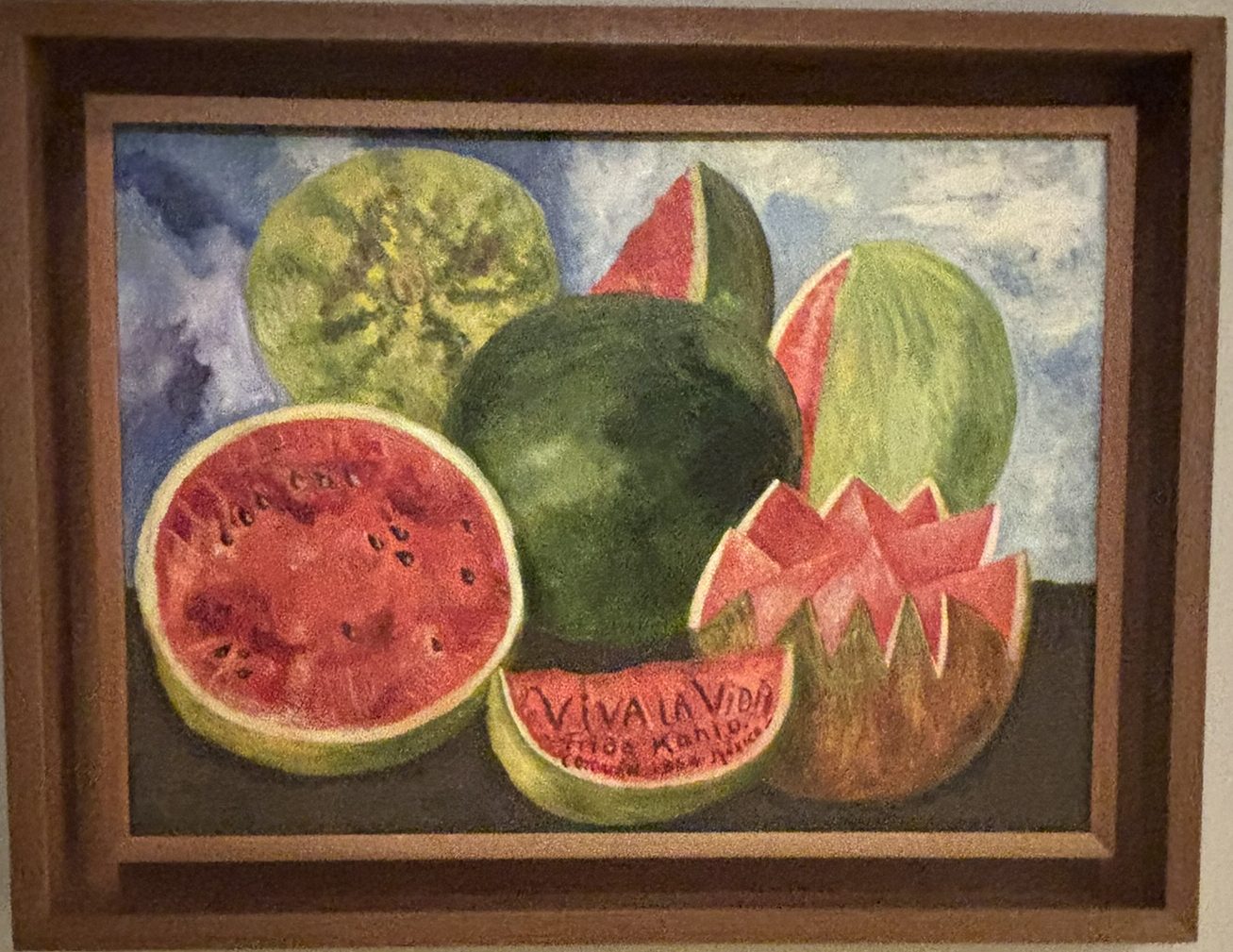
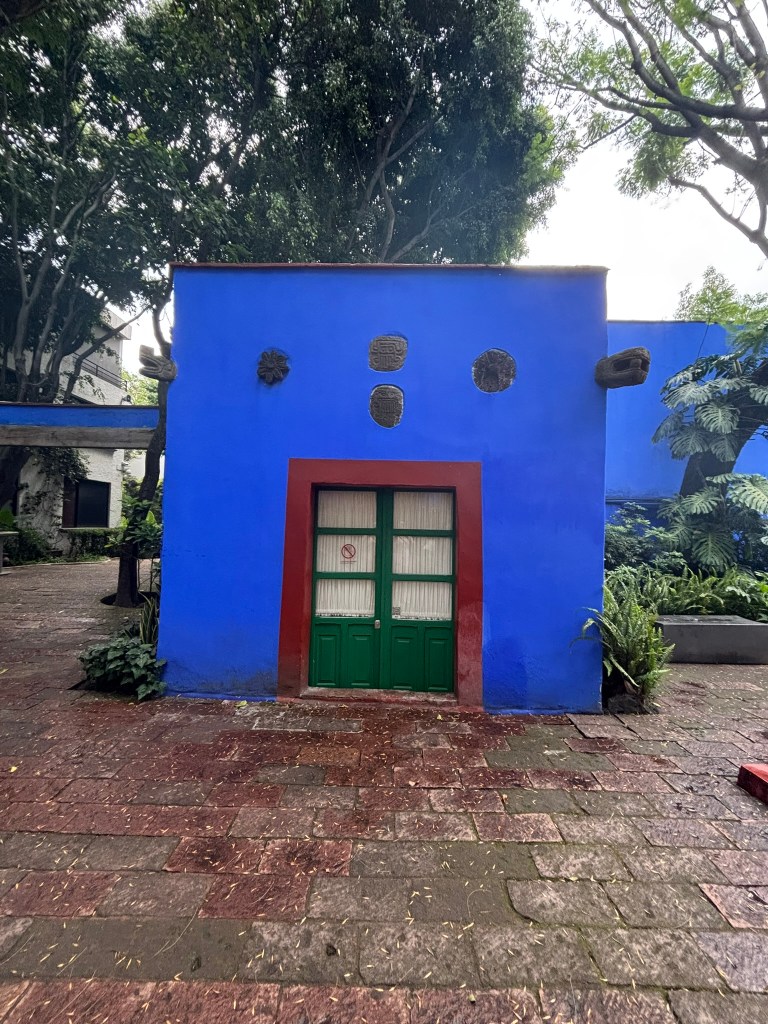
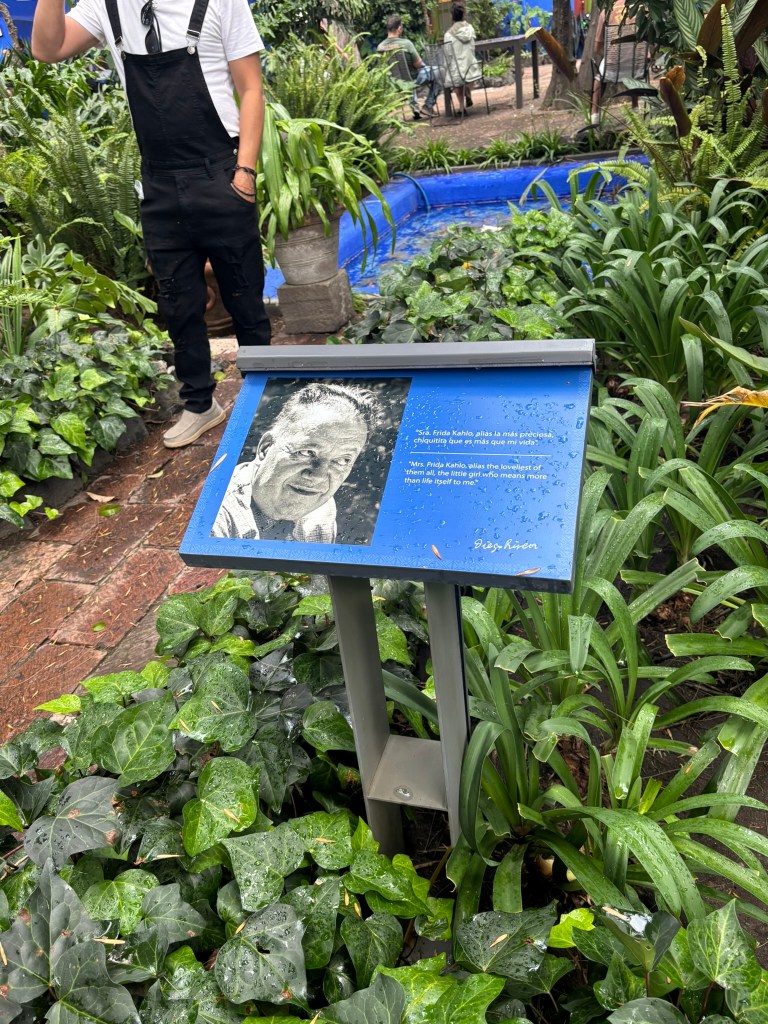
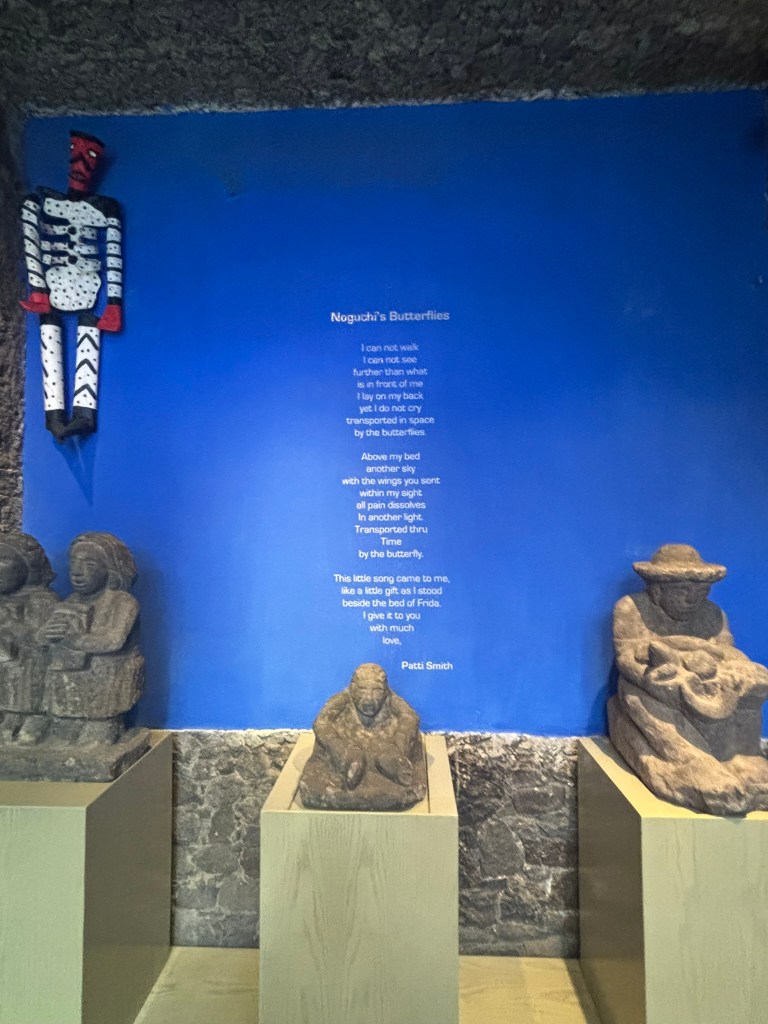
Mara: The Casa Azul guide is the anchor here, and the post on how Frida's art eclipsed Diego's empire maps the full arc. The Blue House is where it becomes visceral — as the writing describes it, the mirror above Frida's daybed is "the exact glass her mother installed, which allowed Frida to paint her soul through self-portraiture while completely immobilized."
Pip: She turned confinement into the most portable artistic identity of the twentieth century.
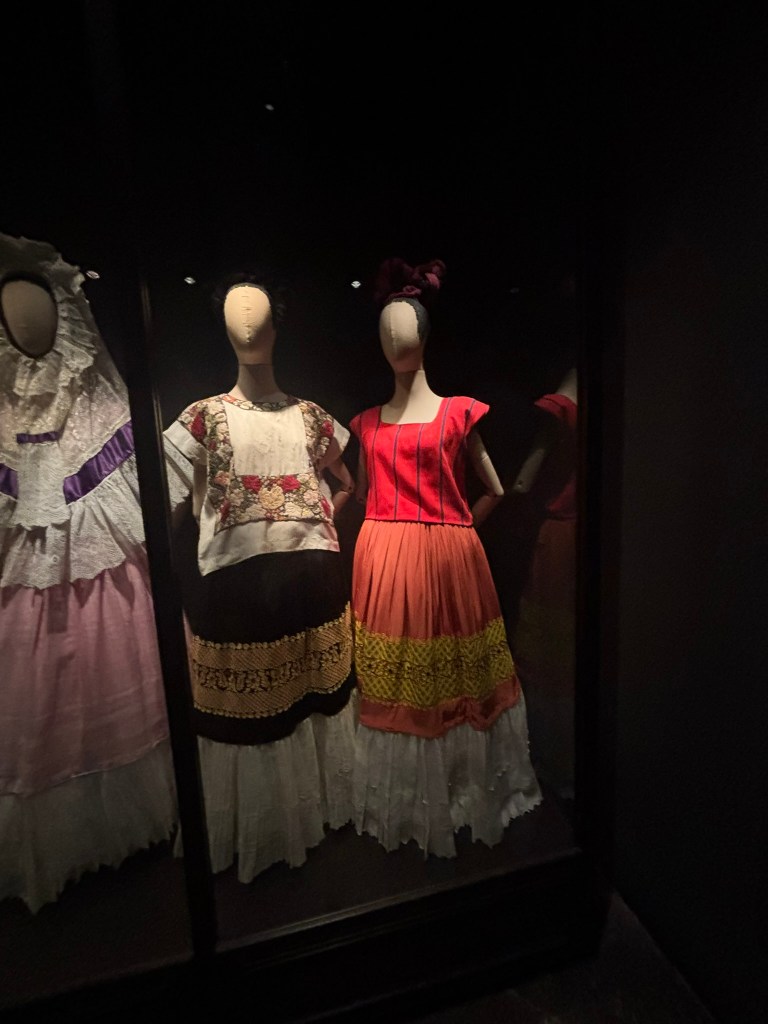
Mara: The wardrobe exhibition — sealed by Diego's instruction until 2004 — makes that concrete: hand-painted plaster corsets, steel spinal braces, and a prosthetic leg encased in a red leather boot embroidered with Chinese silk and tiny bells. The post calls it "the ultimate testament to a woman who refused to hide her scars."
Pip: The broader piece on tracing their footsteps through the city adds the San Ángel twin houses — two separate concrete towers connected by a single rooftop bridge, designed so either of them could lock the door when things got unbearable.
Mara: The architecture is almost too literal as a metaphor, but it holds. And the post's conclusion lands cleanly: Diego painted the history of Mexico on grand public walls; Frida painted the history of the human soul on small, intimate panels. The city still reflects both, but one of them draws the longer lines.
Pip: Mexico City as a destination where the food has a pre-Hispanic backstory, the cathedral is held together by engineering ingenuity, and the most famous house is a cobalt-blue fortress that outlasted an empire.
Mara: There's more from Peaks to Palaces ahead — same instinct for the history underneath the surface, wherever the next destination lands.
Imagine walking down a busy street in modern Mexico City and discovering the heart of the Aztec Empire. Visiting the Templo Mayor is more than stop in Zocalo. it’s a trip through history, myths, and amazing archaeological finds. As you get closer to the ruins, the tall buildings and detailed carvings tell stories from long ago, highlighting a civilization that honored many gods and held important ceremonies.
As you explore, you might feel a deep respect for the spirits of ancestors watching over the ruins. The Templo Mayor reminds us of the richness and complexity of Mesoamerican cultures, sparking curiosity that goes beyond time and place. You leave not just with a greater appreciation for Mexico City’s history, but with a better understanding of how the past influences today’s lively culture.
To ensure your journey into the Aztec past goes seamlessly, keep these essential travel details in mind:
Location: Right in the heart of the Centro Histórico, located at Seminario 8, immediately northeast of the Zócalo main plaza and right next to the Metropolitan Cathedral.
How to Get There: Take the Mexico City Metro Line 2 directly to the Zócalo/Tenochtitlan station. The museum entrance is just a brief walk from the exit.
Hours: Open Tuesday through Sunday from 9:00 AM to 5:00 PM. The site is strictly closed on Mondays.
Admission Fees: General entry is 95 MXN (approximately $5.50 USD), which grants access to both the open-air ruins and the indoor museum rooms. It is completely free for children under 13, students, teachers, and senior citizens with valid IDs.
Pro-Travel Tip: Avoid visiting on Sundays if you want to dodge massive crowds; Sunday is the free admission day for Mexican residents and expats.
Security & Baggage: You must clear a security checkpoint upon entry. Large bags, backpacks, food, and water bottles are not allowed into the exhibition areas. You can use the museum’s secure on-site baggage locker service for free to hold your items while you tour.
What to Wear: The first half of the tour takes place completely outdoors on elevated metal and wood boardwalks. Wear comfortable walking shoes, a hat, and sunscreen, as there is very little shade over the ruins before you enter the air-conditioned museum.
From Imperial Capital to Hidden Ruins
In 1325, the Mexica (Aztec) people founded their capital, Tenochtitlan, on an island in the middle of Lake Texcoco (Now Mexico City). At its center stood the Templo Mayor—the literal and spiritual core of their universe.
After the Spanish Conquest in 1521, the temple was destroyed. The conquistadors used its monumental stones to build the massive Metropolitan Cathedral that still stands next to the site today. For centuries, the remains of the Aztec empire lay completely buried and forgotten beneath the growing capital of New Spain.
The Electric Discovery That Changed Everything
The temple stayed hidden until 1978, when a crew of electrical workers digging near the city’s main plaza struck something hard. It was a massive, finely carved stone monolith depicting the dismembered goddess Coyolxauhqui (Bells-Her-Cheeks). Finding the monument pinpointed the exact, long-lost location of the Templo Mayor, the main religious and political center of the Aztec capital, Tenochtitlan. This discovery subsequently launched one of Mexico’s largest and most significant archaeological excavation projects.
According to myth, her brother—the patron god Huitzilopochtli—killed her when she attempted to assassinate their mother. This single, accidental discovery sparked a massive excavation, revealing that the grand Aztec temple was waiting just beneath the pavement.
Today, visitors can view the original monolith at the on-site Museo del Templo Mayor, which stands immediately adjacent to the open-air archaeological ruins where it was first found
Visualizing the Ancient Valley
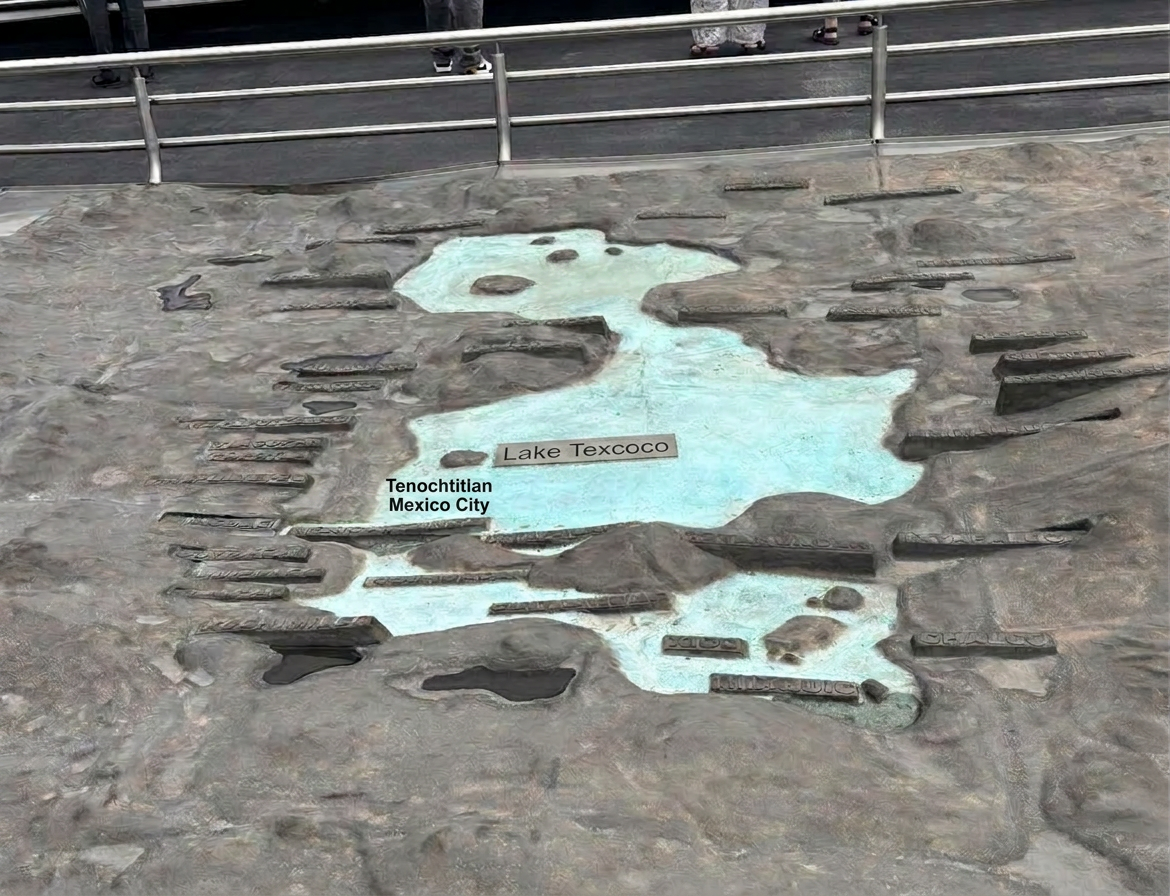
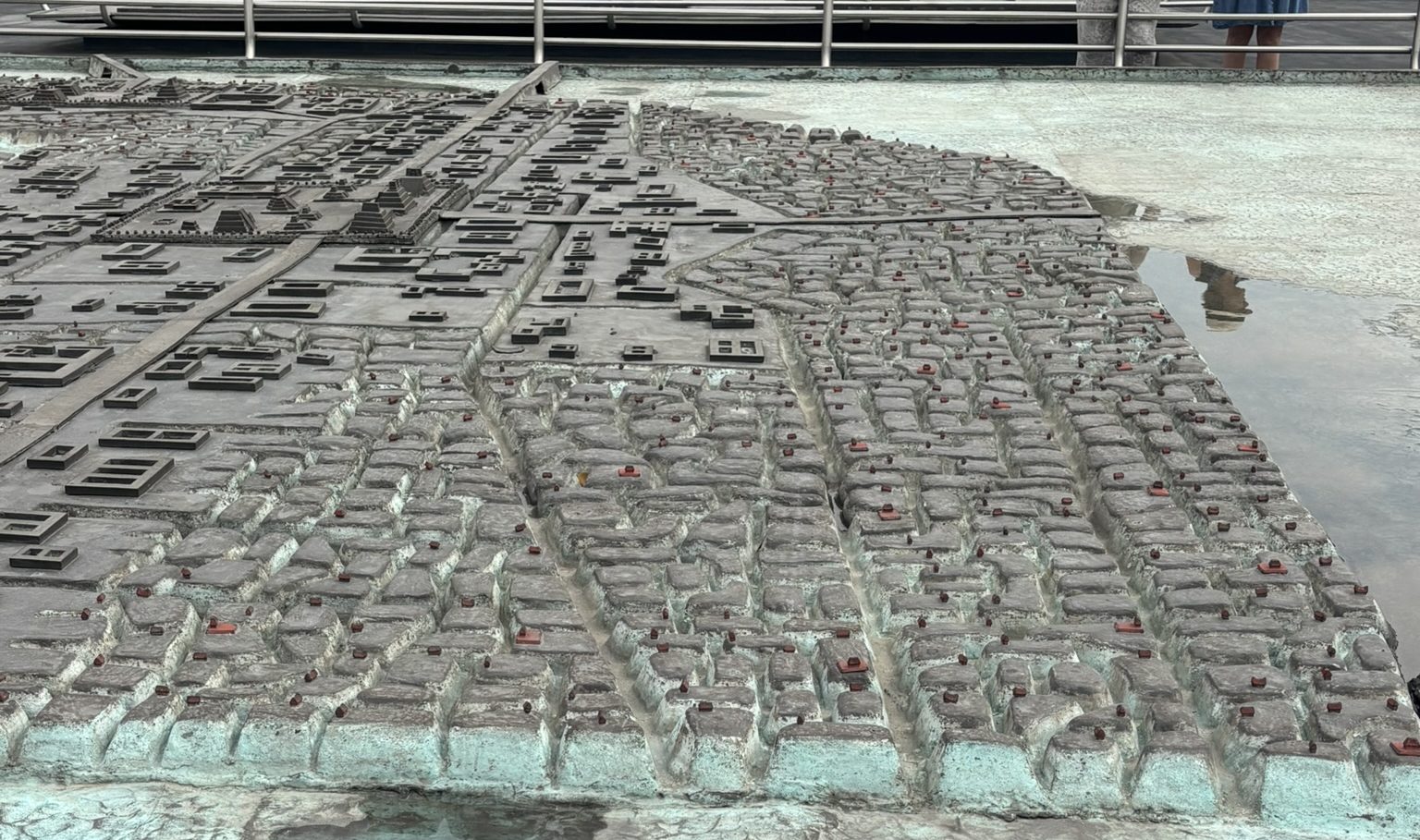
Before you even step into the ruins, your visit begins with an incredible perspective shift. Out on the viewing platforms, you will encounter a large topographical scale model that recreates the ancient Valley of Mexico and Mexico City.
The model highlights the vast turquoise expanse of the historical Lake Texcoco system, contrasting sharply against the surrounding mountainous terrain. Looking at this map, you can clearly see how Tenochtitlan was meticulously engineered right out of the water, connected to the mainland only by narrow causeways. It serves as a powerful visual reminder of how drastically this geography has changed to become the concrete metropolis you are standing in today.
Model of ancient Mexico City and Lake Texcoco
A Metropolis Built on Water
Getting a closer look at the city layout on the scale model reveals the sheer brilliance of Aztec urban planning. The city wasn’t just a random cluster of buildings; it was a highly organized, dense grid of residential neighborhoods (calpullis) stretching across the water.
In this detailed view, you can see how the streets were a combination of packed earth walkways and turquoise water canals. These canals acted as the main highways of Tenochtitlan, allowing thousands of canoes to navigate daily between homes, markets, and agricultural plots. Standing there and comparing this highly advanced Venice-like water city to the modern traffic of Mexico City is an unforgettable experience.
What Happened to the Lakes?
Spanish Siege (1521): Conquistadors intentionally destroyed Aztec floodgates and filled canals with debris to build standard European roads.
The Great Drainage (1607–1900s): To stop catastrophic colonial flooding, engineers built massive tunnels to permanently divert water out of the mountain valley.
The Concrete Overhaul: By the mid-20th century, the final lakebeds were completely drained to pave the way for urban mega-expansion.
The Sinking Modern Legacy Because modern Mexico City sits on this soft, empty clay lakebed, the historic center is actively sinking—dropping up to 10 meters (33 feet) over the past century!
Where to See the Canals Today
Destination: Xochimilco (Southern Mexico City)
What it is: The last remaining UNESCO-protected network of original Aztec canals and chinampas (floating gardens).
The Experience: Rent a vibrant, flat-bottomed wooden boat called a trajinera to cruise the historic waterways.
Recreating the Sacred Precinct
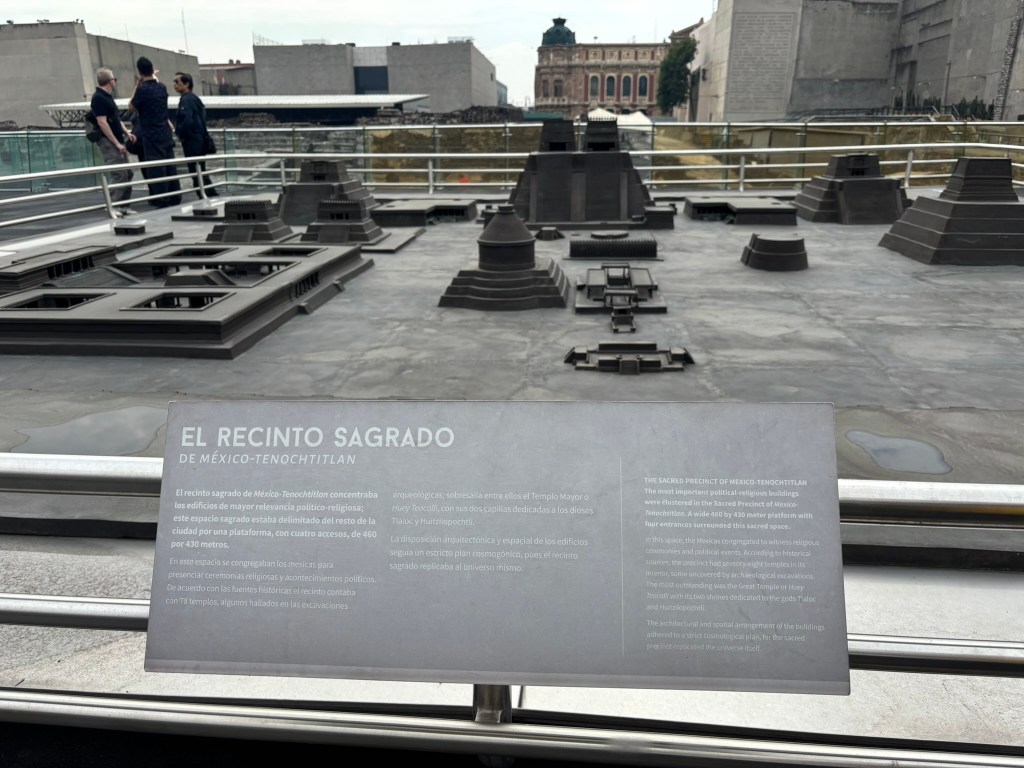
As you continue along the outdoor walkways, you will come across another fascinating display: a detailed architectural model of the Sacred Precinct (El Recinto Sagrado). This dark, geometric miniature brings the core of the ancient city to life right before your eyes.
Historical sources note that this entire sacred space was an immense 460 by 430-meter platform enclosed from the rest of the city, featuring four main entrances. The precinct held around 78 temples and religious structures, laid out according to a strict cosmological plan meant to replicate the universe itself. Towering over the model is the main Templo Mayor (Huey Teocalli), crowned by its distinctive twin shrines dedicated to the rain god, Tlaloc, and the patron war god, Huitzilopochtli.
Stepping Onto the Sacred Grounds
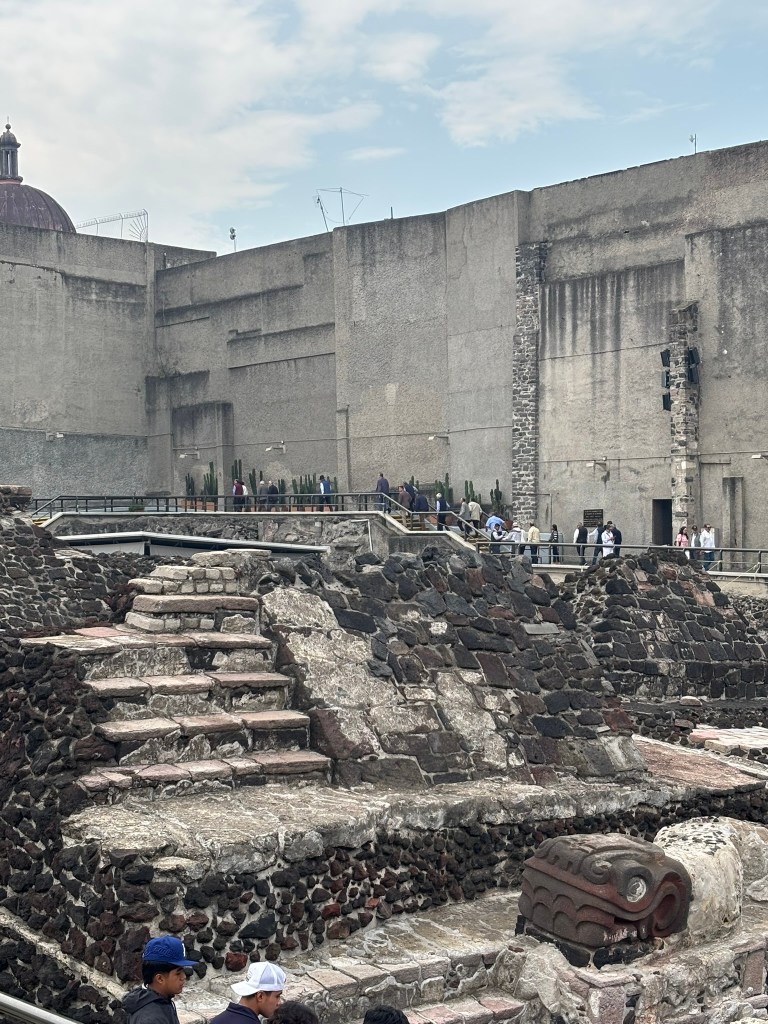
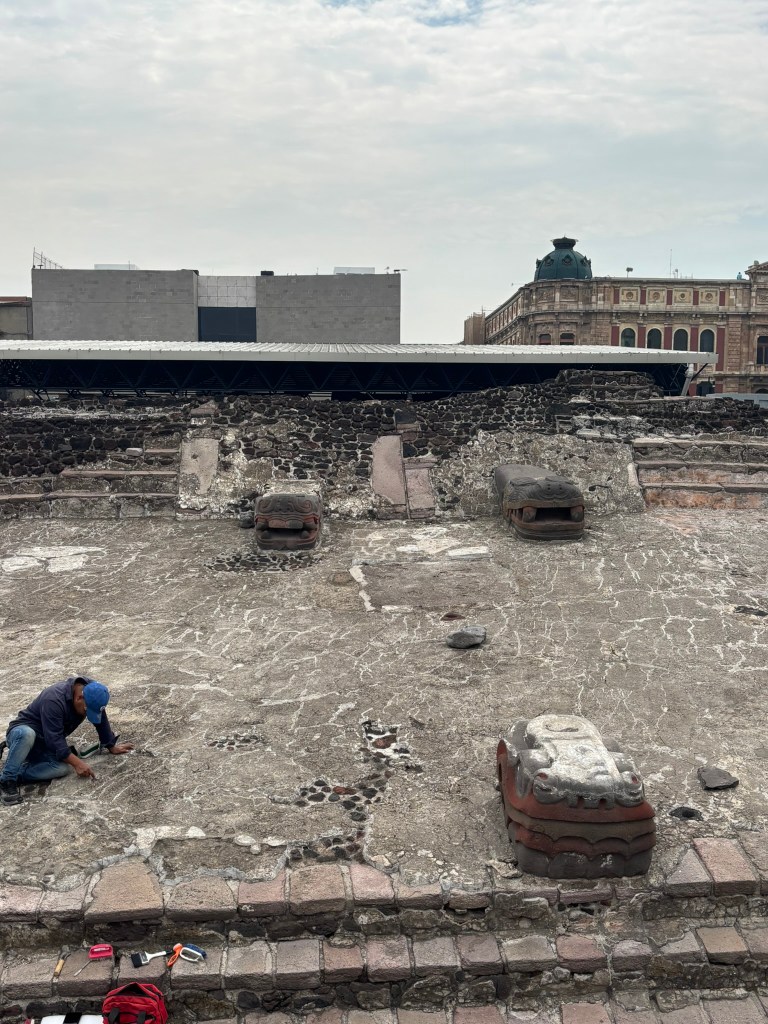
Moving past the models, you finally step onto the raised walkways directly over the excavated ruins. The physical reality of the site is breathtaking. You are confronted with steep, layered stone staircases built primarily out of dark, porous reddish-black tezontle (volcanic rock) and covered in stucco.
Guarding the base of these ancient structures are massive, masterfully carved stone serpent heads. In Mexica culture, serpents were deeply sacred, representing the earth, fertility, and the heavens. Seeing these formidable carvings resting exactly where Aztec priests once stood—juxtaposed against the towering concrete walls and colonial domes of modern Mexico City right behind them—is a surreal visual clash of two entirely different worlds.
Serpent imagery was central to Aztec spirituality, but it triggered immediate, severe friction with the Spanish due to deep cultural misunderstandings.
The Christian Association with Satan
In Christian theology and the Bible, the serpent is the ultimate symbol of evil, deception, and Satan (tempting Eve in the Garden of Eden). When the Spanish arrived in Tenochtitlan and saw massive stone carvings of feathered and fire serpents adorning every temple wall and staircase, they did not see art or cultural symbols; they believed they had walked into a kingdom openly worshipping the Devil
What to Expect When You Visit Today
Today, you can walk directly through the open-air archaeological zone on raised platforms, viewing the surviving foundations of the temple layers.
Right next to the ruins is the onsite Templo Mayor Museum. It is packed with exquisitely crafted objects found during the excavations, including shell mosaics, monumental stone sculptures, and colorful ceramics.
The crown jewel of the collection is the recent discovery of the Tlaltecuhtli monolith. This earth deity carving is the largest Mexica monolith ever found, and seeing its scale in person is worth the trip alone.
🌟 The Verdict: Why It Can’t Be Missed
Templo Mayor is a striking reminder that history is never truly erased—it simply waits beneath the surface. Walking through this active archaeological wonder, sandwiched between a centuries-old Spanish cathedral and a bustling modern capital, offers a humbling perspective on the passage of time. It is a rare chance to look directly down into the bedrock of Mexican identity and witness history being reclaimed, one volcanic stone at beveled stone. If you want to understand the true, raw soul of Mexico City, your journey has to begin right here at its ancient core.
One of the greatest advantages of traveling for business is the opportunity to dine with local co-workers. They act as your ultimate culinary guides, leading you past the tourist traps straight to the city’s best traditional restaurants for an authentic taste of local culture. Furthermore, dining with locals provides an invaluable safety net. Having native speakers clearly explain your ovo-lacto-vegetarian preferences to the restaurant staff gives you complete peace of mind, so you can relax and fully enjoy your meal without worrying about hidden meat broth or unexpected lard.
This local guidance is especially liberating in Mexico City. On the surface, the capital’s food scene presents a notoriously meat-heavy facade, dominating the streets with the aroma of sizzling pork pastor and rendering lard into a daily staple. Yet, beneath the carnivore-centric surface lies a profound culinary secret: traditional high-end Mexican cuisine is rooted in an incredibly rich, pre-Hispanic biodiversity of corn, ancient grains, wild greens, chilies, and dairy.
With local colleagues guiding the kitchen, navigating this meat-based city becomes an effortless, rewarding journey. Here is how to experience three of Mexico City’s most prestigious culinary institutions as a sophisticated ovo-lacto vegetarian.
1. Restaurante El Cardenal: The High-Mass of Mexican Breakfast
Located in the heart of downtown (with its classic flagship on Calle de la Palma 23), Restaurante El Cardenal is an absolute institution [Food 9]. Established in 1969 by Oliva Garizurieta de Briz and her husband Jesús Briz, this multi-story dining temple treats traditional Mexican cuisine with religious reverence.
The restaurant operates its own dedicated dairy farms outside the city to process fresh milk, cream, and artisan cheeses daily, ensuring a farm-to-table lineage that is rare for a metropolitan hub.
       ┌────────────────────────────────────────────────────────┐
       │             THE EL CARDENAL MORNING RITUAL             │
       ├────────────────────────────────────────────────────────┤
       │ 1. Sit down and open the historic menu manifesto.      │
       │ 2. Order the artisan "Chocolate Doña Oliva".           │
       │ 3. Select a warm, fresh Concha from the pastry tray.   │
       │ 4. Slather a thick layer of raw "Nata" inside the bun. │
       │ 5. Dunk the cream-filled pastry straight into hot cocoa│
       └────────────────────────────────────────────────────────┘
The Vibe: Formal, bustling, and deeply traditional. You will dine alongside multi-generational Mexican families, politicians, and local business leaders.
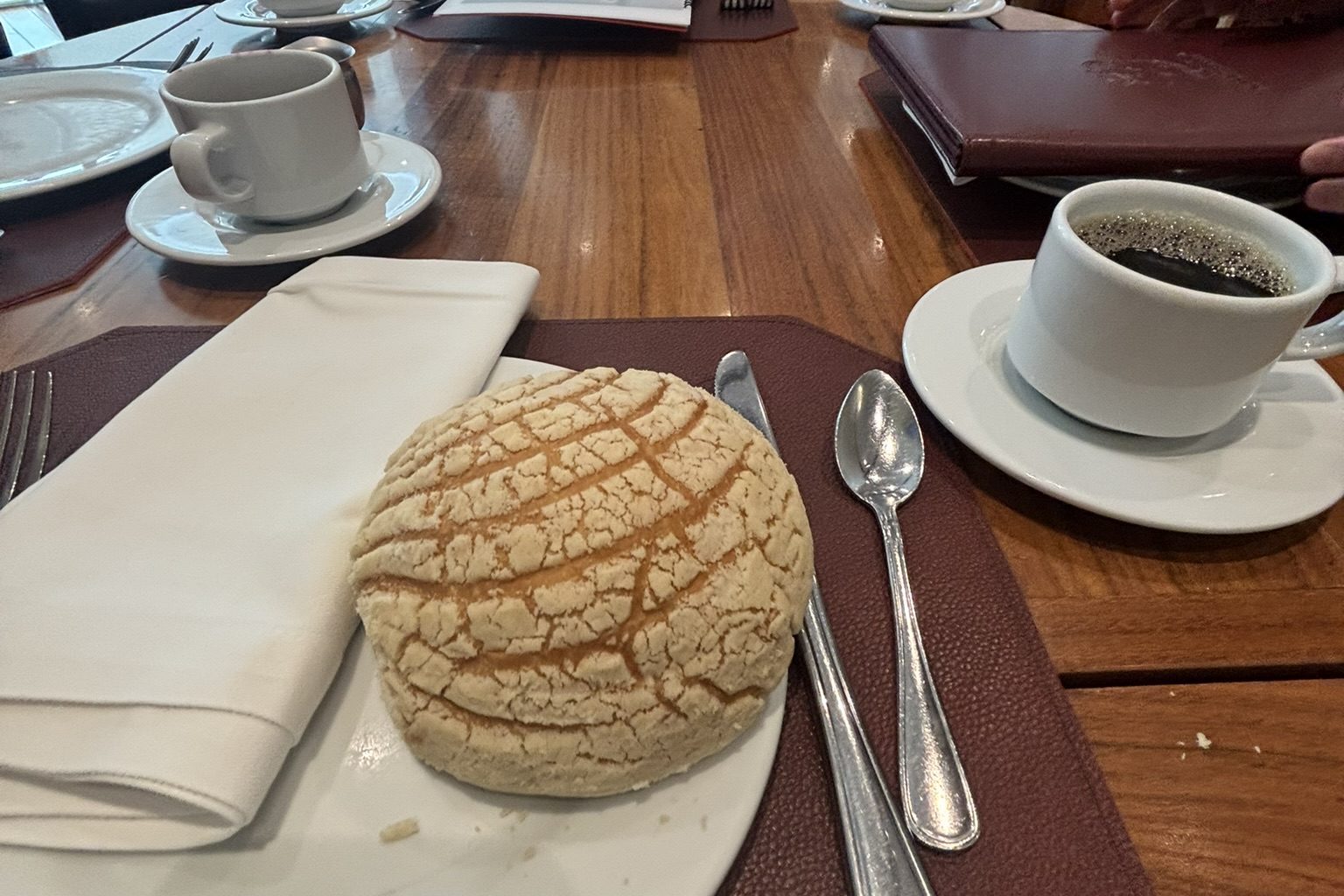
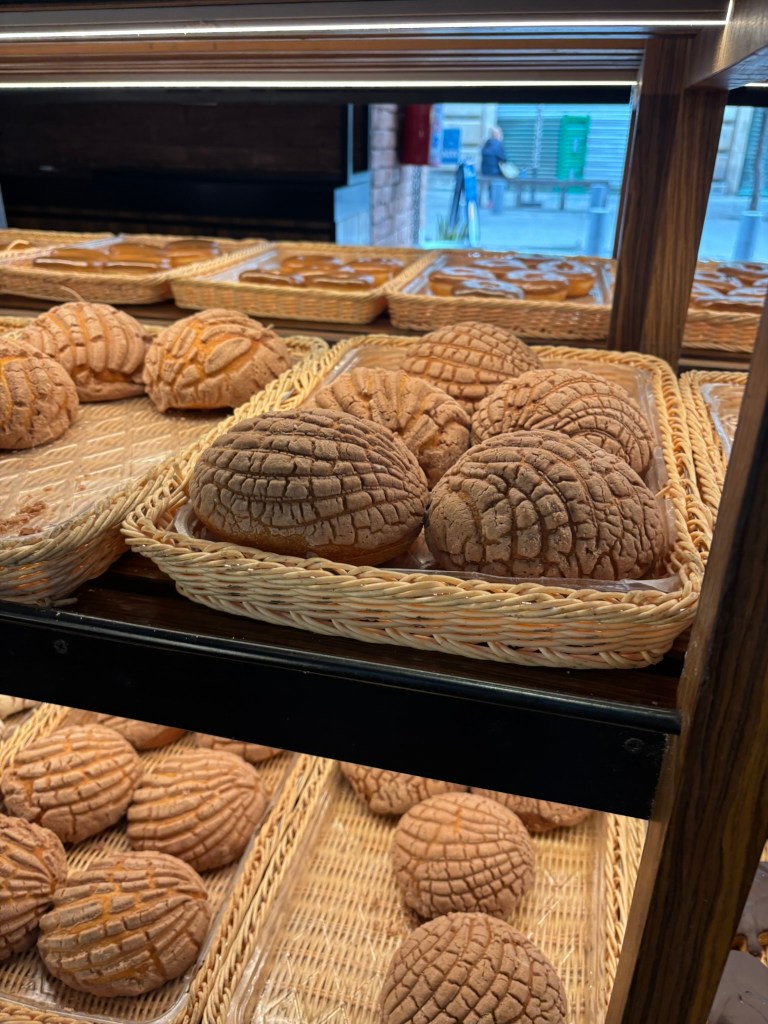
My first Concha
The magic here begins the exact second your feet hit the floor. Almost as soon as you sit down, a waiter balancing a massive wicker basket sweeps by your table to offer an array of fresh, warm bakes. For a first-time traveler, this moment can be beautifully overwhelming. After consulting my local co-workers on what to choose, I was handed my very first Concha—and an immediate obsession was born. The roll was unbelievably soft, pillowy, and carried a delicate sweetness from its crackled cookie crust that harmonized perfectly with a cup of hot black coffee.
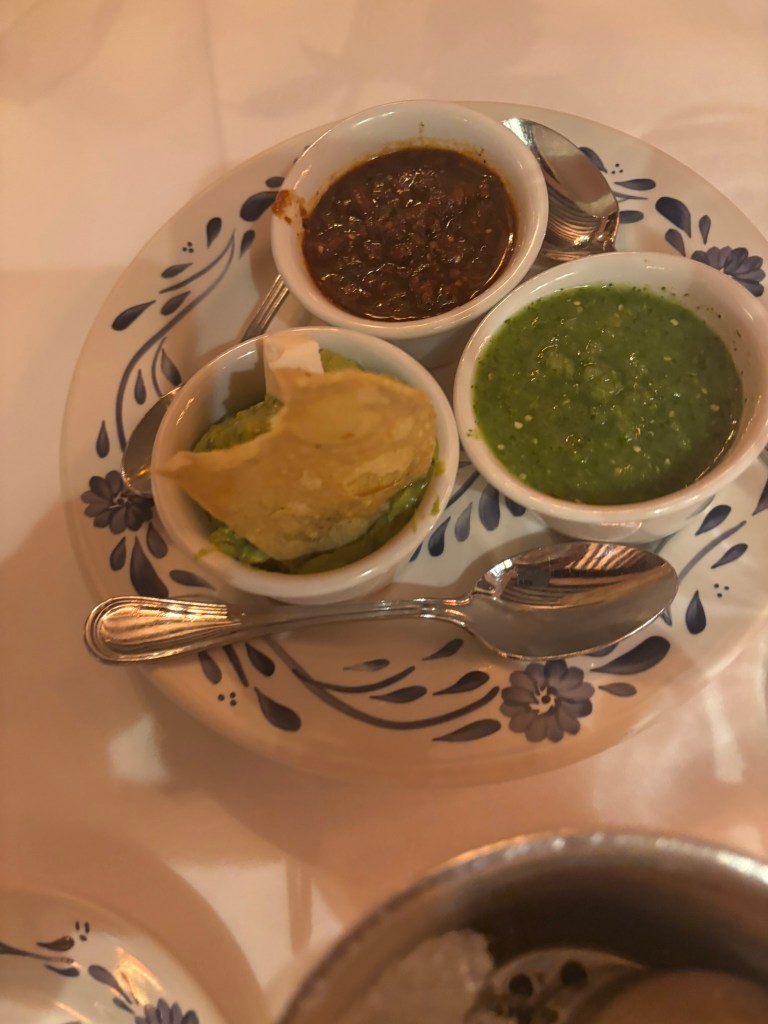
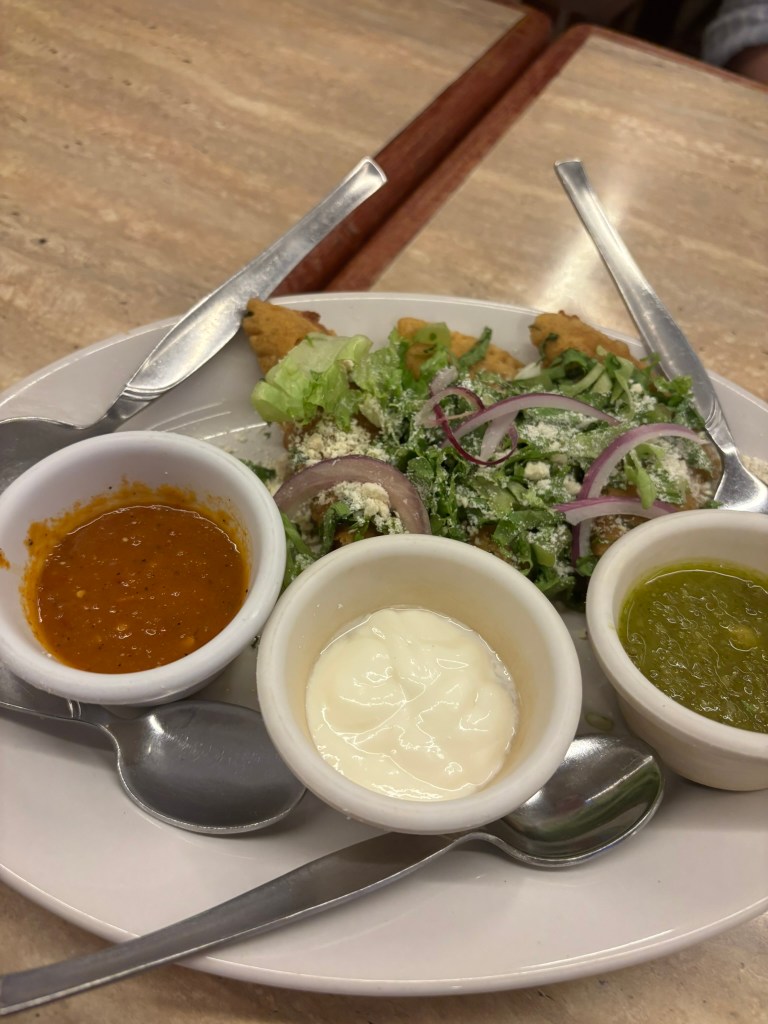
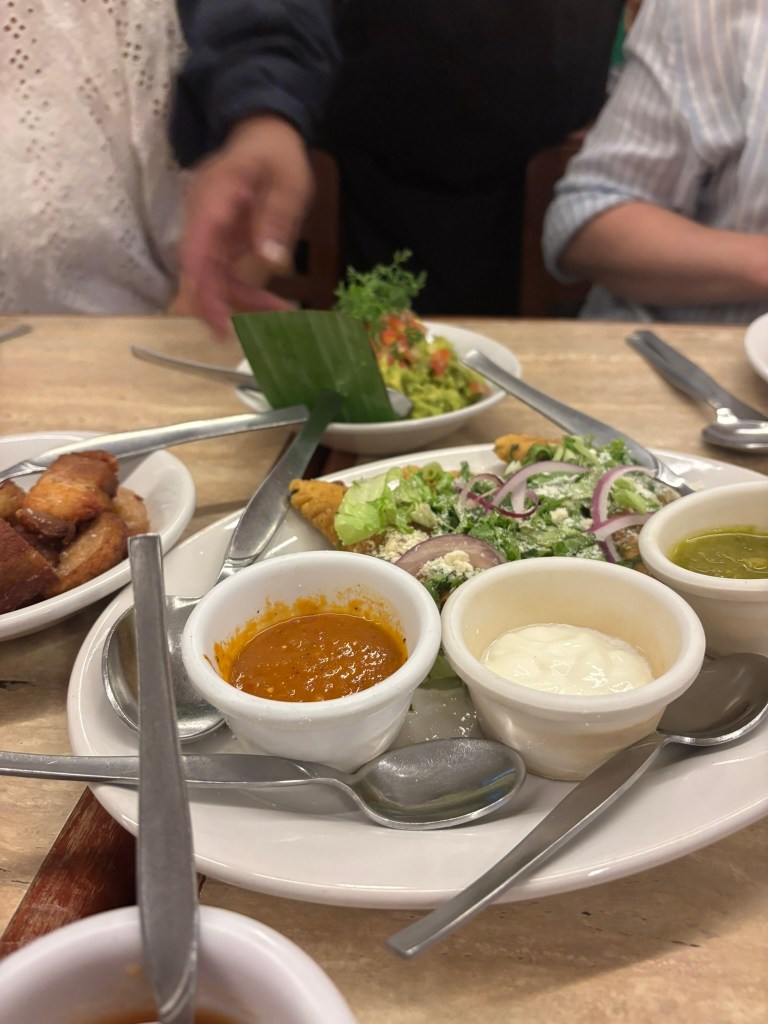
The Appetizer Starter: Kick off your breakfast with a plate of crisp Molotes. These deep-fried, pocket-shaped corn masa dumplings arrive under a fresh garden layer of shredded lettuce and cotija cheese. Use the three accompanying dishes to dress each bite with cool cream, smoky red salsa, or bright green tomatillo salsa. Vegetarian Check: Have your co-workers double-check with the waiter that these are fried in clean vegetable oil rather than pork lard (manteca).
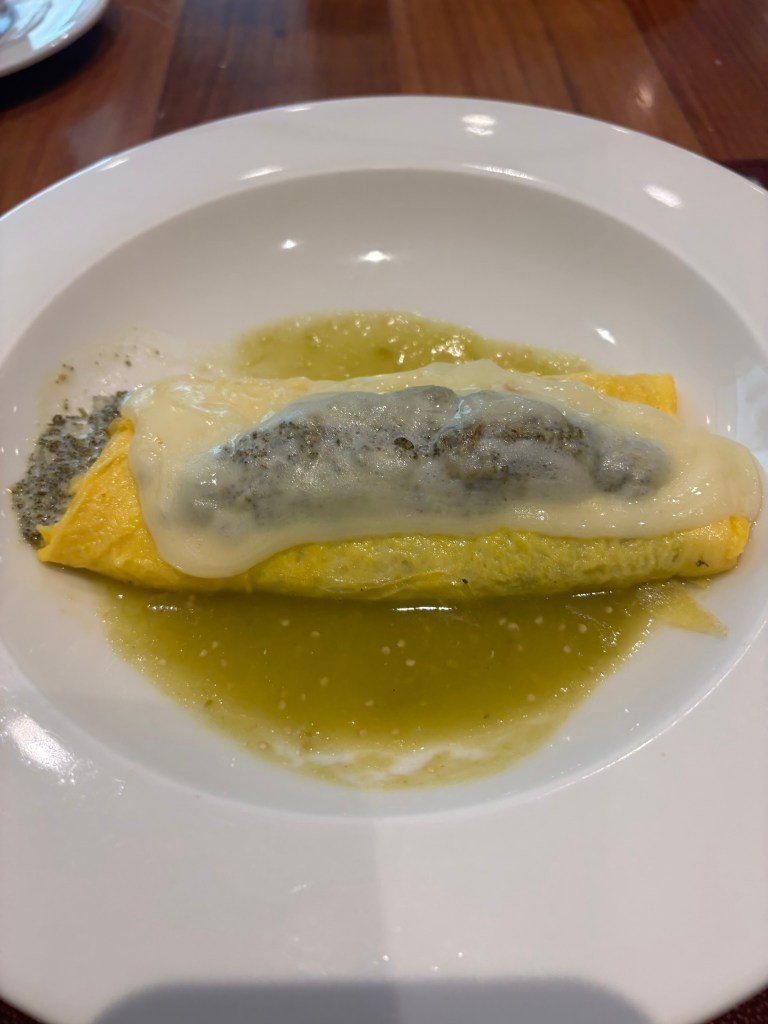
The Masterpiece Main: For your primary dish, request the historic Omelette de Huauzontles. This dish is a masterclass in culinary balance: a silky, folded egg jacket generously stuffed with huauzontle—an ancient, pre-Hispanic Aztec chenopod herb carrying a robust, slightly bitter herbal punch. El Cardenal perfectly balances this natural bitterness by blanketing the omelet under a rich layer of melted artisan cheese and pooling it in a vibrant, tangy green tomatillo sauce. Crucially, the plate is accompanied by an uchepo—a highly distinct, sweet, fresh-corn tamal native to the state of Michoacán.
Omelette de Huauzontles.
The Historical Significance of Your Plate
Choosing the huauzontle is a triumphant nod to indigenous survival. Along with corn and amaranth, huauzontle was one of the primary staple crops of the Aztec Empire, often used as sacred tribute. Because it was heavily integrated into indigenous religious ceremonies, the Spanish conquistadors strictly banned its cultivation under penalty of severe physical punishment. Despite centuries of systemic suppression, indigenous farmers secretly preserved the seeds in remote mountain valleys, allowing this highly nutritious wild green to survive all the way to your modern breakfast table.
2. San Ángel Inn: Aristocratic Elegance & Mid-Century Bohemianism
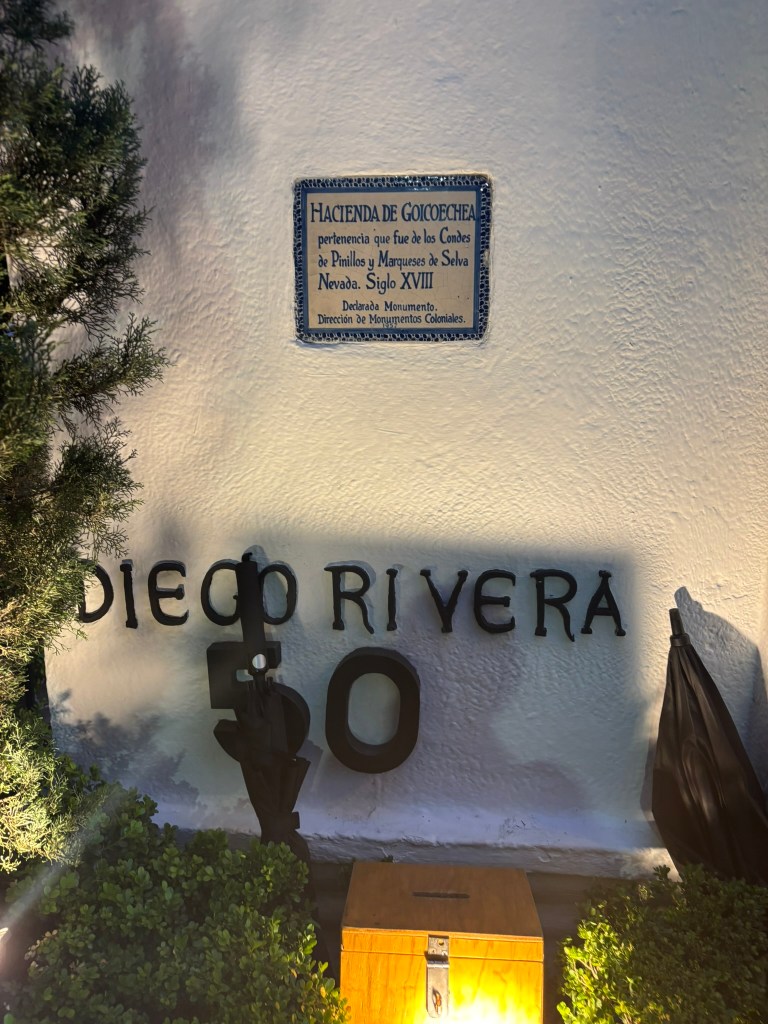
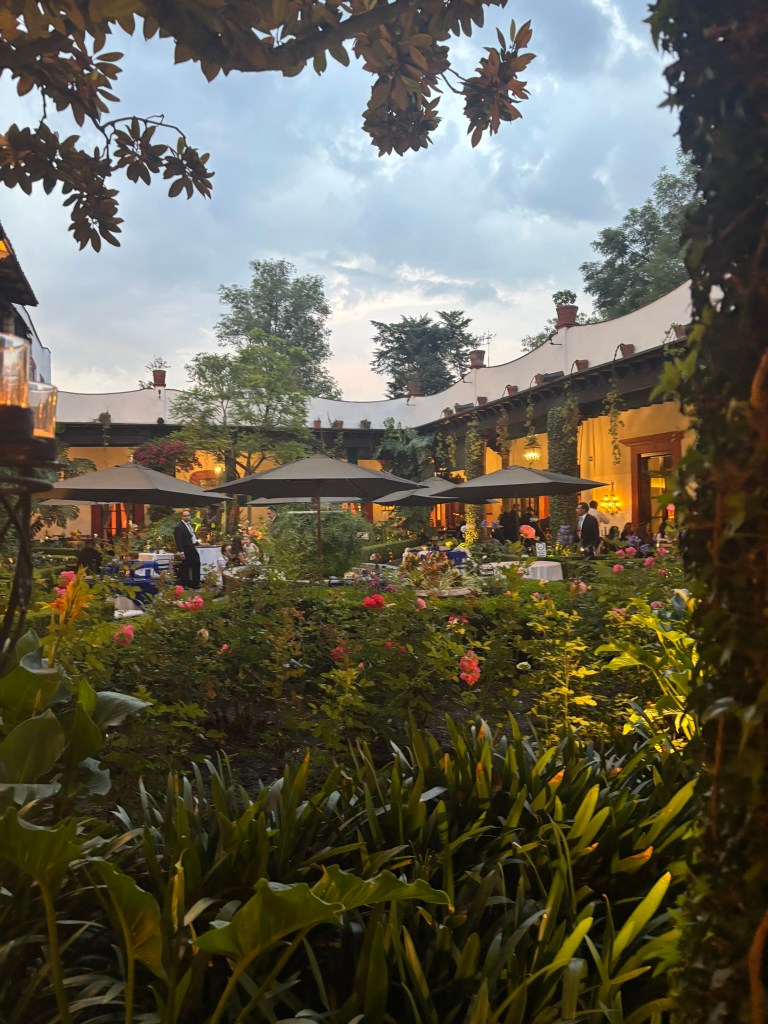
To escape the concrete roar of the center, head southwest into the winding, cobblestone lanes of the exclusive San Ángel neighborhood. Here, inside a beautifully manicured 18th-century estate at Diego Rivera 50, you will find the breathtaking San Ángel Inn.
The property originally functioned as the Hacienda de Goicoechea, a massive colonial pulque plantation and monastery complex. In 1937, it was officially declared a National Monument to preserve its flawless Mexican-Baroque architecture.
In the mid-20th century, it became a legendary meeting hub for the city’s bohemian art elite. Directly across the street sits the striking, functionalist block houses of the Museo Casa Estudio Diego Rivera y Frida Kahlo. Diego and Frida, along with visiting international stars like Marilyn Monroe, would regularly cross the cobblestones to lounge, drink, and argue by the colonial fountains.
The Vibe: Old-world opulence, immaculate white-glove service, and lush, tranquil garden courtyards.
What I ate and drank at this restaurant
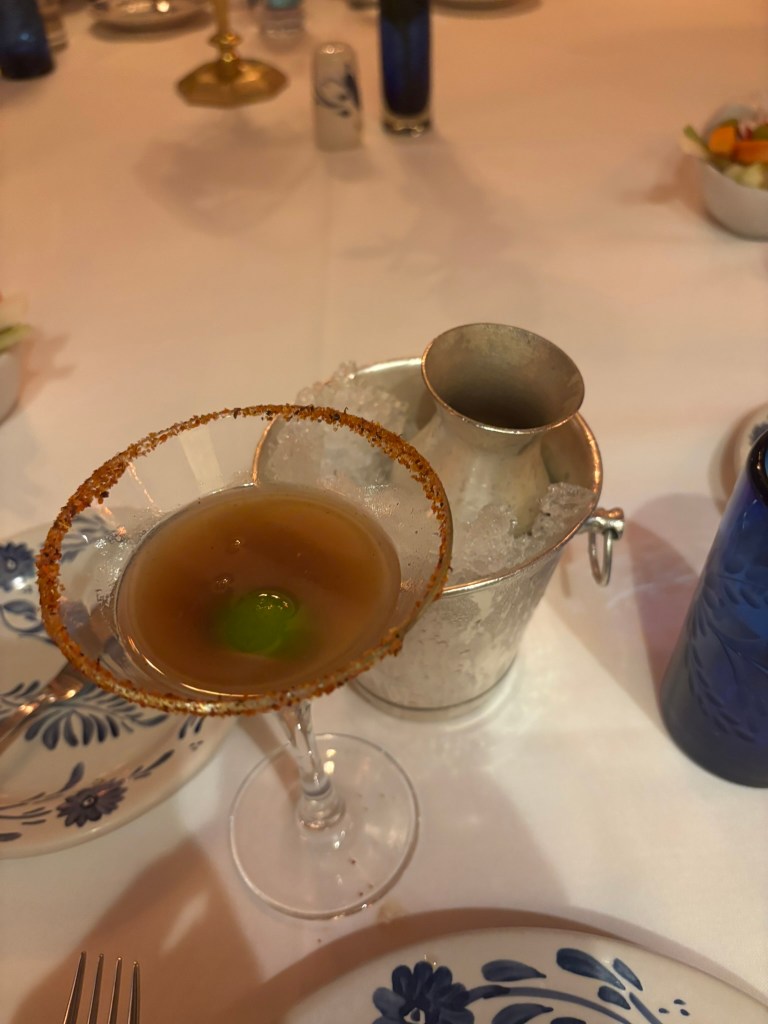
Started the evening sitting by the courtyard fountains with a Tamarind Margarita. The sharp, puckering acidity and earthy sourness of the native tamarind serve as the ultimate palate cleanser against rich food.
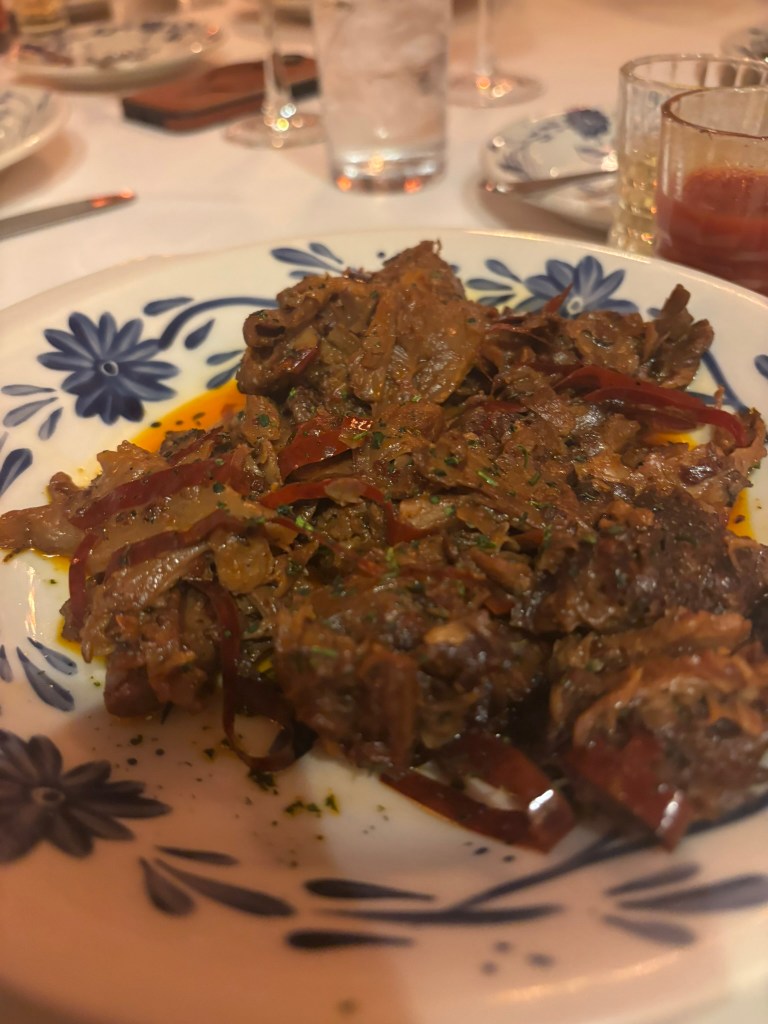
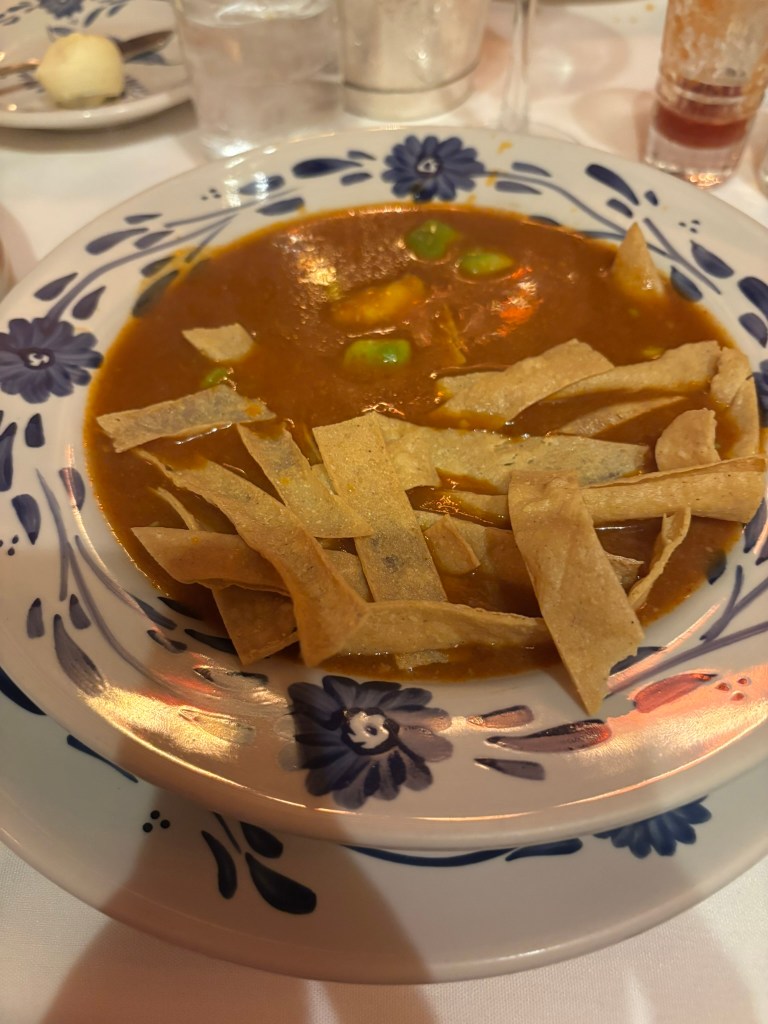
For dinner, follow up with their delicate, earthy Mushroom Tacos and Tortilla soup, seamlessly paired with a premium Tequila, served alongside a traditional tomato-based sangrita digestif.
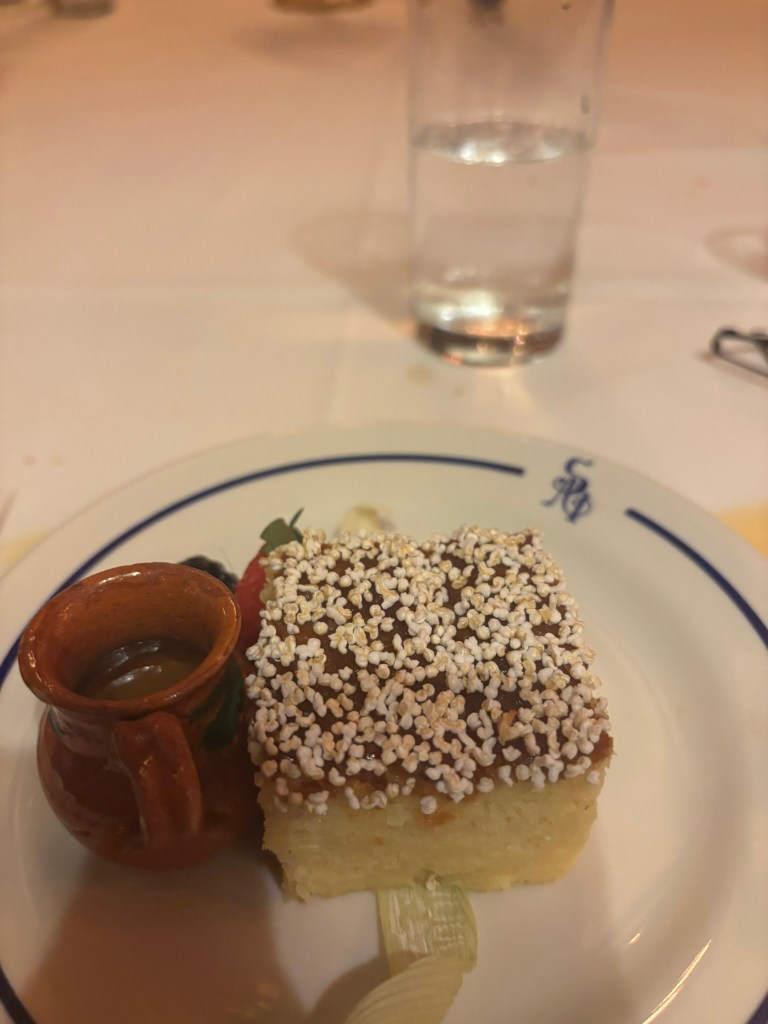
The Grand Finale: End your meal with their absolute showstopper dessert: the Panqué de Elote (Mexican Sweet Corn Cake). Rather than utilizing dry cornmeal, San Ángel Inn prepares this cake by scraping raw, tender kernels straight off the cob to create a dense, intensely moist, pudding-like crumb. The cake arrives wrapped in a rustic corn husk, heavily encrusted with popped amaranth seeds (alegría) for a nutty crunch, and is served alongside a miniature clay jarrito filled with hot cajeta caramel to drizzle tableside.
3. Cantina La Ribera: Fire, Smoke, & Modern Cantina Artistry
For a complete shift in energy, head into the vibrant, urban pulse of Colonia Doctores at Avenida Cuauhtémoc 140 to experience Cantina La Ribera. While it carries the title of a Cantina Restaurante, this is far from a dark, dusty drinking saloon—it is a massive, multi-story celebration of northern Mexican culinary arts, celebrated for its tableside interactive carts (carritos).
While known heavily for its charcoal meat-grilling, this is where having your local co-workers pays off the most: the kitchen gladly adapts its high-end service to craft a bespoke, vegetarian-friendly feast.
The Vibe: High-energy, loud, and celebratory, featuring live mariachi music, oversized embroidered sombreros for the table, and rolling drink carts weaving between tables.
What I ate at this restaurant
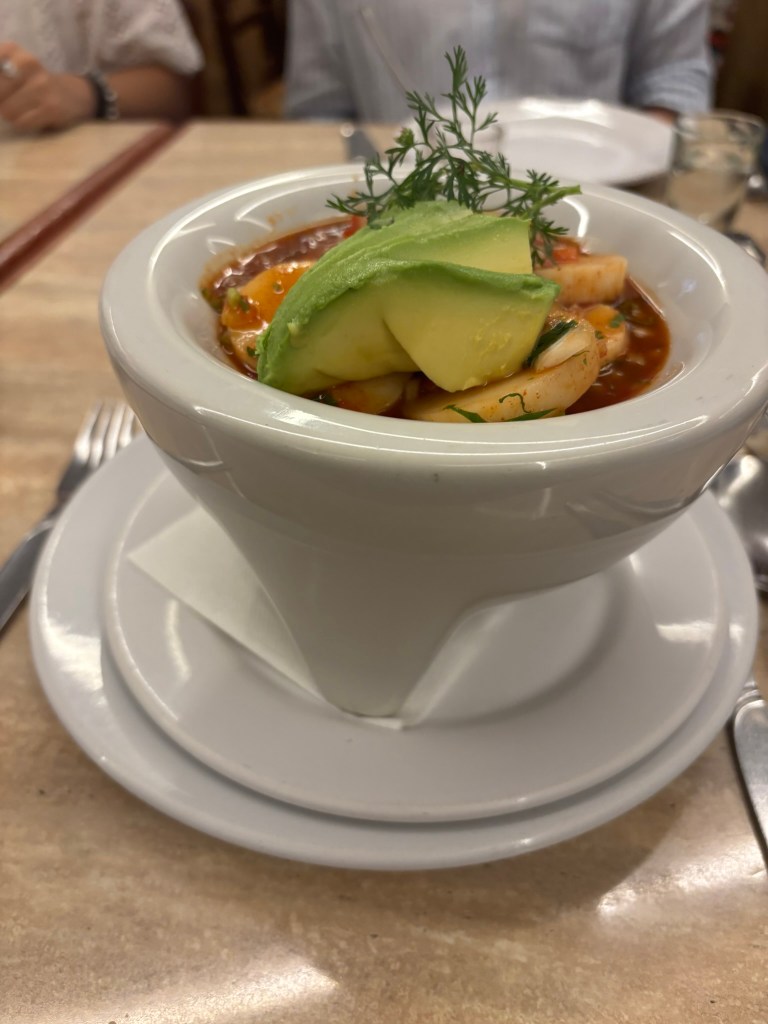
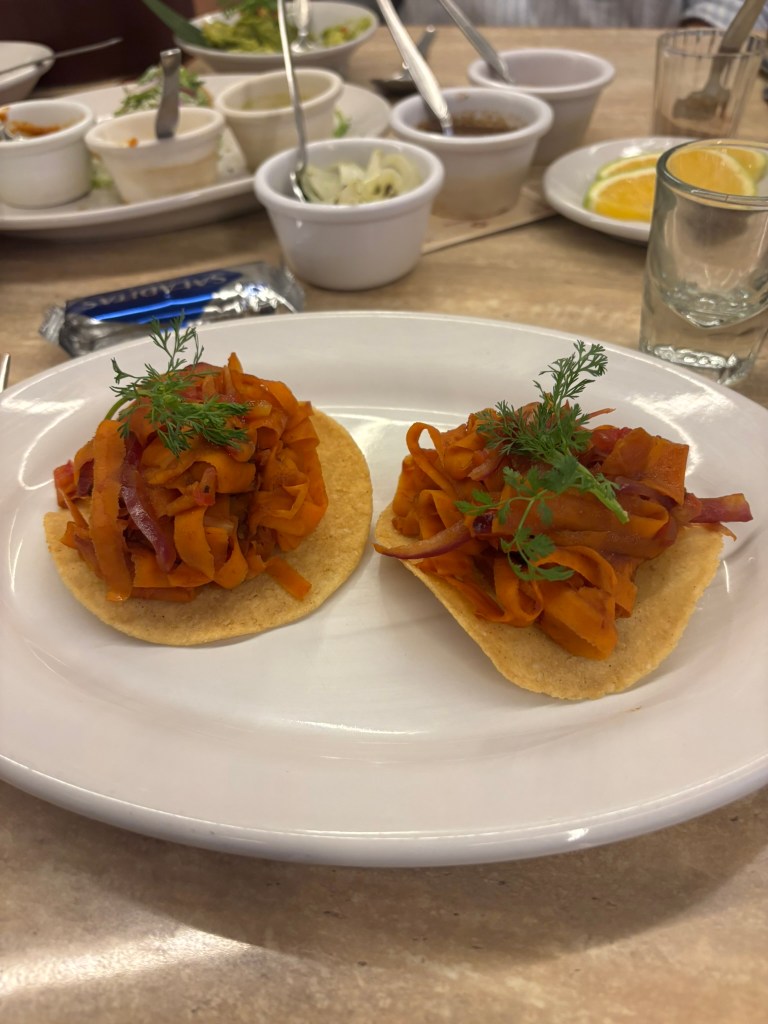
We started with a very tasty vegetarian Ceviche made with tofu, as well as vegetarian empanadas. I followed that with a spicy carrot tostada that wasn’t on the menu but created specially for me
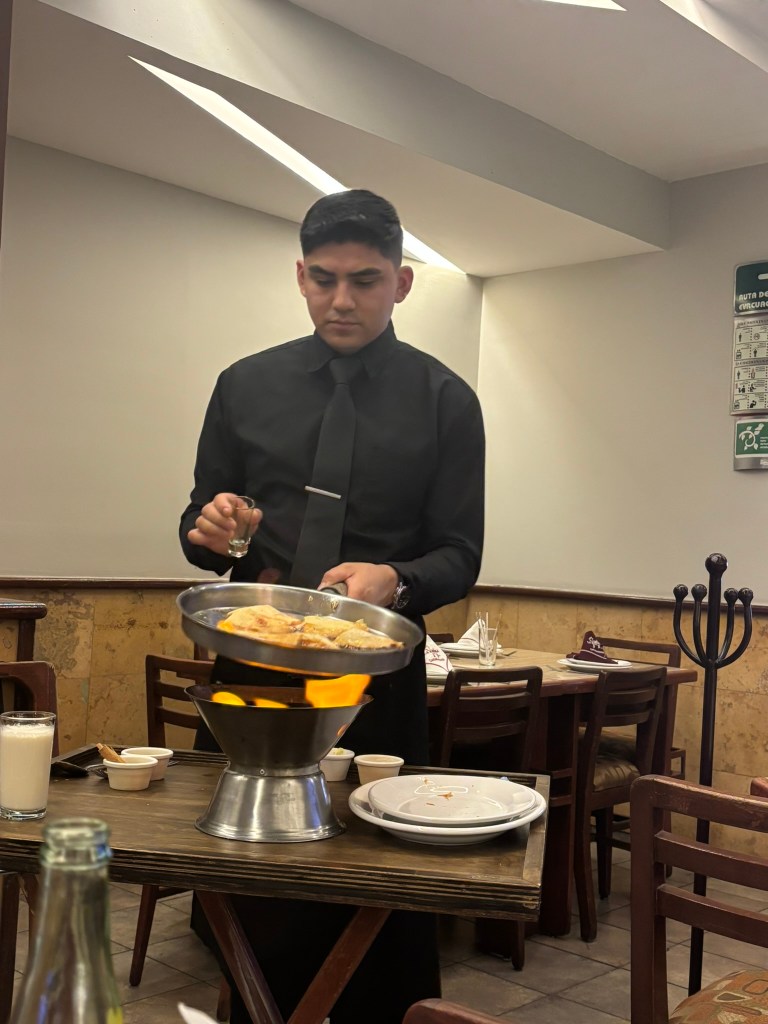
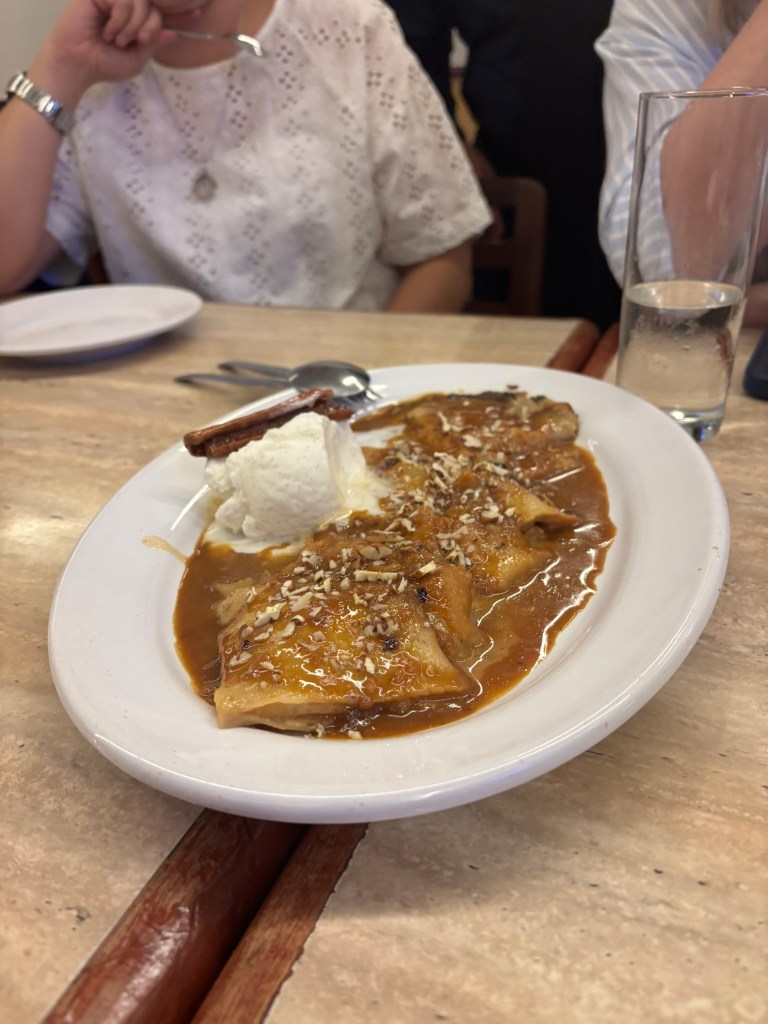
The Grand Finale: Close out the entire evening with an elegant performance as servers prepare Crepes Suzette tableside on rolling, fire-lit carts, splashing spirits over an open flame to perfectly caramelize the sweet orange-butter sauce.
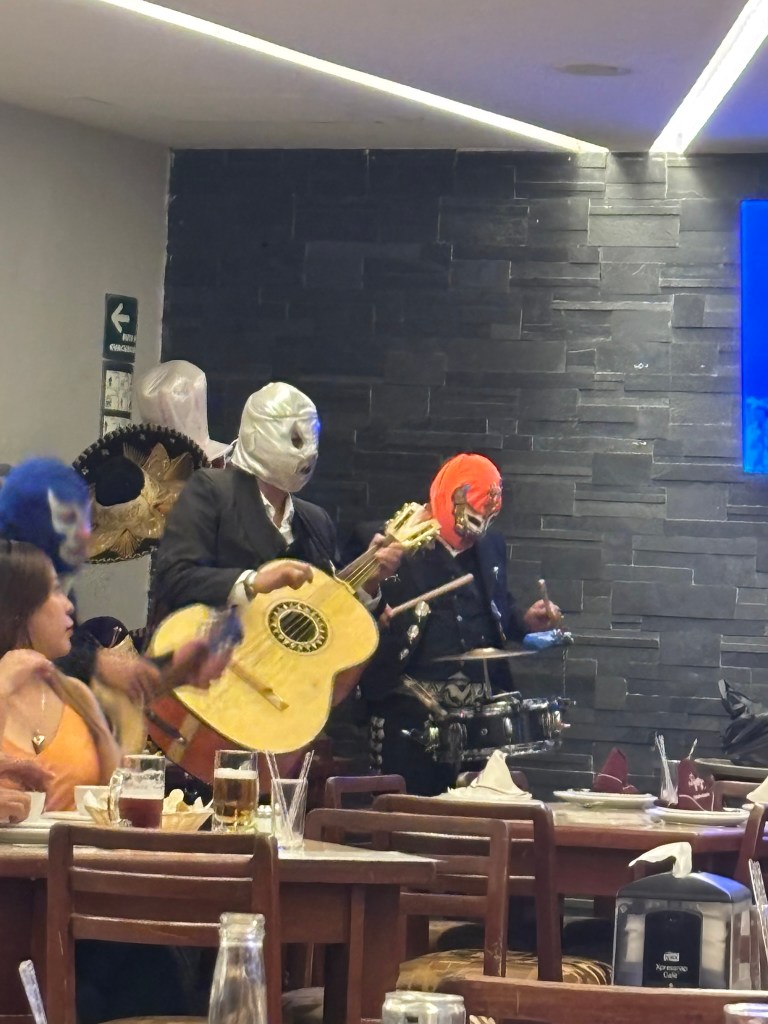
The Ultimate Entertainment: While you eat, the restaurant erupts with a performance entirely unique to Mexico City: a Lucha Libre Mariachi band. Musicians dressed in immaculate traditional black charro suits storm the floor, wearing iconic wrestling masks—paying homage to legends like El Santo and Blue Demon—and deliver high-octane acoustic sets that turn the dining room into a festive, unforgettable party.
Cultivating Connections: The Final Takeaway of the Vegetarian Business Traveler
Ultimately, navigating a world-class culinary capital like Mexico City proves that business travel is about much more than boardroom meetings and spreadsheets—it is about the deep cultural connections forged across the dinner table.
While the city’s complex, meat-dominant landscape can initially feel intimidating to an ovo-lacto vegetarian, stepping into its historic dining rooms alongside local colleagues completely unlocks the destination. Having trusted coworkers to navigate the nuances of the menu not only ensures total comfort and peace of mind, but it also opens the door to regional secrets—like discovering a life-changing obsession with your very first warm concha bread straight out of a waiter’s basket.
By leaning on local expertise, respecting ancient ingredients, and embracing the celebratory spirit of the table, you don’t just eat like a local—you get to experience the very soul of Mexico.
In Mexico City, the sweet smell of yeast, caramelized sugar, and warm butter is an inescapable part of the morning commute. The Centro Histórico surrounding the Zócalo (the central plaza) serves as the beating heart of this vibrant flour-and-sugar universe.
To fully understand Mexico’s unique panadería (bakery) culture, you must look beyond the shelves. The classic pan dulce we love today is a product of culinary hybridization—born from 16th-century Spanish wheat farming, indigenous adaptations with local ingredients like lard and piloncillo sugar, and 19th-century French lamination techniques popularized during the French intervention.
When touring the historic center, follow this guide to the ultimate historic bakeries, what you need to order at each, and the deep, hidden histories carved into their foundations.
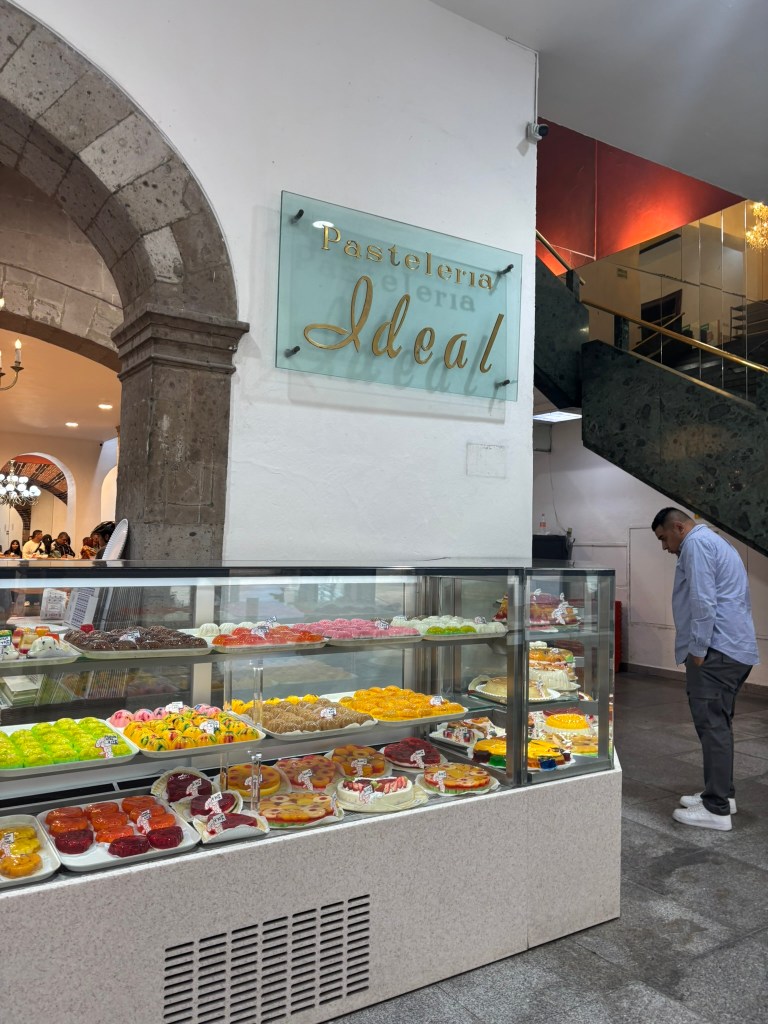
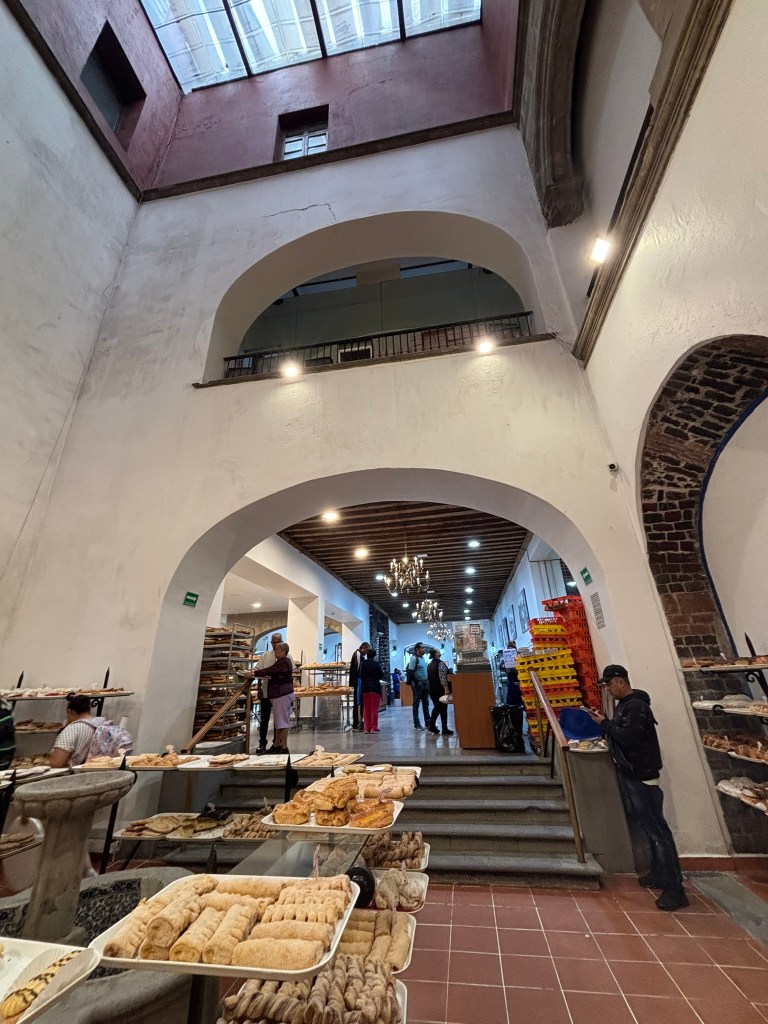
1. Pastelería Ideal: The Cathedral of Dough Built on Sacrificial Stone
No culinary tour of the Zócalo is complete without stepping into the pure, high-volume pandemonium of Pastelería Ideal (Address: 16 de Septiembre 18). Established in 1927 during the turbulent years of the Cristero War, Ideal has transformed from a humble neighborhood bread shop into a massive, multi-generational cultural pillar.
   ┌────────────────────────────────────────────────────────┐
   │                THE PASTELERÍA IDEAL RITUAL             │
   ├────────────────────────────────────────────────────────┤
   │ 1. Grab a massive, circular metal tray from the stack. │
   │ 2. Take a pair of long mechanical tongs.               │
   │ 3. Weave through the crowds to pile your tray high.   │
   │ 4. Take your haul to the wrap counter.                 │
   │ 5. Watch clerks tie it up in iconic blue-white boxes. │
   └────────────────────────────────────────────────────────┘
The Sacrificial History Beneath the Flour
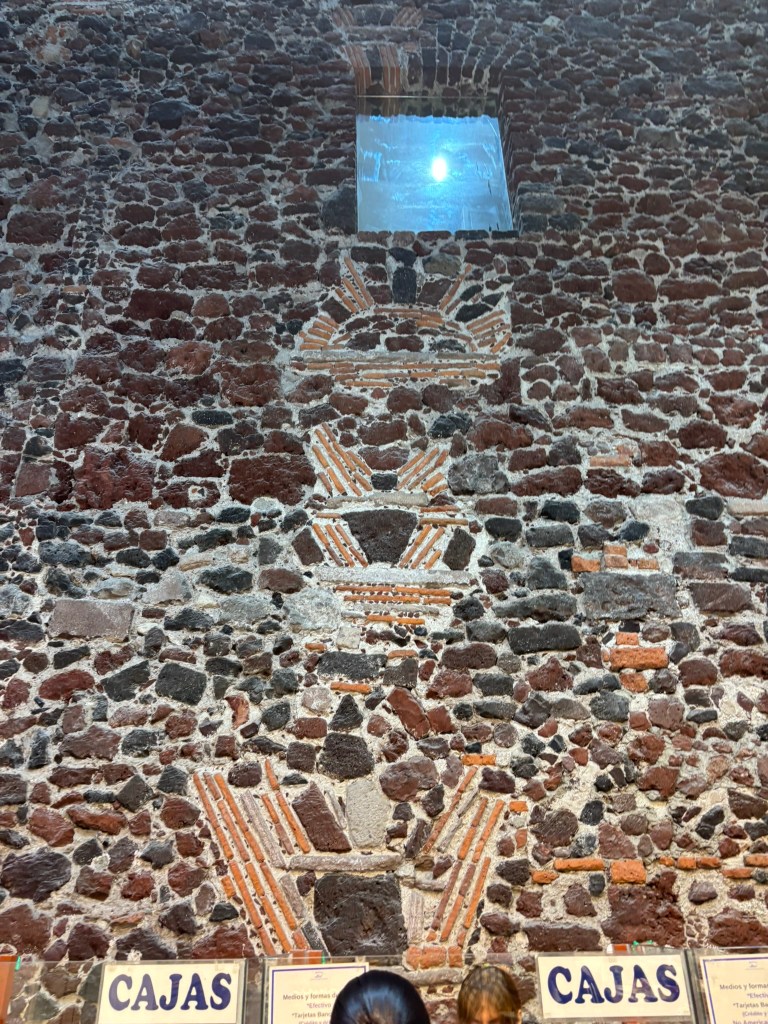
The address itself holds profound historical weight. Pastelería Ideal was built directly within the footprint of the Convento de San Francisco de Asís (Conquest-era Franciscan Monastery).
Following the Spanish Conquest of Tenochtitlan in 1521, Hernán Cortés granted land to the Franciscan order to build their headquarters. Built directly over the ruins of the Aztec Emperor Moctezuma’s wild-animal zoo (Vivario), the Convento de San Francisco grew into the largest monolithic religious complex in the Americas. It housed extensive cloisters, gardens, chapels, and the first primary school for indigenous youth.
The complex was systematically dismantled and largely demolished during the Reform War (Guerra de Reforma) under President Benito Juárez. The Liberal government’s 1856 Ley Lerdo confiscated all church-owned property. To break the economic power of the clergy and integrate the city, streets like 16 de Septiembre were cut directly through the monastery’s sacred cloisters, structures were torn down, and plots were sold off to secular business entities. The massive sugar factory, Pastelería Ideal, operates directly atop these centuries-old ruins.
What to try: Get the classic Concha (a pillowy brioche bun topped with an iconic, crackled vanilla or chocolate cookie shell) and their delicate Pastas Secas (traditional dry butter cookies).
2. La Vasconia: The Oldest Standing Bakery in the City
Operating continuously since 1870 at the corner of Calle Tacuba and Calle de la Palma, La Vasconia is officially Mexico City’s oldest standing bakery.
Founded by a Basque immigrant during the peak of the Porfiriato—the era where President Porfirio Díaz attempted to fully Europeanize the architecture and food of the capital—La Vasconia is a living museum. The interior, with its heavy wooden trim, high ceilings, and time-worn glass displays, feels entirely unchanged by time.
What to try: The bakery is famous for its crisp Orejas (the Mexican take on French Palmiers; flaky puff pastry layered with caramelized sugar) and their freshly baked savory lunch tortas made on-site.
3. Pastelería El Molino: The Birthplace of a Global Empire
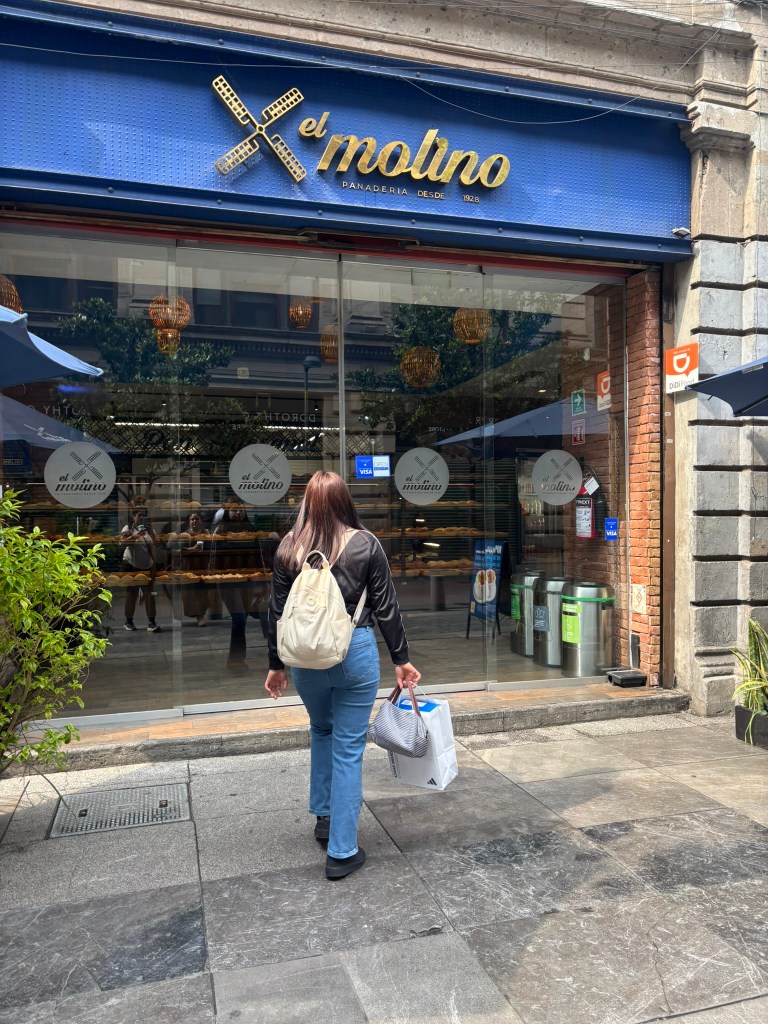
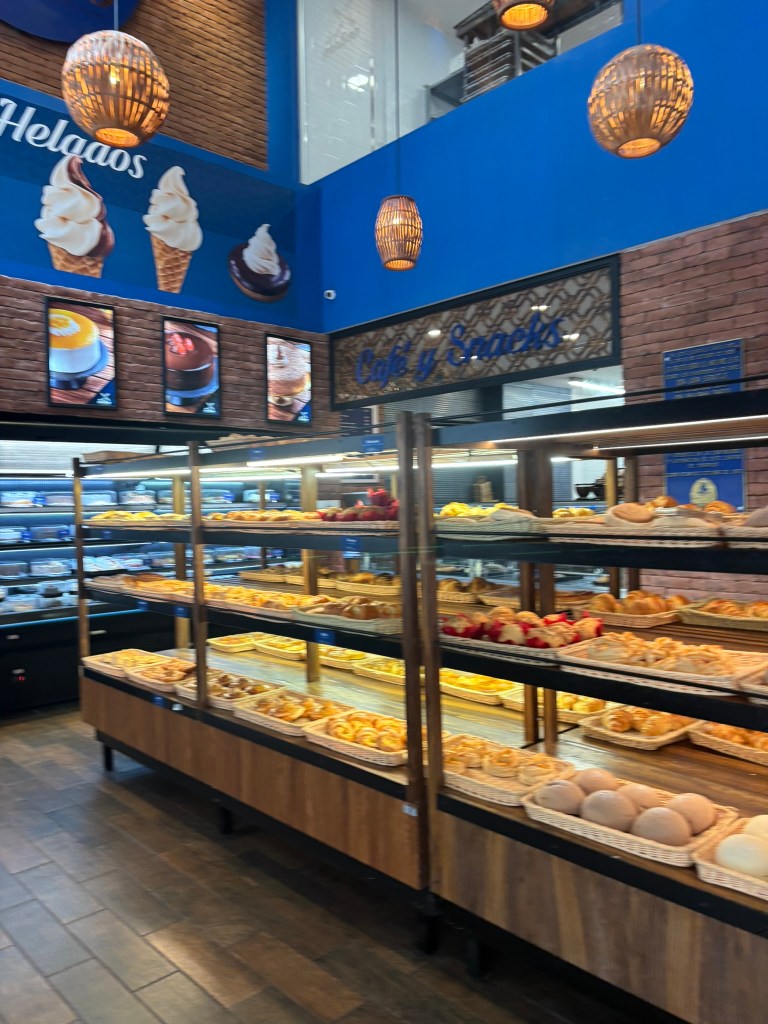
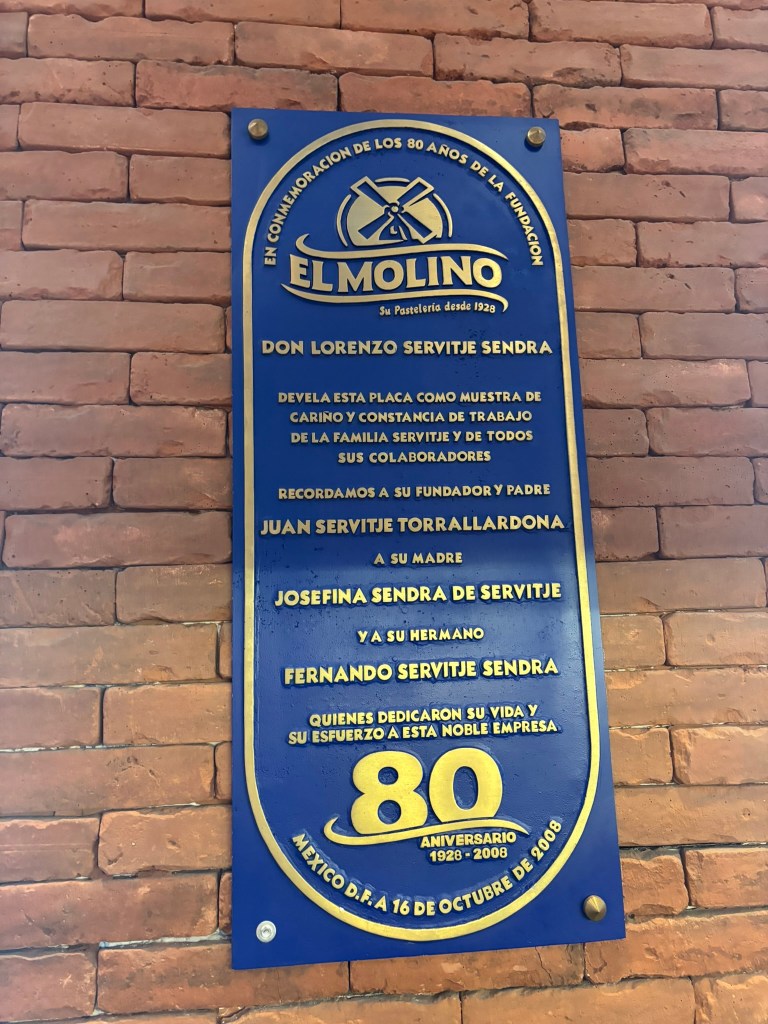
Located at Av. 16 de Septiembre 59, Pastelería El Molino has been serving passersby under its striking blue-and-gold windmill logo since 1928. While it operates today as a modern, budget-friendly neighborhood pastry shop, a commemorative plaque on the interior brick wall uncovers its massive industrial legacy.
El Molino is the exact birthplace of Grupo Bimbo (Bimbo bakeries), the largest commercial baking company on Earth. Founded by Catalan immigrant Juan Servitje Torrallardona, the shop passed to his son, Don Lorenzo Servitje Sendra, in 1937. Lorenzo honed his commercial knowledge running this exact storefront. In 1945, using the capital, supply chains, and industry practices developed right here, he co-founded Panificación Bimbo—launching an empire that now spans over 35 countries.
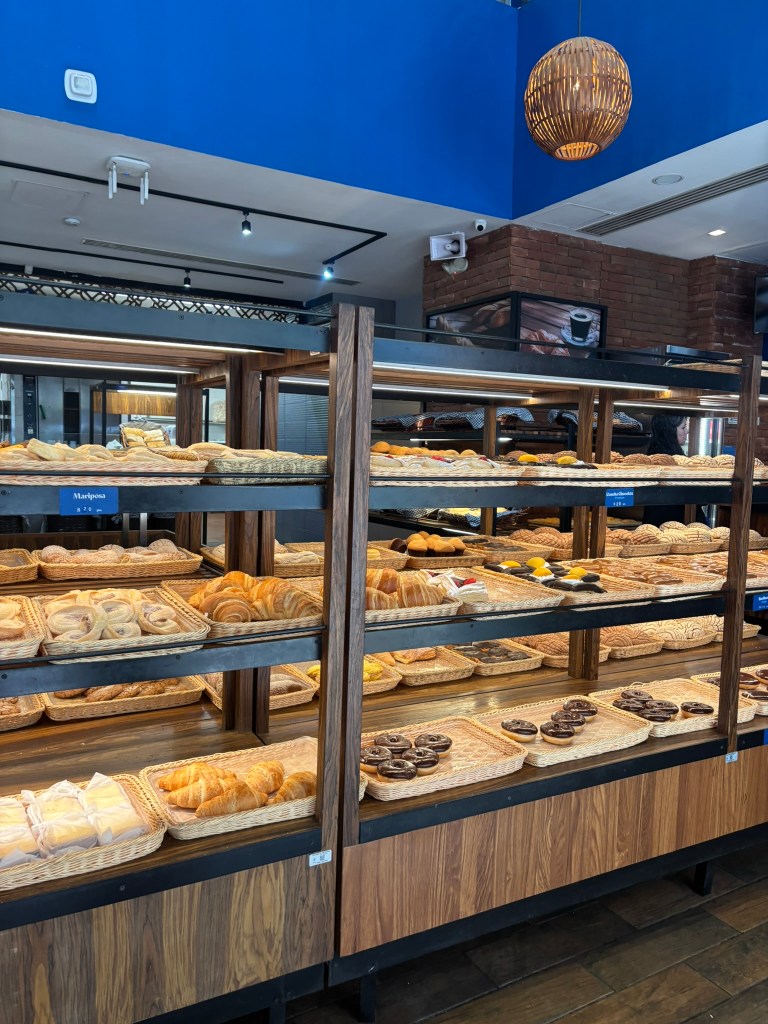
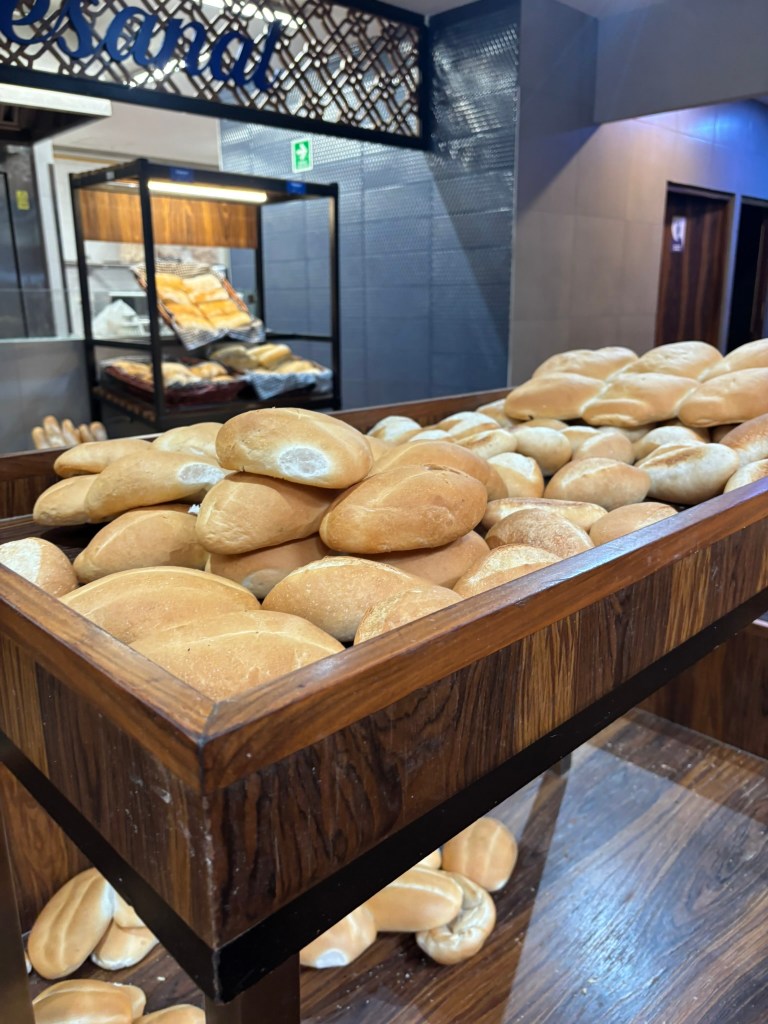
What to try: Do not miss their fresh Bolillos (traditional savory sandwich rolls descended from the French baguette, featuring a crisp outer crust and a pillowy soft interior) or their traditional Mariposa (butterfly puff pastry) dusted heavily in white sugar.
4. Pastelería Madrid: The Chilango Local Favorite
Tucked slightly away from the primary tourist paths at C. 5 de Febrero 25, Pastelería Madrid is where local Chilangos go to buy their daily bread. It is noisy, budget-friendly, and deeply integrated into the local neighborhood routine.
What to try: This is the absolute best spot to sample Panqué de Elote (a dense, intensely moist, and naturally sweet Mexican corn cake) along with their exceptional cheese-filled pastries.
Walking route map
Here is a 1.6-kilometer (1-mile) custom walking loop through the Centro Histórico, designed to hit all four historic bakeries in a seamless, logical path starting and ending near the Zócalo.
The entire walk takes about 20 to 25 minutes of pure walking time, keeping you on historic, highly pedestrianized streets.
       [ START: Zócalo Plaza ]
                 │
                 ▼ (Walk 1.5 blocks West on Av. 16 de Septiembre)
     1. PASTELERÍA IDEAL  ───►  2. PASTELERÍA EL MOLINO
                 │                        ▲
                 ▼ (South on Filomeno Mata)│ (West on 16 de Septiembre)
     [ Cross Av. Madero & 5 de Mayo ]     │
                 │                        │
                 ▼ (North on Tacuba)      │ (South on 5 de Febrero)
     3. LA VASCONIA       ───►  4. PASTELERÍA MADRID
Detailed Navigation Steps
Stop 1: Pastelería Ideal
Route: From the main Zócalo plaza, walk west down the pedestrian-friendly Avenida 16 de Septiembre. Walk past the front of the Gran Hotel de México. After 1.5 blocks, Pastelería Ideal will be on your right side.
Vibe Check: Grab your massive metal tray immediately upon walking in.
Stop 2: Pastelería El Molino
Route: Exit Ideal, turn right, and continue walking west down Avenida 16 de Septiembre for just half a block. Cross Calle de Bolívar, and Pastelería El Molino will be right there under its blue-and-gold windmill sign.
Vibe Check: Stop inside to read the historic Bimbo foundation plaque on the brick wall.
Stop 3: La Vasconia
Route: From El Molino, turn right and walk to the next corner (Filomeno Mata). Turn right (heading north). You will cross the busy pedestrian hubs of Avenida Madero and Avenida 5 de Mayo. Continue north until you hit Calle de Tacuba. Turn right on Tacuba and walk 2 blocks east. La Vasconia is on the corner of Tacuba and Palma.
Vibe Check: Notice the 19th-century wooden framing. This is the oldest bakery in town.
Stop 4: Pastelería Madrid
Route: From La Vasconia, head south down Calle de la Palma. Walk 3 blocks south, crossing straight back over Madero and 5 de Mayo. When you hit Avenida República de Uruguay, turn right, walk one block, then turn right again onto Calle 5 de Febrero. Pastelería Madrid is just up the street.
Vibe Check: This is a local favorite; expect low prices and crowd energy.
Heading Back to the Zócalo
From Pastelería Madrid, walk half a block north to Avenida 16 de Septiembre, turn right, and walk 1.5 blocks straight east to find yourself right back in the center of the Zócalo.
Rising like a stone titan over the northern edge of the historic Zócalo, the Mexico City Metropolitan Cathedral (Catedral Metropolitana) is not just an architectural marvel—it is the raw, beating heart of Mexican history. As the oldest and largest cathedral in Latin America, it has towering twin bell towers and a massive stone facade that has borne witness to nearly five centuries of conquest, rebellion, and spiritual devotion. To step through its heavy wooden doors is to walk through a literal timeline of a nation in transition.
The Dark History: Recycled Aztec Stones
The cathedral is a physical manifestation of Spanish colonial imposition. Following the fall of Tenochtitlan, Spanish conquistador Hernán Cortés ordered the construction of a grand church to anchor the new colonial capital. Built between 1573 and 1813, the cathedral was deliberately erected directly atop the sacred Aztec precinctadjacent to the Templo Mayor.
To hammer home the spiritual conquest, the Spanish pulled down the surrounding Aztec pyramids, utilizing those exact, hand-carved ancient stone blocks to lay the cathedral’s massive foundations. If you look closely at some of the older exterior walls today, you are looking at the very stones that once formed the temples of Aztec gods.
Because construction spanned nearly 250 years, the building serves as a living museum of architectural evolution. It is a stunning crossroad of styles, shifting seamlessly from its deep Gothic foundations into heavily ornate Baroque facades, and finally culminating in a majestic Neoclassical dome designed by renowned architect Manuel Tolsá.
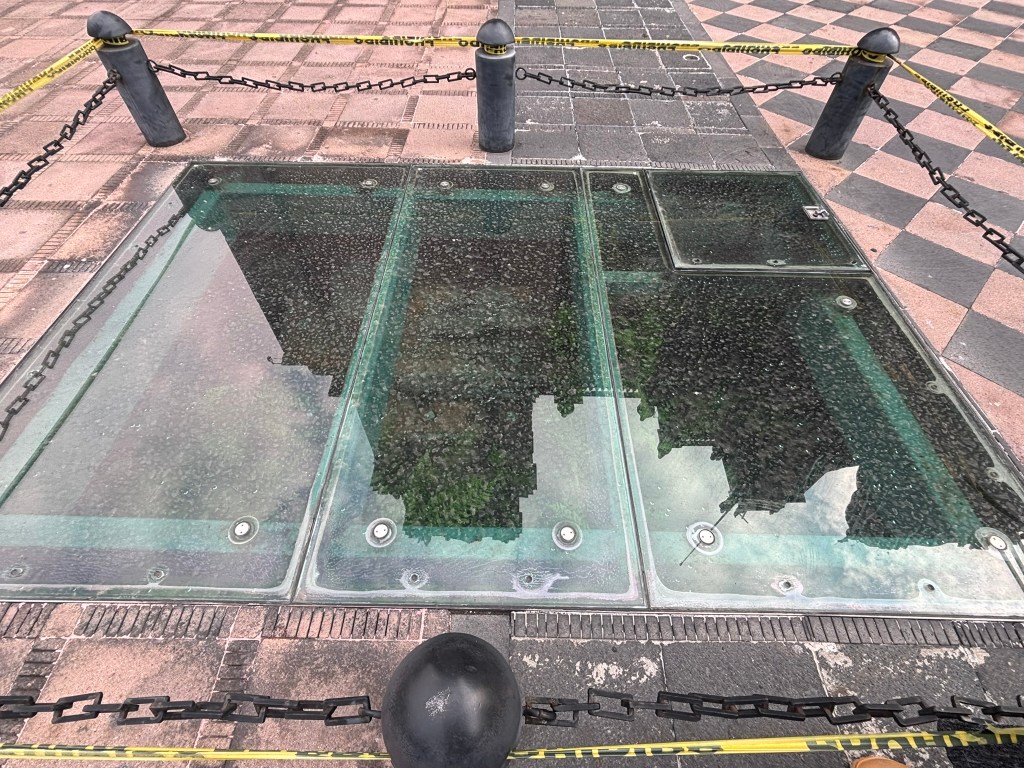
Windows into the past: Glass panels embedded in the stone plaza outside the Metropolitan Cathedral reveal the original Aztec foundations lying directly beneath the building. It is a stunning visual reminder of the literal layers of history making up the heart of Mexico City.
Practical Information for Visitors
Planning a visit to the spiritual heart of Centro Histórico is straightforward, but a few local tips will make your experience seamless:
Getting There: Take the Metro Blue Line directly to the Zócalo station. The cathedral sits right outside the station exit gates on the main plaza.
Hours: Open daily from 9:00 AM to 5:30 PM.
Admission: Entry to the main nave and side chapels is entirely free. However, checking out the rooftop views or taking a guided bell tower tour requires a small ticket fee paid inside (approx. $100 MXN / $6 USD).
Visitor Rules: Non-flash photography is fully permitted for personal use. Because it remains an active house of worship, dress respectfully (avoid overly revealing clothing) and maintain a quiet demeanor during ongoing religious service
The Exterior Architecture and Towering Facades
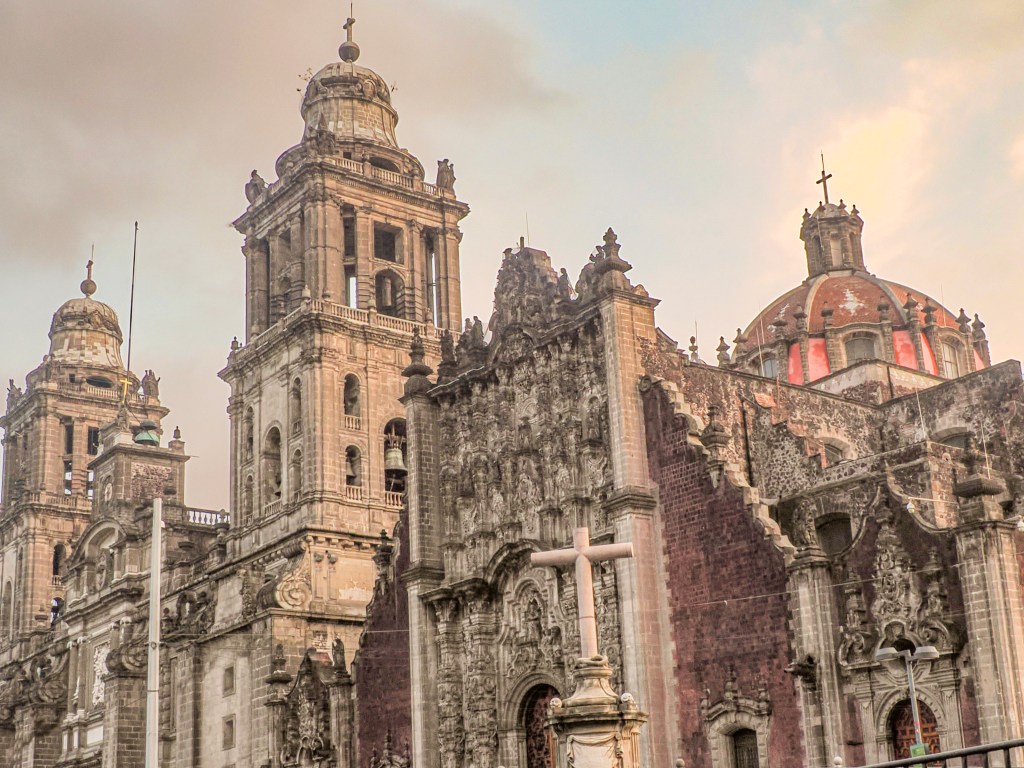
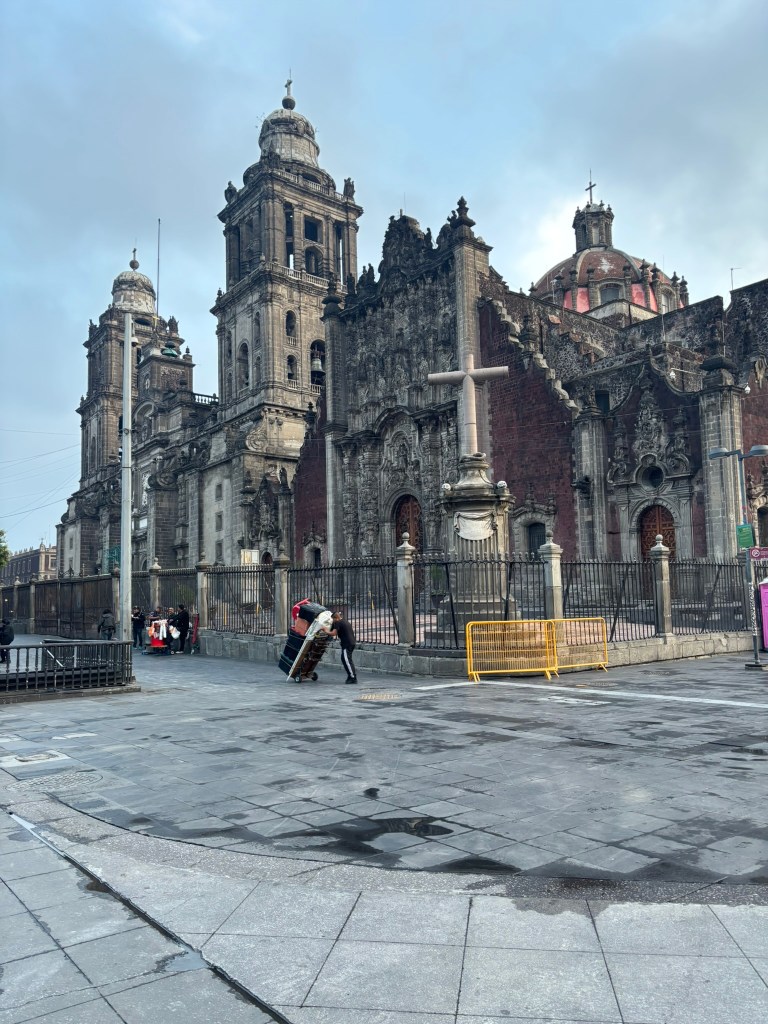
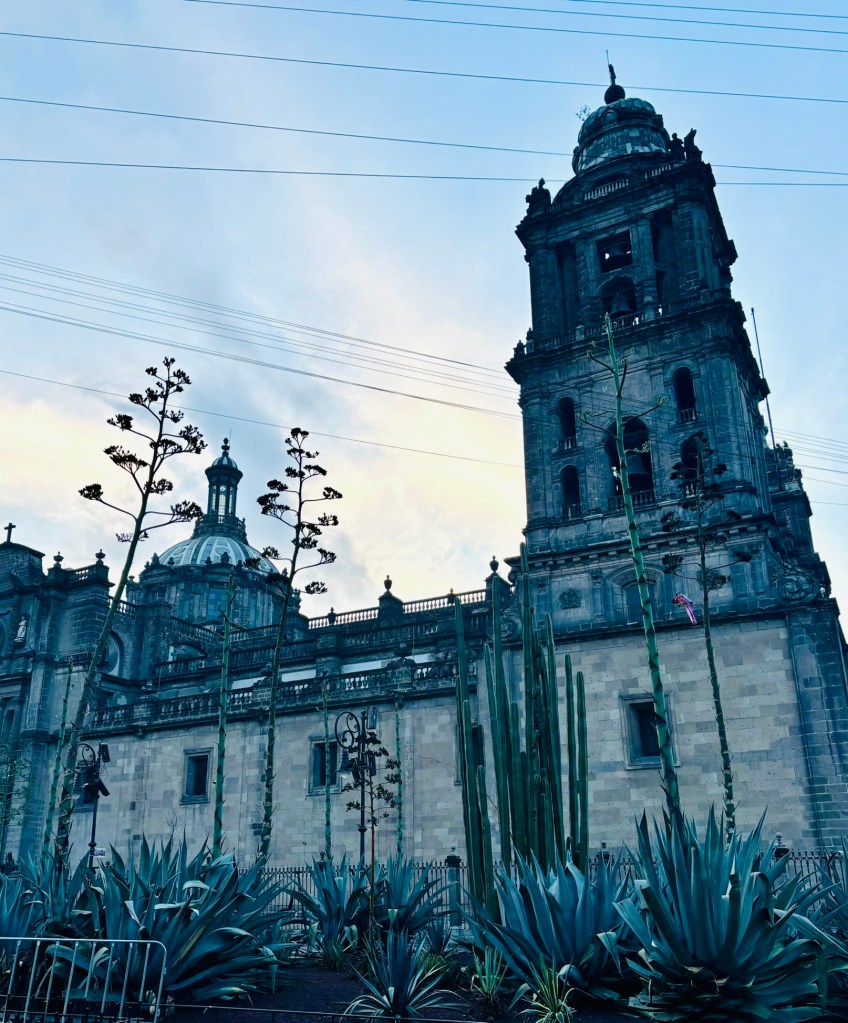
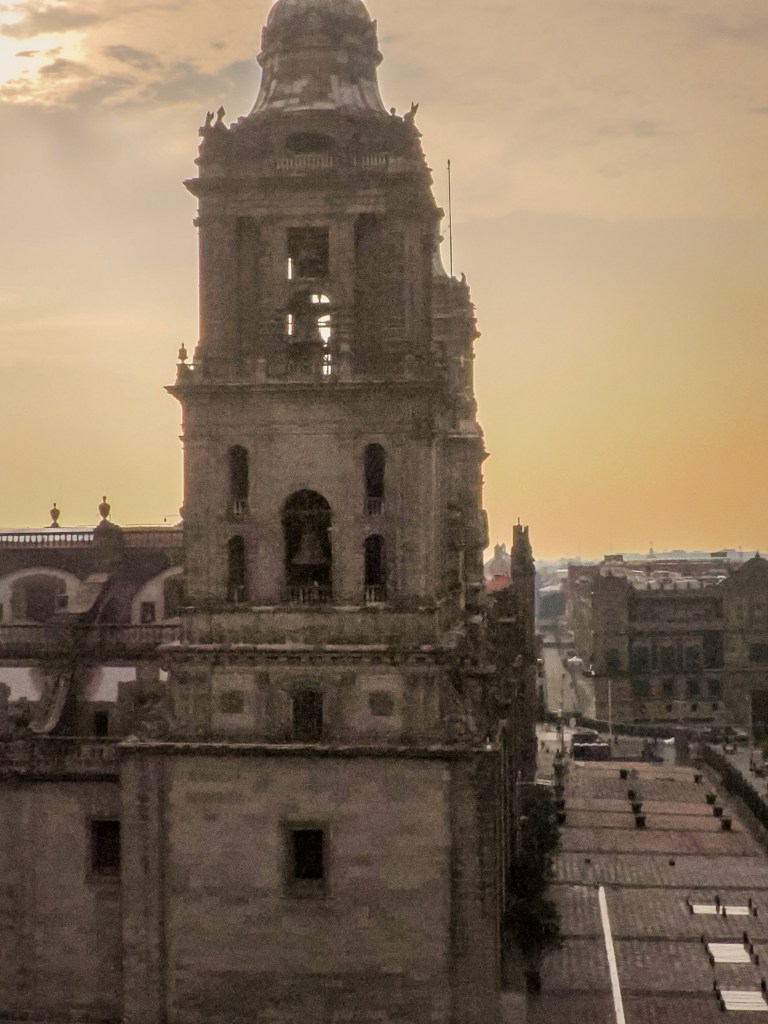
When viewed from the open expanse of the Zócalo, the cathedral’s exterior presents a block-wide stone tapestry that dominates the city’s northern horizon. The primary visual anchor of this massive facade is the pair of towering twin bell towers, which soar nearly 220 feet (67 meters) into the sky. Designed in a restrained Neoclassical style by architect Manuel Tolsá, these multi-tiered gray limestone structures feature stately columns, rhythmic arches, and distinct, bell-shaped caps topped with stone spheres.
Housed within these open-air belfries are more than 30 historic bronze bells—including the massive, 13-ton Santa María de la Guadalupe—which have rung out over the valley for centuries. These solid, geometric towers stand in sharp, dramatic contrast to the attached Sagrario Metropolitano (Metropolitan Tabernacle) directly to the right. While the main cathedral is wrapped in smooth, gray limestone, the tabernacle’s exterior walls are built from a porous, deep-red volcanic rock called tezontle, acting as a vibrant canvas for the central portal’s dizzying, hyper-intricate white limestone (chiluca) carvings. Framed by highly decorated estípite columns (inverted, tapered pyramids) and heavy, relief-carved wooden doors, this Ultra-Baroque facade mimics a magnificent church altarpiece brought outdoors, rising majestically above a geometric, checkerboard-paved stone courtyard.
The View from Above
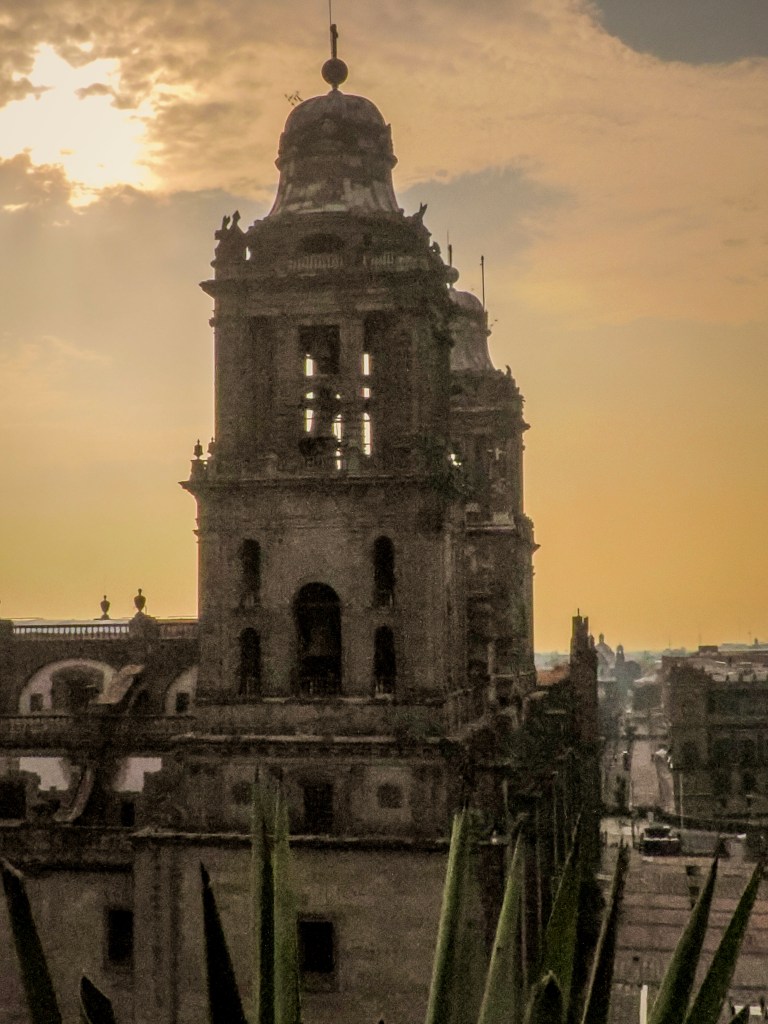
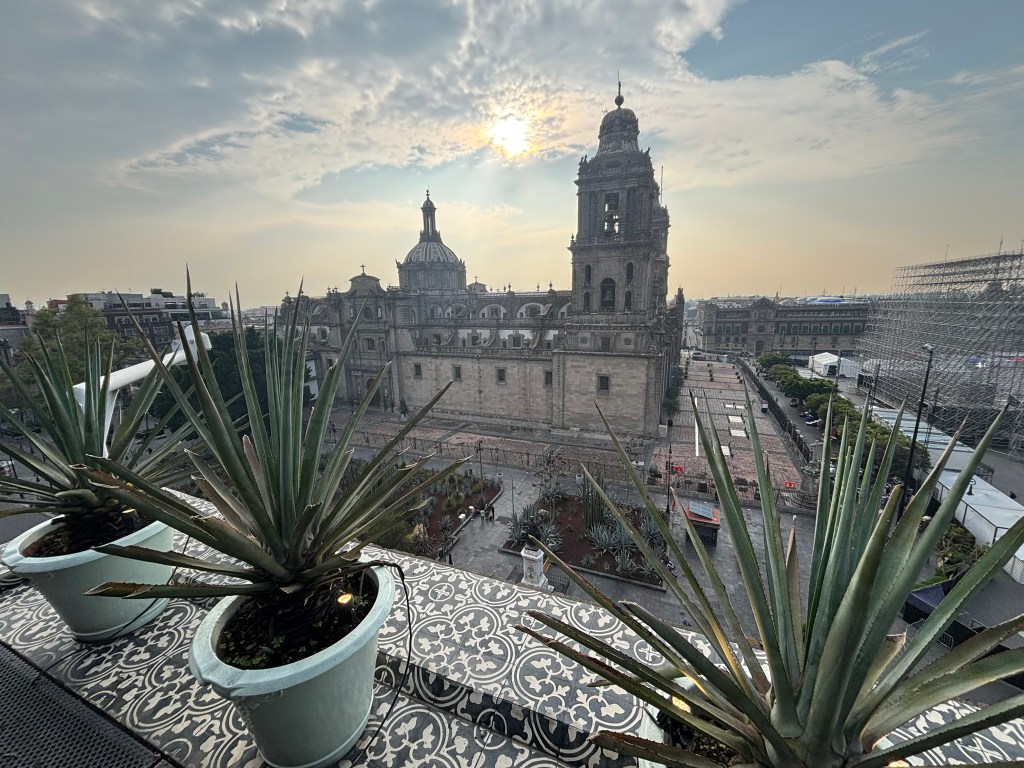
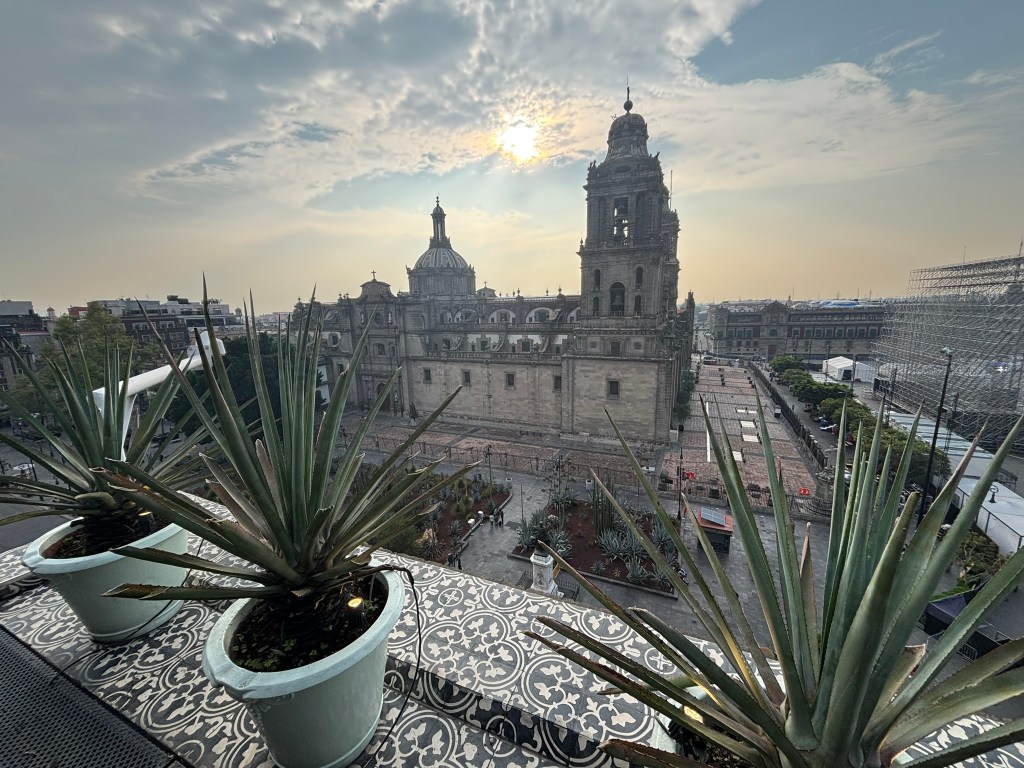
Ascending to a nearby rooftop terrace reveals an entirely different, three-dimensional world. From above, the rigid flat lines of the plaza disappear, replaced by a sweeping landscape of Manuel Tolsá’s grand Neoclassical dome capped with a lantern. Looking down from a birds-eye vantage point, framed beautifully by potted agaves and native organ pipe cacti, the cathedral transforms into an intricate maze of rolling stone vaults, ornate lanterns, and balustrades. I took the photo from the rooftop restaurant at Hotel Zocalo Central.
Cathedral view from the rooftop restaurant of Hotel Zocalo Central
🏛️ What to See from the Inside: Interior Highlights
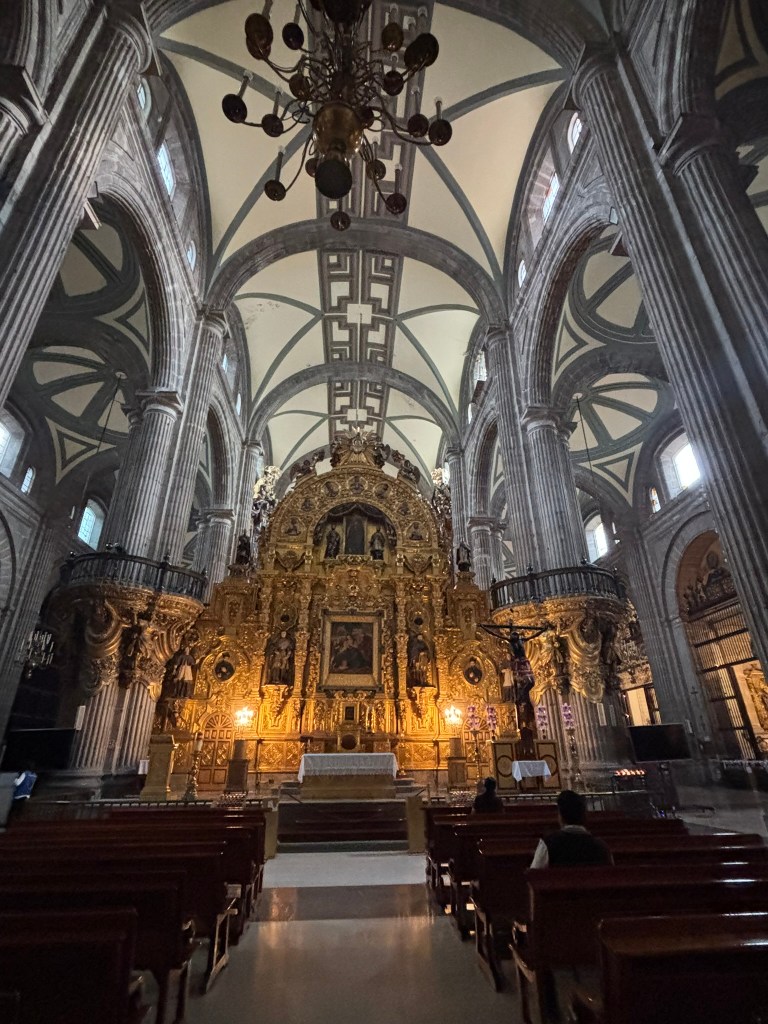
The interior of the cathedral is a soaring, cavernous expanse of stone, wood, and gold. As you wander down the monumental central nave, make sure to seek out these essential features:
The Altar of Forgiveness (Altar de Perdón)
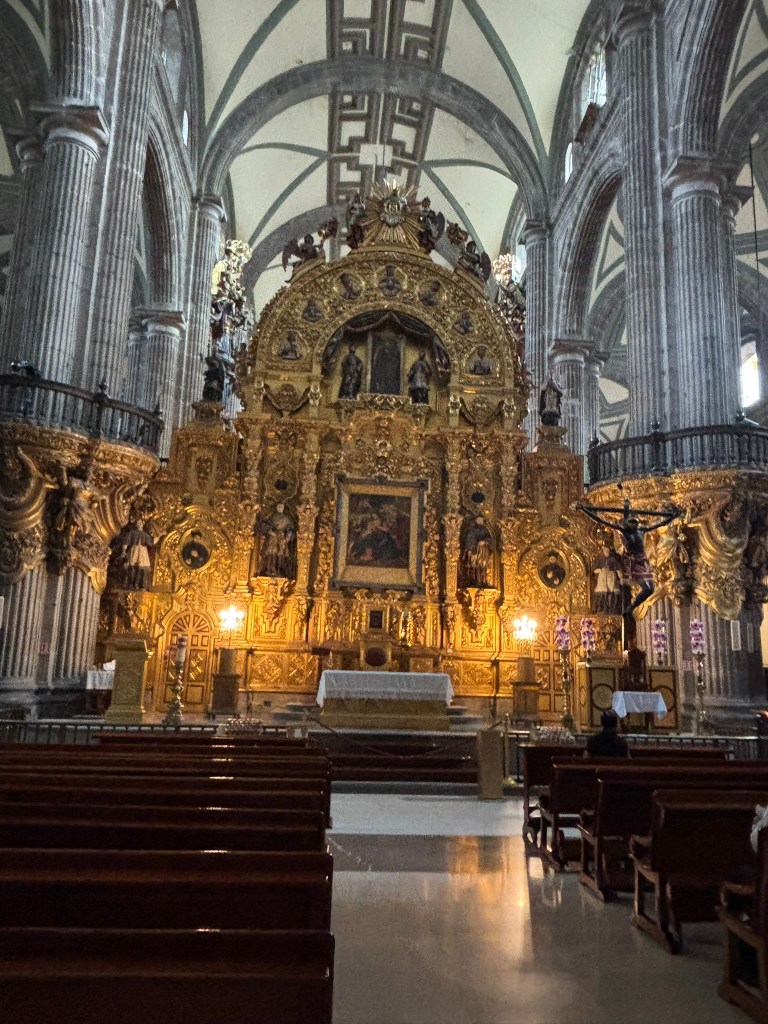
Positioned right inside the central entrance doors, this beautifully carved altar greets visitors immediately. It features an immense gold-leaf altarpiece and houses a dark-colored crucifix called Señor del Veneno (Lord of the Poison). Local folklore claims the crucifix miraculously turned pitch-black after absorbing a lethal dose of poison from the lips of a holy clergyman targeted by an assassin.
The 14 Side Chapels
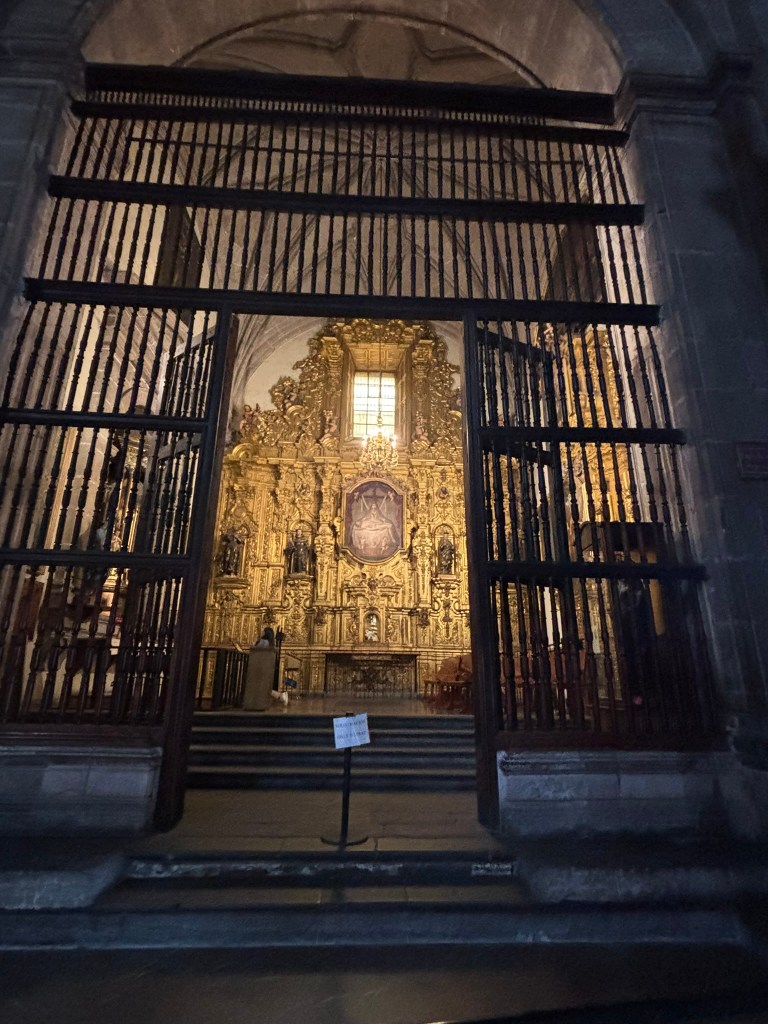
Flanking the monumental nave are 14 distinct chapels, each sponsored by colonial guilds and dedicated to different saints. Peering through their towering wrought-iron gates (rejas) reveals independent, gold-drenched sanctuaries filled with historic colonial retablos and religious iconography that function as private vaults of historical art.
The Vaulted Nave and Historic Organs
Walking down the central perimeter aisle reveals the building’s immense structural mastery. Massive fluted stone columns march down the length of the hall, rising up into soaring, elegant ribbed cross-vaults. Interspersed along the ceiling are grand circular domes that drop natural shafts of dramatic sunlight straight down onto the polished stone floor.
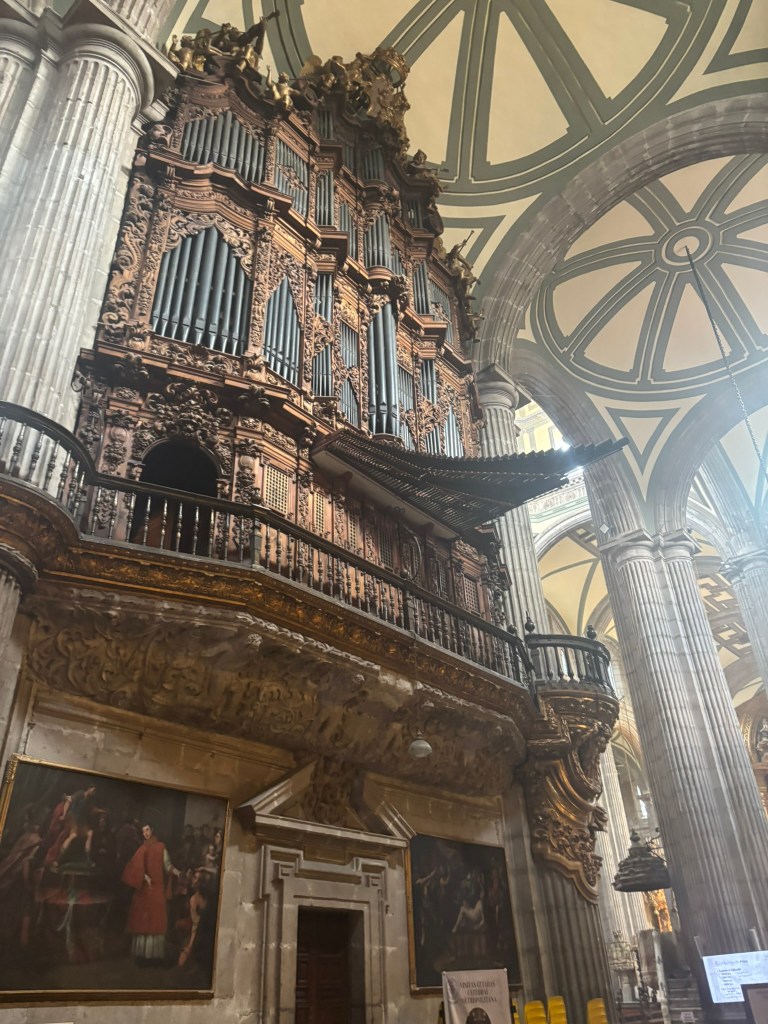
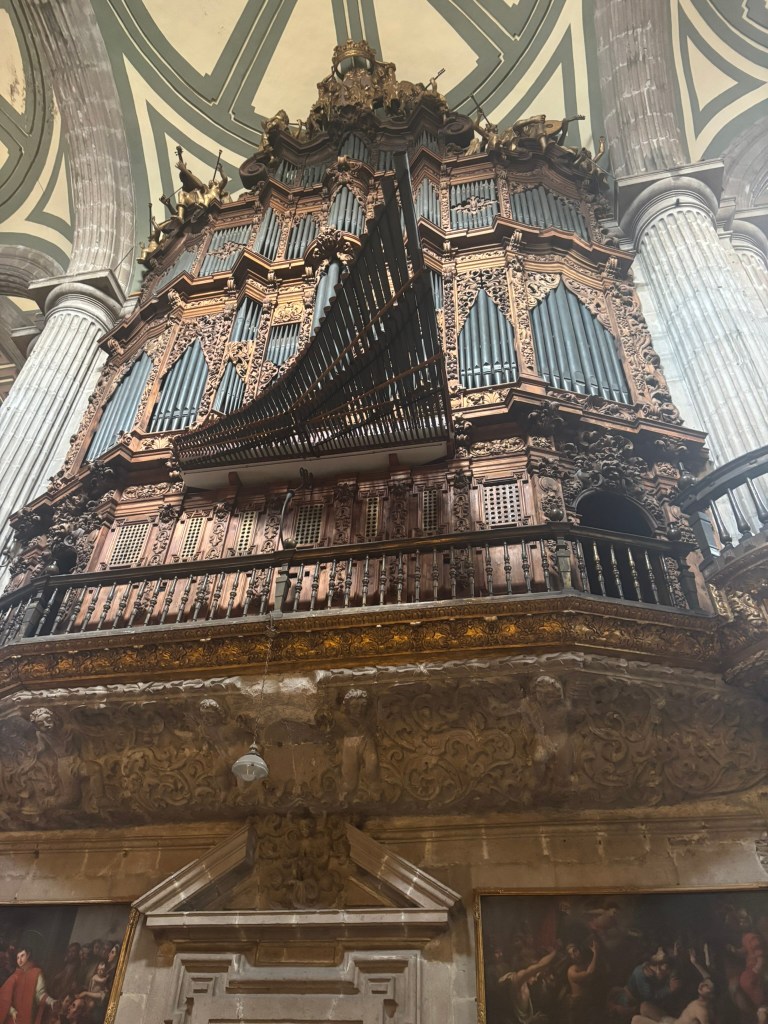
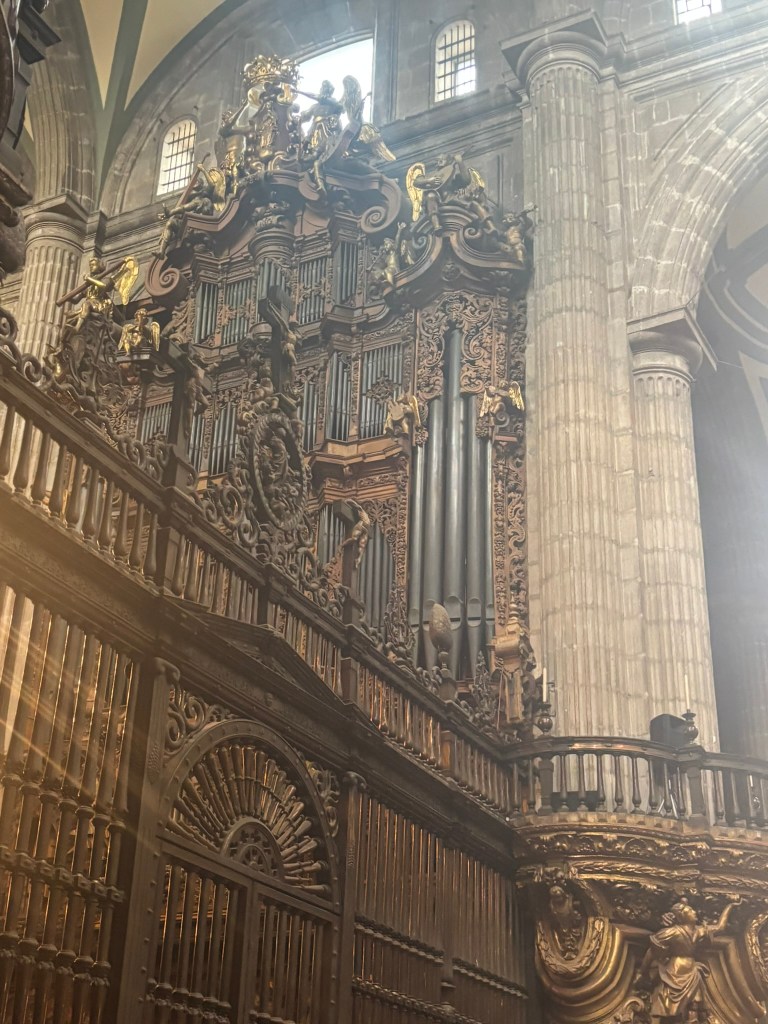
Mounted along the choir galleries stand the cathedral’s two legendary 18th-century pipe organs. These instruments are encased in heavily carved, gilded woodwork that erupts from the stone pillars, featuring a dramatic fan of horizontal trumpet pipes (trompetería) designed to fire sound directly over the congregation.
Grandeur from within: Looking down the side aisle of the cathedral’s interior. Soaring fluted stone columns branch out into elegant ribbed cross-vaults, while natural light streams down from the high dome windows to illuminate the historic pipe organs on the left.[IMAGE: CLOSE-UP OF THE SPANISH COLONIAL PIPE ORGAN]
A wall of sound: A close-up view of one of the cathedral’s historic 18th-century pipe organs. The intricate, gilded Baroque woodwork frames a dramatic fan of horizontal trumpet pipes projecting directly out into the grand stone nave.
The Sinking Foundation Pendulum
Look toward the center of the nave floor to find a fascinating modern addition—a massive brass pendulum suspended by a long cable from the cathedral ceiling. Because the complex was constructed on the soft, clay-heavy lakebed of ancient Lake Texcoco, the colossal stone structures have spent centuries unevenly sinking into the earth. This pendulum was installed over a calibrated tracking diagram to chart the building’s shifting tilt in real time, serving as a testament to the massive engineering rescue projects of the late 20th century.
As your camera tilts upward to photograph the high vaulted ceilings, you will notice an intense structural network of massive steel cables stretching horizontally across the stone arches of the nave. These tension rods are a visible reminder of the cathedral’s fight against gravity and mud. As you walk through the cathedral, you can also feel the ground sloping in one direction or the other. This is because different parts of the heavy stone structure began sinking at vastly different rates. The central nave began bowing outward, causing severe structural fracturing that threatened to split the roof down the middle. During the historic 1990s engineering rescue project, engineers did not just stabilize the ground below using underpinning shafts; they also wrapped the cathedral’s upper skeleton in an invisible “corset.” These high-tensile steel cables were carefully bored through the massive stone columns and tensioned to literally pull the leaning walls back inward, locking the shifting arches together. For photographers, these stark, industrial steel lines provide a fascinating, raw contrast cutting directly through the historic 18th-century stone design.
The Altar of the Kings (Altar de los Reyes)
Located at the very back of the apse, this breathtaking 18th-century altarpiece is the definitive crown jewel of the cathedral complex. Towering toward the ribbed ceiling like a golden wall, the entire structure is blanketed in shimmering gold leaf and executed in the hyper-intricate Churrigueresque style. It frames a stunning central liturgical stage adorned with the Mexican and Vatican flags, surrounded by rows of beautifully framed, dark colonial oil paintings that depict biblical narratives, kings, and saints.
The Tomb of Emperor Agustín de Iturbide
Located within the Chapel of San Felipe de Jesús, this corner contains a deeply significant chapter of Mexico’s political history. It houses the glass-and-gilded-bronze reliquary containing the remains of Agustín de Iturbide (Emperor Agustín I). Directly beneath his crystal urn, the green-and-gold marble pedestal permanently holds another national relic—the preserved heart of Mexican President Anastasio Bustamante, placed here, according to his final wish in 1853, to rest beside his commander.
Final Thoughts: A Monument of Defiance and Endurance
To stand in the center of the Metropolitan Cathedral complex is to feel the sheer weight of Mexico City’s layered identity. It is a place where two empires collided, leaving behind a structure that is equal parts beautiful and tragic. It is an architectural marvel that refused to collapse into the ancient lakebed beneath it, mirroring the unshakeable endurance of the city itself. Surrounded by the ringing of its historic bells and the faint scent of incense, you realize this isn’t just a monument to the past—it is a living, breathing testament to the capital’s soul.
Preparing for an upcoming business trip to Mexico City, I reached out to my local Mexican colleagues for recommendations on how to spend my free time. One coworker—a self-proclaimed, ultimate Frida superfan whose Zoom background always features the artist and whose dog is even named Frida—offered a critical piece of advice: book tickets to La Casa Azul (The Frida Kahlo Museum) immediately. Because the historic home operates strictly on timed entry, tickets routinely sell out weeks in advance and cannot be purchased at the gate. This should tell you how popular Frida Kahlo is in Mexico City, and visiting Casa Azul should be on your must-do list.
To visit La Casa Azul (The Frida Kahlo Museum), you must plan ahead, as tickets are not sold at the physical ticket window and usually sell out weeks in advance. The museum uses a strict timed-entry system to regulate crowds and protect the historic structure.
Self-Service Kiosk: If you are already in the Coyoacán neighborhood, you can purchase tickets via the digital kiosk at the museum’s gift shop showroom at Londres 234
Backup Option: If official slots are sold out, your best alternative is to book an organized day tour through reputable third-party platforms like Tourscanner or Evendo, which often bundle museum entry with local neighborhood tours. I bought my tickets via Viator for this tour. I requested a 3 PM tour, but got 4.15 PM option, which worked out just fine. It says it’s a skip-the-line tour, but you will still have to stand in line at your timed entry.
*** Pro tip: Traffic in Mexico City is unpredictable, and tickets have a 15-minute grace period. If you show up 30 min late to the museum, you won’t be let in. Plan to be in the timed lane at least 10-15 min before your assigned time.
💰 Ticket Pricing & Inclusions
Every ticket includes a complimentary general admission pass to the nearby Diego Rivera Anahuacalli Museum, located a short taxi ride away in south Coyoacán. [1, 2]
Note: General admission now includes permission to take non-flash photos with mobile devices for personal use
🕒 Hours & Best Time to Visit
Monday: Closed.
Wednesday: Open from 11:00 AM to 6:00 PM.
Tue, Thu, Fri, Sat, Sun: Open from 10:00 AM to 6:00 PM. [1]
Pro-Tip: Aim for an early morning weekday slot (Tuesday or Thursday) right at opening. Weekends are incredibly crowded, and even with a timed ticket, you may still wait 15–30 minutes in the entry queue outside the blue walls.
📍 Location & Getting There
The museum is located at Londres 247, Del Carmen, Coyoacán. Because Coyoacán features beautiful, narrow colonial streets, traffic can be heavy. Taking an Uber or a radio taxi directly to the entrance is highly recommended for safety and convenience, especially if you are traveling from the downtown center
📜 The Roots of the Blue House: A Sanctuary Bought by Love and Debt
Long before it became a vibrant cobalt monument to radical art, La Casa Azul was built in 1904 by Frida’s father, Guillermo Kahlo, a German-Hungarian immigrant and photographer. It was within these original, pale stucco walls that Frida was born in 1907. However, the family’s financial stability disintegrated following the 1910 Mexican Revolution and the astronomical medical bills tied to Frida’s childhood polio and her catastrophic 1925 bus accident. Deeply in debt, the Kahlos were on the verge of losing their heavily mortgaged family home. Enter Diego Rivera. When he married Frida in 1929, one of his first acts of devotion was to step in and pay off the entire family mortgage, legally placing the property deed exclusively under Frida’s name to ensure her financial security. In the 1940s, the couple moved back into the home permanently, transforming it into the fortress we see today: they painted the exterior walls a brilliant cobalt blue to ward off evil spirits, added volcanic stone extensions, and built the lush, walled courtyard to shield a fragile Frida from the outside world.
🏛️ Inside the Blue Walls: Must-See Highlights of Casa Azul
Casa Azul is not a sterile gallery; it is an intimate, frozen-in-time sanctuary where Frida’s physical pain and creative triumph echo in every room. As you move through the cobalt-blue compound, ensure you slow down for these essential, deeply personal spaces:
A Final Toast to Life
Painted just eight days before her death at age 47, this vibrant oil-on-masonite still life serves as a poetic, defiant farewell from an artist who endured a lifetime of physical agony and emotional turmoil. Instead of a somber self-portrait, Kahlo chose a group of rich, sun-ripened watermelons—a fruit deeply intertwined with Mexican Día de los Muertos (Day of the Dead) traditions, symbolizing the delicate boundary between life and death. As you stand before the original frame on the first floor of casa Azul, the stark contrast between the bright, blood-red pulp and the dark, shadowy background feels incredibly intimate. Carved directly into the central slice are the triumphant words, “Viva la Vida” (Long Live Life), a breathtaking testament to her resilient spirit and an unforgettable highlight for any traveler seeking the true heart of Mexican modern art.
The Traditional Mexican Kitchen
Located on the museum’s first floor, the vibrant kitchen is not to be missed.
A vibrant explosion of sunflower yellow and cobalt blue, this stunning space reflects Frida and Diego’s fierce, daily commitment to Mexicanidad. Rather than adopting modern, Europeanized appliances of the 1940s, Frida kept her home intentionally rustic, utilizing a traditional Mexican colonial-style kitchen equipped with classic tiled stoves (fogones) fueled by charcoal. The walls are a curated museum of folk art, lined with traditional brown earthenware cazuelas and jars. Look closely above the tile line: Frida meticulously arranged tiny, miniature clay pots to spell out “Frida” and “Diego” on either side of the room, flanked by clay doves—a touching, domestic testament to their intertwined lives.
The Light-Filled Art Studio
After visiting the bright kitchen, you will go upstairs to Firda’s art studio.
This stunning, high-ceilinged room remains precisely as Frida left it, serving as a powerful monument to her creative willpower. Though it feels seamlessly integrated today, this entire wing was a later 1944 addition. Funded by Diego Rivera and designed by their brilliant architect friend Juan O’Gorman, it was constructed out of dark local volcanic stone to honor Mexico’s pre-Hispanic heritage. Inside, Frida’s wheelchair sits parked directly in front of her easel, flanked by her original paintbrushes, jars of raw pigment, and a half-squeezed tube of paint. Towering, expansive windows look out over the lush, tropical courtyard, flooding the space with the exact high-altitude sunlight she relied on to weave her pain into timeless masterpieces.
The Dual Sanctuaries: Frida’s Two Bedrooms
Stepping directly off the art studio brings you into the most intimate corner of the house: Frida’s two interconnected bedrooms. Because her physical state dictated her daily life, she maintained distinct “daytime” and “nighttime” beds. Together, these rooms offer a profoundly raw look at how she turned physical confinement into an artistic triumph, filled with tiny details that demand your close attention
Confined to her bed for months following her catastrophic bus accident and subsequent spinal surgeries, Frida refused to stop painting.
The Daytime Bedroom: Bathed in sunlight, this room features the simple bed where Frida spent agonizing months recovering from spinal surgeries.
The Canopy Mirror: Looking closely at the dark wooden frame above the pillow, you can clearly see the large rectangular mirror built into the canopy’s underside. This is the exact glass her mother installed, which allowed Frida to paint her soul through self-portraiture while completely immobilized. The Death Mask: Resting prominently on the pillow is Frida’s bronze death mask, sculpted shortly after she passed away in this very house in 1954. It is draped in her iconic striped Mexican rebozo (shawl), serving as a poignant, haunting focal point for visitors. The Surrounding Details: On the wall beside her bed hangs an intimate oil painting, and her personal bookshelf rests just within arm’s reach on the adjacent wall—reminders of how she turned a space of intense physical confinement into a rich intellectual and creative universe.
The Nighttime Bedroom: A darker, more enclosed space designed for rest, this room holds a deeper psychological weight.
When you enter the nighttime bedroom just off the daybed, don’t forget to pay attention to the canopy of the bed and the quote on the wall
Looking up from eternity: The underside of Frida’s canopy night bed holds a framed butterfly collection gifted to her by her lover, sculptor Isamu Noguchi
The Butterfly Collection: Mounted directly into the wood where the mirror used to be is a framed collection of dead butterflies. This was a gift from the famous Japanese-American sculptor Isamu Noguchi, with whom Frida had a passionate, intense love affair in the late 1930s.
The Symbolism: Metamorphosis, fragility, and beauty emerging from a state of confinement—the butterflies are a flawless mirror of Frida’s own existence. Lying immobilized on her back, staring up at creatures that broke free of their cocoons, she found a visual escape from her broken bones.
The Emotional Friction: The bittersweet irony of this space is staggering. While the room houses the frog urn dedicated to Diego, and the wall features a quote praising how love made her “whole,” her very canopy holds a permanent token from another man who loved her deeply. It encapsulates the dizzying, overlapping layers of her romantic life.
The Frog Urn and Her Nighttime Bedroom: In her nighttime bedroom, sitting quietly on her dresser, rests the pre-Columbian, frog-shaped ceramic urn containing Frida’s ashes. Staring at it next to her simple bed offers a profoundly moving finality to her turbulent love story with Diego.
Toad-Frog: Diego Rivera was a heavyset man with large, bulging eyes. Rather than taking offense to his unusual looks, he fully embraced them and frequently drew himself as a frog. Throughout their volatile marriage, Frida affectionately used the toad-frog nickname for him. Pre-Columbian Passion: The vessel itself is an authentic pre-Hispanic ceramic artifact. Both Frida and Diego were passionate collectors of ancient Indigenous artifacts, viewing them as symbols of pride in Mexico’s roots. A Pact of Eternal Love: Before her death in 1954, Frida personally requested that her remains be placed inside this specific frog artifact. The couple originally intended for their ashes to be mixed together inside this urn forever.
The Secret Wardrobe: “Appearances Can Be Deceiving”
For half a century, a heavy silence hung over a private bathroom at the back of Casa Azul. Before his death in 1957, Diego Rivera left strict instructions to keep Frida’s most intimate personal closets sealed. That lock was maintained for decades until the room was finally opened in 2004, revealing a time capsule of over 300 highly personal artifacts. Today, those items form the permanent exhibition “Appearances Can Be Deceiving” (Las Apariencias Engañan).
The room is a profound study of how Frida constructed her public identity, masterfully balancing tradition, disability, and political armor. On display are her legendary, floor-length Tehuana skirts, which she meticulously stylized with indigenous jewelry and woven rebozos to distract from her asymmetrical, polio-weakened lower body. But it is the medical items that truly leave visitors speechless: her hand-painted plaster corsets adorned with revolutionary hammer-and-sickle motifs, her heavy steel spinal braces, and her right prosthetic leg, which she defiantly encased in a bright red leather boot embroidered with Chinese silk threads and accented with tiny dangling bells. It is the ultimate testament to a woman who refused to hide her scars, choosing instead to style them into a visual masterpiece of sheer defiance
Where to find the Wardrobe Gallery: Frida’s wardrobe and other items are housed in a dedicated, climate-controlled gallery wing on the museum grounds outside the main house. The collection was originally found locked away inside the private bathroom directly adjacent to Frida’s bedroom.
The Pyramidal Courtyard Garden
The lush, tropical central patio acts as the lungs of Casa Azul. It features a stepped, miniature stepped pyramid built by Rivera to display their joint collection of pre-Columbian idols. Walking through the monstera leaves and volcanic rock paths feels like stepping directly into one of Frida’s fertile, nature-filled canvases.
Final Thoughts: The Eternal Blue Sanctuary
To step out of La Casa Azul and back into the bustling streets of Coyoacán is to realize that you haven’t just visited a museum—you have witnessed a resurrection. For decades, the world treated Frida Kahlo as a tragic moon orbiting Diego Rivera’s massive, mural-painted sun. But history has corrected its lens. Walking through the Blue House reveals the ultimate triumph of her life: she did not survive Diego’s crushing psychological weight by conforming to his world; she built an entirely independent universe of her own.
Casa Azul was both Frida’s womb and her fortress. It was the place where she suffered her greatest physical torments, yet it is also where she forged her unshakeable artistic and political identity. Every yellow floorboard, every cobalt wall, and every tiny clay pot spelling out their names serves as a reminder that she transformed her pain into a visual armor of pure defiance. Diego paid off the mortgage, but Frida gave the house its soul. Today, while Rivera’s massive murals stand as magnificent monuments to a historical era, it is Frida’s intimate, raw, and fiercely authentic world inside the Blue House that continues to capture, heal, and inspire the global imagination.
Architecture as a Marriage Map: Two Houses, One Bridge
You can further continue Frida and Diego’s journey by visiting the twin houses in the San Ángel neighborhood. I didn’t get a chance to go inside these two houses, but I was dropped off by Uber in front of one of them when I went for dinner with my co-workers at San Ángel Inn. On a side note, San Angel Inn is historic in its own right. It is world-renowned for its high-end, traditional Mexican gastronomy. Its signature Pechuga de Pollo en Mole Poblano and ultra-classic, silver-shaker margaritas are legendary components of a traditional Mexico City sobremesa.
The San Ángel property is not a single home, but two completely separate, free-standing concrete towers connected only by a narrow, high-altitude rooftop footbridge. It serves as a literal, physical manifestation of their radical marital contract: absolute creative and personal independence, yet total connectivity.
Diego’s Studio (The Rust-Red Tower): Towering, aggressive, and painted a deep volcanic red, Diego’s workspace is massive. It features soaring, double-height saw-tooth factory windows designed to flood his canvas with uniform northern light. Here, surrounded by massive papier-mâché Judas skeletons and pre-Columbian idols, he painted his towering historical commissions.
Frida’s Studio (The Cobalt Blue Cube): Smaller, intensely private, and painted the exact cobalt blue of her childhood home, Frida’s house sits adjacent to his, raised on minimalist concrete stilts (pilotis). This architectural isolation was intentional; it was within this blue cube that she painted The Two Fridas and What the Water Gave Me—masterworks born from her profound inner solitude.
The Bridge: The thin, unreinforced concrete bridge stretching between the two roofs represents the fragile, volatile link between them. It was a physical doorway they could lock from either side when the infidelities and psychological warfare became too much to bear, allowing them to remain completely separate while remaining entirely bound to one another.